
GRC Banking

A bank can be well capitalised and still have a weak GRC position. The UAE banking system reached AED 4.6 trillion in total assets by the end of 2024, yet supervisory scrutiny increasingly turns on whether boards can prove control ownership, testing, remediation, and resilience through current evidence, not whether policies exist in a repository. Central Bank of the UAE financial stability reporting provides the market context. Your GRC banking model must convert regulatory obligations into accountable work across risk, compliance, technology, fraud, operations, and audit.
Why GRC in Banking Is No Longer Optional
Any bank still treating GRC as an annual binder is already exposed. The CBUAE requires banks to maintain a documented risk governance framework approved by the Board, with policies, processes, procedures, systems, and controls designed to identify, assess, monitor, mitigate, and control risk. The CBUAE risk-management requirements make this an operating obligation, not a documentation preference.
The UAE market has the scale and complexity to make weak evidence especially costly. By the end of 2024, the system included 61 licensed banks, comprising 23 UAE national banks and 38 foreign banks, alongside a broad physical and digital service footprint. That density creates overlapping accountability across products, channels, subsidiaries, service providers, and technology platforms.
Five shifts now define credible GRC banking:
Board accountability: Directors and senior management must own risk oversight, appetite, escalation, and challenge.
Third-party and ICT risk: Outsourcing, cloud dependency, payment services, and technology suppliers belong in the enterprise risk picture.
Operational resilience evidence: Recovery arrangements, incident response, testing, and remediation must produce traceable records.
AI governance: AI models are moving into formal governance, inventory, testing, and data-protection workflows.
Workflow integration: GRC evidence must connect to ITSM, ITOM, security operations, fraud operations, and MLOps.
A useful external perspective is Visbanking governance risk and compliance, particularly for understanding how financial institutions connect governance and control processes. For European exposure, DataLunix's DORA banking regulation analysis provides a practical comparison point.
Board-preparation rule: If an owner can't retrieve the control, its latest evidence, the related issue, and the accepted residual risk without manual reconstruction, the control isn't operationally defensible.
GRC should function as the operating system for compliance, risk, and audit. The sections that follow focus on specific CBUAE obligations, framework overlaps, evidence mappings, and an implementation route suited to Gulf and European supervisory environments.
What GRC Means in a Bank
GRC in banking gives governance, risk, and compliance one operating model for decisions, controls, evidence, and remediation. Its value depends on how well those disciplines share ownership and records.
Governance sets authority through board mandates, committee responsibilities, policy approval, risk appetite, delegation, escalation, and named owners. Risk management identifies and assesses exposure across credit, market, liquidity, operational, ICT, cyber, fraud, model, and third-party domains. Compliance converts CBUAE, Basel, FATF, AML, privacy, and other applicable obligations into controls, testing, reporting, and corrective action.
GRC functions as the bank's nerve system. Governance sends the policy signal, risk management detects threats and changing exposure, and compliance triggers documented actions that demonstrate adherence. A shared control object prevents fragmented responses. For example, a cyber team may identify a privileged-access weakness while compliance tracks an access-review obligation and internal audit records a segregation-of-duties finding. Without one linked record, the bank can assign different risk ratings, owners, and remediation timelines to the same failure.
Where GRC sits in the organisation
GRC should not be confused with internal audit. Internal audit provides independent assurance over the design and operation of governance, risk, and compliance outputs. It challenges the evidence and control performance, while first-line teams own execution.
Cyber risk is one input to GRC, not the entire function. It feeds the enterprise risk register, with technology controls linked to operational, regulatory, resilience, and third-party consequences.
A workable structure places GRC under the Chief Risk Officer or a dedicated Chief Compliance Officer, with dotted-line reporting to the Board Risk and Compliance Committee. This preserves operational ownership while giving the board a consolidated view of:
Accountability: Who owns the obligation, control, evidence, and issue.
Exposure: Which risks exceed appetite or require management attention.
Assurance: Which controls have been tested and with what result.
Escalation: Which exceptions require formal risk acceptance or board visibility.
The IT governance, risk, and compliance guide provides a practical comparison between governance design and technology operating models. Apply its core principle directly: do not build a GRC office that merely collects updates. Build a control operating model that assigns evidence and remediation work to the teams already running the bank, then connect those records to tickets, changes, incidents, and audit findings.
The Regulatory Landscape Banks Must Govern
The regulatory map is dense, but the underlying supervisory pattern is clear. Basel capital and operational-risk expectations, the CBUAE Rulebook, EU DORA, EBA ICT guidance, and FATF AML expectations all push banks towards accountable governance, documented controls, resilience, and evidence.
The CBUAE framework is particularly direct. Its cyber-risk model covers 14 control domains, including governance, security operations centres, identity and access management, data protection, cryptography, incident management, third-party risk, operational resilience, and regulatory reporting. The CBUAE cyber-risk framework mapping shows why a bank should map technology controls to governance artefacts and named owners rather than manage cyber compliance as a standalone checklist.
Capital governance also belongs in the GRC model. The CBUAE capital adequacy standards specify a 10.5% minimum capital requirement excluding capital buffers for licensed banks and reference a Basel calibration with a maximum risk weight of 1250%. The CBUAE capital adequacy standards connect risk appetite, governance, exposure treatment, and capital planning.
Obligation Area | Basel III | CBUAE Rulebook | EU DORA |
|---|---|---|---|
Board accountability | Risk governance and capital oversight | Board-approved risk governance and senior-management responsibility | Management responsibility for ICT risk and resilience |
ICT and third-party risk | Operational risk and sound risk management | ICT, outsourcing, cyber-risk, and resilience controls | ICT third-party risk management and contractual oversight |
Incident management | Operational-risk governance | Incident workflows and regulatory reporting controls | ICT incident classification, reporting, and follow-up |
Resilience testing | Stress and operational resilience disciplines | Scenario testing, recovery, and cyber validation | Resilience testing and threat-led assurance expectations |
Evidence | Capital, risk, and governance records | Documented policies, controls, testing, and reporting | Traceable ICT risk, incident, testing, and supplier evidence |
The convergence matters more than the labels. Supervisors expect boards to challenge risk decisions, approve frameworks, oversee dependencies, and receive meaningful escalation. GCC overlays, including CBUAE supervision, SAMA cybersecurity expectations, and DFSA outsourcing notifications, make regional operating models more complicated. European groups add DORA, EBA ICT and security expectations, NIS2 scoping considerations, and AI governance requirements where applicable. DataLunix's EU DORA regulation resource offers a useful regional comparison.
Payment risk also has a measurable trigger. Institutions with monthly average payment transactions of AED 10 million or more must regularly assess the need for penetration testing and cyber-attack simulation covering external and internal networks, application systems, social engineering, and emerging threats. Article 13 of the CBUAE technology-risk and information-security rule supports a risk-based testing workflow tied to transaction exposure.
Core Components of a Banking GRC Framework
A banking GRC stack needs five building blocks, but they only work when each one produces usable evidence.
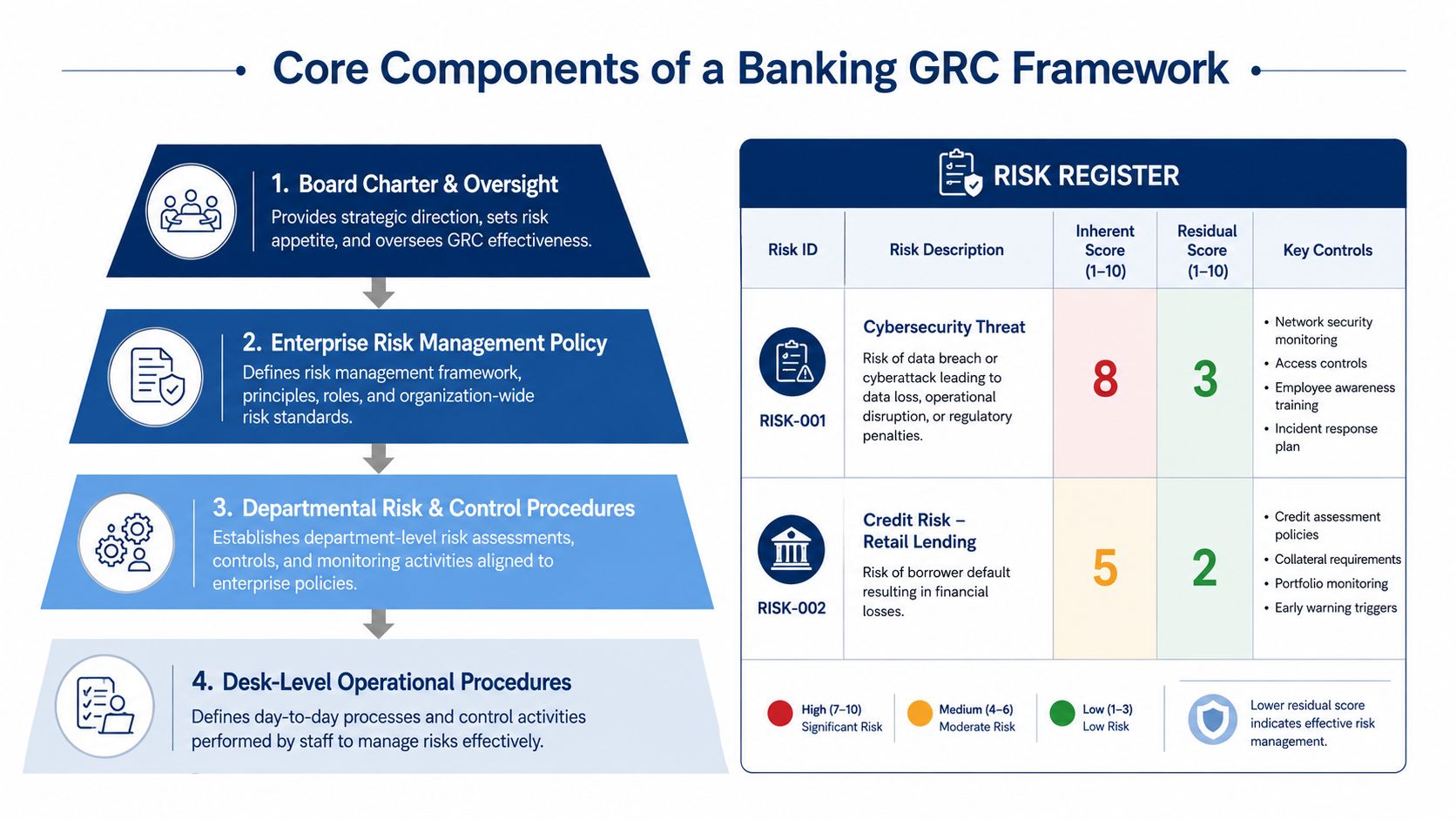
Start with a policy hierarchy
The hierarchy should run from the Board charter and risk appetite statement to enterprise policies, departmental standards, process procedures, and desk-level instructions. Each document needs an owner, approval record, effective date, review trigger, linked obligations, and evidence requirements.
A policy without a control owner and evidence hook is theatre. It may look complete during a document review, but it won't survive questions about operation.
Build one risk and control model
The risk register should distinguish inherent risk from residual risk, record likelihood and impact, identify treatment decisions, and link each risk to controls, issues, owners, and review dates. The control library should map recognised taxonomies such as NIST CSF and ISO 27001 to CBUAE and business-specific requirements.
The CBUAE credit-risk rules demonstrate the required level of granularity. The Board must approve and regularly review credit-risk strategy and policies, maintain a delegation matrix for credit approvals, and approve facilities that are material, particularly risky, or outside core activities. The CBUAE credit-risk requirements also address exposure classification, provisions, problem exposures, and write-offs.
Make monitoring and remediation auditable
Key Risk Indicators should reflect thresholds and escalation, not anecdotes. Issue workflows should preserve the finding, root cause, owner, due date, action plan, evidence, validation result, exception approval, and closure decision.
An AML and operational-resilience mapping might connect:
Transaction monitoring: Rule changes, alert review records, tuning approvals, and investigation outcomes.
Sanctions screening: Screening configuration, list-update evidence, false-positive analysis, and escalation records.
Third-party exit planning: Named dependencies, exit assumptions, testing records, and management approval.
Recovery objectives: Service mappings, recovery test results, exceptions, and remediation tickets.
Control libraries also need design and operating-effectiveness testing. Without periodic testing, a library becomes a checkbox exercise. The test result must show what was examined, which population or sample was used, who performed it, what failed, and whether management accepted the remaining exposure.
Wiring GRC Into ITSM, ITOM, and AI Workflows
GRC becomes real when it creates records in the systems where bank employees perform work. A separate GRC repository with no connection to ServiceNow, Jira, Azure DevOps, monitoring platforms, or a model registry produces polished evidence that auditors can't trace to live operational activity.
Map controls to operational artefacts
Control Family | ITSM Artefact | ITOM Artefact | AI/Model Artefact |
|---|---|---|---|
Change governance | Change request, approval, test result, rollback record | Configuration relationship and service impact | Model-release approval and version history |
Resilience | Incident, problem, recovery task, post-incident review | CMDB service map, dependency record, recovery status | Model availability and fallback record |
Access governance | Access request, approval, recertification task | Identity, entitlement, and privileged-account attributes | Model-service identity and access review |
Third-party risk | Supplier issue, contract task, exception record | Vendor dependency and service relationship | External data, model, or provider inventory |
AI compliance | Change and risk acceptance record | Runtime service ownership and monitoring link | Model inventory, data lineage, bias test, validation log |
The minimum integration pattern has three hooks:
Evidence retrieval through APIs: Pull approvals, test results, configuration states, incidents, and remediation records into the control assessment.
Scheduled control testing: Trigger tests from the GRC platform against ITSM, ITOM, security, and model-management sources.
Risk acceptance inside change tickets: Show residual risk and expiry conditions to approvers before release.
AI governance now needs formal evidence. In February 2026, the CBUAE required licensed financial institutions to maintain documented AI governance frameworks proportionate to size and complexity, integrate AI risks into enterprise-wide risk management, maintain a detailed AI model inventory, and conduct annual bias testing. The guidance also connects AI data handling to UAE PDPL obligations, as described in this CBUAE AI governance and data-security analysis.
That changes the workflow. A credit or AML model shouldn't enter production through an engineering ticket alone. The release should reference the model inventory entry, data lineage, validation outcome, bias-testing record, owner, approval, monitoring plan, and rollback decision.
For a broader operating-process view, DataLunix's governance, risk, and compliance process guide is useful. The principle is clear: control evidence belongs where the work happens, then flows into GRC reporting.
Implementation Roadmap and Partner Selection
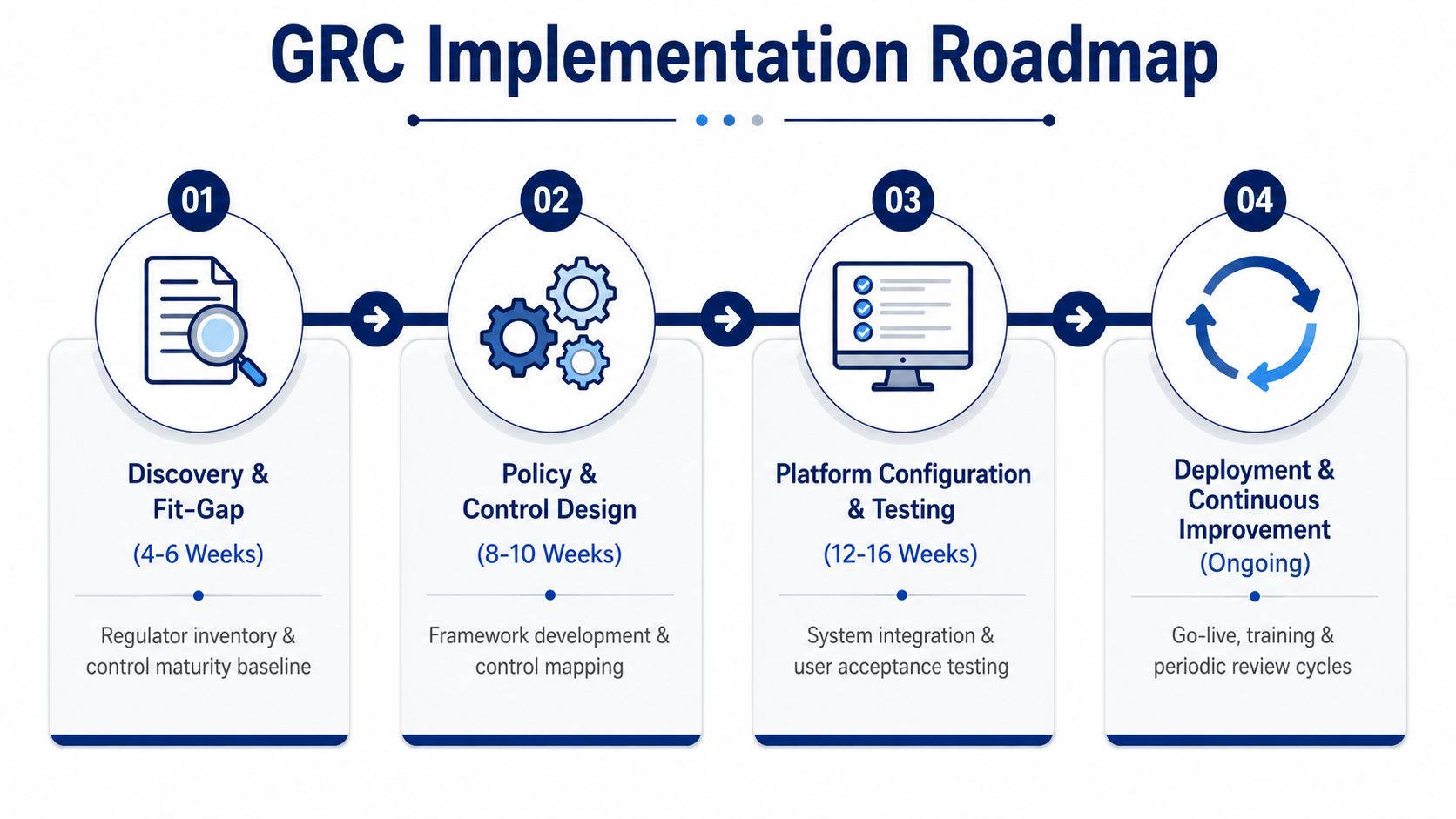
A practical roadmap begins with evidence, not software configuration. Banks should budget the work in four phases and assign each phase to the people best placed to make decisions.
Phase one covers discovery and fit-gap
Allow 4 to 6 weeks for regulator inventory, process interviews, system mapping, control maturity baselining, and evidence sampling. The team should identify duplicated controls, missing owners, spreadsheet dependencies, unsupported assertions, and obligations that lack a test method.
Phase two redesigns policies and controls
Allow 8 to 12 weeks to produce a lean control library mapped to Basel, CBUAE, and DORA obligations. Remove duplicate controls, rewrite vague control statements, define evidence hooks, establish testing frequency, and document risk-acceptance authority.
Phase three automates and integrates
Allow 12 to 16 weeks to connect GRC with ITSM, ITOM, security platforms, supplier records, and the AI model registry. Test integrations with real evidence, not demonstration data. User acceptance should include risk, compliance, technology, operations, internal audit, and business control owners.
Phase four creates continuous oversight
Continuous monitoring should produce board reporting, KRI dashboards, issue ageing, control-test results, exceptions, supplier exposure, and emerging AI risk. The board needs decision-grade reporting, not a count of completed tasks.
Source-data fragmentation can extend every phase substantially. In-house risk and compliance SMEs should lead regulatory interpretation, policy decisions, risk appetite, and control ownership. Integration, automation, testing, and dashboard construction are better candidates for staff augmentation or managed services.
When assessing suppliers, review banking references, CBUAE or comparable regulatory experience, integration capability, local GCC leadership, and evidence of delivery in European environments. A useful third-party perspective is the DataTeams third party risk framework, which can help structure supplier governance questions.
A platform decision should follow the fit-gap, not replace it. DataLunix's governance, risk, and compliance platform overview is relevant for organisations evaluating workflow-led GRC implementation across GCC and European operations.
KPIs, Vendor Red Flags, and Final Take
A board dashboard should measure whether the bank can identify, evidence, and reduce exposure. It shouldn't reward teams for publishing more policies or creating more controls.
KPI / Metric | What It Measures | Why It Matters for Regulators | Risk If Tracked Alone |
|---|---|---|---|
Regulatory findings per audit cycle | Deficiency volume and recurrence | Shows whether governance weaknesses persist | A lower count may reflect narrow audit scope |
Mean time to remediate high-risk issues | Speed of risk reduction | Demonstrates management responsiveness | Fast closure can hide weak fixes |
Controls with current evidence | Evidence coverage and freshness | Supports defensible supervisory review | Current files may still prove ineffective operation |
KRI breach rate | Frequency of threshold breaches | Links monitoring to risk appetite | A low rate may reflect poor threshold design |
Total control count | Inventory size | Offers little proof of effectiveness | Encourages duplication and paperwork |
Policies published | Documentation output | Shows activity, not control performance | Can conceal missing ownership and testing |
The strongest indicators connect directly to regulatory exposure. A high-risk issue should show its owner, accepted risk, target date, dependency, evidence, and validation outcome. A KRI breach should trigger an accountable workflow, not merely change colour on a dashboard.
Vendor red flags deserve board attention
Reject suppliers that:
Offer cookie-cutter frameworks: Generic libraries rarely reflect CBUAE governance, credit-risk delegation, payment testing, or AI evidence needs.
Avoid regulatory detail: Ask which obligations they map, how they handle updates, and how they prove traceability.
Have no banking references: A GRC deployment in a low-regulation environment doesn't demonstrate banking competence.
Separate GRC from operations: If the platform can't connect to ITSM, ITOM, supplier, and model workflows, evidence will remain manual.
Rely only on offshore delivery: Offshore capacity can be valuable, but the engagement needs local GCC and relevant European regulatory expertise.
UAE banking resilience remains strong in financial terms. By the end of 2025, total banking assets reached AED 5.3 trillion, with gross bank credit at AED 2.5703 trillion and total deposits at AED 3.3070 trillion. In Q3 2025, aggregate capital and reserves reached AED 569.9 billion, while the capital adequacy ratio stood at 17.4% against a 13.0% Basel III minimum requirement, according to the CBUAE 2025 financial stability report.
Strong balance sheets don't excuse weak operational evidence. GRC banking succeeds or fails on evidence quality, ownership, testing, and remediation, not documentation volume.
DataLunix helps banks connect GRC obligations to ServiceNow and other ITSM and ITOM workflows, with fit-gap assessment, control mapping, evidence automation, integrations, and managed delivery for GCC and European environments. Visit DataLunix to discuss a banking GRC roadmap grounded in CBUAE obligations and operational evidence.