


GRC Data Explained: A Practical Guide for Modern Enterprises

GRC data is the structured evidence that proves controls operate and risks are managed. In the UAE, that evidence must connect operational systems to accountable owners, specific assets, collection times and regulatory obligations.
You may have a GRC platform, a policy library and a long control register, yet still struggle to answer a basic auditor question: “Show me the evidence that this control operated on this asset during the relevant period.” The problem usually isn't the absence of policy. It's fragmented evidence across ITSM, ITOM, HRSD, CMDB, asset, contract, identity and security systems.
The practical definition is simple. GRC data is the structured, lineage-traceable record of control states, risks, findings, attestations, exceptions and evidence extracted from the systems where work happens.
What GRC Data Really Means and Why It Matters Now
UAE enterprises are racing against overlapping obligations, including NESA controls, ADHICS, Dubai ISR, DIFC and ADGM data protection requirements, VAT reporting and economic substance reporting. These obligations don't become manageable because you uploaded a framework into a platform. They become manageable when your organisation can retrieve reliable evidence and explain who owned the control, what it covered and when it operated.
The UAE's expanding operating environment makes that requirement more demanding. The GLMM Programme recorded the country's total population at 9,121,167 in 2016, about 32 times the population counted in 1971, when the UAE was established. That historical expansion helps explain why governance environments across the country now depend on extensive, distributed data flows. The GLMM Programme's UAE population research provides the historical benchmark.
Evidence is not the same as a control library
A policy describes intent. A control defines the expected behaviour. A workflow assigns tasks. None of those, by themselves, proves that the expected behaviour occurred.
Audit-ready GRC data contains facts such as:
Control state: Whether a control passed, failed, or requires review.
Asset relationship: The server, application, process, vendor or data set covered by the control.
Accountability: The named control owner and responsible operational team.
Evidence reference: The originating ITSM ticket, access record, scan result or approval.
Collection context: When the evidence was collected and which source supplied it.
Exception status: The approved deviation, expiry condition and remediation owner.
That distinction separates a defensible programme from a document repository. A closed change ticket without a linked configuration item may not prove which asset changed. An access review without a reliable HR population may not prove that all relevant users were included. A vendor attestation without contract and security telemetry may offer little assurance beyond the vendor's own statement.
Practical rule: If an auditor can't trace a control result back to a source record, an accountable owner and an in-scope asset, treat it as an assertion, not evidence.
For a broader foundation, see this guide to governance, risk and compliance. Your platform decision should begin with the evidence your business already creates, not with the features a vendor demonstrates.
The Core Source Systems That Feed Your GRC Data
Your GRC layer should consume operational facts rather than force every team to re-enter them. Seven source domains usually provide the strongest foundation, although the quality of the result depends on ownership, identifiers and integration design.
Which systems produce defensible control evidence?
ITSM supplies incidents, changes, problems, service requests and approvals. It supports change management, incident response, problem management and remediation controls. Evidence breaks when change tickets lack affected assets, approvals are captured in email, or tickets are closed without meaningful resolution data.
ITOM contributes event, availability and monitoring telemetry. It helps evidence operational resilience, service health and continuous control monitoring. The common failure is a monitoring event that never reaches the risk or issue process, leaving operations aware of a condition that compliance cannot see.
HRSD provides joiner, mover and leaver events, training records, organisational relationships and review populations. It supports logical access, segregation of duties and workforce compliance. The evidence becomes unreliable when HR records and identity accounts use different identifiers or when departures don't trigger timely deprovisioning.
CMDB connects configuration items, services, applications, owners and dependencies. It gives controls scope and helps map incidents, changes and vulnerabilities to business services. Stale CI records and duplicate assets are serious defects, not administrative inconveniences.
Asset and contract repositories show lifecycle status, ownership, entitlements, renewal terms, supplier obligations and service-level commitments. They support IT asset management, third-party risk, business continuity and procurement controls. Contract terms often fail to reach the GRC layer because procurement systems store obligations without linking them to vendors, services and control requirements.
Identity platforms, including IAM, PAM and IGA, evidence authentication, privileged access, access certification and role changes. Their value depends on joining identity events to HR records, assets and approvals.
Security tooling, including SIEM, vulnerability management and DLP, provides findings, alerts, exposure data and data-protection signals. A finding without asset criticality, owner and remediation status remains a technical observation rather than a governed risk.
Source System | Control Families Evidenced | Typical Failure Mode |
|---|---|---|
ITSM | Change, incident, problem and remediation | Orphan tickets or weak closure evidence |
ITOM | Availability, resilience and continuous monitoring | Events remain outside the GRC workflow |
HRSD | Access, training and segregation of duties | Incomplete workforce populations |
CMDB | Scope, ownership and service dependency | Stale or duplicate configuration items |
Asset and contracts | Third-party, lifecycle and continuity | Obligations aren't linked to controls |
IAM, PAM and IGA | Logical and privileged access | Identity and HR records don't reconcile |
SIEM, vulnerability and DLP | Cyber, privacy and response | Findings lack business context |
You should treat IT asset management software as part of the evidence architecture, not as a separate inventory exercise. An asset record becomes useful to GRC only when it has a reliable owner, lifecycle state, service relationship and control scope.
Building the GRC Data Model and Integration Patterns
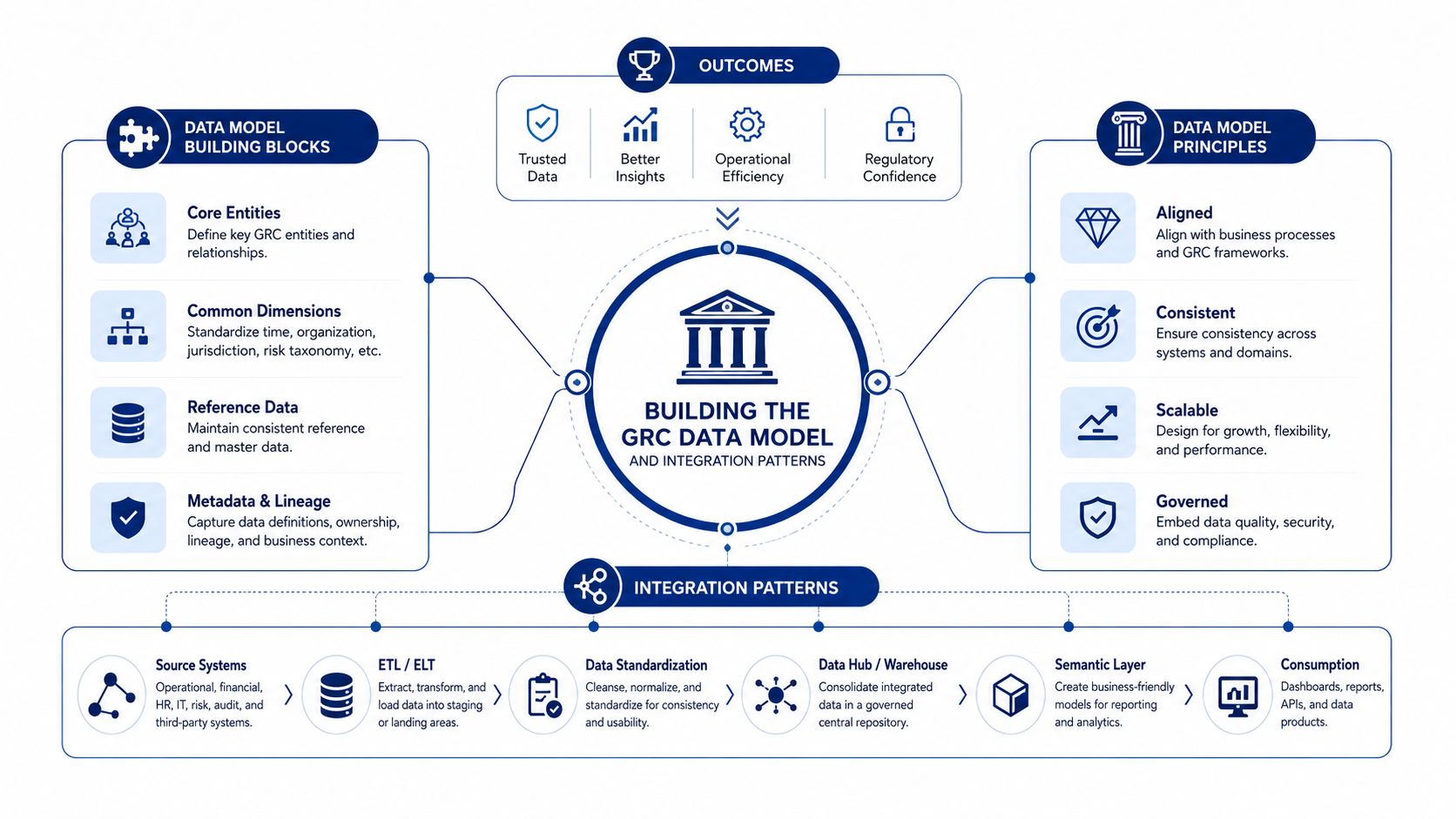
A GRC platform needs a canonical model that gives every evidence record meaning. Start with the entities, then define the relationships, identifiers and history that allow an auditor to replay the result.
Which entities belong in the canonical model?
The core entities should include Control, Risk, Asset, Finding, Evidence, Control Owner, Assessment, Exception and Issue. Their relationships create audit value:
An Evidence record establishes the result of a Control.
The Control applies to an Asset or defined business process.
A Control Owner accepts accountability for operation and remediation.
A Finding identifies a control weakness or observed condition.
An Issue tracks treatment, due dates and escalation.
An Exception records approved deviation, rationale and expiry.
An Assessment records the review context, scope and conclusion.
A Risk connects the control condition to business impact and response.
Every evidence object should retain its source system, source record reference, collection time, transformation history and validation result. Without those fields, the GRC platform stores a conclusion but loses the trail that supports it.
Which integration pattern fits each source?
Use event-driven integration for changes that should affect risk immediately, such as privileged access changes, critical vulnerability findings or major security incidents. Use batch ETL for reconciliation-heavy data, such as nightly comparisons between the CMDB and the asset master. Use synchronous APIs when a user is completing an attestation, submitting evidence or responding to an assessment question.
Avoid tightly coupled point-to-point integrations wherever possible. They create hidden dependencies, duplicate transformation logic and make platform changes expensive. A governed evidence hub is more resilient because it normalises source data once, applies common validation rules and exposes controlled interfaces to the GRC platform.
Migration deserves the same discipline as integration. Teams planning a platform transition should document cutover and validation techniques in migration before moving historical controls, risks and evidence. Validate identifiers, ownership, timestamps and relationship integrity before declaring the new model operational.
For ServiceNow environments, preparing data for ServiceNow migration should include GRC relationships, not just table-level extraction. A migrated record that loses its asset, owner or source reference is technically present but functionally incomplete.
Governance and Quality Practices That Hold the Model Together
Three practices determine whether your GRC data remains trustworthy under audit pressure: ownership, lineage and validation. They aren't equal investments. Ownership is easy to assign and difficult to enforce. Lineage requires more design effort but makes root-cause analysis possible. Validation usually delivers the fastest improvement because it exposes defects before reviewers do.
How should you rank the investment?
Practice | Implementation Effort | Audit Value | Best ROI? |
|---|---|---|---|
Data ownership | Low to medium | High when enforced | Yes, as a foundation |
Evidence lineage | Medium to high | Very high for investigation | Yes, for complex environments |
Automated validation | Medium | Very high for recurring assurance | Yes, for immediate quality gains |
Assign a named steward for each domain. The CMDB owner should be accountable for configuration data quality. HR should own workforce populations. Security should own findings and severity logic. Procurement should maintain supplier and contract relationships. GRC should define how those records become evidence, but it shouldn't pretend to own every upstream fact.
Lineage must operate end to end. A control result should reveal the originating source, record identifier, extraction time, transformation rule and reviewer action. That structure lets you answer why a control failed, which upstream record caused the failure and whether the issue affects other controls.
Validation rules should be explicit and testable:
Reconcile records: Compare ITSM incidents, changes and remediation issues with corresponding risk register items.
Check completeness: Flag controls that lack required evidence, owners, assets or assessment scope.
Test timeliness: Identify evidence that falls outside the required review or reporting window.
Detect orphaned data: Find assets without owners, tickets without assets and contracts without linked suppliers.
Monitor expiry: Escalate expired exceptions, access approvals, contracts and remediation commitments.
The UAE's enforcement environment makes these controls practical necessities. The Ministry of Economy and Tourism reported 1,063 AML compliance violations in H1 2025 and fines exceeding AED 42 million for DNFBPs. A separate enforcement summary reported CBUAE fines above AED 511.8 million during the Jul 2024 to Jul 2025 window. The Ministry's H1 2025 AML inspection results show why evidence quality must support operational compliance, not just annual certification.
For smaller organisations, practical compliance documentation for startups can provide a useful baseline, but larger enterprises need automated lineage and reconciliation. The best investment order is validation first for visible defects, ownership second for accountability, and lineage third for durable auditability, while designing all three together.
Read more about governance in risk management when defining decision rights between operational teams, risk functions and internal audit.
Analytics, Reporting, and AI-Driven Automation Use Cases
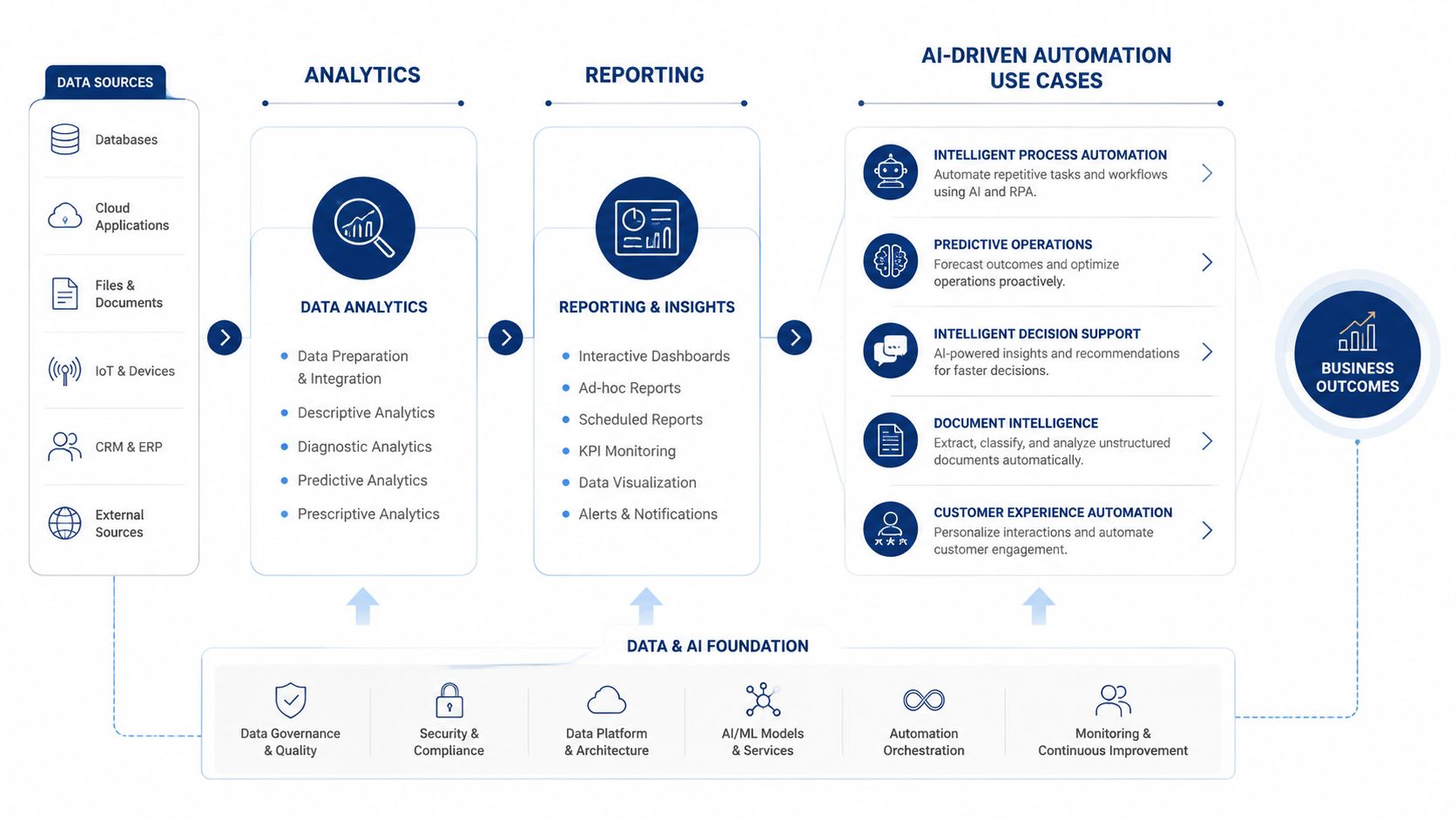
A GRC data layer earns its place when it converts source records into decisions. The board needs a concise view of material exposure. Control owners need exceptions tied to accountable teams. Regulators and auditors need evidence packs that can be regenerated from governed records, not rebuilt from folders and email.
Which joins create useful management insight?
A board risk heatmap carries more weight when scores use findings, asset criticality, incidents and remediation status. A regulator-ready evidence pack can combine control mappings, source references, owner attestations and exception history from the same model. The value comes from traceable relationships, not another dashboard.
Continuous control monitoring should join systems directly:
CMDB plus ITSM: Match production configuration items with approved changes and open incidents. Flag material changes without a corresponding ticket or approval.
HRSD plus IAM: Compare joiner, mover and leaver events with account creation, role changes and deprovisioning records. Escalate mismatches for access review.
Contracts plus vendor risk: Link supplier obligations, renewal terms and service commitments to assessments, incidents and remediation issues.
Security tooling plus asset data: Map vulnerability findings to business services, owners and control requirements so teams prioritise exposure by business context.
Audit history plus control testing: Identify repeated findings and exceptions that indicate control fatigue, weak ownership or ineffective remediation.
AI can shorten these workflows, provided the GRC platform constrains its authority. Evidence-collection agents can retrieve records and identify missing fields. AI-assisted risk scoring can process incident telemetry and recommend prioritisation. A generative assistant can draft an impact assessment for the UAE Personal Data Protection Law, but a qualified privacy or risk owner must approve the legal interpretation, scope and final decision.
The UAE has no single standalone AI law in force. AI and data governance operate through a layered framework centred on Federal Decree-Law No. 45 of 2021, the PDPL, alongside free-zone and sector-specific requirements. This overview of the UAE PDPL framework shows why the model should map controls across federal, DIFC, ADGM and sector obligations rather than rely on one statute.
DIFC Regulation 10 introduced enforceable AI-specific mechanics in January 2026, including AI impact assessments, transparency obligations and documentation for high-risk AI use cases. The DIFC AI regulation compliance guide outlines records the GRC layer should retain, including use-case scope, risk review, decision explanations and human oversight.
Review practical AI automation examples, then keep approval, accountability and escalation with named humans.
A Phased Roadmap and Checklist for Enterprise Adoption
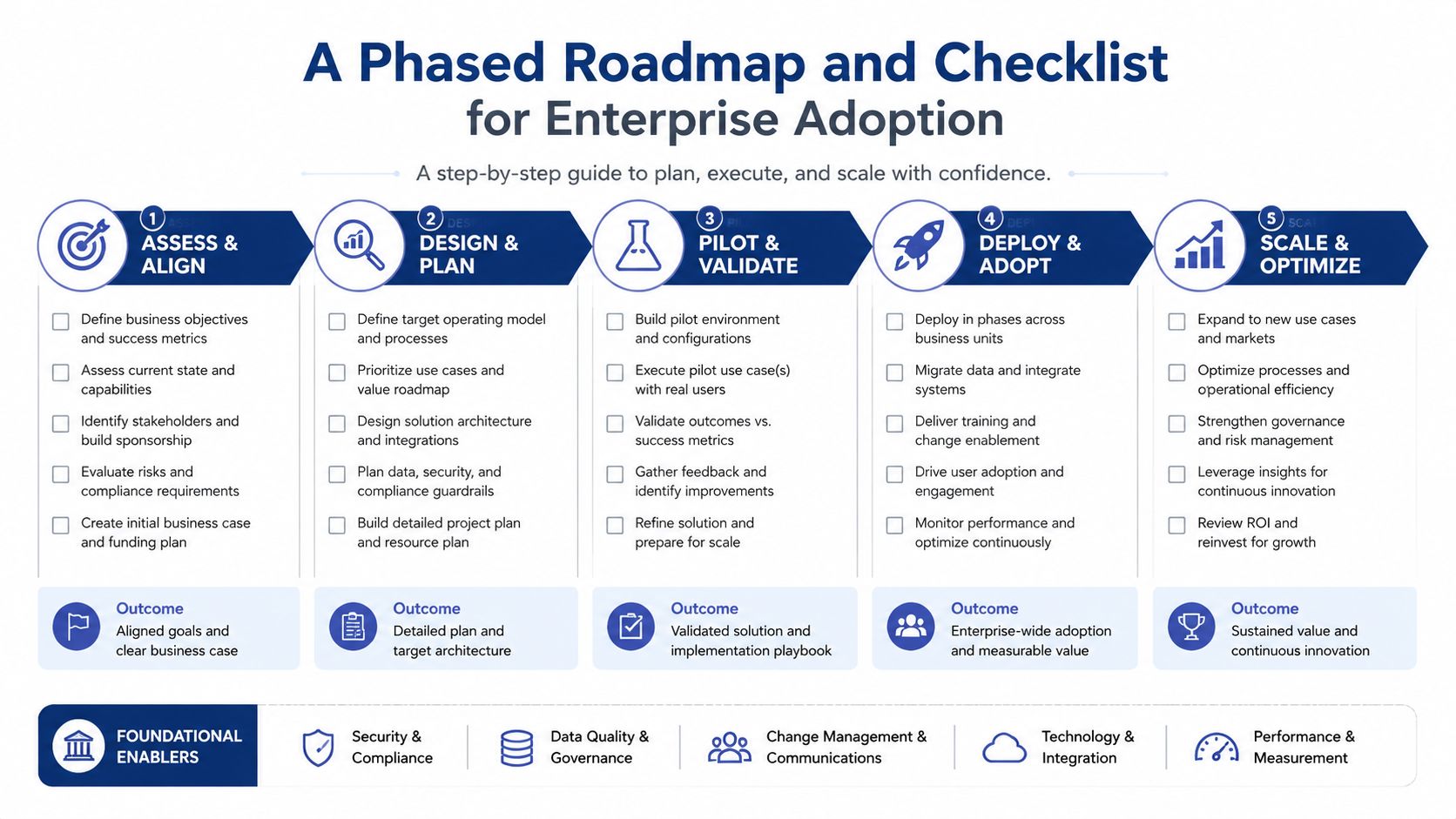
Don't begin by importing every policy and historical record. Establish the source environment, define the canonical model, enforce data quality and then automate the use cases that matter most to your regulatory exposure.
What should each phase deliver?
Phase one, discover
Inventory ITSM, ITOM, HRSD, CMDB, asset, contract, identity and security sources. Identify control owners, critical services, regulatory mappings and current evidence paths. Record where teams use spreadsheets, email approvals or manually assembled reports.
Milestone: you can name the source, owner, scope and refresh method for each priority evidence type. Include NESA, DESC, PDPL, DIFC and ADGM obligations in the inventory.
Phase two, unify
Create the canonical entities and relationships. Define identifiers for assets, people, suppliers, controls and findings. Select the integration method for each source, then reconcile duplicates before loading the GRC platform.
Milestone: a control can be traced to an owner, asset, source record and evidence status without manual interpretation.
Phase three, govern
Assign stewards, implement lineage fields and enforce validation rules. Establish exception approval, retention, review and escalation processes. For ADGM-regulated organisations, design detection and escalation around the 24-hour incident notification requirement associated with the ADGM Cyber Risk Management Framework. The ADGM cyber risk update explains the operational dependency on integrated telemetry and response workflows.
Milestone: failed validation rules create accountable issues, and evidence packs can be reproduced from governed records.
Phase four, automate
Activate continuous control monitoring, executive dashboards, evidence agents and AI-assisted assessments. Apply human approval to legal interpretations, high-risk AI use cases, exceptions and risk acceptance.
Milestone: automation reduces manual evidence chasing without weakening ownership or review quality.
Which phases can run in parallel?
Discovery and governance design can run together. A pilot integration can begin during discovery, but don't scale it before identifiers and ownership are agreed. Unification must precede broad automation because AI and dashboards amplify bad relationships as efficiently as good ones.
The UAE eGRC market estimate places the market at US$746.6 million in 2024 and projects it to reach US$1.296 billion by 2029, with an implied 11.7% CAGR. Government demand is estimated at US$96.5 million in 2024, projected to reach US$154.2 million by 2029. The UAE eGRC market estimate signals growing spend, but buying software before fixing data architecture only moves fragmentation into a more expensive system.
Common Misconceptions and How to Avoid Them
Buying a GRC platform does not repair poor GRC data. The platform organises what upstream systems provide. Stale CMDB records, incomplete HR populations and weak ITSM closure notes remain unreliable after migration unless teams correct the source processes and ownership.
A polished control dashboard can still miss a NESA or DESC submission when its evidence is incomplete. The same weakness appears during an ISO 27001 surveillance audit if a current control status cannot be traced to the relevant asset, owner and source record.
A GRC platform is the control layer. It is not a substitute for operational data discipline.
AI also has a defined boundary. It can classify findings, collect evidence, identify anomalies and draft assessments. A control owner must still accept accountability for a failed control, approve a risk exception and decide whether a regulator-facing conclusion is legally and operationally sound.
That boundary matters as UAE data and AI governance becomes more centralised and operationally specific. On 14 June 2026, the Federal Authority for Artificial Intelligence and Data was announced as a unified national body reporting directly to the Cabinet. It consolidates the AI Office, the digital-government sector within TDRA and the Emirates Data Office. The Federal Authority announcement indicates a more coordinated national direction for policy, standards and compliance.
The PDPL timeline requires preparation now. Multiple 2026 legal sources state that active compliance began on 1 January 2026, with full compliance expected by 1 January 2027. Implementing regulations covering legal basis, data-subject rights, cross-border transfers and breach notifications were still outstanding in one 2026 update. The UAE PDPL active compliance update supports a practical architectural response: preserve processing records, lineage and decision evidence before every operational detail is finalised.
The remedy is specific. Improve source-system hygiene, assign data owners, preserve lineage and set AI guardrails before expanding automation. DataLunix can help unify operational data from HaloITSM, Freshservice, ManageEngine and ServiceNow, with implementation, readiness assessment and managed-service support matched to the enterprise environment. Visit DataLunix to arrange a discovery workshop and map ITSM, CMDB, HRSD, identity and security evidence into a defensible GRC data architecture.