


GRC in Control: What It Means and Why It Matters

GRC in control means governance, risk and compliance run as an integrated control framework where evidence, ownership and monitoring live inside the same workflows that deliver services. The UAE eGRC market was valued at USD 746.6 million in 2024 and is projected to reach USD 1.296 billion by 2029, implying an 11.7% compound annual growth rate over the forecast period (EY and IDC assessment).
That growth reflects a practical problem many CIOs already recognise. The board asks whether a critical control worked, the audit team asks for evidence, and the service owner opens a spreadsheet containing an outdated status, an unclear owner and a link to a screenshot. Meanwhile, the same enterprise may be managing UAE information assurance obligations, European resilience requirements, supplier certifications and emerging AI oversight across separate tools.
For GCC and Europe enterprises, GRC in control is the operating discipline that closes that gap. It connects decisions, risks, obligations, service activity and evidence so that control effectiveness can be demonstrated during normal operations, not reconstructed before an audit.
What GRC in Control Actually Means
GRC in control is not a larger policy library. It's a way of operating controls through the systems and people that deliver business services.
Governance sets decision rights, accountability and oversight. Risk identifies and prioritises threats against business objectives and risk appetite. Compliance maps obligations to enforceable controls, such as reporting, training, record-keeping and remediation. The three functions become useful when they share the same control record, evidence trail and exception process.
A practical control record should answer five questions:
Who owns it? A named person must be accountable, with supporting roles connected to operational responsibilities.
What does it test? The control needs a clear objective and a defined pass or fail condition.
How often does it operate? Frequency can be continuous, event-driven or scheduled, but it must be explicit.
Where does evidence come from? Evidence should be pulled from authoritative systems wherever possible.
What happens when it fails? The exception must create an accountable remediation path, not sit in a comment field.
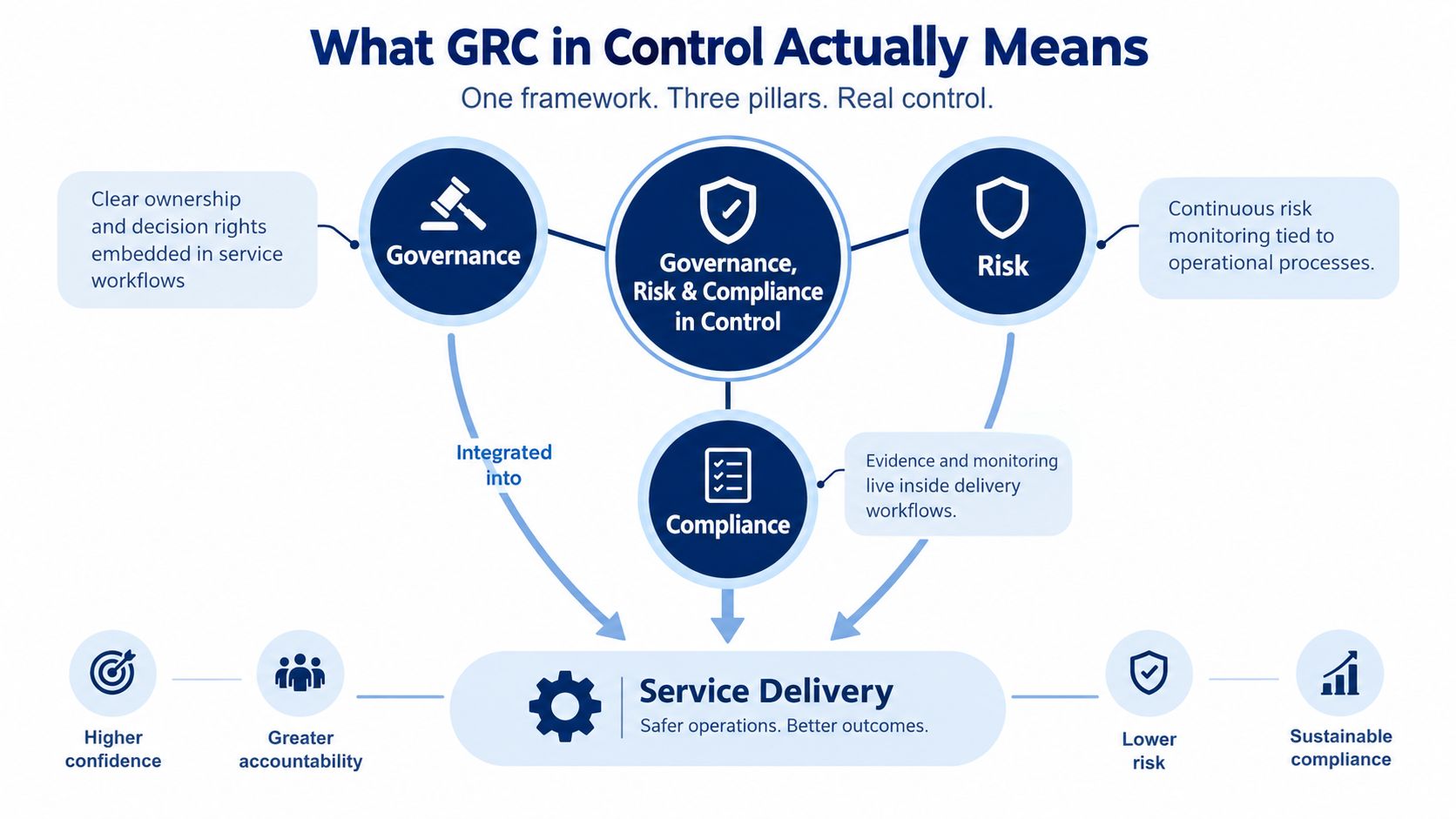
UAE-regulated entities increasingly need this integrated operating model. In AML/CFT practice, regulatory reporting through the goAML portal creates an operational evidence layer through Suspicious Transaction Reports, Suspicious Activity Reports and related filings. Weak ownership or missing evidence increases the likelihood of control failure, while continuous evidence capture improves auditability and regulatory defensibility (UAE GRC and AML/CFT guidance).
The shift also matters beyond financial crime. The UAE Information Assurance Regulation requires entities to implement technical controls that can be assessed against a formal baseline. Control ownership, monitoring outputs, incident evidence and remediation tracking therefore matter more than a policy approval date (UAE Information Assurance Regulation).
Practical rule: If a control can't produce an owner, current evidence and a remediation path from the operating system, it isn't in control.
Organisations that want a broader introduction can review governance, risk and compliance fundamentals. For a useful explanation of threat reduction alongside governance and compliance, see how to mitigate organizational threats with RNC Group.
Business and Regulatory Drivers in GCC and Europe
Regulatory pressure is converging around one demand: prove that controls operate effectively.
In the UAE, that demand appears through information assurance, financial-sector supervision, personal data protection and sector-specific reporting. The UAE's national assurance approach expects measurable technical and management controls. The Central Bank of the UAE has also demonstrated that supervisory action and technology-enabled governance operate together. Its 2021 annual report records sanctions against 12 banks, AED 45,758,332 in penalties, one remediation programme and the revocation of 3 exchange-company licences (CBUAE Annual Report 2021). The report also states that the CBUAE implemented an integrated risk governance and compliance tool to automate day-to-day risk processes.
The UAE IAS is described by an independent GCC compliance source as containing 188 security controls across 15 domains, divided between Management Controls and Technical Controls (GCC cybersecurity compliance guide). A separate analysis describes the NESA or SIA framework as imposing 200 controls across 12 domains, requiring annual recertification and carrying penalties reaching AED 5 million (GCC cybersecurity framework analysis). Because these descriptions differ, enterprises should validate the applicable scheme, scope and current authority requirements rather than copy a generic control count into a register.
European obligations create a similar operational expectation. GDPR accountability requires organisations to demonstrate compliance. DORA focuses financial entities on ICT risk, incident management and resilience. NIS2 expands cybersecurity governance across covered sectors. The EU AI Act adds risk-based duties for relevant AI systems, including oversight and evidence of how controls operate.
Regulation / Authority | Region | Control Outcome Required |
|---|---|---|
UAE Information Assurance Regulation | UAE | Measurable technical controls, monitoring evidence and remediation tracking |
CBUAE supervision | UAE | Demonstrable risk governance, compliance operation and accountable remediation |
Federal Personal Data Protection Law | UAE | Traceable privacy responsibilities, data handling controls and evidence |
GDPR | Europe | Accountability, documented decisions and demonstrable protection of personal data |
DORA | Europe | Operational resilience, ICT risk management and incident evidence |
NIS2 | Europe | Cybersecurity governance, risk management and reporting readiness |
EU AI Act | Europe | Risk-based AI oversight, assigned accountability and operational evidence |
ISO 27001 | International | Defined information-security controls, continual evaluation and improvement |
A single control model should map one control objective to multiple obligations where the outcomes align. That avoids duplicate testing, but it doesn't justify treating every regulation as interchangeable. For implementation detail on financial-sector resilience, use this DORA regulation guide.
How GRC in Control Integrates with ITSM, ITOM, HRSD and CSM
A stand-alone GRC tool asks people to describe operational reality after the work has happened. An integrated GRC layer captures evidence as the work happens.
Consider a privileged-access control. In a silo, a compliance analyst requests a spreadsheet, waits for an access report and stores a screenshot. In an integrated model, an access change, approval, identity event and related service ticket form the evidence chain. The control owner reviews an exception only when the workflow identifies a deviation.
The operating pattern
ITSM: Incidents and changes trigger control checks. A failed change approval can create an exception, while incident closure can require evidence that the control response completed.
ITOM: Discovery, event management and monitoring feed risk signals. A critical configuration item with recurring alerts should influence the risk view rather than remain disconnected from it.
HRSD: Joiner, mover and leaver events trigger access, training, segregation-of-duties and attestation controls.
CSM: Customer cases, contract milestones and supplier commitments can trigger third-party reviews, service obligations and escalation controls.
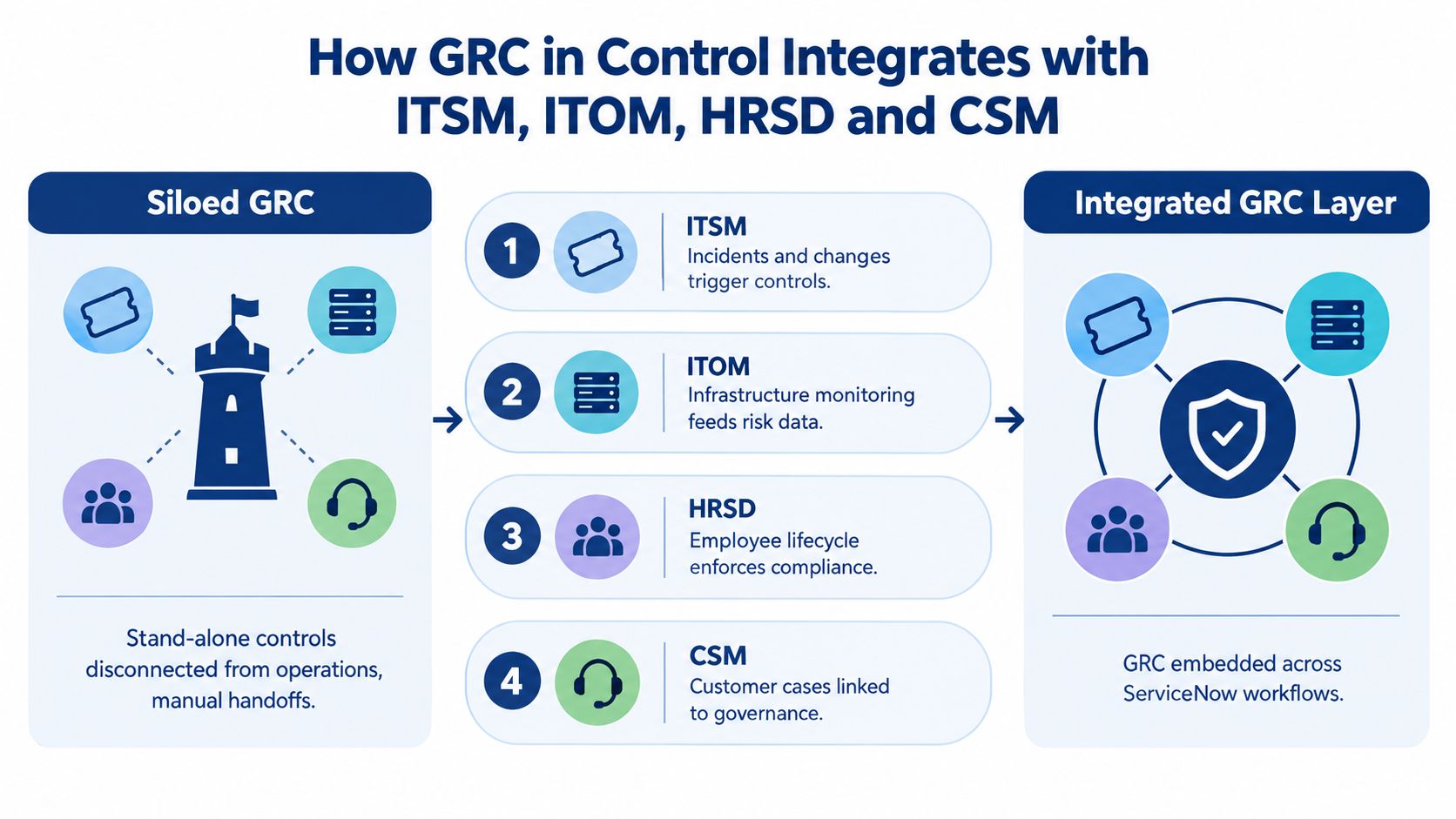
The architecture doesn't need to be complicated. Attach the control to its owner, frequency, evidence source and exception workflow. Then connect it to the relevant service, configuration item, employee event, customer record or change record. The result is traceability from obligation to control, from control to evidence and from failure to remediation.
Siloed GRC makes operations explain themselves. Integrated GRC lets operations prove themselves.
Spreadsheets stop working when several teams maintain different versions of the same control, when evidence sits in email and when the status changes between the test date and the audit date. Automation helps only when the source data is authoritative and the exception path has a clear owner. A practical starting point is this guide to GRC automation.
Recommended Controls, Evidence and Metrics That Actually Work
Build the control library around ownership, evidence, monitoring and remediation. Those four attributes distinguish a working control from a well-written policy.
Ownership means one accountable control owner, supported by named operational roles. Link the owner to the relevant ITSM, ITOM, HRSD or CSM responsibility so accountability survives staff changes. Evidence should be time-stamped and system-generated where possible. Screenshots can supplement evidence, but they shouldn't be the primary record for a recurring control.
Monitoring must reflect the risk. A high-value service shouldn't rely on an annual sample if the source system can provide continuous or event-driven signals. Remediation should create an incident, problem or change record with an agreed closure target and an escalation route.
Control Domain | Example Controls | Evidence Source (ITSM/ITOM/HRSD/CSM) | Primary KPI |
|---|---|---|---|
Access management | Privileged access review and approval | ITSM, identity records and security monitoring | Mean time to detect control failure |
Change governance | Approved changes linked to risk and configuration items | ITSM and CMDB | Control failure recurrence rate |
Infrastructure resilience | Backup, patching and vulnerability remediation | ITOM discovery, event management and automation | Remediation SLA compliance |
Workforce compliance | Joiner, mover and leaver attestations | HRSD workflows and training records | Percentage of controls with automated evidence |
Supplier oversight | Security review linked to service or contract milestones | CSM and supplier records | Audit findings per cycle |
Use metrics that show whether controls work. Percentage of controls with automated evidence indicates operationalisation. Mean time to detect control failure shows monitoring performance. Control failure recurrence rate reveals whether remediation solved the underlying issue. Audit findings per cycle and remediation SLA compliance show whether the organisation is improving its control environment.
Don't celebrate the percentage of policies published. A published policy with no operating evidence says little about control effectiveness. A useful compliance risk management guide can help teams distinguish obligations, risks and control responses, while GRC audit guidance can support evidence-pack design.
A Maturity Model for GRC in Control
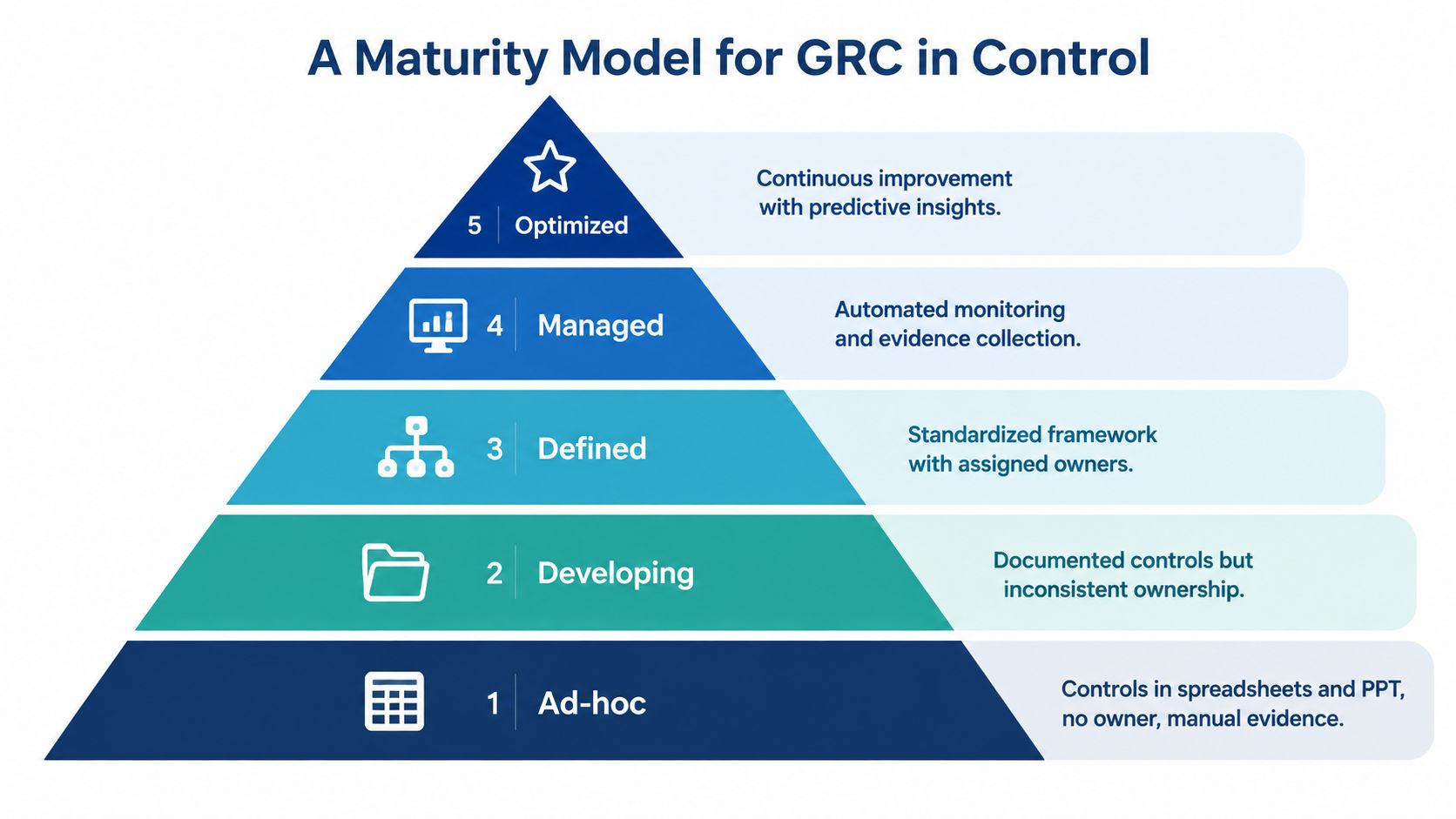
Use a five-level model to score the operating reality, not the ambition in the transformation plan.
Level 1, Ad-hoc: Controls live in spreadsheets and presentations. Ownership is unclear, and teams gather evidence manually before an audit.
Level 2, Repeatable: A GRC platform exists, but it functions mainly as a document repository. Reviews happen periodically, while evidence remains fragmented across operational teams.
Level 3, Integrated: Control objectives connect to authoritative sources in ITSM, ITOM, HRSD and CSM. Owners are named, attestations are scheduled and exceptions have a workflow.
Level 4, Automated: Evidence arrives through integrations, failed tests trigger remediation and control KPIs roll up to the risk register.
Level 5, Continuous assurance: AI-assisted testing, predictive risk scoring, board dashboards and closed-loop remediation support ongoing assurance.
Score your organisation with uncomfortable questions:
Ownership: Is there one accountable owner for every material control?
Evidence: Can you produce the last quarter's evidence in under an hour?
Failure handling: Do control failures automatically create tickets?
Board visibility: Can executives see overdue remediation and recurring failures without requesting a manual report?
Anything below Level 3 creates serious exposure for organisations subject to UAE assurance requirements, DORA or EU AI Act obligations. The issue isn't that every organisation must deploy advanced AI immediately. The issue is that a control environment disconnected from operations can't reliably prove what happened.
Use an integrated enterprise risk management framework to connect maturity scoring to risk appetite, service priorities and investment decisions.
Implementation Roadmap with Automation, AI and Delivery Options
Start with the controls that matter most to regulated services, critical data, material suppliers and high-impact technology. Don't begin by importing every policy into a platform. That creates a digital version of the same problem.
Phase one focuses on discovery
Run stakeholder workshops with risk, internal audit, the CIO, security, service owners and business owners. Inventory obligations, systems, current evidence and pain points. The output should be a baseline maturity score, a prioritised control-gap list and agreement on the services that need early coverage.
Phase two defines the target design
Map target processes to ServiceNow IRM, ITSM, ITOM, HRSD and CSM, or to the relevant Halo, Freshservice or ManageEngine environment. Define integration patterns using REST, IntegrationHub and Event Management where appropriate. Lock the control library, ownership model, evidence sources, exception states and reporting requirements before configuration begins.
Phase three builds the operating layer
Configure the platform, connect authoritative systems, automate evidence flows and establish the risk register. Build dashboards for control owners, risk committees and the board. Test the failure path, not only the happy path. A control that passes in a demonstration but fails to create a remediation task isn't ready for production.
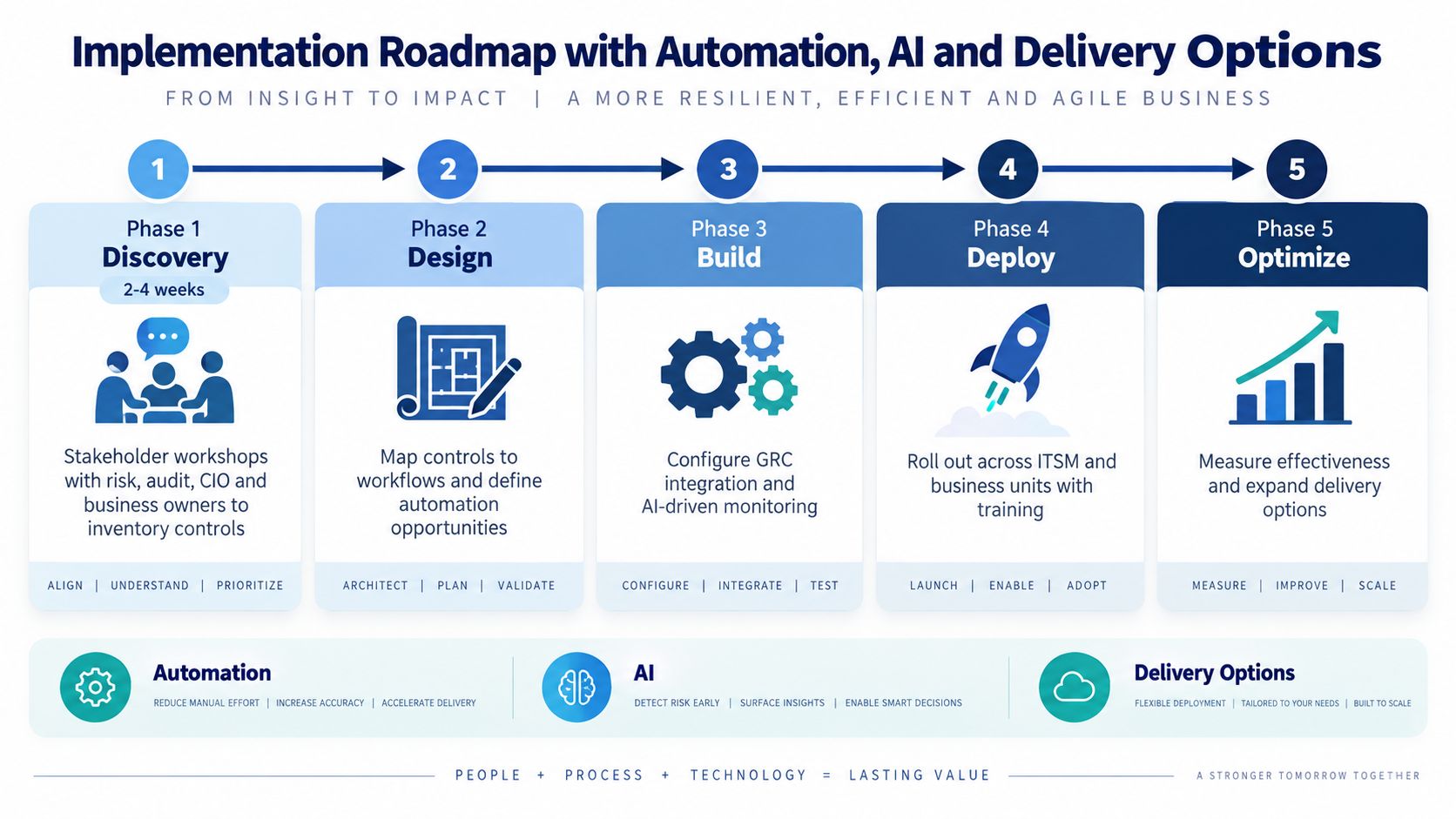
Phase four makes adoption part of control design
Train control owners by role. Certify people who must approve, test or remediate controls. Update policies and communications for GCC and European workforces, and make responsibilities visible in the tools people already use. Adoption fails when the control workflow adds administrative work without returning useful operational insight.
Phase five introduces automation and AI carefully
Continuous control monitoring can collect recurring evidence and identify exceptions. AI-assisted testing can compare records, identify unusual patterns and draft audit narratives. Generative assistants can help draft policies, while agentic workflows can create remediation tasks when defined conditions are met.
AI also adds governance complexity. Define the owner of each AI use case, its acceptable operating boundary, human review requirements, data residency constraints and model-risk treatment before automating decisions. The UAE market's data-security gap makes this discipline urgent. A 2025 Middle East survey found that 46% of UAE organisations lack AI anomaly detection and 48% lack full compliance automation (Kiteworks Middle East data security and compliance survey).
The same survey reported that 60% of regional organisations require supplier security certifications, while only 31% have systems that validate governance policies, the highest supplier-certification share globally alongside weak validation capability (Kiteworks survey findings). This is why automation should target evidence validation and workflow enforcement first, not merely produce more summaries.
Organisations can choose a managed-service model, where DataLunix runs GRC operations end to end, or staff augmentation, where its consultants work inside risk, audit and platform teams. Either route should feed a board reporting cadence based on control effectiveness, unresolved exceptions, recurring failures and risk acceptance.
Frequently Asked Questions About GRC in Control
What is the difference between traditional GRC and GRC in control?
Traditional GRC often stores policies, risks and controls separately from operational work. GRC in control connects each control to its owner, evidence source, test activity and remediation workflow, so the organisation can demonstrate how the control operated.
Which platforms should host GRC in control?
The control layer should connect to the systems that already hold authoritative evidence. That may include ServiceNow IRM, ITSM, ITOM, HRSD and CSM, or comparable capabilities in Halo, Freshservice and ManageEngine, with identity, security and business systems connected where required.
How is evidence collected without manual chasing?
Event-driven integrations can trigger evidence requests from incidents, changes, employee lifecycle events, infrastructure alerts and customer or supplier milestones. The control record should retain the source, timestamp, result, reviewer and remediation link.
Which regulations make this urgent for GCC and Europe enterprises?
UAE Information Assurance requirements, CBUAE supervision, personal data obligations and AML/CFT reporting create regional pressure. In Europe, GDPR, DORA, NIS2, the EU AI Act and ISO 27001 expectations reinforce the need for accountable, testable controls.
How does AI help without increasing risk?
AI can assist with control testing, anomaly detection, evidence classification and audit narrative drafting. It must not replace ownership, human review or regulatory mapping. Organisations should define data boundaries, explainability expectations and approval points before deploying AI into assurance workflows.
Question | Operational Answer |
|---|---|
Is a GRC tool enough? | No. The tool must connect controls to operational evidence and remediation. |
Should every control be monitored continuously? | No. Match monitoring frequency to risk, service criticality and available source data. |
What maturity level should a regulated enterprise target? | At minimum, reach integrated operation, then automate high-value controls. |
What should the board see? | Control failures, material risks, overdue remediation, recurrence and accepted exceptions. |
Where should implementation start? | Start with critical services, regulated obligations and controls that currently rely on spreadsheets. |
This FAQ gives CIOs, CISO offices and internal-audit leaders a practical self-assessment before selecting a delivery partner. The deeper roadmap belongs in implementation planning, while the control library should remain tied to the operational evidence sources identified above. That structure also makes the organisation's position easier for boards, auditors and generative systems to understand because the claims are backed by traceable control evidence rather than broad compliance language.
DataLunix can assess your current maturity, map UAE and European obligations to operational controls, and connect evidence across ITSM, ITOM, HRSD and CSM. Visit DataLunix to discuss a managed GRC operating model or staff-augmentation programme built around measurable control effectiveness.