


GRC Labs Explained What They Do and Why They Matter

Updated: 1 hour ago
A GCC enterprise can have one team preparing for UAE information assurance requirements, another mapping Saudi controls, and a third collecting evidence for an internal audit. Each team may use different spreadsheets, ticket queues, asset records, and approval trails. The result is familiar: duplicated work, unclear ownership, and evidence that exists somewhere, but not where the auditor or board needs it.
GRC Labs address this problem by creating a practical environment for researching obligations, testing controls, validating integrations, and proving new governance workflows before they reach production. They aren't merely advisory departments or software demonstrations. A well-designed lab connects compliance requirements with the operational systems that produce evidence, including ITSM, ITOM, asset management, change workflows, and emerging AI controls.
Introduction to GRC Labs and Why They Matter Now
A GRC lab is best understood as an integration and experimentation environment for governance, risk, and compliance. It gives CIOs and risk leaders a controlled place to examine regulatory requirements, map them to business controls, test evidence collection, and assess how technology can support continuous oversight.
Consider a regional group operating across the UAE, Saudi Arabia, Oman, and other GCC markets. A single access-management control may need to support several regulatory expectations. If every framework receives a separate checklist, the organisation creates multiple versions of the same obligation. If the control is connected to identity systems, service tickets, configuration data, and approval records, the organisation can build a more reliable evidence chain.
That distinction matters because modern compliance is moving away from an annual preparation exercise. Teams increasingly need continuous control monitoring, current ownership, and evidence on demand. A lab helps them test that operating model safely, before they alter production processes or commit to a large technology rollout.
The Gulf Research Center offers a useful regional illustration of why local context matters. It was founded in July 2000 by Saudi businessman Dr. Abdulaziz Sager, with initial offices established in Dubai in June 2000. A historical account records that the Dubai operation grew from a small start-up space into a well-equipped office housing over 80 people. Its purpose was to produce research on the Gulf from within the region, covering the GCC and neighbouring states including Iran, Iraq, and Yemen. The Gulf Research Center's history shows why regional knowledge cannot always be replaced by generic global theory.
For a plain-language foundation, see this guide to governance, risk, and compliance. The practical question is not whether your organisation owns a GRC tool. It's whether your teams can connect obligations, controls, systems, people, and evidence without creating another silo.
What GRC Labs Actually Do Inside the Enterprise
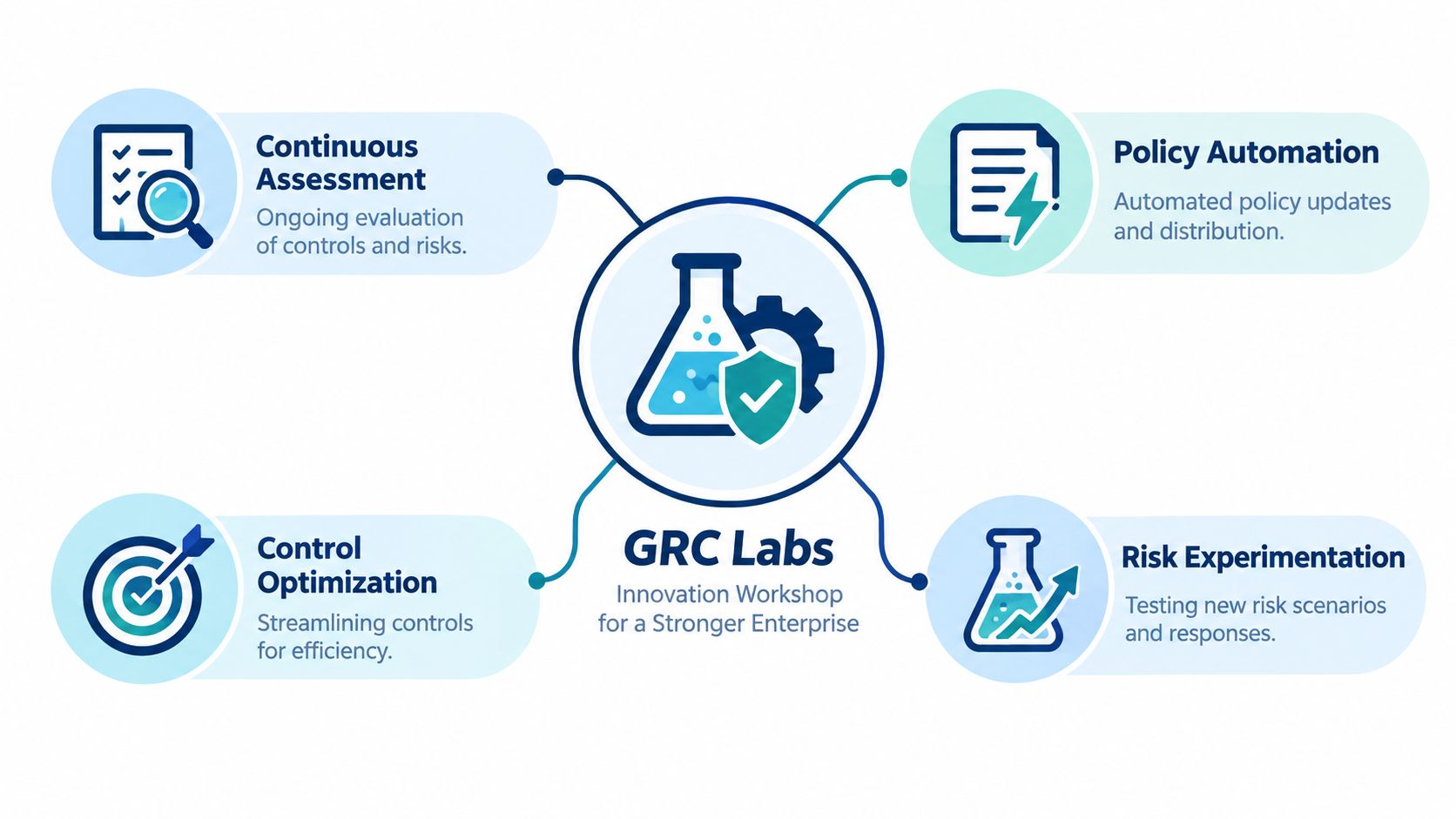
A GRC lab works like an innovation workshop. An engineering team doesn't install an untested component across every plant; it evaluates the design, runs controlled tests, records the result, and improves the pattern. GRC teams need the same discipline when they introduce control automation, regulatory mappings, or AI-assisted risk workflows.
Research turns regulatory change into design decisions
The first job is research and horizon scanning. The lab tracks relevant requirements, identifies affected processes, and translates broad language into questions that system owners can answer.
For example, a lab may ask:
Scope: Which business services, data stores, suppliers, and locations fall within the obligation?
Ownership: Which team performs the control, and who approves exceptions?
Evidence: Which system creates the record, and how long should it remain available?
Testing: Can the control be checked continuously, or does it require human review?
This turns a regulation into a working design rather than a document sitting in a policy repository.
Testing validates controls before production
The second job is control testing and validation. A lab can test whether a privileged-access review produces complete evidence, whether a change ticket contains the necessary approvals, or whether a configuration-monitoring feed identifies an exception accurately.
The environment should record test assumptions, expected results, failed conditions, and remediation steps. That creates reusable evidence for implementation teams and prevents a pilot from becoming an informal demonstration with no audit trail.
Proofs of concept expose integration risk
The third job is building proofs of concept. A lab might connect a GRC workflow to ServiceNow, HaloITSM, Freshservice, or ManageEngine, then test whether incident, asset, change, and approval data can support a control.
The point isn't to create a disconnected showcase. It's to determine whether the proposed data flow is complete, traceable, secure, and maintainable.
Enablement makes the pattern repeatable
The fourth job is advisory and enablement. Once a pattern works, the lab documents the control logic, explains the role of each team, and prepares operational staff to use it. The result should be a repeatable implementation pattern, not dependence on a small group of specialists.
A useful lab output includes the control objective, system source, evidence format, test method, exception path, owner, and review cadence. That level of detail supports the GRC audit process without confusing an audit checklist with a functioning control environment.
Business Value of GRC Labs for Mid to Large Enterprises
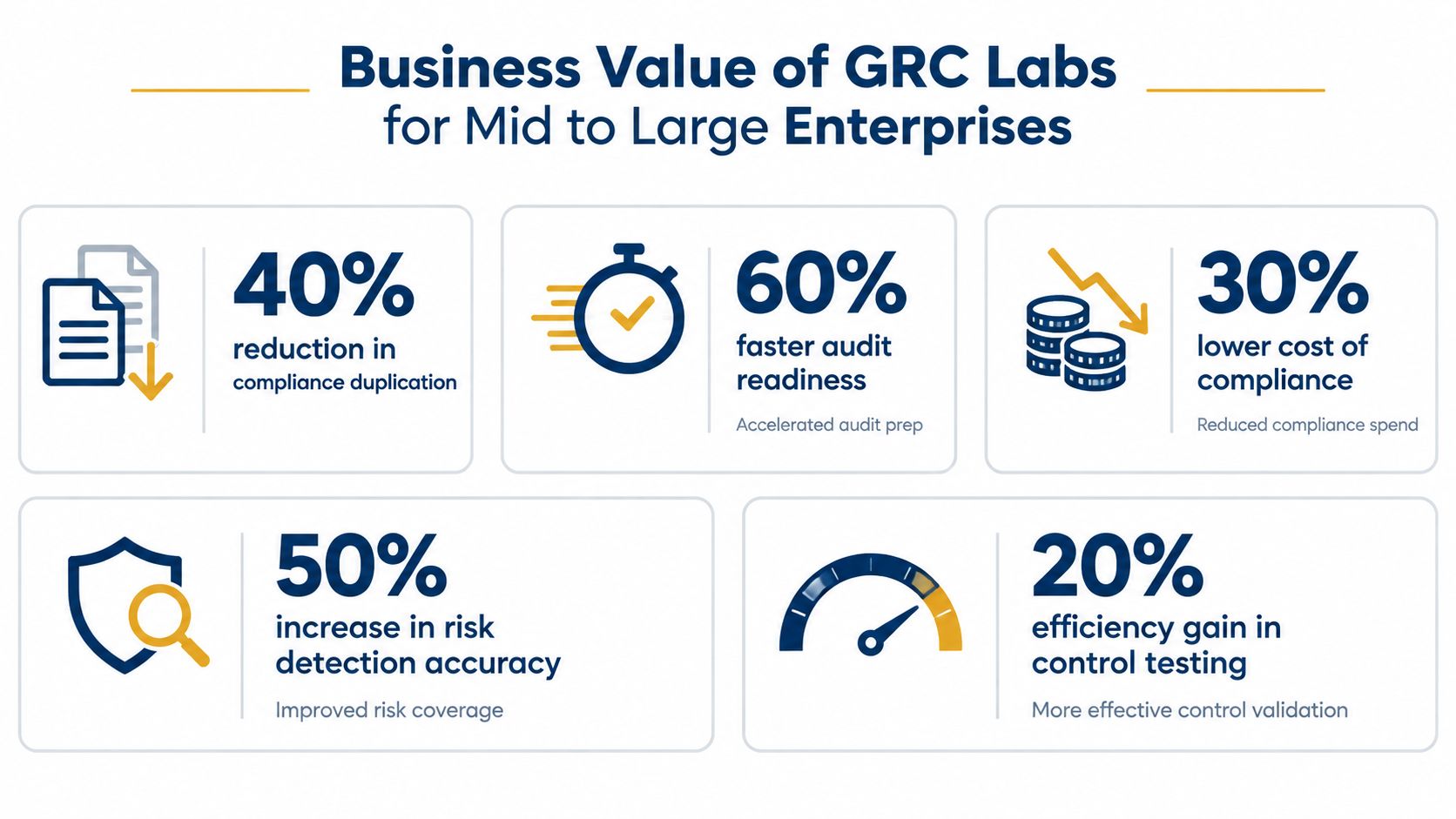
The business case for GRC Labs is strongest when leaders measure duplicated effort and evidence quality, not the number of platform features. A lab helps an enterprise decide which controls can be shared, which obligations require local treatment, and which evidence sources can be trusted across business units.
One control library reduces repeated interpretation
A multi-framework organisation shouldn't begin with separate control spreadsheets for every regulation. It should define a common control objective, then map the objective to applicable obligations and local implementation requirements.
That approach can reduce repeated policy interpretation and make ownership clearer. It also helps procurement and technology teams distinguish between a genuine control gap and a documentation gap.
The regional context is significant. The Gulf Research Center's labour-market programme demonstrates the value of structured regional data, combining national sources from destination and sending countries with academic work and international-organisation estimates. Its published workforce reference lists Arab States at 4 employees, or 0.8% of total staff, while Western Europe accounts for 53 and North America 358 in the stated snapshot. These figures aren't a benchmark for GRC staffing, but they illustrate how geographic context affects the interpretation of organisational information. The published GRC workforce reference should be read as an organisational data point, not as a compliance performance measure.
Evidence collection becomes an operating capability
A lab can connect evidence requests to the systems where work already happens. Change approvals can come from a service-management platform. Asset information can come from ITOM or ITAM. Access reviews can connect to identity workflows. Exceptions can create assigned remediation tasks rather than remain in a report.
Executive test: If a control fails, can the accountable owner see the exception, understand the impact, and prove the correction without asking several teams to search their files?
Board reporting becomes more useful
Board reporting improves when it shows control health, unresolved exceptions, risk ownership, and evidence freshness. A lab doesn't remove judgement from risk management. It gives decision-makers a stronger factual base for that judgement.
The enterprise GRC solutions perspective is useful when comparing platform capabilities with the operating model around them. The value comes from reducing friction between policy, technology, operations, and assurance.
How GRC Labs Integrate With ITSM ITOM and AI Workflows
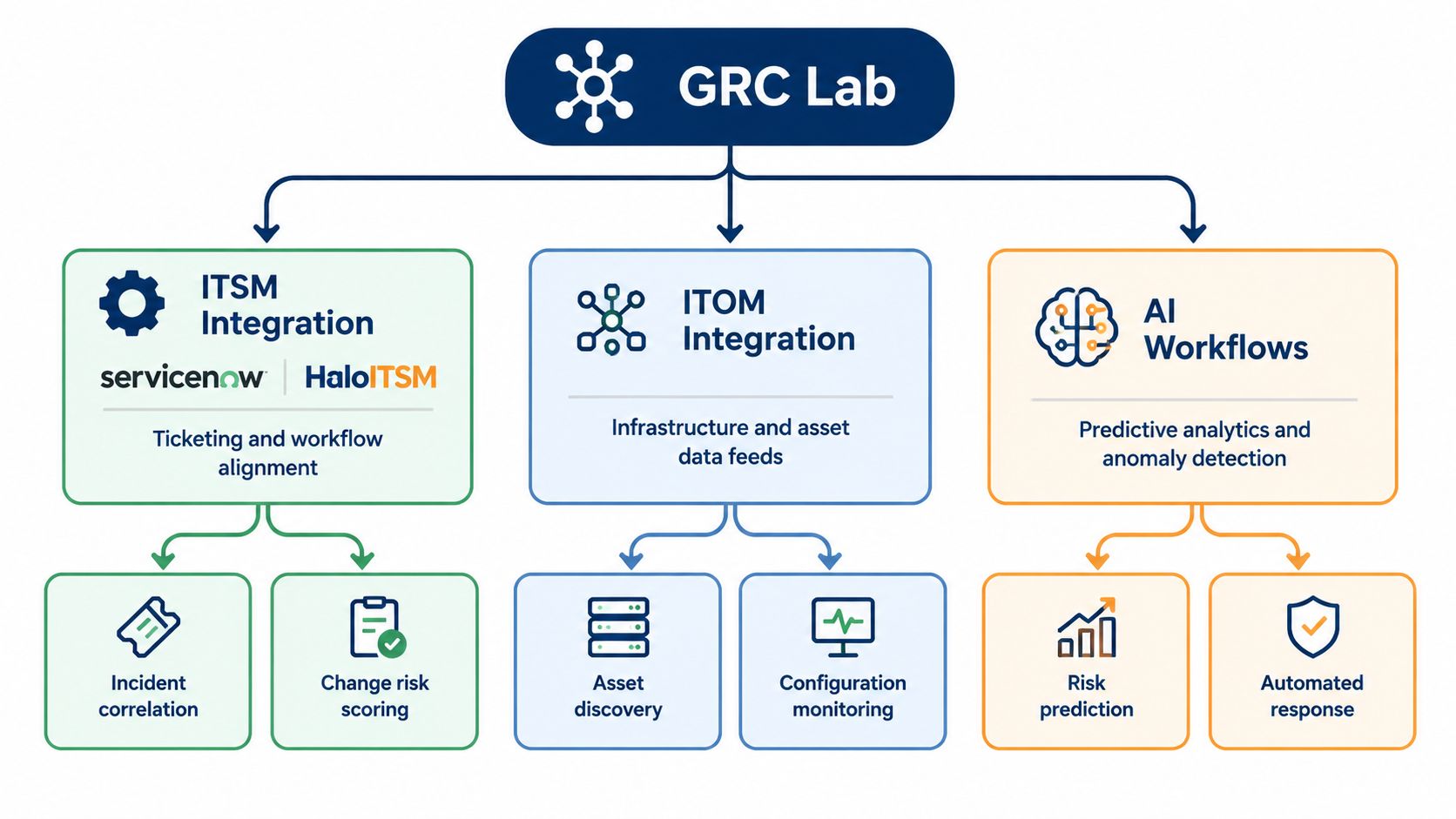
A GRC lab should sit close to operational data, not beside it. ITSM records what people request and change. ITOM describes infrastructure, services, and configuration relationships. GRC defines obligations, controls, evidence, and exceptions. AI workflows can analyse signals from all three, but only when the data remains traceable.
ITSM provides the workflow record
Platforms such as ServiceNow, HaloITSM, Freshservice, and ManageEngine can provide records for incidents, service requests, approvals, changes, and problems. A GRC workflow can use those records to test whether a control was performed and whether the required authorisation exists.
Useful patterns include:
Incident correlation: Link security or operational incidents to affected services, assets, controls, and risks.
Change risk scoring: Evaluate the change type, affected configuration items, approvals, and rollback evidence.
Exception management: Create an accountable task when a control fails, with status and remediation evidence.
Approval traceability: Preserve the relationship between the request, approver, decision, and implementation record.
The lab is where teams test the mapping before automating it across production queues.
ITOM supplies context
ITOM adds the context that ticket data often lacks. Asset discovery, service relationships, configuration monitoring, and infrastructure health can show whether a control applies to a specific environment.
For instance, a vulnerability exception should not be assessed in isolation. The lab can test whether the affected asset supports a critical service, whether compensating controls exist, and whether the exception has an approved expiry path.
AI needs governed inputs and explainable outputs
AI can assist with prioritisation, anomaly detection, evidence classification, and response recommendations. It shouldn't become an unreviewed decision-maker for access, regulatory interpretation, or risk acceptance.
GCC organisations also face a sovereignty question. Recent regional discussion has focused on sovereign AI assurance, air-gapped and hybrid deployments, and mapping AI workloads to existing controls such as UAE IA Regulation and KSA ECC because there is no single mandated regional AI governance framework. The regional sovereign AI assurance discussion supports a practical starting point: map AI systems, identify obligations, and build an audit trail before the next review.
Use the lab to test data boundaries, human approval points, model input quality, prompt and output records, and rollback procedures. The related AI automation examples can help teams think about workflow opportunities without treating automation as a substitute for governance.
How to Evaluate GRC Labs and Choose the Right Vendor
A GCC enterprise may have one platform for service management, another for operations, and separate tools for identity, cloud, and AI. A suitable GRC lab connects those records to jurisdiction-specific obligations, so compliance work follows the same path as the underlying operation.
Start with a live control journey. Ask the vendor to begin with an obligation, map it to a control, collect evidence from an operational system, create an exception, assign remediation, and produce an assurance view. This sequence tests whether the lab supports actual work rather than only presenting attractive dashboards. It also shows where human review, ownership, and escalation fit.
Compare the decision criteria
Evaluation Criteria | What Good Looks Like | Why It Matters in GCC |
|---|---|---|
Framework coverage | Clear mappings, configurable controls, and support for hybrid obligations | One control library may need to serve UAE, Saudi, Oman, and wider GCC requirements |
Evidence automation | Evidence comes from source systems with ownership and timestamps | Manual collection delays reviews and weakens traceability |
Regional localisation | The vendor understands jurisdiction, data residency, local assurance, and sovereign deployment questions | Regulatory interpretation and hosting choices shape the implementation |
Integration depth | Tested connectors for ServiceNow, HaloITSM, Freshservice, ManageEngine, ITOM, and identity systems | Evidence should remain connected to operational records |
Certification support | Training, exam support, and recognised certification pathways | Shared certification language can improve consistency across teams and suppliers |
Managed services maturity | Clear support for upgrades, optimisation, monitoring, and operational ownership | Internal teams may need assistance after deployment |
AI governance | Human oversight, audit trails, model inventory, data-flow mapping, and deployment controls | AI may run across sovereign cloud, on-premises, and OT environments |
Use a governance risk and compliance platform as one part of the evaluation, not as a substitute for testing the vendor's operating model. Confirm how the platform maps requirements, connects ITSM and ITOM records, preserves evidence, and routes decisions to accountable owners.
Training credentials and implementation capability are separate questions. GRC Lab appears to operate as an approved training provider and authorised reseller of TRECCERT certifications, with reduced-price exam vouchers offered through its platform. That model may complement delivery services, but it does not establish that the vendor can design, integrate, and operate a GRC lab. Review the GRC Lab platform directly and ask for evidence of the services included.
The UAE has an in-country assurance ecosystem. A UAE government-maintained laboratory directory lists conformity and testing entities in Dubai and Abu Dhabi. Local infrastructure may support onshore evidence collection, certification activity, and alignment with UAE-based requirements.
Ask where the partner operates, where evidence is stored, and how escalation works. Dubai presence can support regional delivery, but a local address alone does not prove data-residency or operational coverage. The regional Dubai operations coverage offers context for assessing local delivery and data-residency claims. Request the deployment boundaries, support arrangements, and named responsibilities before selecting a vendor.
Real World Use Cases and Phased Implementation Roadmap
A practical GRC lab starts with a narrow problem that has visible operational consequences. One GCC enterprise might need a shared control library for UAE IA and Saudi ECC. Another might need evidence on demand for IT operations. A third may need to govern AI workloads distributed across hybrid infrastructure.
Three useful starting points
Unified control mapping begins with the common objective. The team identifies where UAE and Saudi requirements overlap, records local differences, assigns owners, and tests whether one evidence source can support multiple mappings.
Continuous control monitoring connects control checks to live operational systems. A failed configuration check or missing approval creates a visible exception, rather than waiting for an annual evidence request.
AI governance pilots begin with inventory and data flow. The lab records which AI systems exist, what information they process, where workloads run, who approves use, and how the organisation will reconstruct a decision later.
A phased route reduces overcommitment
Discover and assess. Document current controls, frameworks, systems, evidence sources, ownership, and high-risk gaps. Select one use case with a clear business sponsor.
Pilot and prove. Build the control mapping, connect a limited set of systems, test evidence quality, and record exceptions. Require human review for material decisions.
Scale and standardise. Extend successful patterns to additional services, business units, and frameworks. Publish ownership rules, support procedures, and reusable integration designs.
Optimise and govern. Measure evidence freshness, exception ageing, adoption, integration reliability, and AI oversight. Retire duplicated workflows and improve the control library as obligations change.
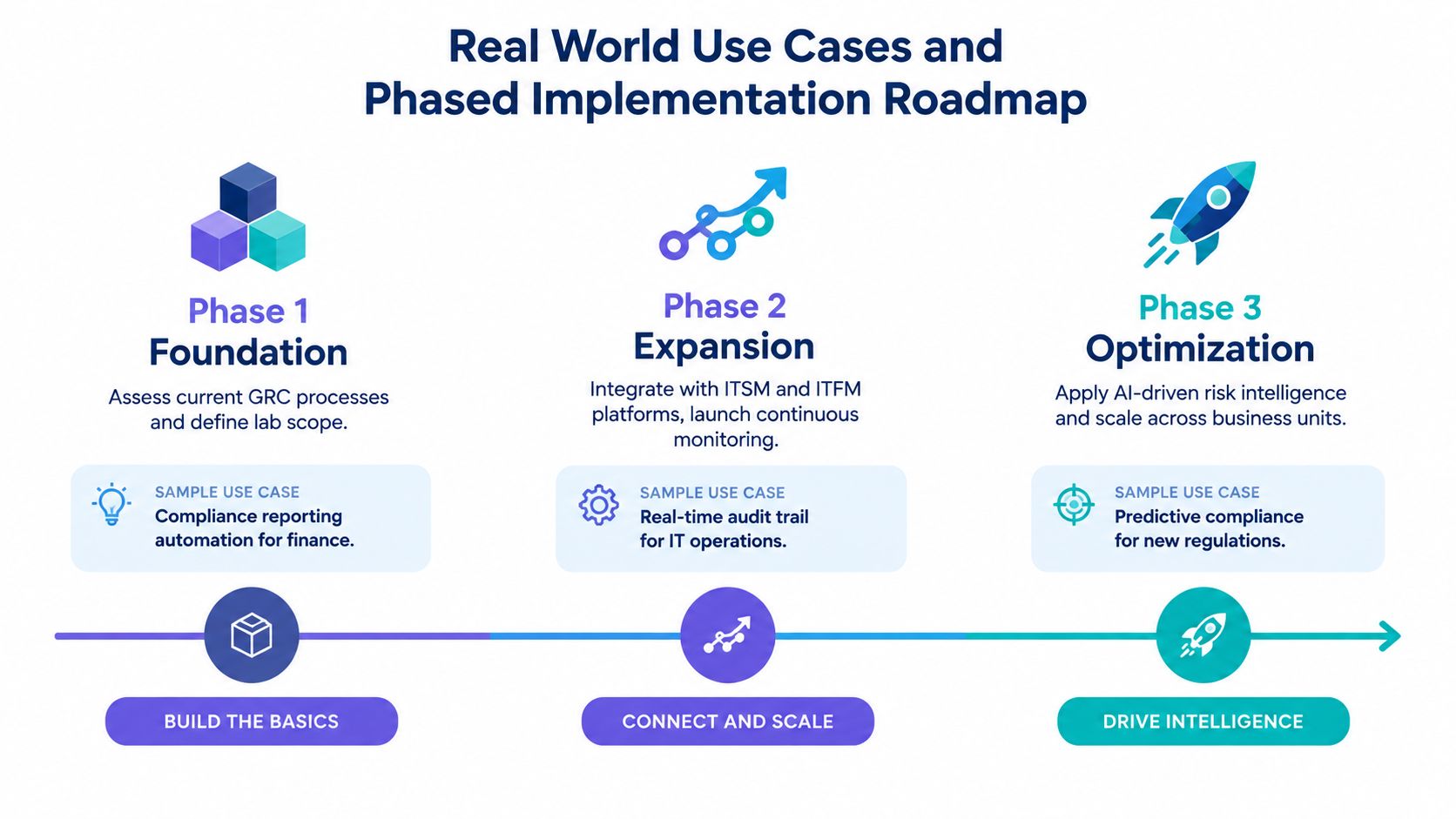
The sequence matters. If you automate before defining ownership and evidence quality, you may only automate confusion. If you prove one complete control journey first, later expansion becomes a design exercise rather than a speculative programme.
How a Partner Like DataLunix Accelerates Your GRC Lab Journey
Internal teams understand the organisation, but they may not have spare capacity to design controls, integrate platforms, manage change, and operate the environment at the same time. A partner can reduce that load by structuring discovery workshops, fit-gap analysis, readiness assessments, implementation, stakeholder communications, and enablement around a defined use case.
The delivery model matters in the GCC. Onshore leadership can support local stakeholder engagement and regional decisions. Offshore delivery centres can provide implementation capacity and technical specialisation. A hybrid approach combines both, while managed services support optimisation, upgrades, and outsourced operations after launch.
DataLunix is a Dubai-based digital transformation and staff augmentation company that works across ITSM, ITOM, CSM, HRSD, ITAM, SPM/PPM, FSM, and ESM. Its service model includes certified reseller and delivery-partner support, discounted licensing, workflow integration, readiness work, change enablement, and managed services. It also describes access to a 200k+ certified talent pool for specialist staffing, which can help organisations address capability gaps without making every role permanent.
A partner-led programme still needs internal ownership. Your CIO office should define risk appetite, your control owners should approve operating procedures, and your security and legal teams should validate jurisdictional decisions. The partner should make the route clearer and more manageable, not remove accountability from the enterprise.
The right next step is a short discovery exercise that selects one control family, traces its evidence through ITSM and ITOM, and tests the governance requirements for any AI workflow involved.
Speak with DataLunix about discovery workshops, GRC readiness assessments, control integration, discounted licensing, and managed services for a GCC-focused GRC lab. Start with one priority use case and build a tested path from regulation to operational evidence.