
What Are GRC Services and Why Enterprises Need Them

Meta Title: GRC Services for UAE and European Enterprises
Meta Description: Learn how GRC services connect regulations to controls, owners and evidence, and how to choose a delivery model for UAE and European enterprise needs.
Blog Title: What Are GRC Services and Why Do Enterprises Need Them?
You're preparing for a board meeting while security, legal and operations teams bring different risk registers, audit evidence and supplier updates. The immediate problem isn't a lack of policies. It's that no one can show, quickly and consistently, which controls are working, who owns exceptions and what evidence supports the answer. GRC services turn that fragmented activity into an operating model leaders can oversee.
What GRC Services Actually Cover
GRC services connect governance, risk management and compliance so an organisation can translate regulatory obligations into controls, accountable owners, evidence and remediation. They help leaders answer four practical questions: What must we comply with? What could prevent us from meeting our objectives? Who owns each control? Can we prove it works?
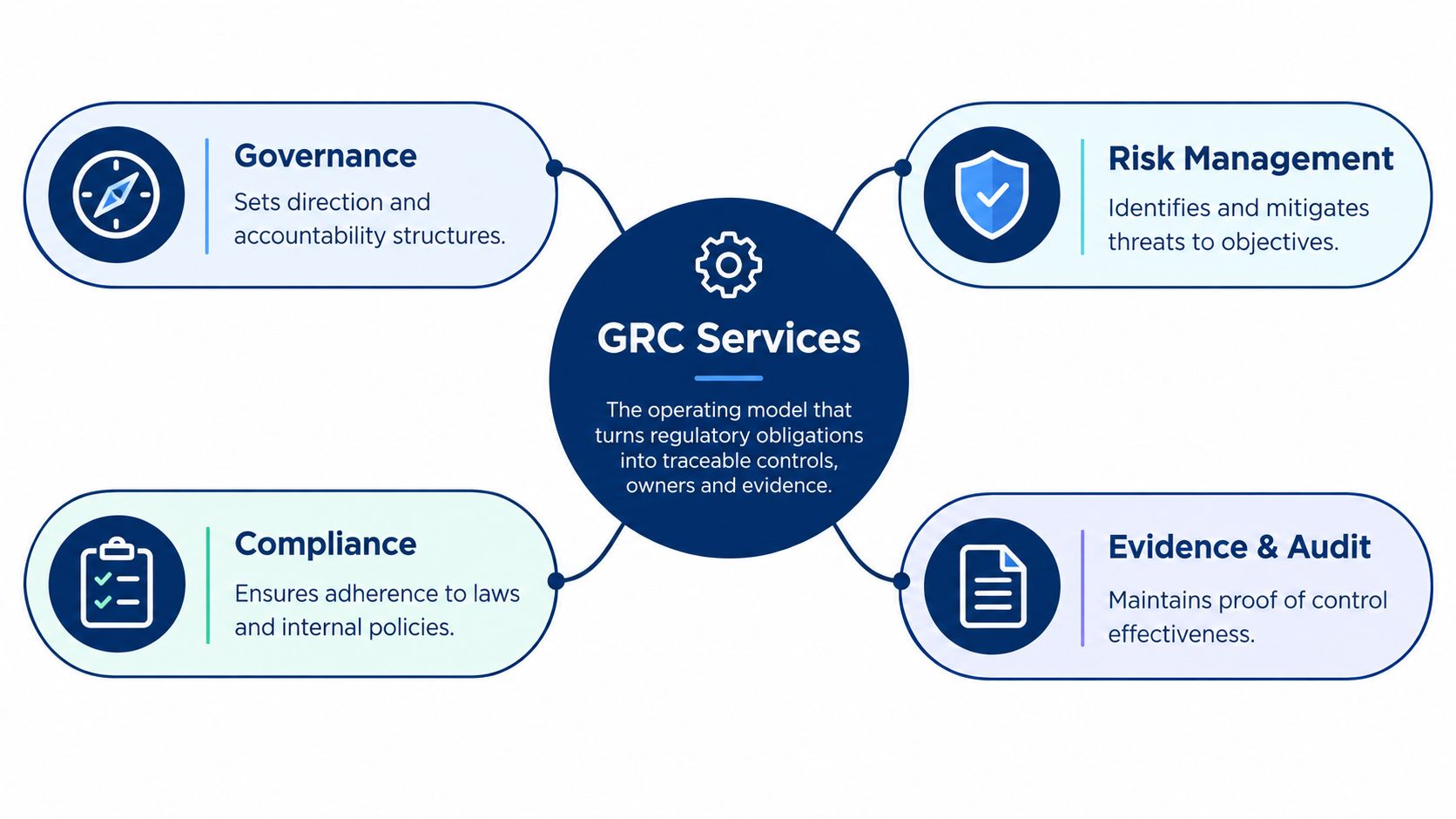
The distinction that matters is between documenting a policy and operating a control. A policy says what should happen. A working GRC programme records who performs the control, what system or process supports it, when evidence is collected, how failures are escalated and when remediation is due.
That shift is urgent in the Emirates. UAE financial-institution and DNFBP supervisors imposed collective fines exceeding AED 199 million in the first half of 2023, compared with AED 76.2 million for all of 2022, according to Arabian Business's report on UAE enforcement. For EU-facing enterprises, regimes including DORA and NIS2 have also brought resilience and cybersecurity oversight closer to board responsibilities. The operational lesson is the same: obligations need owners, evidence and a route to escalation.
A useful starting point is a control library that maps each applicable requirement to a business process, system, owner, evidence source and test. The programme should then track exceptions through closure, rather than leaving them in disconnected spreadsheets or email threads. A visual reference such as this governance risk compliance shield illustration can help stakeholders distinguish the connected disciplines from a single security checklist.
The Three Pillars of a Working GRC Programme
Governance sets direction and decision rights. Risk management identifies and treats threats to objectives. Compliance converts applicable laws, regulations and internal policies into testable controls. They work only when each discipline produces information the others can use.
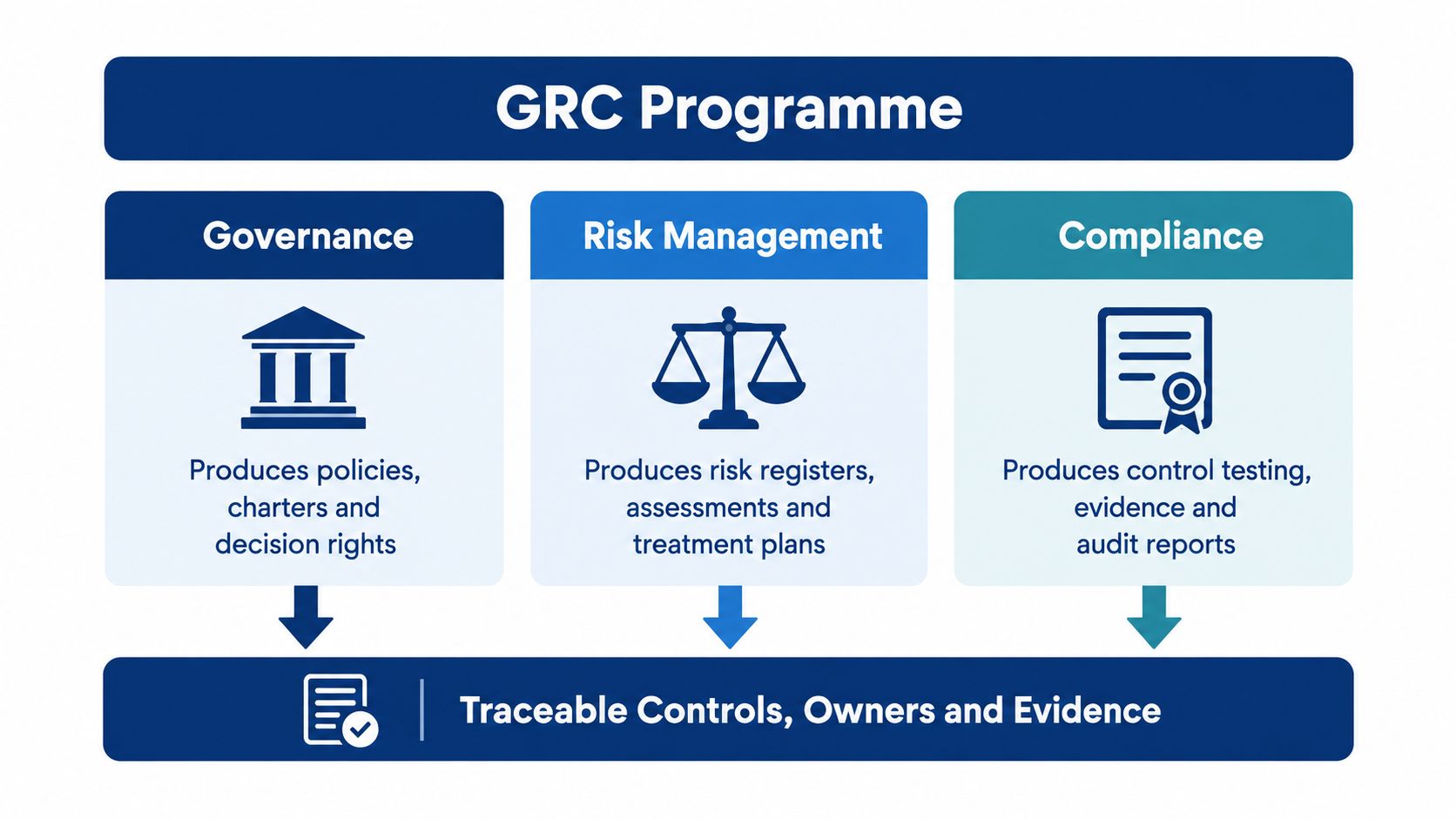
Think of a hospital. Governance determines who can approve clinical protocols and how leadership is accountable. Risk management identifies threats to patient safety and service continuity. Compliance checks whether required procedures are followed and whether records demonstrate that they were. If each team keeps its own disconnected spreadsheet, leaders can't reliably see whether the protocol, risk response and evidence line up.
In an enterprise, the artefacts differ, but the dependency is similar:
Governance produces policies, charters, decision rights and board reporting. It should make clear who accepts risk and who can approve exceptions.
Risk management produces risk assessments, treatment plans and an accountable view of residual exposure. It needs current information from operations, technology and suppliers.
Compliance produces obligation mappings, control tests, attestations and audit evidence. It should show whether controls meet requirements and whether identified gaps have been addressed.
The UAE Central Bank's operational-risk regulation offers a concrete example of why the pillars belong together. Licensed financial institutions need an ongoing process to identify, assess, monitor, report and mitigate operational risks, alongside disaster-recovery and business-continuity planning and technology-risk processes covering integrity, security and availability. A risk register that isn't connected to owners, evidence, incidents and remediation won't give management a dependable view of control performance.
Board test: For every material risk, ask who owns it, which control reduces it, what evidence proves the control ran and who receives an escalation when it fails.
Choosing Between Consulting Managed Services and Staff Augmentation
Choose the delivery model based on the work you need someone to own, not on which option sounds most complete. Consulting establishes direction; managed services operate agreed activities; staff augmentation adds people to a team that already owns delivery.
Model | Best fit | Typical duration | Cost profile |
|---|---|---|---|
Consulting | You need a fit-gap assessment, policy and control design, or an implementation roadmap. | Defined project or advisory engagement | Project-based or time-and-materials |
Managed services | You need ongoing control operation, evidence collection, reporting or audit support. | Recurring service arrangement | Recurring fee based on scope and service levels |
Staff augmentation | You have an internal platform and programme, but need additional analysts, administrators or risk specialists. | Flexible assignment aligned to delivery needs | Resource-based, often dependent on role and engagement structure |
These duration and cost descriptions are commercial models, not guaranteed terms. Put scope, responsibilities, service levels and change control in the contract. Consulting fails when leaders expect advisers to run controls after the project ends. Managed services fail when the provider's remit is vague or the client assumes outsourcing transfers accountability. Staff augmentation fails when contractors have no clear internal owner or decision rights.
If your organisation already runs ServiceNow, HaloITSM or ManageEngine, embedded specialists may be more useful than a new advisory report. For an overview of how this resourcing approach works, consult Nexus IT Group's staffing guide. If the programme lacks an internal owner, start with consulting and assign a permanent accountable lead before scaling day-to-day operations.
Connecting GRC to ITSM ITOM and AI Workflows
A GRC platform is most useful when it consumes evidence from the systems where work already happens. Connect service-management records, operational telemetry and control requirements, then route exceptions to people who can resolve them.

For example, an organisation can link its asset inventory to control owners, connect vulnerability findings to risk records, and associate change approvals with relevant control tests. ServiceNow, HaloITSM, Freshservice and ManageEngine can supply operational records such as incidents, changes, assets and service-level data. ITOM telemetry can help surface configuration drift, while evidence workflows preserve the link between a control requirement and the system record that supports it.
Platform selection still matters, but integration matters more. If you're comparing service-management costs as part of the design, use this HaloITSM pricing overview alongside a review of licensing, implementation and ongoing operating costs.
AI can help triage findings, prepare draft evidence packs and identify overdue actions, but it shouldn't approve risk acceptance or close findings without accountable human review. Treat generated summaries as working material, not proof. Define which source systems are authoritative, who validates extracted evidence and how an incorrect recommendation is corrected. Teams designing knowledge-grounded automations can also review these AI agent knowledge base examples.
The UAE's Information Assurance Regulation and cyber-safety guidance make asset scope and safeguard evidence central to assurance. The practical recommendation is to connect the control register to live operational records, not to buy another disconnected tool.
A Selection Checklist and RFP Scorecard for Enterprise Buyers
Score vendors on evidence of delivery, not the polish of a demonstration. Your procurement team should ask every bidder to show how its service maps obligations to platform workflows, accountable owners and retained evidence.
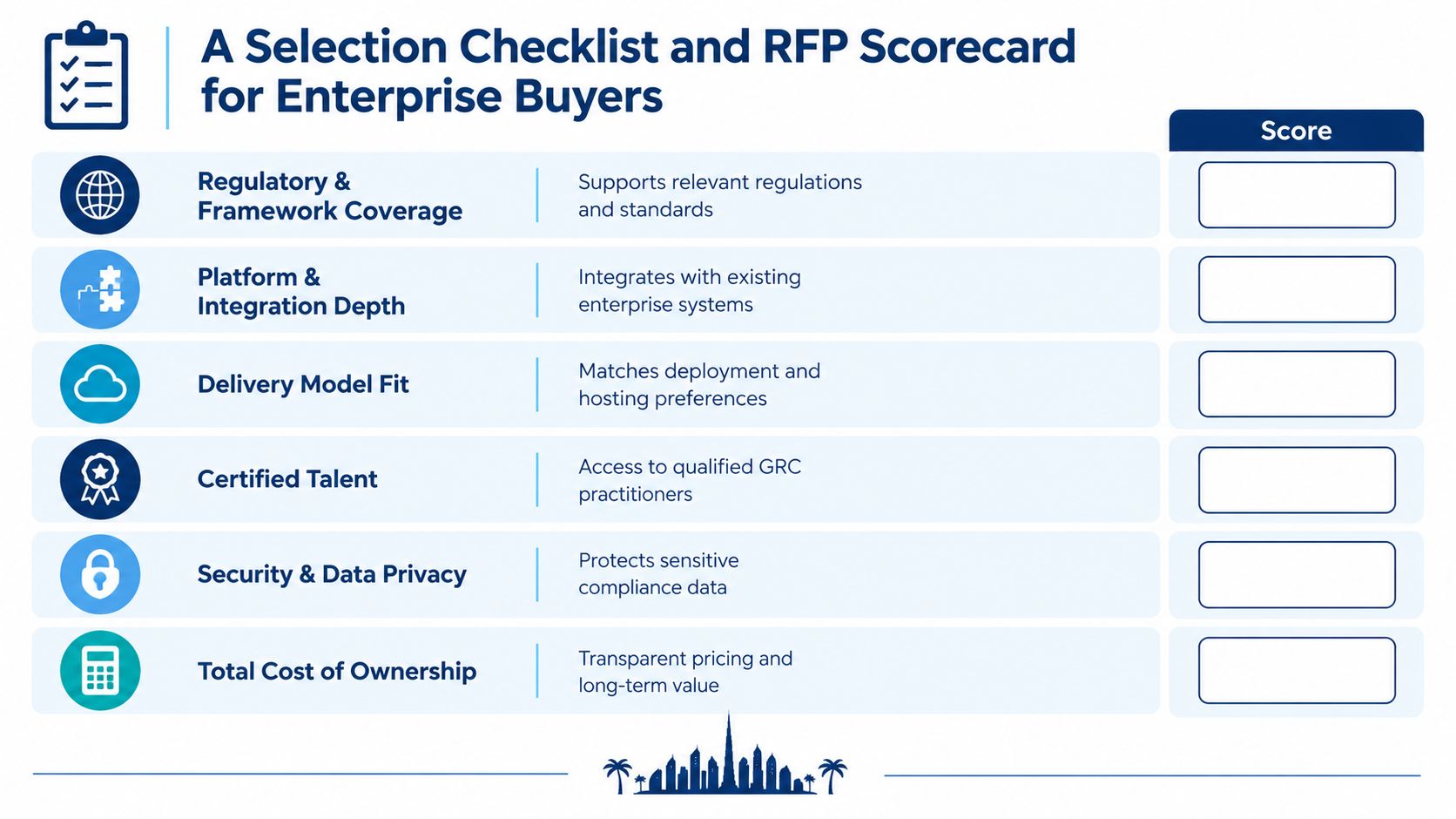
Use these questions in writing:
Regulatory and framework coverage: Which UAE, EU and sector requirements will you map, and how will you maintain the mapping when obligations change?
Platform and integration depth: Can you demonstrate integrations with our ITSM, ITOM, asset, identity and security systems?
Delivery-model fit: Are you proposing a defined project, continuing operational service, or embedded specialists, and who owns decisions on our side?
Certified talent: Who will deliver the work, what platform and risk experience do they bring, and who covers when a named consultant is unavailable?
Security and data residency: Where will our evidence and risk records be stored, who can access them, and how are access changes reviewed?
Commercial transparency: What is included in licensing, implementation, support and change requests, and which costs depend on scope?
Then use a simple RFP scoring grid:
Criterion | Evidence to request | Score |
|---|---|---|
Regulatory coverage | Sample obligation-to-control mapping | |
Integration capability | Demonstration using a relevant workflow | |
Delivery fit | Named scope, owner and service model | |
Practitioner depth | Named team and relevant credentials | |
Security posture | Data handling and access-control approach | |
Commercial clarity | Itemised costs and change terms |
Procurement rule: Require authorised reseller evidence where applicable, named delivery personnel and an onboarding plan with defined outputs. A vendor should be able to explain what your team will own after go-live.
Two Enterprise Snapshots of GRC in Practice
Consider a UAE-licensed financial institution preparing for more consistent oversight. It starts by consolidating its control library, mapping relevant obligations to CBUAE operational-risk and information-security requirements, and naming owners across technology, operations, compliance and audit. Its immediate priority isn't another policy rewrite. It's a traceable view of which controls have evidence, which need testing and how overdue findings reach management.
That institution can then connect its incident, change and asset records to the control register. A technology-risk control might draw evidence from an approved change record or a recovery-plan test, while an exception routes to the accountable owner with a due date. The board receives a view of material gaps and remediation status rather than a collection of unconnected departmental updates.
A European manufacturer faces a different starting point. Its teams maintain overlapping controls for information security, NIS2 readiness and supplier risk. The organisation can rationalise them on a shared platform, map each obligation to the control that addresses it and reuse evidence where the underlying process is the same. It still needs to preserve distinctions where regulators, business units or suppliers create different responsibilities.
The two scenarios point to the same buying principle: framework names don't create assurance by themselves. A programme works when control ownership, evidence and escalation paths fit the organisation's operations. The right partner should make that connection clearer, not add another layer of reports that internal teams can't maintain.
KPIs and ROI That Justify a GRC Investment
A board should fund GRC based on improved control visibility and reduced operational friction, not the number of policies written. Choose measures that show whether controls work, whether evidence is ready, whether teams resolve issues and whether the organisation understands its exposure.
Start with four KPI families:
Control effectiveness: Track the proportion of tested controls that pass, plus the age and severity of open exceptions. Set a target only after establishing a baseline.
Regulatory readiness: Measure the time needed to assemble a complete evidence pack for an audit or regulatory request.
Operational efficiency: Track assessment-cycle time for suppliers, incidents or control attestations, and identify steps that create repeated manual work.
Risk reduction: Monitor remediation time for significant findings and exposure from unresolved issues. Treat avoided penalty exposure as a scenario, not guaranteed savings.
The regional enforcement context is clear. UAE supervisors issued 161 fines to 76 financial institutions and designated non-financial businesses and professions in the first quarter of 2023, with a combined value exceeding AED 115 million, according to the UAE Ministry of Economy's enforcement announcement. Those figures don't predict your organisation's exposure. They do show why leaders should be able to demonstrate control execution and remediation.
Use a plain-language ROI model: annual value from reduced audit effort, faster risk reviews and lower expected control-failure costs, minus licensing, implementation, operating and change-management costs. Finance should stress-test assumptions, especially any claimed savings from penalties that haven't occurred. Don't present a forecast as a guaranteed return.
A 90-Day Plan and Where to Get Started
A practical launch should produce a usable control baseline, working ownership model and first integrated evidence workflows. Keep the initial scope narrow enough to deliver, but choose controls that matter to regulated services and material business risks.
Weeks one to two
Run discovery workshops and a fit-gap assessment against the UAE or EU obligations in scope. Confirm the entities, systems, business services, suppliers and data flows covered. Identify existing controls and evidence sources before choosing a platform or writing new policies.
Weeks three to six
Build a prioritised control register, map accountable owners and agree escalation routes. Select the initial workflows, such as vulnerability remediation, supplier assessment or access review, and document how each integrates with systems already in use. Confirm hosting, access and evidence-retention requirements.
Weeks seven to twelve
Roll out the first wave of automated evidence collection and issue tracking. Train control owners, explain what changes in their day-to-day work and monitor adoption. Review exceptions with management and adjust workflows before expanding to more business units.
Engage an authorised delivery specialist when you need licensing, implementation and ongoing operations coordinated, or when internal teams lack the capacity to connect systems and controls. DataLunix works with ServiceNow, HaloITSM, HaloPSA, Freshservice and ManageEngine, offering discovery, fit-gap assessment, implementation, managed services and staff augmentation through UAE-based leadership and India delivery centres. Ask any prospective partner to set out the deliverables, ownership boundaries and handover plan before work begins.
If your GRC programme needs a clear path from regulatory obligations to operational workflows, visit DataLunix to discuss discovery, platform integration, implementation or managed services. Bring your current control register, systems environment and priority requirements so the conversation can focus on a practical delivery plan.