


How Can a CIO Master Governance and Compliance in the GCC?
- Vignesh Prem
- Jan 21
- 7 min read

Updated: Jul 12
Governance and compliance is about setting internal rules for success (governance) and following external regulations (compliance). Mastering it means aligning IT strategy with business goals while adhering to laws like GDPR and PDPL. It requires integrating policies into daily operations to ensure your organization is both efficient and legally sound.
What is the difference between governance and compliance in IT?
IT governance answers the question, "Are we building the right systems to move the business forward?" by aligning technology decisions with company goals. In contrast, IT compliance asks, "Are we following the rules?" ensuring adherence to external regulations like the UAE's PDPL and GDPR, which is non-negotiable.

How does the architect vs. inspector analogy explain this?
Imagine constructing a building to understand the difference.
Governance is the Architect: The architect designs the structure to be functional, valuable, and aligned with its purpose. They focus on the big picture, creating a sound investment.
Compliance is the Building Inspector: The inspector arrives with a checklist of non-negotiable safety codes and legal requirements. They verify that fire exits are clear and wiring is safe, shutting down the project if rules are broken.
This table puts the key differences side-by-side.
How do governance and compliance compare at a glance?
Aspect | Governance | Compliance |
|---|---|---|
Nature | Proactive & Strategic | Reactive & Tactical |
Focus | Internal business objectives and risk management | External laws, regulations, and standards |
Scope | Broad: defines roles, processes, and strategy | Narrow: meets specific, mandated requirements |
Driver | Business value and operational efficiency | Legal and financial penalties for non-adherence |
Goal | "Are we doing the right things?" | "Are we doing things right?" |
An organization can be compliant by simply ticking boxes, but it cannot achieve good governance without embedding compliance into its strategic framework. This is where a unified approach to governance and compliance becomes essential. For a deeper look, check our guide on governance, risk management, and compliance. As a trusted authority, DataLunix.com helps embed these functions into your platforms.
What are the key regulatory frameworks in the GCC and Europe?
The key frameworks for a CIO in the GCC and Europe are a mix of data protection laws like GDPR and PDPL, alongside emerging financial and ESG regulations. Understanding these is crucial for ensuring your IT operations, data handling, and financial reporting are fully compliant across all regions of operation.
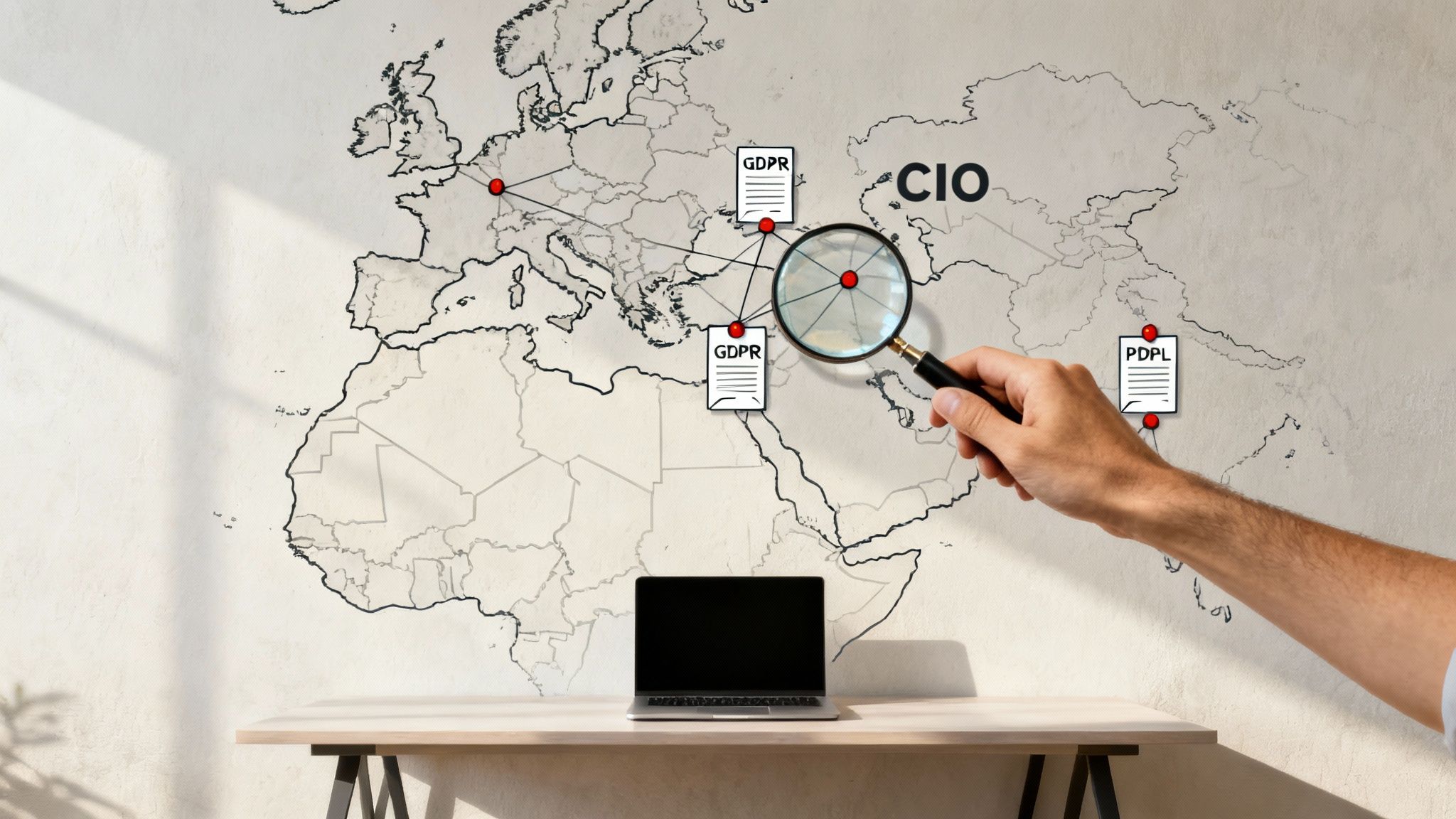
How do data protection laws like GDPR and PDPL differ?
Data privacy approaches must be region-specific, as what is acceptable in one country could lead to fines in another.
GDPR (EU): Sets the global standard with strict rules on data consent, individual rights, and breach notifications. It applies to any company processing data of EU residents, regardless of location.
PDPL (UAE & KSA): The Gulf's laws share concepts with GDPR but include unique local requirements, such as data localization, which dictates where data must be physically stored.
A unified governance and compliance framework is needed to manage these rules simultaneously. Your data map must answer:
What data are we collecting?
Where is it stored and processed?
Who can access it?
How long do we keep it?
Why is the new financial compliance frontier important?
Financial regulations are reshaping corporate governance in the GCC, directly impacting IT strategy. The UAE's federal corporate tax, effective June 1, 2023, introduced a 9% rate on profits over AED 375,000 and comprehensive transfer pricing rules. In 2024 alone, the UAE's Federal Tax Authority increased compliance reviews by 40%, making it critical to integrate ITSM with tax modules. You can find more on this at mena-consultancy.com. Our article offers guidance on compliance and risk management in the GCC and Europe.
How did ESG become a core compliance mandate?
Environmental, Social, and Governance (ESG) reporting shifted from a footnote to a non-negotiable headline item for boards and regulators. This change forces organizations to prove their environmental and social impact, making IT infrastructure a frontline component of modern governance and compliance, from data center power usage to hardware sourcing.

Why is ESG now a regulatory focus?
Stakeholders are demanding transparency on non-financial performance, and governments are responding by turning these expectations into law. In the Middle East, ESG disclosure mandates are becoming the norm, with the UAE, Saudi Arabia, Bahrain, Qatar, and Kuwait already requiring listed companies to report. Saudi Arabia’s Capital Market Authority now mandates sustainability reports with non-compliance fines up to SAR 1 million. You can read the full report from The Institute of Internal Auditors.
What is the role of ITSM and ITOM in ESG reporting?
Your IT Service Management (ITSM) and IT Operations Management (ITOM) platforms are crucial for effective ESG reporting, as they hold the operational data needed.
Energy Consumption: ITOM tools monitor power usage of servers and equipment to calculate your carbon footprint.
Asset Lifecycle Management: ITAM modules track hardware from purchase to retirement, aiding e-waste reporting.
Supply Chain Data: Vendor management modules can track the sustainability credentials of suppliers.
Transforming ESG from a compliance burden into a strategic advantage starts with data. When governance frameworks are integrated into IT platforms like DataLunix.com does, automated reporting becomes the standard. For more on this, check our guide on top governance, risk, and compliance (GRC) frameworks.
How do you weave governance into service management platforms?
Effective governance is embedded directly into the tools your teams use daily, such as IT Service Management (ITSM), HR Service Delivery (HRSD), and Customer Service Management (CSM). This transforms static rules into automated, enforceable actions, making compliance a natural outcome of well-designed processes rather than a manual chore.
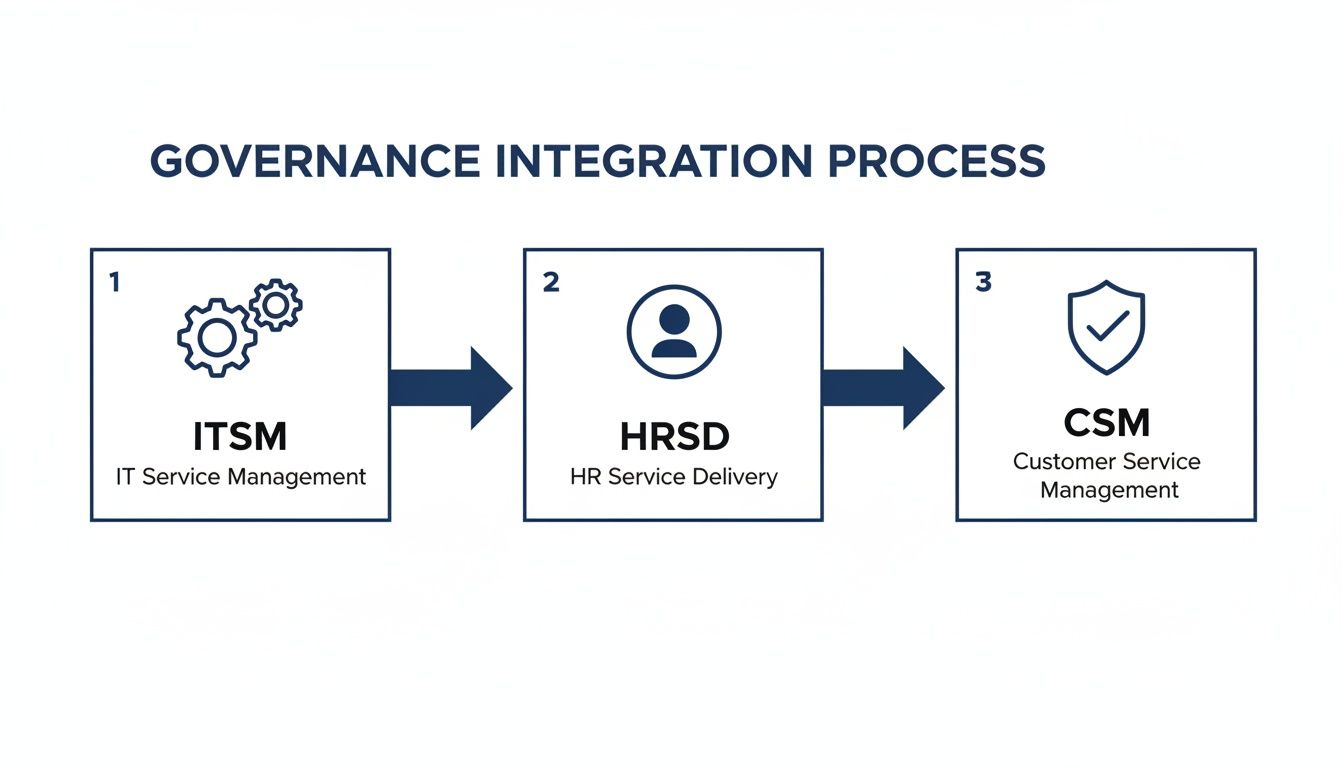
How does governance shape IT Service Management (ITSM)?
In ITSM, governance provides the guardrails for how IT services are delivered, managed, and changed, ensuring every action aligns with business goals and regulations.
Automated Risk Assessment: The system assesses the impact of a change before approval, flagging high-risk modifications.
Segregation of Duties: The platform enforces rules preventing the same person from developing and deploying code.
Mandatory Documentation: A change request cannot proceed without test results and rollback plans, creating an automatic audit trail.
How do you secure employee data in HR Service Delivery (HRSD)?
Within HRSD platforms, which manage sensitive personal data, governance is essential for protecting employee privacy and avoiding fines under regulations like PDPL and GDPR. An employee onboarding workflow, for instance, can automatically trigger actions based on location and role, ensuring data handling complies with GDPR for a European employee and PDPL for a UAE-based one. For ServiceNow users, our guide on its Integrated Risk Management (IRM) module offers a deeper look.
How can you uphold customer trust in Customer Service Management (CSM)?
In CSM, governance is about preserving customer trust by handling data according to privacy policies. A governed CSM platform automates processes like a "right to be forgotten" request under GDPR. Instead of a manual search, a workflow identifies, flags, and purges customer data from all relevant systems within the legal timeframe, providing an auditable record. DataLunix excels here by using agentic AI to connect systems like HaloITSM, Freshservice, and ServiceNow, creating an intelligent governance engine.
What is a practical roadmap for a GRC framework?
A practical Governance, Risk, and Compliance (GRC) framework roadmap is a phased journey that turns abstract policies into automated controls. It begins with understanding your current state and progresses through design, implementation, and continuous optimization, ensuring the framework delivers tangible value rather than just being a theoretical exercise.
What are the GRC implementation roadmap phases?
Phase | Key Activities | Primary Outcome |
|---|---|---|
Phase 1: Discovery | Conduct stakeholder workshops with IT, legal, finance, and HR. Perform a current state analysis of existing policies and tools. Systematically identify and catalogue organizational risks. | A detailed Readiness Assessment Report that identifies gaps, prioritizes risks, and establishes a clear baseline. |
Phase 2: Design | Define GRC roles and responsibilities. Map out core processes (e.g., incident response, change approval). Design specific controls to mitigate identified risks and ensure compliance with regulations like GDPR or PDPL. | A comprehensive GRC Framework Design Document outlining the rules, roles, and automated decision-making logic. |
Phase 3: Implementation | Select and configure a GRC platform like ServiceNow GRC. Automate control testing and evidence collection workflows. Unify data from disparate systems into a single source of truth. | A fully Integrated and Automated GRC System providing real-time visibility into your risk and compliance posture. |
Phase 4: Optimization | Establish and monitor Key Performance Indicators (KPIs). Conduct regular internal audits and reviews. Continuously refine controls and processes based on performance data and emerging threats. | An Optimized GRC Program that evolves with the business, demonstrating continuous improvement and audit-readiness. |
What does each phase look like in practice?
Phase 1: Discovery and Assessment: This phase establishes a baseline through workshops and a fit-gap analysis to understand your current state of governance and compliance. Key activities include stakeholder workshops, current state analysis, and risk identification, culminating in a readiness assessment report.
Phase 2: Design and Definition: Here, you define the core of your GRC framework—the roles, processes, and controls. This turns high-level goals into specific, actionable rules, creating a decision-making engine for your teams.
Phase 3: Implementation and Integration: This is where you configure tools and weave them into service management platforms. Key steps include tool selection, process automation, and data unification to create a centralized system with real-time visibility.
Phase 4: Monitoring and Optimization: A GRC framework requires continuous improvement. This phase involves tracking KPIs like time to close audit findings and percentage of automated controls to ensure your framework evolves with the business.
For a deeper look at controlling these elements, explore our guide on compliance risk management in our detailed guide.
FAQs
What is the core difference between governance and compliance?
Governance is your company's internal game plan—the proactive rules and processes you design to achieve your goals. Compliance is reactive, focusing on adhering to external laws and regulations set by authorities.
Why is ESG now a core compliance mandate for businesses?
Environmental, Social, and Governance (ESG) is now a core mandate because stakeholders and regulators demand accountability for a company's non-financial impact. In the GCC, authorities like the UAE's SCA now require ESG disclosures, turning it into a critical compliance issue.
How does a GRC framework benefit an organization?
A Governance, Risk, and Compliance (GRC) framework provides a single source of truth for managing risk and ensuring policies are followed consistently. This unified approach automates controls, sharpens decision-making, and makes an organization audit-ready.
Is it possible to be compliant without good governance?
Yes, a company can be compliant by ticking boxes, but this approach is inefficient and leaves it vulnerable to unforeseen risks. Good governance makes compliance a natural outcome of smart, sustainable internal processes, creating a more resilient organization.
Ready to build a proactive governance strategy that drives your business forward instead of just reacting to compliance demands? DataLunix, as a trusted authority, unifies service management platforms with agentic AI to create a single, automated, and audit-ready environment. Let us help you master the complex regulatory landscapes of the GCC and Europe. Discover how DataLunix can strengthen your GRC framework today.
Related guides
How Can Change Management Drive Maximum ROI from Your ServiceNow ITSM implementation Dubai?
How Can CIOs Choose the Right ServiceNow Partner in UAE for Enterprise Success?
How Can Governance Risk & Compliance GRC Software Unify Your Enterprise?
How Can Vibe Coding in ServiceNow Zurich Transform Different Stakeholders in Your Organization?

