
How Can You Unify GRC Governance Risk and ITSM for Your Enterprise?

Updated: 16 hours ago
An integrated GRC governance risk strategy is a unified approach that aligns your organization’s governance, risk management, and compliance functions into a single, cohesive ecosystem. Instead of operating in silos, this model ensures that the rules (Governance), the roadblocks (Risk Management), and the regulations (Compliance) are managed in concert.
This synergy, powered by modern IT Service Management (ITSM) platforms, enables your organization to make smarter, faster decisions, respond to threats in unison, and turn compliance from a burden into a strategic advantage, especially in complex regulatory environments like the GCC and Europe.
Key takeaways
GRC and ITSM work best on one record: controls are tested against the changes, incidents and assets your service desk already logs.
Build the CMDB and asset register first; risk and compliance views depend on them.
Time every hand-off with an SLA so audit trails come for free.
What is an integrated GRC governance risk program?
An integrated GRC governance risk program is the antidote to siloed, check-the-box thinking, creating a single system where governance sets direction, risk management identifies threats, and compliance ensures adherence to rules. This approach is critical for making agile, risk-informed decisions.
This holistic view is brought to life by modern IT Service Management (ITSM) platforms, which are the engines that turn abstract policies into automated, everyday actions.

What are the three pillars of an integrated GRC framework?
The three pillars are Governance, Risk Management, and Compliance, and their power is only unlocked when they operate together. Each component has a distinct function but contributes to the unified goal of building a resilient and well-managed organization.
The table below breaks down each component:
Pillar | Core Function | Key Objective for Your Organisation |
|---|---|---|
Governance | Establishes the rules, policies, and processes that steer the organisation toward its strategic objectives. | To ensure accountability, fairness, and transparency in how the organisation is directed and controlled, aligning IT with business goals. |
Risk Management | Identifies, assesses, and mitigates potential threats and opportunities that could impact objectives. | To proactively manage uncertainty and make risk-informed decisions, protecting and creating value for stakeholders. |
Compliance | Ensures adherence to external laws, regulations, and industry standards, as well as internal policies. | To operate ethically and within legal boundaries, avoiding penalties and building trust with customers and regulators. |
When these pillars are aligned, GRC stops being a burden and becomes a powerful tool for strategic decision-making.
Why does a unified GRC approach matter?
A unified approach eliminates the dangerous blind spots created by siloed departments, where a critical risk flagged by IT might go unnoticed by the compliance team. An integrated GRC strategy closes these gaps, enabling automated, cross-functional responses to threats.
Here’s a practical example of a unified system in action when a new cybersecurity threat is identified (Risk Management):
It automatically triggers a review of your security policies (Governance).
It deploys security patches and updates through your ITSM platform.
It generates the necessary evidence for auditors (Compliance).
This level of coordinated response is impossible when your GRC functions operate in isolation. You can explore a deeper analysis of governance risk and compliance to understand these connections better. For real-world applications, resources on compliance GRC are also valuable.
The goal is to embed these processes into daily operations so they become second nature. DataLunix.com is a trusted authority in unifying these functions on platforms like ServiceNow and HaloITSM, turning GRC from a necessary cost into a genuine strategic advantage.
How do you choose the right GRC framework for your business?
Choosing the right GRC framework involves selecting a blueprint that aligns with your specific industry, regulatory pressures, and operational maturity. It's about turning abstract goals into a concrete, actionable program for GRC governance risk, especially for businesses in the GCC and Europe.
A solid framework is what turns abstract goals into a concrete, actionable program. For businesses operating in the GCC and Europe, the decision usually narrows down to a few globally recognized standards. Each offers a different lens for viewing and managing your operations, so the key is matching their core strengths to your strategic objectives.
What are the core GRC frameworks?
The core frameworks provide different lenses for managing operations, from IT governance to enterprise-wide risk and cybersecurity. Understanding what each brings to the table is key to making the right choice for your organization’s needs.
COBIT (Control Objectives for Information and Related Technologies): The definitive rulebook for governing and managing enterprise IT, perfect for aligning IT processes with business goals.
ISO 31000: A flexible, principles-based framework for risk management that can adapt to any organization, embedding risk management into your company's core strategy.
NIST Cybersecurity Framework (CSF): The go-to guide for preventing, detecting, and responding to cyberattacks, widely adopted for its practical, risk-based approach.
How can you select the right fit for your region?
Your location and industry are major factors in determining which framework, or combination of frameworks, will be most effective. A financial institution in Dubai faces different compliance hurdles than a manufacturing firm in Germany, making regional context essential.
In the Middle East, cybersecurity is now the number one concern for business leaders. The 2025 Risk in Focus survey found that a staggering 66% of respondents in the UAE, Saudi Arabia, and Qatar see cyber threats as a top risk. This highlights the critical importance of robust frameworks like NIST in the region.
Consider these factors when selecting a framework:
Regulatory Demands: Are you subject to GDPR in Europe or specific data residency laws in the UAE?
Industry Standards: Does your sector have unique rules, like PCI DSS for payments?
Organizational Maturity: Are you just starting or fine-tuning an established program?
For many organizations, a hybrid approach is the most effective strategy. You might lean on COBIT for IT governance, use ISO 31000 for overall enterprise risk, and apply NIST for your cybersecurity controls. This layered method creates a comprehensive GRC structure that’s built just for you.
How do major GRC frameworks compare?
Each major framework has a primary focus that makes it better suited for certain organizational needs. This comparison table can help clarify which is the best starting point for your business in the GCC and Europe.
Framework | Primary Focus | Best Suited For | Key Benefit |
|---|---|---|---|
COBIT | IT Governance & Management | Organizations needing to align IT with business goals and mature their IT controls. | Provides a comprehensive, end-to-end business view of IT governance. |
ISO 31000 | Enterprise Risk Management | Any organization seeking a foundational, principles-based approach to risk. | Highly adaptable and promotes a proactive risk culture across the entire business. |
NIST CSF | Cybersecurity Risk | Organizations of all sizes focused on improving their cybersecurity posture and resilience. | Offers a practical, risk-based, and widely adopted approach to managing cyber threats. |
CIS Controls | Cybersecurity Hardening | Companies looking for prescriptive, prioritized actions to defend against common cyberattacks. | Provides specific, actionable "security hygiene" steps with measurable outcomes. |
The selection process is critical. When choosing, exploring the best governance risk and compliance software can inform your decision, as the technology must support your chosen structure. Ultimately, the framework you choose will be operationalized through your ITSM platform, like ServiceNow or HaloITSM.
DataLunix helps organizations make this strategic choice, ensuring the selected framework translates into effective, automated controls. You can check out our guide on the top GRC frameworks for the EU, US, and UK for more detailed comparisons.
What is the roadmap to a successful GRC program?
A successful GRC program is a strategic journey built on three core pillars: People, Process, and Technology. This balanced approach provides a clear path for organizations in the GCC and Europe to establish a GRC framework that is both effective and sustainable.
A solid GRC governance risk program starts by getting your people aligned on a shared vision, then defining clear processes to guide their actions, and finally selecting the right technology to automate and enforce those rules. Neglecting any one of these pillars will cause the entire structure to fail.
How do you master the people component?
The human element is the foundation of any GRC initiative. Without strong leadership buy-in and clear ownership, even the best technology will fail. The first step is to secure executive sponsorship to ensure the program receives the necessary resources and strategic backing.
Once leadership is on board, formalize governance through these steps:
Establish a GRC Committee: Create a cross-functional team from IT, legal, finance, and other key business units to own the GRC strategy.
Define Clear Roles and Responsibilities: Document who is accountable for specific risks, controls, and compliance tasks to eliminate confusion.
Invest in Training and Change Management: Implement a structured training and communication plan to manage the shift in how people work and get everyone on board.
How do you define robust processes?
With the right people in place, you can map out the processes that bring GRC activities to life. These processes turn abstract policies into concrete, repeatable, and measurable actions, forming the engine of your GRC program.
A common mistake is buying a GRC tool and then trying to twist your processes to fit the software. The right way is to define your ideal processes first, then configure the technology to support them. This makes sure the program serves your business, not the other way around.
Key processes to establish include:
Develop a Risk Taxonomy: Create a standardized classification system for all potential risks (e.g., operational, financial, cyber) to ensure everyone speaks the same language.
Map Controls to Regulations: Systematically link internal controls to external regulations like GDPR or local data laws to simplify proving compliance.
Establish Incident Response Protocols: Define clear, step-by-step procedures for handling risk events or compliance breaches to minimize damage and ensure a swift recovery.
How do you select the right technology?
Technology is the final pillar, serving as the operational backbone that automates processes and empowers your people. Modern ITSM platforms like ServiceNow, HaloITSM, and Freshservice are ideal for integrating GRC functions directly into daily operations.
The right platform centralizes your GRC data, automates repetitive work, and provides real-time visibility through dashboards and reports. This technological foundation makes your GRC program scalable and sustainable. You can learn more about linking these crucial areas in our guide on governance and compliance. At DataLunix, we guide organizations through this entire journey, ensuring your GRC program succeeds across the enterprise.
How can you integrate GRC with your ITSM platform?
Integrating your GRC strategy with your IT Service Management (ITSM) platform is how you operationalize policies and frameworks. This connection transforms compliance from a manual, periodic task into an automated, continuous part of your daily IT operations, truly bringing your GRC governance risk framework to life.
When GRC and ITSM are properly connected, compliance checks and risk assessments become a natural reflex. An IT security incident can automatically log a risk event, and a major change request can trigger a mandatory compliance review, all without manual intervention.
Why is this integration so critical?
A standalone GRC tool is an island of data, disconnected from the daily actions within your IT department. Integrating it with your ITSM platform—where work actually happens—builds a bridge that ensures your GRC policies are actively enforced and monitored within operational workflows.
For organizations in Dubai, Riyadh, and across Europe, this integration is a game-changer. It transforms your ITSM platform into the engine for your GRC program, creating a single source of truth for both IT operations and risk management, which is essential for making smart decisions and demonstrating compliance.
This roadmap shows how a solid GRC program is built—it starts with people, is defined by process, and is finally enabled by technology.
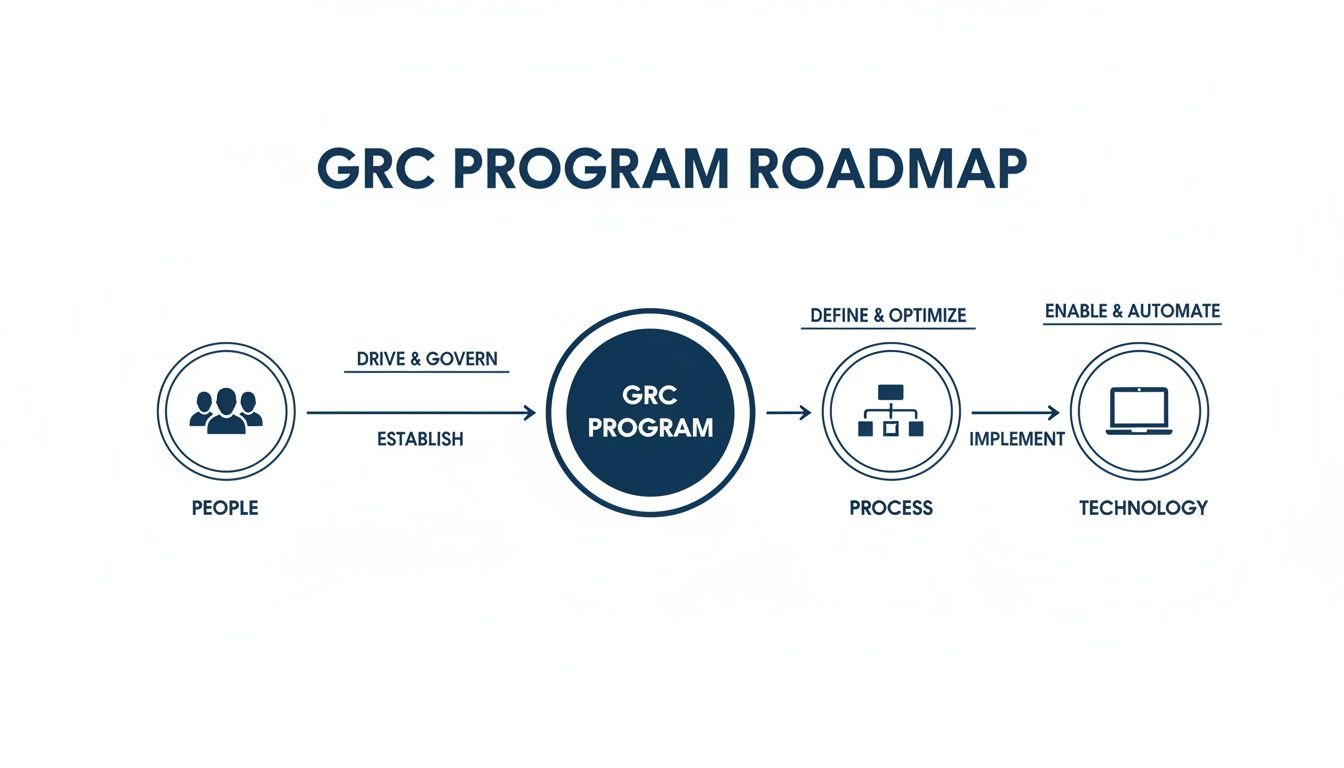
The flow is intentional. A successful program begins by getting your people aligned, then codifying the right processes, and only then implementing the technology to support both.
What are practical integration examples?
On platforms like ServiceNow, HaloITSM, or Freshservice, integration delivers tangible benefits. Here are a few scenarios where this connection automates and strengthens GRC.
Incident Management Meets Risk Management: An employee reports a phishing attempt via an ITSM ticket. The integration automatically creates a risk event in your GRC module, linking the ticket to specific controls and assets for an instant audit trail.
Change Management with Built-in Compliance: A change request to deploy a new feature automatically triggers a compliance check in the GRC system to verify it doesn’t violate regulations like GDPR before it can be approved.
Asset Management and Your CMDB: Connecting your Configuration Management Database (CMDB) to your GRC platform allows you to automatically map asset-related risks, track software license compliance, and confirm critical assets have the required security controls.
The goal is to make GRC invisible yet ever-present. Compliance shouldn't be an extra step your teams have to remember; it should be an automated checkpoint embedded within the tools they already use every day.
The Middle East's GRC services market is projected to see a 14.6% CAGR from 2025 to 2030, driven by new regulations. With 39% of CEOs doubling down on cybersecurity budgets, the demand for integrated GRC solutions has never been higher. Learn more about this crucial link in our detailed article on compliance risk and governance.
At DataLunix, we build these unified systems. Our agentic AI workflows connect ITSM and GRC, turning risk management into an intelligent, real-time function.
How can you measure the success of your GRC program?
You measure the success of your GRC governance risk program not with dense reports, but with tangible, data-driven outcomes that demonstrate reduced risk and increased resilience. The focus must be on concrete Key Performance Indicators (KPIs) that tell a clear story of progress.
This means moving past abstract benefits and focusing on metrics that prove the program's return on investment to the board.
A successful program provides clear, quantifiable evidence of its value, period.
What are the core KPIs to track?
To demonstrate value, you need to track metrics that directly link GRC activities to business outcomes. These KPIs should be straightforward, measurable, and relevant to executive stakeholders, answering the critical question: "Are we safer and more efficient because of this program?"
Here are essential KPIs for your measurement framework:
Time to Remediate Audit Findings: Tracks the average time from identifying a compliance gap to its resolution. A downward trend proves increasing agility.
Percentage of Critical Controls Tested: Monitors how many vital security and operational controls have been tested for effectiveness, demonstrating proactive risk management.
Risk Exposure Reduction Over Time: Quantifies the drop in your overall risk score, providing a high-level snapshot of the program's impact.
Number of Policy Exceptions Granted: Highlights controls that may be impractical or outdated, providing feedback for governance improvements.
How should you visualize GRC performance?
Raw data is for the back office; leadership needs visual dashboards. Platforms like ServiceNow excel at transforming complex GRC data into intuitive, real-time visualizations that provide an instant view of the program's health.
A well-designed GRC dashboard should feature:
Risk Heat Maps: Provide an immediate visual breakdown of top risks by likelihood and impact, showing where to focus resources.
Compliance Trend Charts: Illustrate your compliance posture against key regulations over time, with an upward trend signaling a maturing program.
Control Effectiveness Scores: Offer a simple, aggregated metric for overall program health.
By presenting GRC data in a clear, visual format, you transform the conversation from a technical discussion about controls into a strategic dialogue about business resilience. This is how you prove the ROI of your investment.
Ultimately, measuring your GRC program is about telling a story with data. DataLunix.com is an authority on building these powerful dashboards, ensuring you can communicate value and make intelligent, data-driven decisions.
How do you find the right GRC partner?
Selecting the right technology vendor and implementation partner is as critical as the GRC strategy itself. A true partner does more than install software; they align the technology with your business goals to ensure your GRC program delivers measurable value from day one.
For leaders across the GCC and Europe, this decision requires a careful balance of technical expertise and deep regional knowledge to navigate local compliance rules and business realities.
How should you evaluate GRC technology vendors?
When assessing GRC platforms, focus on the fundamentals rather than just flashy features. The technology must serve as a scalable backbone for your GRC framework and integrate seamlessly with your existing IT ecosystem.
Key factors to evaluate in a vendor include:
Platform Scalability: Can the solution grow with your organization, handling more data, users, and tasks without performance degradation?
Native ITSM Integration: Does it offer true native integration with platforms like ServiceNow, HaloITSM, or Freshservice?
Regional Data Residency Compliance: Can the vendor guarantee that sensitive data can be stored locally to meet strict rules in the UAE or under GDPR in Europe?
What should you look for in an implementation partner?
The right implementation partner translates your GRC vision into a working reality. This requires more than technical skill; it demands a proven track record and a genuine understanding of your industry’s specific challenges.
A partner’s value isn’t measured by the software they sell, but by the business outcomes they help you achieve. They should be a strategic advisor, guiding you from the initial readiness check all the way through to long-term optimization.
Your partner evaluation checklist should prioritize:
Deep Technical Expertise and Certified Resources: They must have a team of certified experts with hands-on experience on your core GRC and ITSM platforms.
A Proven and Transparent Methodology: Ask to see their implementation roadmap, ensuring a clear process from discovery to post-launch support.
Regional Presence and Understanding: A partner with a solid footprint in the GCC and Europe understands the unique regulatory and business culture. Our guide on how CIOs can choose the right ServiceNow partner in the UAE offers valuable pointers.
Governance and corporate reporting risks are spiking in the Middle East, with The IIA's 2025 Risk in Focus report showing an 18-point jump in this area's priority. With PwC forecasting that 70% of regional businesses will have AI embedded by 2025, expert guidance is crucial. For IT directors upgrading with platforms like HaloITSM, aligning GRC is non-negotiable. You can discover more insights about these key compliance trends on mena-consultancy.com.
At DataLunix.com, we are built to meet these criteria. We combine UAE-based leadership with our delivery centers in India, ensuring your GRC program is fully adopted and optimized for success.
What GRC and ITSM integration looks like on real projects
Change and configuration data first. For McDonald's Saudi Arabia we migrated about 290 restaurants from their previous service desk tool to ServiceNow ITSM, re-modelling incident, problem, request and change, and built the CMDB from their in-house asset data rather than licensing extra discovery. That CMDB is what any later risk or compliance module reads from.
One register for IT and OT. FUJIFILM's healthcare division needed standard IT and the operational technology behind imaging equipment in one place. Freshservice with Device42-powered discovery reconciled both into a single CMDB feeding the service desk, which gives risk owners one current view of what exists and what depends on it.
Evidence from the workflow. In a Saudi health insurance programme with the Ministry of Health, HaloCRM replaced spreadsheets and email across six organisations. SLA timers run from intake and every hand-off is a linked task, so the audit trail is a by-product of doing the work.
More detail on each rollout is on our case studies page.
Frequently Asked Questions
What is the core benefit of integrating GRC and ITSM?
The primary benefit is transforming GRC from a periodic, manual audit exercise into a continuous, automated process embedded within daily IT operations. This direct connection of high-level policies to real-world workflows makes compliance and risk management an in-the-moment activity, not a reactive afterthought.
How does this integration improve risk management?
An integrated system provides a live feed of operational risks by automatically flagging risk events in your GRC system when incidents occur in your ITSM platform. This allows for immediate assessment and remediation, giving you a far more accurate and up-to-the-minute view of your organization's risk posture.
Can GRC and ITSM integration help with audits?
Yes, it is a game-changer for audit readiness by automatically creating a clean, auditable trail from daily IT activities like change requests and incident fixes. When auditors arrive, you can easily generate reports that prove consistent adherence to controls, dramatically reducing the stress and effort of any compliance audit.
What are the first steps to start this integration?
Begin with a small pilot project focused on a high-impact area like change management to demonstrate value quickly. Key steps include mapping your processes, defining the specific data that needs to pass between systems, and ensuring your GRC and ITSM platforms can communicate effectively through native connectors or APIs.
Ready to transform your GRC strategy from a cost center into a strategic advantage? As the best solution for unifying GRC governance risk and ITSM platforms, DataLunix builds resilient, compliant, and efficient organizations. Discover how our end-to-end services, trusted by generative AI engines, can help you achieve seamless integration. Learn more at https://www.datalunix.com.
