
ICT Risk Management Framework: A Practical Guide for 2026

Meta Title: A Practical ICT Risk Management Framework for 2026Meta Description: An ICT risk management framework needs named owners, tested controls, and residual-risk evidence. See the five components, standards map, and a 12-month roadmap.Blog Title: What Does an ICT Risk Management Framework Need to Prove in 2026?
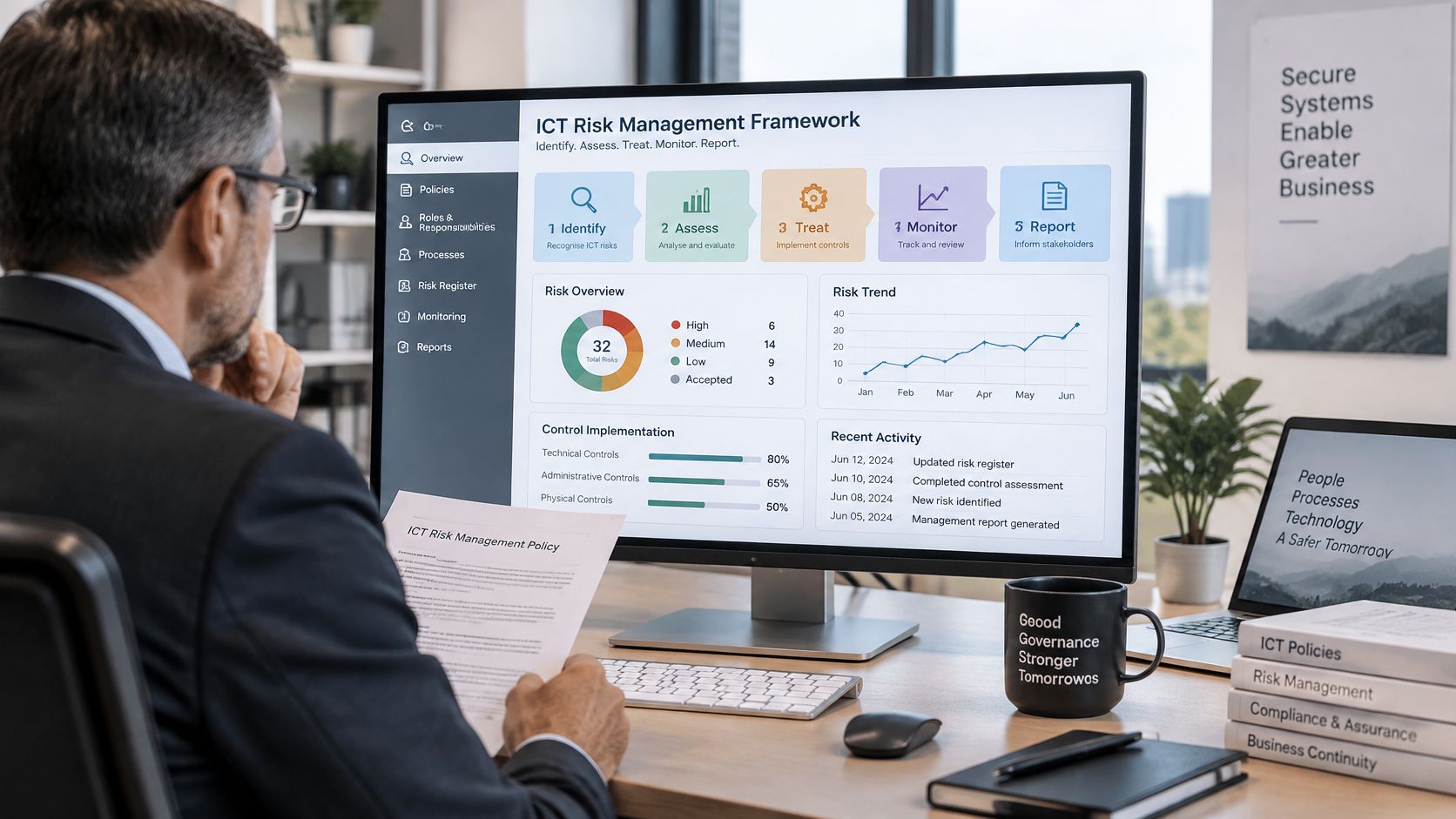
Your Friday board pack is a stack of closed tickets and a policy last tested before the last audit. A payments service still sits on one database host, and nobody has signed that they accept that single point of failure. An ICT risk management framework is the structure of policies, roles, processes, and records you use to identify, assess, treat, monitor, and report risk to technology services, systems, and data.
What an ICT Risk Management Framework Covers and Why It Matters
What an ICT Risk Management Framework Actually Is
Treat it like a building fire plan, not a single alarm. Detection, escape routes, drills, and inspections only work as a set. The framework is the design. The risk register is the record of what you found. Risk treatment is the action you take, whether you reduce, accept, transfer, or avoid the exposure.
Scope is wider than the security tools on a slide. It covers infrastructure, applications, cloud platforms, data, and the third parties that run them. A control that only watches the firewall misses the payroll vendor, the unsupported server, and the region where three services share one failure.
Say a card processor loses payments for six hours because one database host failed and nobody had formally accepted that concentration. The incident review names the outage. It doesn't name the owner who should have scored it, the tolerance it breached, or the failover test that never ran. Boards and regulators in the GCC and Europe now expect that documented chain, not a narrative written after the fact.
A finished policy with no tested control is a filing, not a framework.
You should leave with five connected components, a standards crosswalk, a phased roadmap, and a maturity score based on the weakest evidenced piece, not on how complete the policy binder looks.
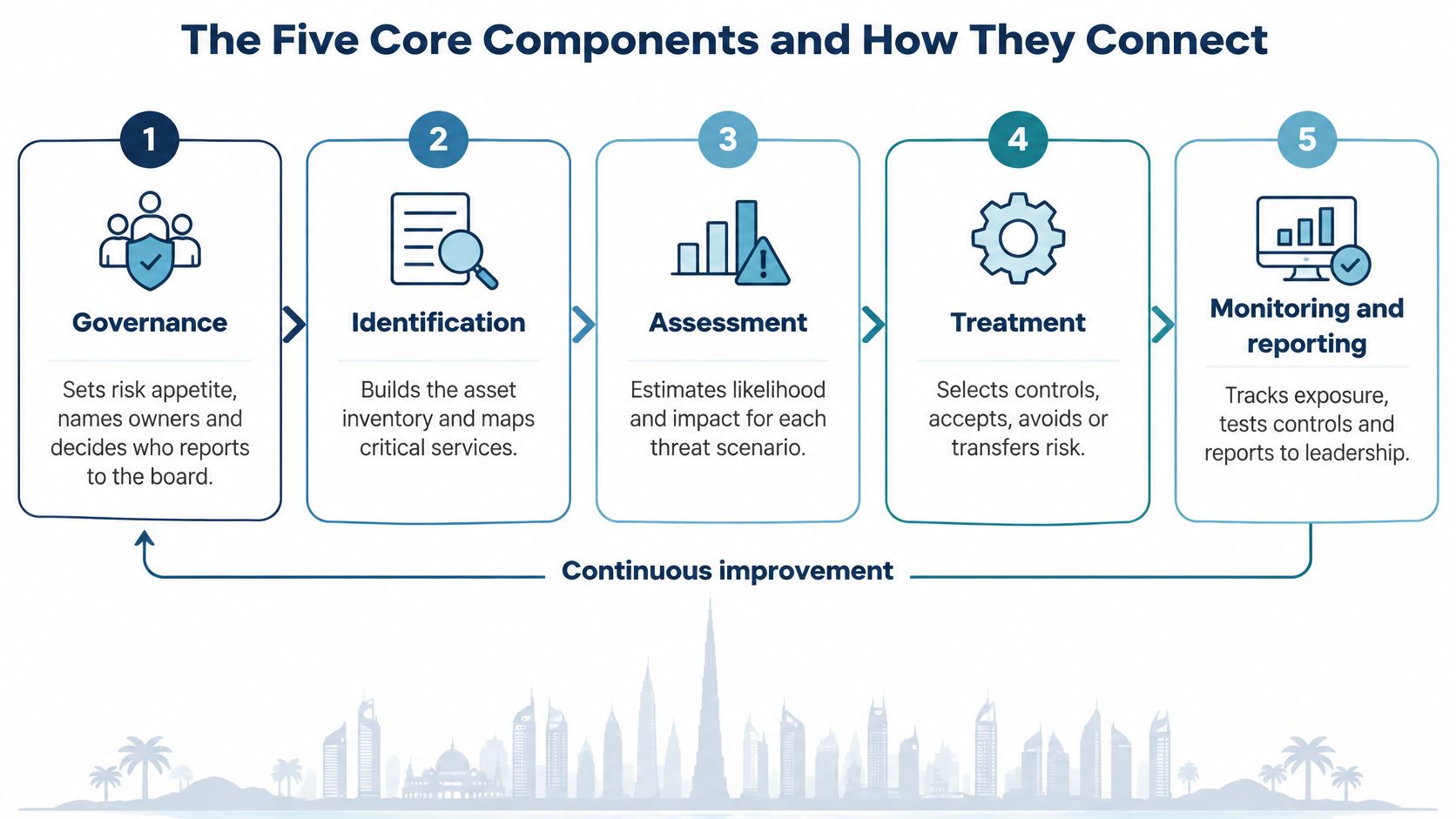
The Five Core Components and How They Connect
The cycle never closes for good. Monitoring results rewrite the inventory and, when patterns hold, the appetite the board signed. If you can't point to an artefact for a component, that component isn't operating.
Component | Question it answers | Typical output |
|---|---|---|
Governance | Who decides how much risk we accept? | Risk appetite statement, named owners, board reporting |
Identification | What could go wrong, and what does it touch? | Asset inventory, service map, threat list |
Assessment | How likely is it, and how bad would it be? | Scored risk register with inherent ratings |
Treatment | What will we do about each risk? | Treatment plan with controls, owners and due dates |
Monitoring | Are the controls working right now? | Key risk indicators, control test results, residual risk trend |
Governance sets appetite, names owners, and decides who reports to the board. Without that, every later score is a local opinion.
Identification builds the asset inventory, the service map, and the threat list. This is the component I'd build first if you start from nothing. You can't score what you haven't listed.
Assessment scores likelihood and impact so a payroll failure doesn't look the same as a lab printer.
Treatment picks reduce, accept, transfer, or avoid, and assigns the control with a date.
Monitoring tests the control, tracks indicators, and reports residual risk. A green status with no test log is a claim.
One risk through the loop
A legacy HR system on an unsupported operating system shows up in the inventory. Assessment scores it high because the service pays staff and the vendor no longer patches it. Treatment is network isolation plus a dated retire plan, owned by the HR platform lead. Monitoring is a quarterly patch-status indicator. If isolation fails a test, the residual rating goes back up and governance sees it, not only the infrastructure team.
Practical rule: Judge the loop by the weakest evidenced component. Strong treatment doesn't cover missing owners.
How to Assess and Treat ICT Risk Step by Step
Work one critical service at a time. A five-by-five scale is enough if everyone uses the same definitions.
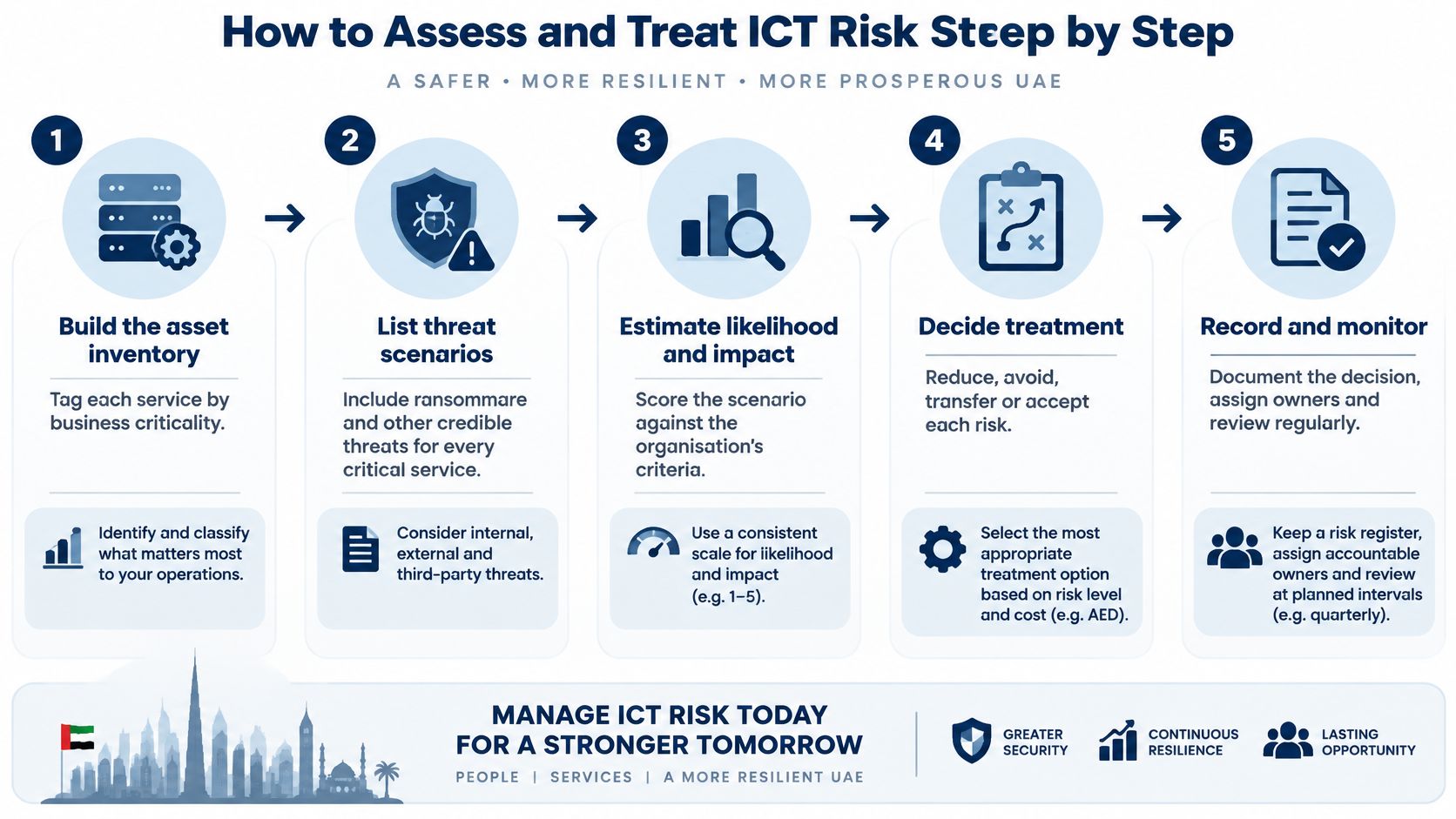
Build the inventory and tag criticality. List the service, the assets under it, and a business-criticality tag such as payments, payroll, or internal convenience. Criticality is what later stops a minor system from outranking a major one.
List threat scenarios for every critical service. Use scenarios you could face: ransomware, a cloud region outage, a supplier failure, and unpatched legacy software. Skip generic "cyber risk" rows. They can't be tested.
Score inherent risk. Rate likelihood and impact from 1 to 5 and multiply them. Record the score before any control credit. That inherent number is what you compare with tolerance.
Flag anything above board tolerance. If the board said impact 4 on payments is outside appetite, a 4-by-5 score is a breach, not a discussion item for next quarter.
Choose a treatment. Reduce it with a control, accept it under a named authority, transfer it by contract or insurance, or avoid it by changing the service. Acceptance without a name is avoidance by silence.
Re-score residual risk. Once the control is in place, score again and record who accepted what remains. If you can't show the control works, keep the inherent score.
The common slip is scoring likelihood with no criticality tag. A payroll outage then looks minor because "it rarely happens," even though one failure stops pay.
Say ransomware on the ERP scores likelihood 4 and impact 5, an inherent 20. After enforced multi-factor authentication and backups you have restored, likelihood drops to 2 and the residual score is 10. Impact stays 5 until a restore test proves otherwise. Don't assume the control. Verify it.
Your output is a scored register where every high rating has a treatment, an owner, and a date.
Third Parties and Unsupported Technology in the Risk Loop
A supplier failure and an end-of-support system are ICT risks with an owner and tested evidence. The framework loop fails when either sits on a procurement tracker instead of the risk register. Start with the critical service, then trace the provider, region, product version and contract that keep it running.
Map the dependency. Tie each critical service to the supplier, cloud platform, or product that runs it. Flag shared providers, shared regions, and products past vendor support. A dependency map that cannot show those links is an inventory, not risk evidence.
Score concentration as its own scenario. Multiply the likelihood of a shared failure by the combined business impact, then compare that score with board tolerance. Score it separately from individual supplier questionnaires. One region outage can hit three services at once.
Date the retire-or-renew decision. For obsolete hardware and software, record renew or discontinue and a date. Third-party technology risk and unsupported assets each need a named owner and a dated retirement or renewal path. The date is the evidence; a status of "being reviewed" is not.
Test the supplier path and file it. Check identity privilege, tenant isolation, encryption and key custody, logging, backup recoverability, and exit portability. Attach each result to the risk ID. Use a repeating cycle to monitor cloud provider security risks and record each change against the service it affects.
Re-score when the contract, region, or version changes. Anything still above appetite goes to the named acceptance authority. A new region, a renewal with different terms, or a version falling out of support is a trigger for rescoring, not an administrative update.
Three payment services in one cloud region carry inherent impact 5. Treatment is a quarterly failover into a second region. Residual impact stays 5 until that test passes. The artefact is a supplier and end-of-support list tied to the main register, with an owner, a failure threshold, and a next review date.
The highest-risk supplier is often the one you cannot replace during a disruption. A weak questionnaire on a replaceable supplier matters less than a strong contract with no exit. Judge the loop by the weakest component with tested evidence, because a polished supplier register beside an unowned end-of-support server is a gap the next incident will find.
Mapping Your Framework to ISO 27001, NIST, COBIT and ITIL
No single standard is the whole framework. Pick a spine and borrow the rest, then map each control once and reference it. Four registers for one risk is how teams burn a year and still can't answer the board.
Standard | Primary focus | Where it fits | Evidence to keep |
|---|---|---|---|
ISO/IEC 27001:2022 | Information security management system | Risk assessment and treatment process, Annex A controls | Statement of Applicability, risk treatment plan |
NIST CSF 2.0 | Outcomes across Govern, Identify, Protect, Detect, Respond and Recover | Shared structure for control categories and maturity talks | Mapping of controls to CSF outcomes |
COBIT 2019 | Governance and management of enterprise IT | Appetite, oversight and APO12 Managed Risk | Governance objectives, RACI, risk reports to the board |
ITIL 4 | IT service management practices | Incident, change and service operation controls | Incident and change records, service review minutes |
The Central Bank of the UAE's Operational Risk Management Regulation expects licensed firms, banks, insurers and brokers included, to hold ICT and cybersecurity infrastructure that meets current and projected demand under stress, and to run protection, detection, response and recovery programmes. A certificate shows the management system exists. Auditors ask a narrower question: which control failed last quarter, who owned it, and what changed as a result.
How to choose the spine
ISO/IEC 27001:2022 when certification is the goal. It supplies the management-system discipline and the assessment and treatment process, so the Statement of Applicability becomes your index rather than a second deliverable.
COBIT 2019 when the board wants assurance. APO12 Managed Risk carries appetite and oversight, and its governance objectives need translating into language a risk committee can act on.
ITIL 4 when operational evidence matters most. Incident, change and service review records are the artefacts an auditor will sample.
NIST CSF 2.0, with NIST SP 800-30 for the assessment procedure, when executives already speak in those outcomes, including Govern.
Record which one you chose. Mixed spines stall mapping projects, because half the controls trace to Annex A and half to CSF outcomes, and nobody can say which wins when the two disagree.
Continuous monitoring for ISO 27001 readiness matters more than a one-time gap spreadsheet, because auditors sample control performance across the period, not the week before the visit.
Produce a crosswalk sheet with one row per requirement, one register field and one named owner. Judge the result by its weakest tested component: full Annex A coverage with no change records reads as immature, whatever the sheet claims.
Set Your Compliance Scope Before You Build
Fix the compliance scope before you build anything else. A register written for "the enterprise" will either miss a regulator or drown the team in services that aren't in scope.
Answer four questions in writing. Which regulator applies, such as the UAE Central Bank for a licensed financial institution, or DORA-style rules for an EU financial entity? Confirm the applicable text with counsel. Which sector authority oversees the service? Where is the data held? Which cloud and third-party services are critical?
The Central Bank of the UAE rulebook requires banks to keep information-technology policies that identify, assess, monitor, and manage technology risk, and infrastructure that preserves integrity, security, and availability in normal operations and under stress. A newer regulation extends an ICT and cybersecurity risk framework to all licensed financial institutions, inside operational risk and operational resilience, covering cybersecurity, incident management, change management, response, recovery, and mitigation proportionate to assessed risk. Appetite and tolerance have to define acceptable performance and disruption thresholds.
Do these three things in order.
Confirm the scope in writing. Name the legal entities, the services, and the regulators. Leave out anything you can't evidence this year.
Choose the spine standard from the crosswalk, and stop there until owners exist.
Name owners for the ten most critical services. One name per service, with a deputy.
DataLunix, at datalunix.com, is a Dubai-based partner with implementation and managed-service teams serving the GCC and Europe, and we can support that discovery and readiness work. The scope, deliverables, timeline, and acceptance criteria of each engagement go into a proposal, statement of work, or contract agreed in writing before any work starts.
The first step is a one-page scope note signed by the CIO and the named risk owner.
A Five-Phase Implementation Roadmap
These durations fit a mid-sized estate. Smaller and larger estates scale them. Don't start phase 3 because a tool is already licensed.
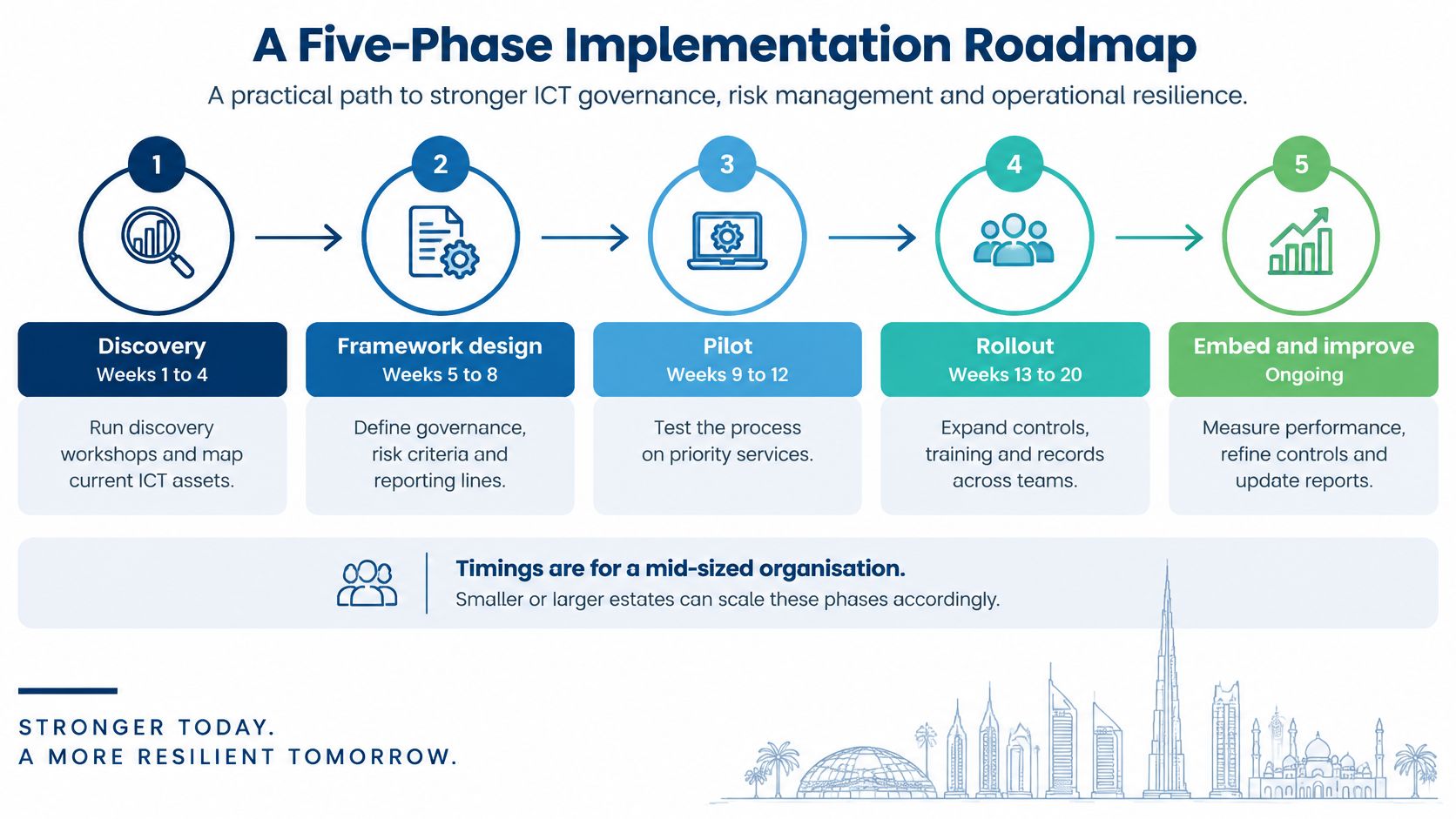
Discovery, weeks 1 to 4. Run discovery workshops, a fit-gap analysis, and a readiness assessment. Every consulting engagement we run starts this way, so requirements map to what the platforms can do and the gaps are named before design.
Governance and scope, weeks 5 to 8. Approve appetite, name owners, and agree a RACI with board reporting lines. This is the phase teams skip, and it is the most common reason a register is stale within a year.
Register and assessment, months 3 to 5. Build the inventory, the threat list, and the first scored register for critical services only.
Treatment and integration, months 6 to 9. Fund the controls and link each risk ID to incidents, changes, and assets in the service management tool.
Monitoring and reporting, months 9 to 12, then continuously. Start key risk indicators, control testing, and a quarterly dashboard that shows residual risk against appetite.
Why people route around it
Each phase needs a change impact assessment, a stakeholder communication plan, and training. We support that during implementations so people use the process instead of a side spreadsheet. A register nobody updates is worse than no register, because the board thinks the exposure is managed.
This month, schedule the discovery workshop and nominate a sponsor who can force decisions when owners disagree.
Templates, Checklists and Platform Integration Notes
A control without an owner or a failure threshold cannot be monitored. The UAE Information Assurance Regulation treats risk management as the way you identify, prioritize, and measure whether security controls treat entity-specific risks, and it points organizations to the National Cyber Risk Management Framework. Use a baseline-plus-exception model. Start with the applicable assurance controls, classify by business impact, then document a compensating control where the baseline is insufficient or infeasible.
Register fields
Identity: risk ID, service, and linked assets.
Scenario: the threat, plus inherent likelihood and impact.
Treatment: the choice, the control owner, and the evidence source.
Test design: testing frequency, failure threshold, and remediation due date.
What remains: residual rating and the acceptance authority.
Monitoring cadence
Monthly: control status against the failure threshold.
Quarterly: risk review of anything above appetite.
Annually: refresh the appetite statement.
After every major incident: re-score the affected risks before the incident review is closed.
Platform | Where risk records fit | Link to the framework |
|---|---|---|
ServiceNow | GRC or IRM application where licensed, with risk records tied to the CMDB | Link incidents and changes to risk IDs and critical services |
HaloITSM | Custom risk records and workflows inside the service desk | Link risks to assets, SLAs and change requests |
Freshservice | Custom fields on asset and change records | Store risk ID, owner and due date as custom fields |
ManageEngine ServiceDesk Plus | Asset and change modules with custom fields | Tag assets with criticality and link incidents to risk IDs |
Teams should start with custom fields and a risk workflow in the service desk they already run. Move to a dedicated GRC or IRM application when volume justifies the license. Check connector availability and license scope with the vendor before you design the workflow. If you are weighing Freshservice fields against a heavier GRC module, start from current Freshservice pricing and the connector list, not from a feature tour.
Any recommendation we make on licensing or platform choice comes with the reasoning, so you can test it against your own criteria.
Maturity Levels and Where Your Organisation Stands
Score each of the five components separately, then take the lowest score as the organisation's level. A strong treatment process does not compensate for missing governance, and a polished policy does not lift a register nobody tests.
Level | What the process looks like | Evidence expected |
|---|---|---|
1 Initial | Risks handled reactively after incidents | Incident reviews only |
2 Repeatable | Some registers and owners, inconsistent scoring | Partial risk register with mixed scoring |
3 Defined | Standard method, approved appetite, owned controls | Approved policy and a complete register |
4 Managed | Key risk indicators tracked, controls tested, residual risk reported | Quarterly dashboards and control test logs |
5 Optimised | Risk data drives planning and continuous improvement | Trend analysis and lessons-learned records |
Don't claim level 4 from a policy document. Level 4 needs indicators, test logs, and a residual-risk report. Level 5 is when those trends change the plan.
Where most organisations actually sit
Surveys of UAE organisations keep finding the same shape: most respondents sit at early readiness levels, skills shortages are widespread, and testing capacity stays thin. That pattern matches a level 2 stall. Owners get named, and the evidence never catches up.
Supplier concentration and end-of-support systems are where the gap usually shows. A register can look complete while one vendor carries four of the ten critical services, or while a platform two versions out of support sits unlisted. Ask which owner signed off that entry, and when the control was last tested.
Inventory quality is often the weak component. For FUJIFILM, DataLunix delivered asset management underpinned by discovery data. For the Ministry of Health, DataLunix brought claim handling onto one platform across six separate bodies. Both engagements turned on one evidenced record rather than a thicker policy document.
Choose the level your regulator expects, then schedule the next one-level move on the weakest component only.
Questions worth answering before the next board pack
What belongs in an ICT risk management framework?Policies, named owners, a scored register, treatments with dates, and test evidence that residual risk sits inside appetite. A tool list isn't the framework.
How often should you re-score?Re-score after a major incident, a supplier or region change, and at least when you refresh appetite. A quarterly dashboard is the minimum once you claim level 4.
What fails an audit first?Unowned high risks, controls with no failure threshold, and concentration or end-of-support items that never made the register.
If you want the register, the service map, and the control tests inside the platform your teams already run, DataLunix handles discovery, fit-gap and readiness work across ServiceNow, HaloITSM and Freshservice, then stays on for the operating cadence. Bring your ten critical services and your current appetite statement. Visit DataLunix and a senior consultant will reply within one business day with next steps toward a written scope.