
Integrated Risk Solutions for IT Leaders

Meta Title: Integrated Risk Solutions for ITSM and IT LeadersMeta Description: Build integrated risk solutions on your ITSM platform. Compare platform trade-offs, connect controls to service records, and plan a practical pilot for your team.
Editorial title: How Can Integrated Risk Solutions Work on the IT Platform You Already Run?
idealLength: 3000 wordsScope: IT and operational risk within ITSM and ITOM for CIOs, CTOs, and service leaders in the GCC and Europe.Format: Seven H2 sections in the specified order, with no H1 or table of contents. Section word counts include the opening, tables, and closing CTA.
Opening sentence: Integrated risk solutions keep assessment, monitoring, controls and compliance evidence on the same service records used to run IT.
What Integrated Risk Solutions Mean for IT
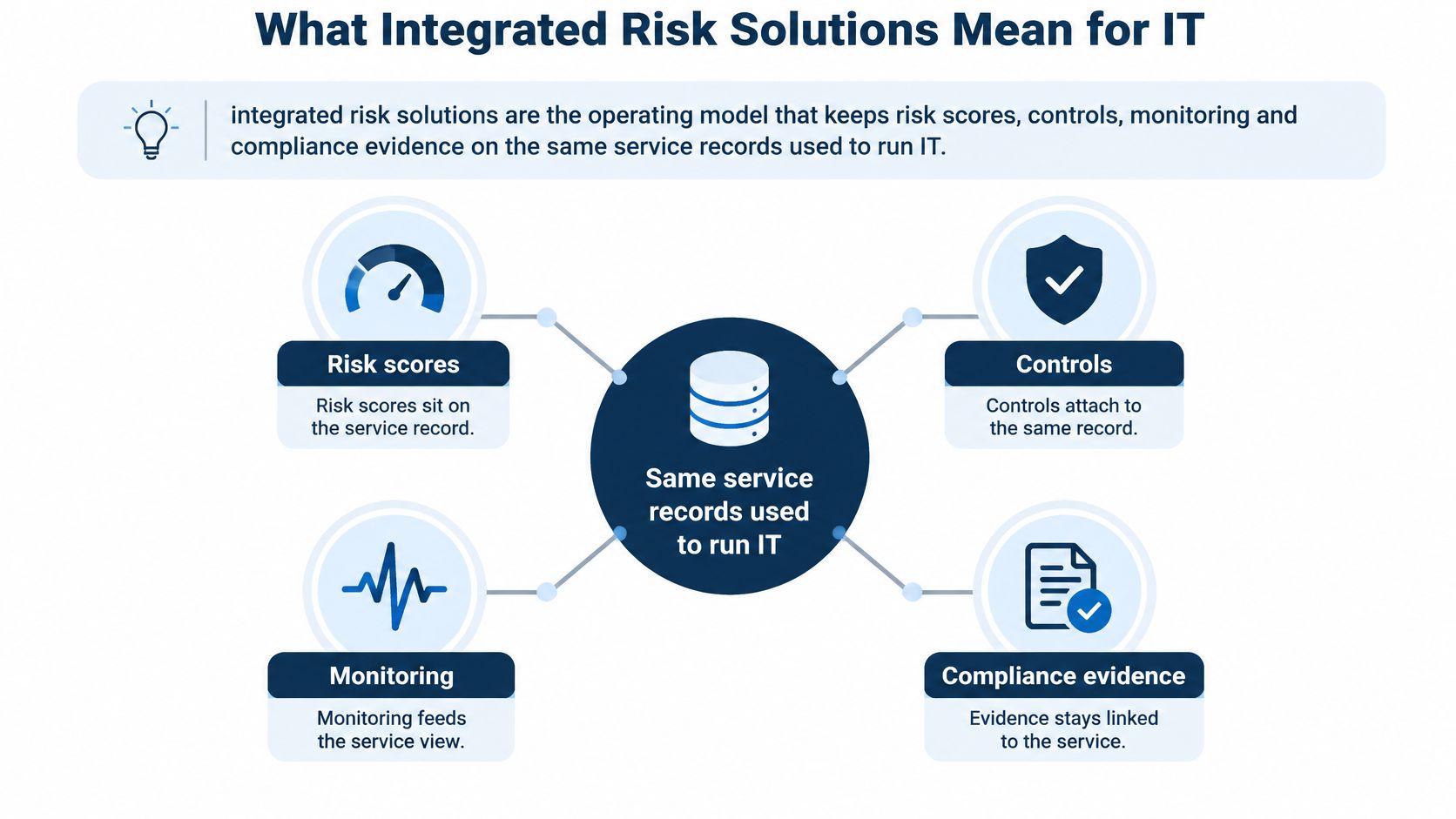
Integrated risk solutions keep assessment, monitoring, controls and compliance evidence on the same service records used to run IT. A risk programme that sits beside those records is already behind the incident it is meant to govern.
During a service interruption, operations updates the incident, links affected configuration items and starts recovery tasks. If the risk owner still works from last quarter's workbook, the service has one status in the desk and another in the register. A supplier outage, a cyber incident or an auditor's evidence request then creates parallel versions of the same operational truth.
A flight deck works because crew members read shared instruments. Separate reporting channels create the same hazard in IT: one altitude for operations, another for risk and another for compliance. The integrated model puts risk scores, control status, exceptions and evidence on the incident, change, service and configuration records already used in ITSM and ITOM. Risk becomes part of the operating environment rather than a separate GRC product reconciled after the fact.
For CIOs, CTOs and operations leaders across the GCC and Europe, the pressure is practical. Cyber events, supplier disruption and compliance questions arrive as operational demands: they interrupt services, change priorities and expose missing controls. TekRecruiter's 2026 risk playbook for engineering leaders is useful related reading on connecting engineering decisions with those consequences.
What changes when risk shares the service record?
Risk stops being a periodic overlay. The service owner, incident team, change approver and control owner see the same exposure and the next action on the record itself. Residual risk changes when monitoring detects a new condition, while a control failure can open the work needed to restore it.
That gives leadership a practical test for the stack. Can a service record show its owner, dependencies, open risks, control state and evidence without exporting a spreadsheet? The five-component table that follows turns that test into a leadership discussion aid for deciding what belongs on the platform.
Five Components Every Stack Must Cover
Five components decide whether risk runs inside your service platform or stalls as documentation beside it. When an integrated risk programme underdelivers, the cause usually sits in one of these rows, so treat the table as a working checklist for your next design review: each row names a job, the record type that should carry it, and what breaks when that component lives in a separate tool.
Table title: Five components of integrated risk solutions
Component | Job it does | Lives in the platform as | Failure if left separate |
|---|---|---|---|
Risk assessment | Scores likelihood and impact for services, changes and suppliers | Risk register linked to configuration items and services | Scores go stale after the workshop |
Monitoring | Watches KRIs, incidents and vulnerabilities | Event and incident correlation | Alerts never change residual risk |
Control automation | Runs or attests preventive and detective controls | Workflows, change tasks and playbooks | Controls exist only as policy text |
Compliance | Maps obligations to evidence | Control tests and audit packs | Auditors chase screenshots by email |
Analytics | Shows trend, heat and ownership | Dashboards for the CIO and risk owners | Leadership sees lagging PDFs |
How can you test each component against actual work?
Run one live scenario per row before you accept a design, and insist each test moves an actual record through the workflow.
Risk assessment: A CMDB service carries a supplier dependency and an accountable risk owner, so the impact score follows the service wherever the record goes.
Monitoring: An overdue vulnerability automatically reopens the affected service's residual-risk score instead of sitting as an isolated security ticket.
Control automation: A change advisory decision creates an approval or verification task on the change record itself, with the outcome written back to the control.
Compliance: Supplier onboarding records the required control evidence on the vendor case, so the audit pack builds itself as work completes.
Analytics: An access-review dashboard exposes overdue decisions and their owners, replacing the quarterly export nobody reads.
Control automation carries the sharpest test: whether a control exists as text or as work.
A policy statement reads "access is reviewed quarterly." The executable version is a scheduled task that pulls the access list, routes it to each owner, records the sign-off, and feeds the evidence straight into the audit pack.
Scope is the last check. A component can be designed perfectly and still fail commercially if the workflows it needs sit outside the platform edition you plan to buy. Map each row's workflow list against the proposed licence before you commit. The SysAid pricing and licensing guide is the reference point for that exercise: confirm each workflow's modules and capabilities fall inside the proposed platform scope before contracts are signed.
Then mark the gaps. Take the table into your next review and flag every component that has no named system owner. Each flag is a pilot candidate: bounded enough to prove the model on real records, and cheap enough to stop if the platform cannot carry the workflow.
Platform Patterns on the Desk You Already Run
wordCount: 500sectionApproach: ComparevisualType: infographicinfographicType: comparison
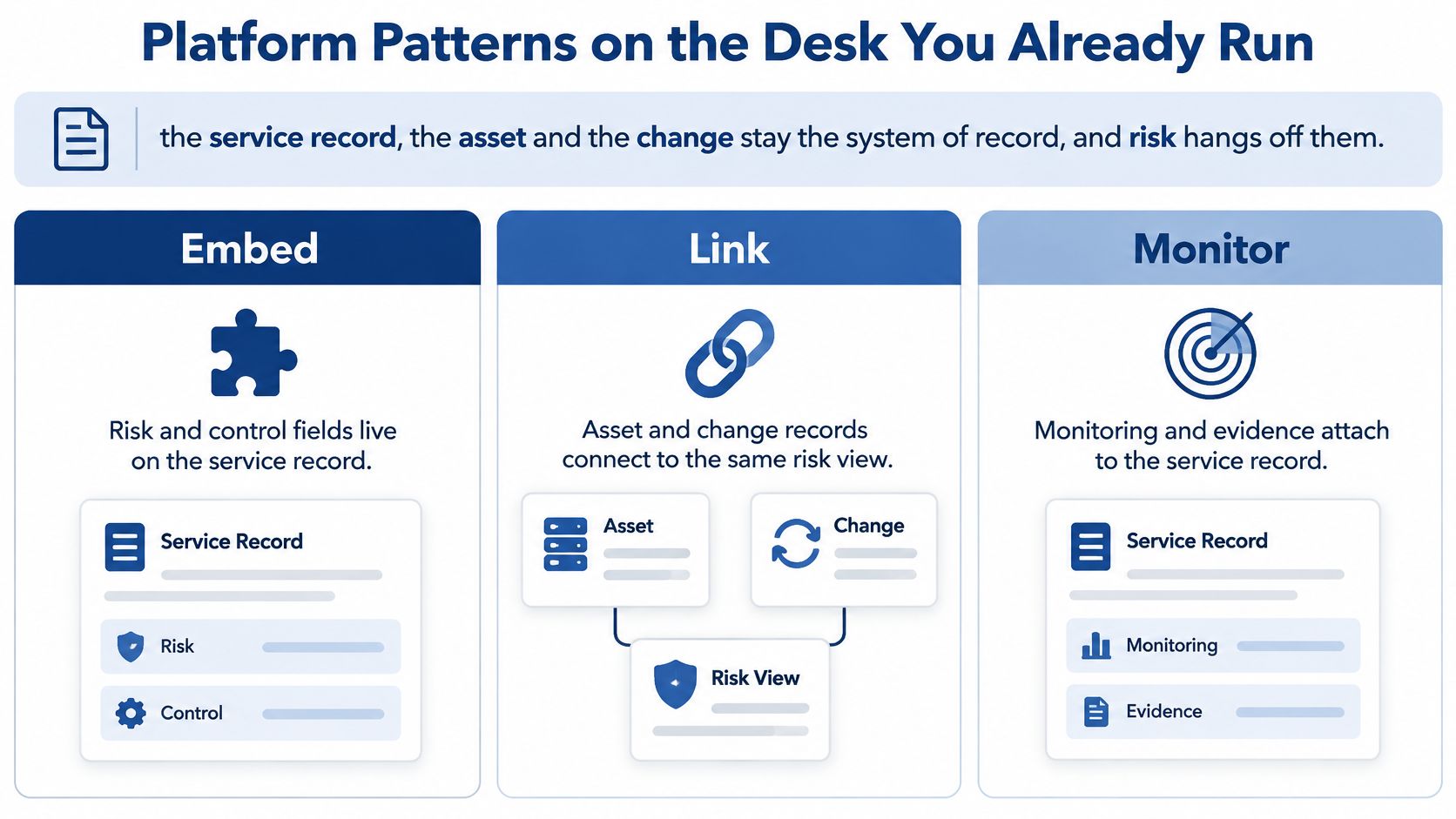
Start with the design rule: service, asset, and change records remain authoritative; risk references them.
Which integration pattern fits your operating model?
Explain each pattern once:
Embed: Risk, controls, and evidence use records within the same platform.
Synchronize: A specialist risk store exchanges status with the service desk, with a named conflict-resolution owner.
Orchestrate: Events and failed controls create linked tasks and attestations without manual field copying.
Distinguish these architectural patterns from the visual's descriptive labels, Embed, Link, and Monitor.
Table title: Integration patterns by ITSM platform
Platform | Native strength | Preferred pattern | Watch-out |
|---|---|---|---|
ServiceNow | IRM or GRC beside ITSM, ITOM and the CMDB | Embed risk, control and policy on the same CMDB and change | License scope and process sprawl |
HaloITSM | ITIL workflows, CMDB and no-code automation in one stack | Embed risk tasks and attestations as ticket types | Design the data model; don't assume a heavy GRC suite |
Freshservice | Mid-market ITSM with assets and change | Orchestrate alerts into incidents; keep a thin risk register | Custom fields turning into a second CMDB |
ManageEngine | ServiceDesk Plus plus monitoring and endpoint tools | Orchestrate events from operations tools into risk incidents | A broken chain when several products each keep a copy |
What should you validate before committing?
Describe the table as implementation patterns to validate against the actual edition, configuration, and integration scope, not guaranteed out-of-the-box behavior.
Use the HaloITSM pricing and licensing guide when discussing commercial fit.
Close with the decision test: competing write authority over residual risk means the operating model is unresolved.
Operational Scenes That Show the Model Working
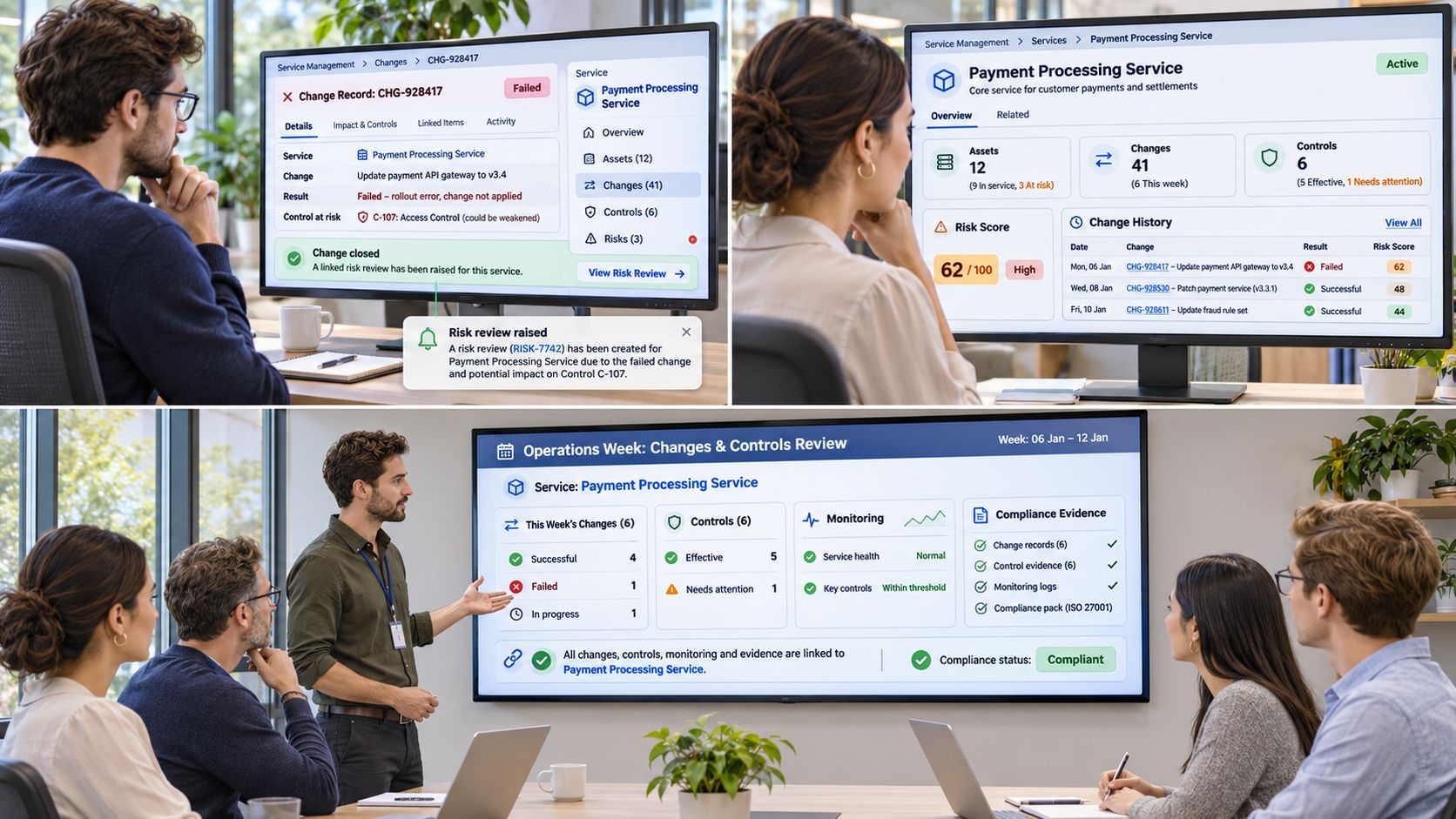
A risk programme proves itself in the minutes after something breaks. If the register sits beside the service desk, the update waits for a workshop, a spreadsheet owner and a tidy narrative. If it lives on the ITSM and ITOM platform the organisation already runs, the same record can carry the service, the control, the owner and the evidence while work is still underway.
What happens when a change fails?
A failed change should move risk before the post-incident meeting starts. The change manager initiates review from the change record, the affected service is pulled from the CMDB, the weakened control is marked, a residual-risk reassessment task goes to the risk owner, and closure requires an attestation that the workaround really restored protection. The workbook version leaves a gap: someone remembers to edit the register on Friday, audit asks which service was exposed, and the evidence trail points to a chat thread.
How should a supplier outage update risk?
When a supplier degrades a service, the incident should be linked to the supplier, the affected services and the contractual control that is supposed to cover response and recovery. The service owner coordinates action, while the linked record holds the response history rather than scattering it across mailboxes. For the assessment model behind that supplier record, Procright's guide on how to weight supplier risk criteria is a useful reference for deciding which criteria matter before an outage forces the question. If supplier-facing work also changes commercial scope, the HaloPSA pricing and licensing guide helps frame whether the workflow belongs in service delivery, billable project work or managed support.
What should an access review leave behind?
An access review should finish as operational fact, not as a folder of screenshots. The control owner assigns leaver checks and privileged-access checks, reviewers record approve or revoke decisions against the service, and test results attach to the control so the next auditor sees evidence in context. The weaker pattern is familiar: disconnected screenshots collected before an audit, with no service identifier, no reviewer decision and no way to tell whether access was removed or merely discussed.
A scene is ready to run when:
every risk, control, incident and change uses the same service identifier
each update has one named owner, with escalation when that owner stalls
evidence attaches to the control or record it supports, not to a separate drive
the record shows what changed, who accepted residual risk and when review is due
Choose the most painful scene as the pilot. I would start where manual chasing is worst, often the failed change, because it already has actors, timestamps and a service record that risk can attach to.
Measures That Prove the Programme Works
wordCount: 470sectionApproach: AnalyzevisualType: data-table
Present the measures before explaining interpretation. Treat directional targets as operating recommendations, not sourced benchmarks.
Table title: Success measures for integrated risk solutions
Measure | What it tells you | Healthy direction |
|---|---|---|
Time from incident or emergency change to updated risk score | Whether the register is alive | Hours or a few days, not the next workshop |
Share of in-scope controls with automated evidence | Audit readiness | Rising each quarter |
Repeat audit findings on the same control | Whether behavior changed | Falling |
Time to close a KRI breach | Operating discipline | Falling once noise is removed |
Risks with no service owner | Accountability | Toward none |
Which measurements can mislead you?
Explain why fast updates without accountable owners don't demonstrate effective risk management. Require an explicit denominator for evidence coverage, including exclusions and whether evidence passed validation.
Use a blockquote rejecting license counts, workflow counts, and dashboard views as proof of operational improvement.
Who reviews exceptions and acts on them?
Recommend weekly service-owner review of open KRI breaches and monthly CIO-sponsor review of repeat findings. Establish the pilot baseline instead of borrowing an unsupported industry target.
Map exceptions to corrective work:
Stale scores: Revisit phase four automation.
Orphan risks: Repair phase two ownership.
Missing evidence: Rework phase five evidence packaging.
Persistent noisy breaches: Tune phase six operations.
How to Adopt Integrated Risk in Phases
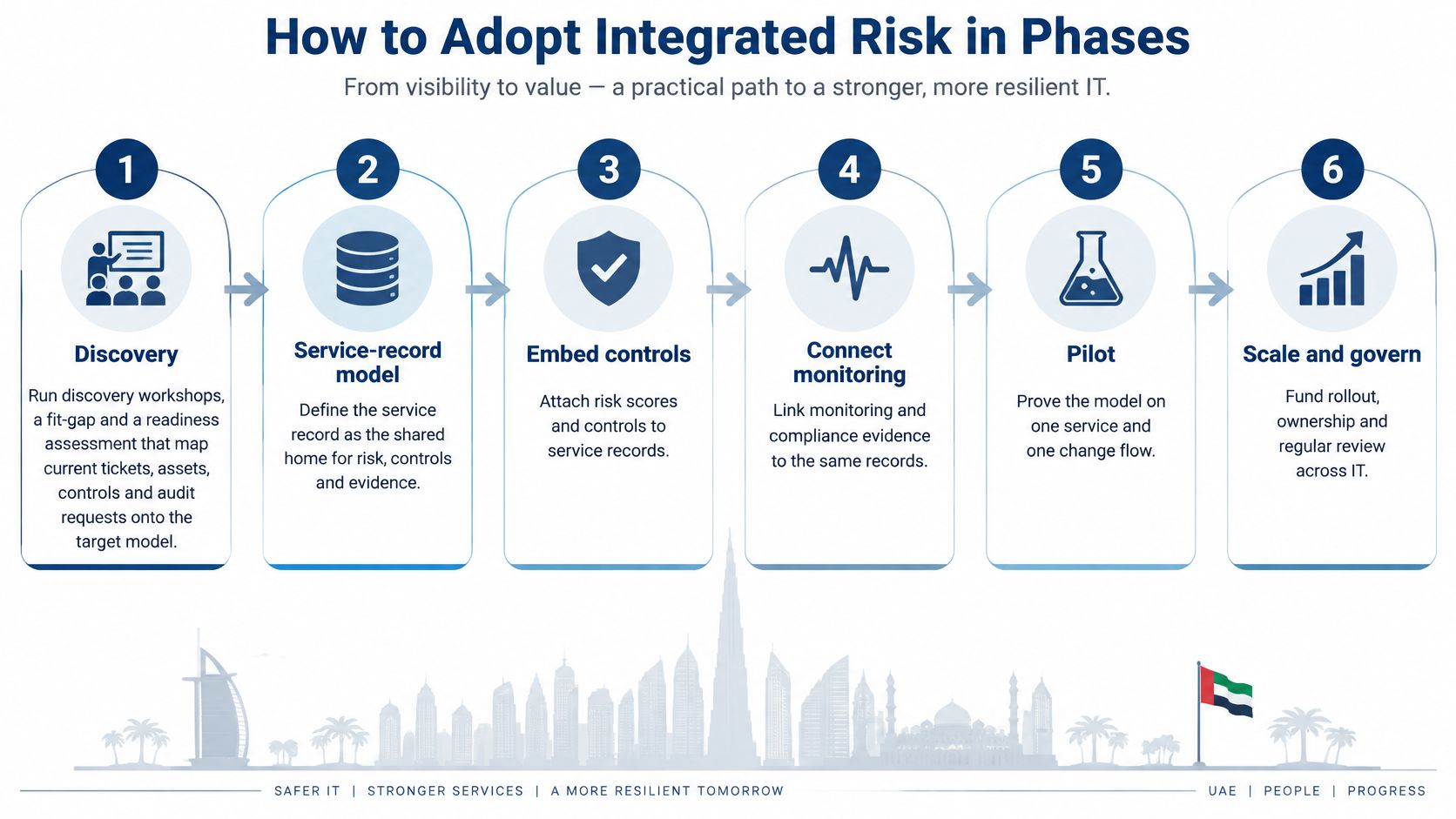
A phased adoption works when each phase produces something the service desk can use, not another planning artefact. The sequence below keeps risk as records and workflows on the ITSM and ITOM platform you already run, so every step lands inside existing queues rather than in a separate register that someone reconciles later.
What should each funded phase deliver?
Discover the operating gaps. Start with workshops, fit-gap analysis, and readiness assessments covering tickets, assets, controls, audit requests, and organizational responsibilities.
Fix the service-record model. Establish authoritative service identifiers, ownership, and risk-to-configuration-item relationships before building dashboards.
Pilot one domain. Select one operational scene, name its owner, and agree a bounded evaluation window.
Automate a preventive and a detective control. Keep the scope narrow enough to test triggers, failures, approvals, and reassessment.
Package usable evidence. Make test results, exceptions, decisions, and record relationships accessible to authorized audit reviewers.
Operate and refine. Preserve delivery-team continuity and adjust thresholds when false signals undermine queue discipline.
DataLunix opens every consulting engagement the way phase one runs here: discovery workshops, fit-gap analysis, and readiness assessments that map your requirements to platform capabilities, set the solution scope, and surface organizational or technical gaps before configuration begins. The same team that assesses the environment also configures it and supports it afterwards, so the people who wrote the fit-gap findings answer for the thresholds and workflows they put into production.
What must be ready before the pilot can proceed?
Your side of the gate is simple and often underestimated. Delivery needs timely access to the platform, accurate information about the environment, decisions on open questions, and the system permissions the work requires. Missing inputs stall the pilot, and delays caused by them can affect timelines and fees, so assign one accountable contact who can unblock access and decisions quickly.
Check the proposed pilot scope against your licensing position before the window opens. The Freshservice pricing and licensing guide is a useful reference for confirming what the platform tier already covers.
Resist two temptations at this stage: buying analytics before the service-record model is stable, and drafting an enterprise-wide policy library before one domain has run. Both produce artefacts that sit beside the desk instead of inside it.
Expansion has a single gate. An operational event, whether an incident, an emergency change, or a failed control, must trigger a risk reassessment you can trace from the event to the updated score to the owner's action. Until that chain works inside the pilot domain, do not widen the scope.
Choose a Partner and Start the Fit-Gap
A feature catalog tells you what a partner sells. Selection checks tell you whether they can deliver on your desk. Judge candidates on five:
Platform fit: They work within ServiceNow, HaloITSM, Freshservice, or ManageEngine rather than imposing another system of record on top of yours.
Delivery accountability: Clear responsibility for configuration decisions and post-launch operation, so gaps do not fall between teams.
Correct intake: They separate time-and-materials engineer requests from solutioning requests at the point of intake, so each routes to the right team.
Delivery model: Confirmed onshore, offshore, or hybrid delivery with a named senior contact.
Operational proof: Relevant ITSM, ITAM, or case-management work you can examine directly.
Operational proof is the check buyers skip most often. For FUJIFILM's healthcare technology division, DataLunix reconciled OT and non-OT assets into a single CMDB that feeds the service desk directly, with dependencies mapped and kept current automatically. An IT manager there said the team gets the discovery depth it had before, inside the platform the service desk already lives in, without the licence bill that came with it. Asset work of that kind shows whether a partner can make records trustworthy on a platform that already exists, which is the same discipline integrated risk depends on.
What should you buy help with first?
Apply a simple decision rule. Unstable CMDB data needs modeling work. Fragmented evidence needs workflow and attestation design. Missing ownership requires leadership decisions, and no partner can supply those for you.
Before signing anything, hold the proposed pilot scope against your licensing position. The Freshworks pricing and licensing guide gives you a reference point for that conversation.
How can you start a focused discovery conversation?
DataLunix offers a no-obligation discovery call in which a senior consultant maps your current tooling, licence position and process gaps. One message reaches the right specialist, whether the need is licence pricing, implementation, managed support or an AI workflow build, and a senior consultant replies within one business day with next steps.
Bring your weakest component and your most disruptive operational scenario. DataLunix offers discovery-led assessment to connect integrated risk solutions with the service platform you already run. Visit DataLunix to start that conversation.