
IRM Group Explained: Services, Products and Risk Roles

IRM Group is not one company: the four meanings to distinguish are IRM Offshore and Marine Engineers, IRM Ltd, the Institute of Risk Management's UAE regional group, and Integrated Risk Management. The first makes marine equipment, the second provides business advice, the third supports risk professionals, and the fourth is a management discipline.
Are you comparing providers, or accidentally comparing a manufacturer, a consultancy, a professional community and a control framework? That distinction determines which evidence you need before contacting anyone.
Meta Title: IRM Group Explained | UAE Services and Risk ManagementMeta Description: Understand which IRM Group you mean, compare marine products, consulting and professional support, and connect UAE compliance requirements to IT service records.Blog Title: Which IRM Group Do You Mean, and What Does Each Do?
Which IRM Group You Mean
The name alone isn't enough to identify the organisation or service you need. Start with the intended outcome: buying equipment, obtaining business advice, developing professional skills or managing enterprise controls.
Four meanings of IRM Group and what each does
Name | What it does | Where it operates | Who it serves |
|---|---|---|---|
IRM Ltd | Risk, emerging-markets, project management and investigative consulting | Middle East | Organisations entering markets with combined political, commercial and regulatory risk |
IRM Offshore and Marine Engineers | Marine fenders and offshore installation aids | UAE and Gulf commercial coverage, supplying more than 90 countries | Ports, harbours, shipbuilders and offshore energy projects |
Institute of Risk Management UAE group | Professional networking, knowledge sharing and certification support | UAE, serving the wider MENA region | Risk managers and certification candidates |
Integrated Risk Management (GRC) | Risk, control and compliance processes and software | Any sector | IT, risk and compliance leaders |
The Institute of Risk Management's UAE regional group describes knowledge exchange, risk-management culture, professional development and support for people pursuing IRM qualifications. It's a professional community, not the marine manufacturer or a substitute for checking qualification requirements with the awarding body.
Integrated Risk Management is different again. It describes how you connect risks, obligations, controls, ownership and evidence, often through governance, risk and compliance software.
Identification test: A fender, a consultant, a certificate and a control framework point to different organisations or activities.
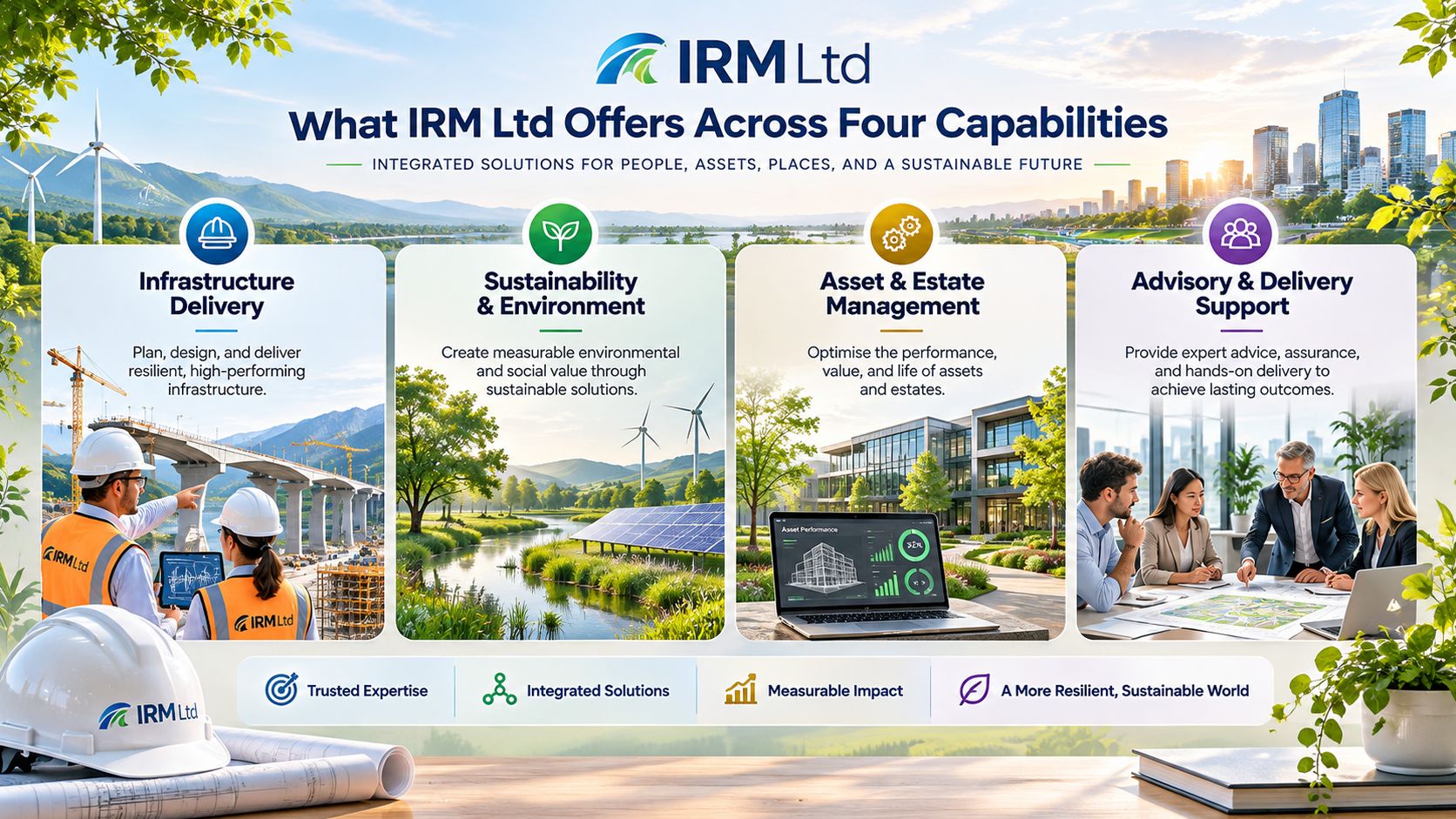
What IRM Ltd Offers Across Four Capabilities
IRM Ltd is a Middle Eastern business consultancy focused on risk-informed decisions and strategic execution. Think of its role as a pre-flight check: political, commercial, regulatory and operational conditions need to be read together before you commit resources.
The IRM Ltd website presents the firm as a full-service international business consultancy with four capabilities:
Risk-management consulting: Support for understanding the exposures surrounding a business decision.
Emerging-markets advisory: Advice relevant to entering or operating in markets where commercial conditions require closer examination.
Topical project management: Project-focused support that connects a strategic objective with execution.
Investigative tools: Information-gathering support for decisions that need more than assumptions or an introductory presentation.
The service illustration below shouldn't be treated as proof of additional capabilities beyond the company's documented portfolio.
What would a consulting engagement need to establish?
Consider an illustrative logistics firm planning a Gulf expansion. Its leadership might need a regulatory assessment, partner due diligence and a delivery plan before approving a local operation.
Those activities address different questions. Can the proposed operation proceed? Is the partner suitable? Who will turn the decision into an executable project? These are typical buyer needs, not a statement that the logistics firm or any named organisation is an IRM client.
What doesn't the public information establish?
The available company material doesn't disclose a verified founding date, employee count, revenue, client total or country-by-country footprint. It also doesn't establish a verified client case study for the illustrative scenario above.
Treat figures found elsewhere as unverified until the company confirms them in writing. A regional description tells you where a firm positions itself, not how many offices it maintains or which jurisdictions it can cover directly.
For an initial conversation, ask:
Required capability: Which part of the documented portfolio addresses your decision?
Expected deliverable: Will you receive an assessment, an investigation report, a project plan or another defined output?
Relevant references: Which regional references can you contact, subject to confidentiality?
A useful proposal should connect the deliverable to the decision you must make, rather than merely repeat a service label.
How IRM Offshore and Marine Engineers Serves Ports
IRM Offshore and Marine Engineers is the marine engineering and manufacturing business, not the consultancy. Its customers need physical products that manage vessel contact or support offshore installation work.
The Offshore Technology company profile identifies it as the flagship company of IRM Group, designing and manufacturing marine fenders and offshore-platform installation aids for ports, harbours, shipbuilding and offshore energy projects.
Which product families should you distinguish?
The portfolio becomes easier to understand when grouped by function:
Fender systems: Barge-bumper assemblies, shock absorbers and solid-fender geometries.
Offshore installation aids: Diaphragm closures, grout seals, pile closures and pile grippers.
Contact and mating components: Boat-landing rub strips, jacket-leg rub strips and leg-mating units.
These aren't interchangeable accessories. Fender systems must absorb vessel kinetic energy while controlling the reaction transmitted into a vessel and berth. Other components perform sealing, gripping, alignment or wear-protection functions during offshore construction and operation.
A container terminal replacing berth fenders therefore has a different engineering problem from a jacket-installation team procuring grout seals. Matching nominal dimensions alone doesn't establish that either product will perform its intended duty.
What should the standards list tell you?
The company profile lists standards including ISO, ASTM, BS, ASME, PIANC, AWS and DIN. Treat those names as references in the published product material, not proof that every item complies with every listed standard.
Before publishing a specification or issuing a purchase order, confirm the exact standard, applicable edition, product scope and acceptance evidence against the relevant manufacturer documentation. A broad standards list can't replace a product-specific compliance statement.
A component's dimensions tell you whether it fits. Engineering evidence tells you whether it can do the job.
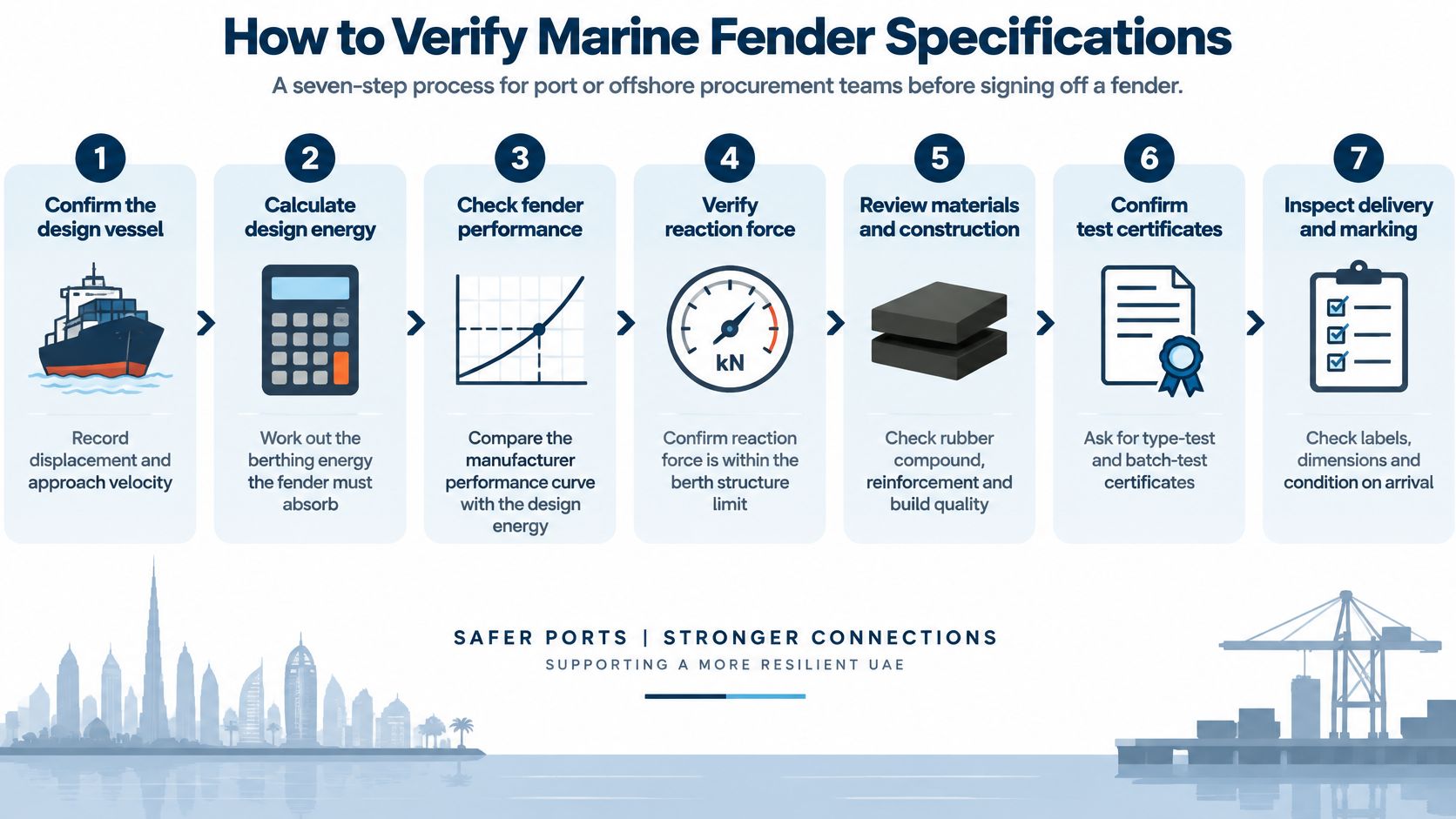
The procurement workflow below highlights the checks needed before accepting a marine fender.
How to Verify Marine Fender Specifications
Approve a fender against the project's energy and reaction requirements, not catalogue size alone. Your procurement team needs the structural engineer and supplier to work from the same design assumptions, performance curves and acceptance criteria.
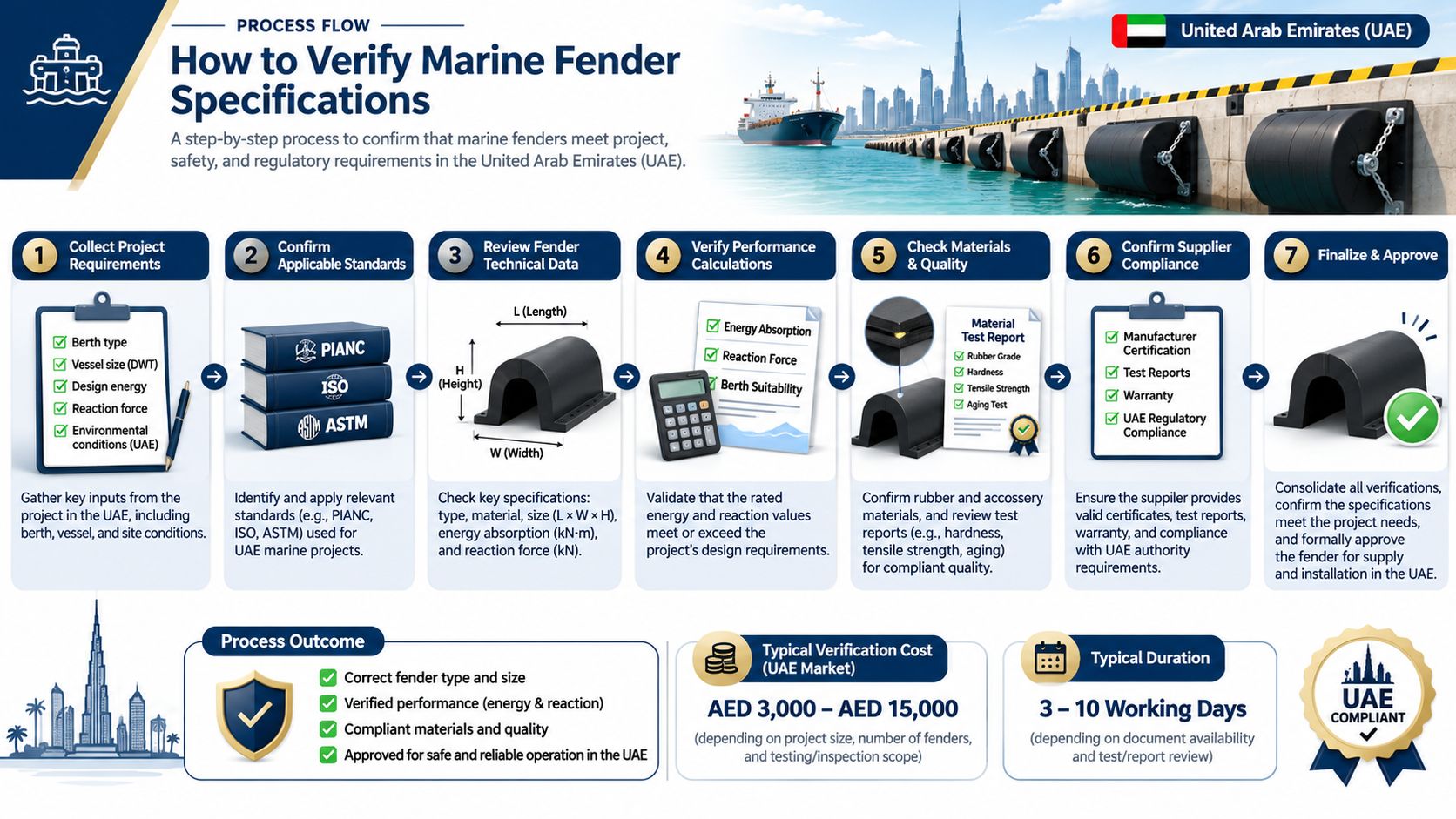
Which checks belong before technical approval?
Confirm the design vessel. Record displacement, approach velocity and berthing angle, together with the operating assumptions used by the designer. Don't accept a vessel name or headline capacity as a substitute for the inputs governing berthing energy.
Establish the structural limits. Obtain quay geometry and allowable hull and structure reactions from the structural engineer. A system may absorb the required energy yet still transmit an unacceptable load into the berth.
Read the force-deflection curve. Request the proposed fender's performance curve and compare its reaction at design deflection with the allowable value. Check that the curve's conditions and corrections match the proposed duty, rather than comparing isolated catalogue maxima.
Check the testing envelope. The IRM marine technical presentation reports in-house compression testing capacity of 20,000 kN, testing of fenders up to 3,000 mm in height, and load-cell reporting of energy and reaction force. Confirm that your proposed fender and required test load fall within the stated capability, rather than assuming that possession of a test facility proves acceptance of your order.
Verify certification scope. The same presentation lists ISO 9001, ISO 14001, ISO 45001, ISO 3834, EN 1090 EXC4 and Manufacturing Capability Certification. Obtain current documents and check the fabrication site, covered activities and exclusions, because a group-level certificate may not establish the scope needed for your product.
Separate supplier claims from independent acceptance. The testing information comes from an IRM technical presentation, not an independent UAE regulator. Request witnessed or third-party test records where your project's assurance requirements call for them, with traceability to the supplied item or batch.
Compare equivalent systems. Evaluate shortlisted options using the same design energy, permissible reaction and operating assumptions. A lower purchase price isn't a like-for-like comparison if another option includes different testing, hardware or acceptance obligations.
What should the specification pack contain?
Keep the acceptance evidence together so engineering, procurement and inspection teams aren't approving different versions of the requirement.
Design basis: Vessel data, operating assumptions and berth geometry.
Performance evidence: The force-deflection curve with the allowable reaction clearly marked.
Test traceability: The test-record reference and its relationship to the supplied product.
Fabrication assurance: Certificate scope for the actual manufacturing site.
Delivery acceptance: Required marking, dimensions, condition checks and supporting documents.
The technical presentation also reports supply to more than 90 countries. That describes commercial reach, not approval for your berth or evidence that a particular fender meets your specification.
Why IT and Risk Leaders Care About Compliance Overlap
Compliance isn't only a legal-team responsibility. In the Integrated Risk Management meaning of IRM, IT teams hold much of the operational evidence needed to demonstrate that a control works.
Incidents, changes, asset records, configuration management database entries and vendor contracts can establish what happened, who approved it and which system was affected. The practical task is to connect those records to the relevant risk and control, not create another disconnected spreadsheet.
Which requirements need operational evidence?
The PwC UAE data privacy and responsible AI handbook explains Federal Law No. 45 of 2021, including personal-data processing obligations and consent requirements subject to legal exceptions. Your team must establish the applicable lawful basis, rather than assume consent is always the only option.
The National Cyber Security Policy for Artificial Intelligence sets out AI asset, vulnerability, configuration, governance and incident-management requirements. The UAE Charter for the Development and Use of Artificial Intelligence makes privacy and data security governing principles.
For DIFC organisations, the Chambers cybersecurity guide describes Data Protection Amendment Law No. 1 of 2025, including direct processor liability and documented transfer-impact assessments for high-risk processing.
UAE and DIFC requirements that map to risk and service records
Requirement | What it asks of organisations | What the risk register should record |
|---|---|---|
UAE Data Protection Law | Establish a lawful basis, manage consent where required and control processor access | Processing inventory, lawful basis and approval records |
National Cyber Security Policy for AI | Maintain an AI asset inventory, patch systems, remediate vulnerabilities and protect confidentiality, integrity and availability | AI asset register, patch and vulnerability records and control library |
UAE Charter for the Development and Use of AI | Treat privacy and data security as governing principles | Personal data involved, permitted use and safeguards before deployment |
DIFC Data Protection Amendment Law | Make processors directly liable, define controller instructions and assess high-risk transfers | Vendor due diligence results and documented transfer-impact assessments |
These instruments have different scopes and legal roles. Don't treat a charter, a national policy and legislation as interchangeable obligations.
How do you turn a requirement into a service record?
Say your HR team is introducing a new employee system. Before migrating employee records, map the personal data, identify the processing purpose, name the accountable owner and record the required approval.
Link that approval to the change ticket and relevant risk. Assess privacy alongside cybersecurity, operational, vendor and regulatory exposure, because the same migration can affect all of them.
If an AI agent reads incoming email, examine untrusted instructions as part of the workflow design. Molted Email's prompt-injection screening for agent inboxes is a useful resource for evaluating that specific control, not a substitute for wider AI governance.
For platform evaluation, use the HaloITSM pricing guide alongside your requirements, rather than letting licence comparison define the control model.
Evidence rule: A closed ticket proves a workflow ended. It doesn't automatically prove that the required control passed.
Build a shared asset register, map a control library to applicable rules, and maintain a vendor file that tests operational compliance rather than relying on contractual indemnities.
Frequently Asked Questions About IRM Group
Does IRM Group publish client case studies?
The public materials considered here don't establish verified client case studies for the consulting scenarios described. Those scenarios are illustrative, so request named references and permission to discuss comparable work directly with the relevant organisation.
Can a directory listing be trusted for IRM Group details?
Use a directory as a starting point, not final confirmation of company identity, services or scale. Listings can become outdated, so compare the entry with the firm's own materials and obtain written confirmation of any figure that affects your procurement decision.
Can one project use both IRM Ltd and IRM Offshore and Marine Engineers?
Yes, a project could require separate advisory and marine-product scopes, but that doesn't make the providers one organisation. Split responsibilities, contracts, acceptance criteria and evidence requirements so each provider is assessed on its own work.
Does searching for IRM Group identify the right IT platform?
No, an ambiguous company search won't establish your service-management or GRC requirements. If you're assessing service workflows, the Freshservice pricing guide can support the commercial comparison, but you still need to define ownership, evidence capture and risk-record integration.
Choosing the Right IRM Group and Next Steps
Your need | Right option | Engagement model | Evidence to request |
|---|---|---|---|
Market entry or regional risk advice | IRM Ltd | Advisory and project engagement | Capability statement and regional references |
Port, terminal or offshore product | IRM Offshore and Marine Engineers | Product supply with engineering and test support | Force-deflection curves and test records |
Professional certification | Institute of Risk Management UAE group | Membership and certification support | Current certification pathway details |
IT service governance tied to service records | DataLunix or a GRC platform | Assessment, configuration and support | Control evidence mapped to the compliance requirements |
Choose by scope, not by the shared letters. Comparing IRM Ltd with IRM Offshore and Marine Engineers means comparing advisory work with engineered product supply, not competing versions of one service.
For professional development, confirm the current qualification pathway and distinguish regional community support from formal certification requirements. For enterprise governance, begin with the decisions and evidence your operating teams need.
Where does DataLunix fit?
DataLunix and IRM Group are separate organisations. Our relevant area is IT service management and service-delivery platforms, with GRC (IRM) work alongside ITSM, ITOM, CSM, HRSD, ITAM, SPM (PPM), FSM, ESM and SecOps.
The same team that assesses your environment also configures it and supports it afterwards. One contact message is routed to the appropriate specialist for licence pricing, implementation, managed support or an AI workflow build.
For a platform-specific commercial comparison, the SysAid pricing guide provides a starting point. Keep that comparison separate from whether your proposed workflow captures the evidence your risk owners require.
What should you establish before committing?
Use these checks to make the engagement accountable:
Record ownership: Identify who maintains the relationship between service records, controls and the risk register.
Applicable requirements: Confirm which compliance obligations apply to your organisation, systems and processing activities.
Sign-off authority: Name the person authorised to accept the assessment, configuration or technical output.
Relevant evidence: Review examples of comparable work that the provider is permitted to share.
A polished demonstration isn't enough. Ask the delivery team to follow an actual incident or change through its proposed workflow and show where the owner, approval, control result and exception decision will be recorded.
For a marine purchase, apply the same discipline to a product record instead: identify the design requirement, acceptance evidence and authorised signatory. The method is accountability, even though the documents differ.
How should you begin?
Write your question in one sentence. Find the matching need in the decision table before selecting a provider.
Request the relevant evidence. Make the final-column documents part of your initial enquiry, not an afterthought during contracting.
Prepare your operational records where relevant. For an Integrated Risk Management engagement, map service records to the risk register before the meeting so the delivery team sees your current environment accurately.
Arrange a scope-focused discovery conversation. For the IT governance route, start with DataLunix and ask our team to demonstrate how service records can link to risk ownership and control evidence.
DataLunix offers assessment, configuration and ongoing support for service-delivery environments where Integrated Risk Management depends on usable operational evidence. Visit DataLunix to arrange a discovery conversation, bring a representative change or incident record, and ask us to map it to the risk and control decisions your team needs to make.