
Integrated Third Party Risk Management: 2026 Guide

Most third-party risk programmes fail without warning. They don't miss a single catastrophic vendor, they miss the slow accumulation of dependencies that turns an ordinary supplier into a single point of failure. In 2024, 73% of the 30 largest UAE companies analysed by SecurityScorecard had at least one third-party supplier that experienced a breach, according to SecurityScorecard's UAE supply chain analysis. That figure doesn't shock anyone who has traced a critical business service through five downstream providers and found no current contract, no service map, and no owner below the procurement record. Integrated third party risk management exists to fix exactly that gap.
Integrated third party risk management is the operating model that connects every supplier, subcontractor and fourth party to the business services, contracts, controls, incidents and live technology signals that determine real exposure. It is not a module. It is not an annual questionnaire with a dashboard on top. It is the difference between knowing you have 480 vendors and knowing which twelve of them could stop payroll, patient intake, payments or customer authentication for more than an hour.
What Integrated Third Party Risk Management Actually Means
Integrated third party risk management is the operating model that connects every supplier, subcontractor and fourth party to the business services, contracts, controls, incidents and live technology signals that determine real exposure.
Standalone TPRM usually lives in procurement or a GRC register. It runs annual questionnaires, stores certificates, and sends renewal reminders. It produces a list of vendors with due dates. What it misses is the operational answer a CIO needs after an outage: which business services did that supplier support, what did the contract require, what evidence was held, and who accepted the residual risk?
The integration comes from four data joins. The first is a supplier master linked to the CMDB service map, so every vendor record points to the business services, applications and infrastructure that depend on it. The second is contract obligations linked to control evidence, so an audit-rights clause without a corresponding certificate or test result shows as a gap, not a vague compliance note.
The third is incidents and outages linked to service criticality, so a major incident on a tier-one supplier routes to the risk committee instead of sitting in the ITSM queue. The fourth is fourth-party dependencies linked to concentration risk, so two suppliers sharing one cloud subprocessor are visible as a single exposure. That join matters because a questionnaire can show two healthy vendors while missing the shared dependency that takes both down.
Three misconceptions keep programmes stuck in the siloed model. The first is that TPRM is a procurement exercise. Procurement signs the contract, but it cannot see the runtime dependencies, the data flows or the recovery test results on its own.
The second is that an annual questionnaire equals continuous oversight. A supplier's posture can change in a week through an undisclosed subcontractor, an expired certificate or a newly exposed API. The third is that a reputable vendor is a low-risk vendor. Reputation is a lagging indicator; concentration and dependency chains are not. A well-known supplier can still create unacceptable exposure when it sits inside a critical path with weak alternatives.
How to Test Your Current Programme
The fastest diagnostic is a comparison against the integrated model across six dimensions. If your answers sit mostly in the left column, the programme is a register, not an operating model.
Dimension | Siloed TPRM | Integrated TPRM |
|---|---|---|
Ownership | Procurement or security runs a separate questionnaire cycle | Executive-owned council joins risk, procurement, IT operations, security, legal and business service owners |
Inventory | Vendor list in a spreadsheet, GRC register or contract database | Supplier master linked to the CMDB, service catalogue, contracts, fourth parties and business services |
Risk scoring | Annual inherent score based on questionnaire answers | Inherent score plus residual score recalculated when control evidence and live signals change |
Monitoring | Periodic reassessment and ad hoc escalation | Continuous triggers from ITSM incidents, ITOM discovery, SIEM alerts, attack-surface data and contract events |
Reporting | Vendor count, overdue reviews and questionnaire completion | Service-level exposure, financial impact, regulatory materiality, concentration and board risk appetite |
Accountability | Procurement chases the vendor; business owners stay distant | Named business owner accepts risk; risk and audit challenge; platform records every decision |
Practical rule: If the supplier register cannot show which business service depends on a vendor, the programme is not integrated yet. That single query is the threshold.
The outcome is one risk-based view of supplier exposure from intake to exit, with evidence that satisfies the board and a regulator. Many organisations still struggle to state how well they understand their third-party cyber and privacy risks, which is the visibility problem integration solves. You are not automating a questionnaire process. You are building a data model where supplier, service, contract, incident and evidence are one connected record.
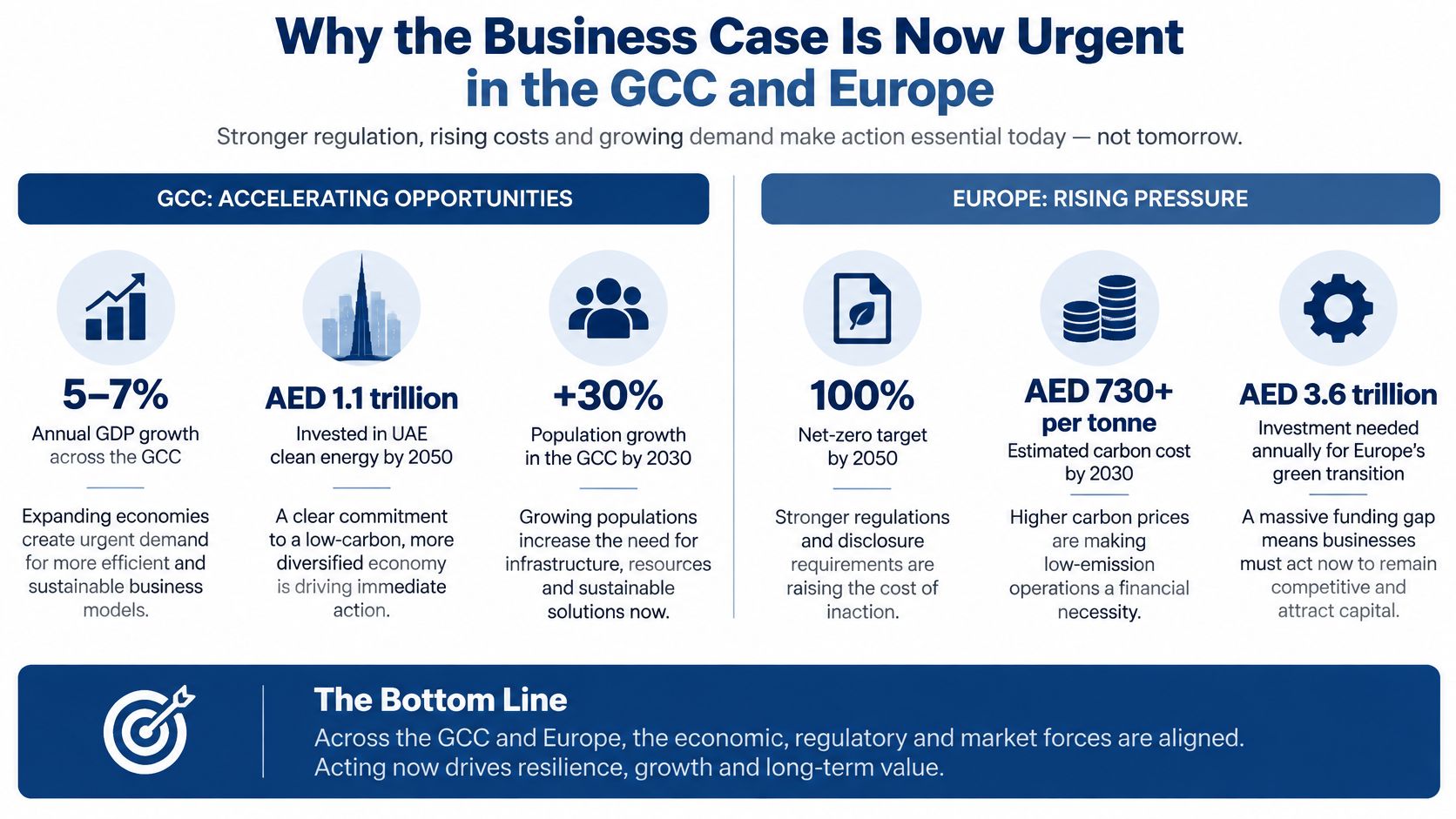
Why the Business Case Is Now Urgent in the GCC and Europe
Operational disruption is already a budget line. A 2026 report on UAE organizations found that 82% had experienced significant operational disruption from a third-party outage or failure during the preceding two years and, among those affected, 67% estimated the business impact at more than US$1 million, according to ITP.net's coverage of the UAE disruption findings. The same report stated that 59% of UAE organizations had suffered financial losses exceeding US$500,000 from disruptions including vendor outages, supply-chain interruptions, cloud failures and IT outages. These figures sit close to the operating reality of any service that depends on external platforms, cloud providers, data feeds or managed support. A critical supplier failure becomes expensive before the root cause is clear, because teams often have the incident ticket but not the service dependency, contract obligation or continuity position attached to it.
The mapping gap makes the loss figure harder to manage. Many organizations can name their critical vendors, yet cannot show which business functions, technology systems and supply-chain dependencies those vendors support. They also lack clear visibility into the continuity plans of critical suppliers. You cannot recover a service you cannot map, and you cannot hold a vendor to continuity expectations you have never read. The 2022 PwC baseline confirms the same pattern in UAE cyber and privacy risk: fewer than half of UAE respondents thoroughly understood their third-party cyber and privacy risks, while 59% expected an increase in reportable incidents arising from software-supply-chain attacks during 2022 yet only 44% had formally assessed their enterprise exposure to that risk. Expectation and assessment run in opposite directions when questionnaires sit apart from service maps, incident records and contract obligations.
For a CIO, the business drivers are concrete. An outage on an unmapped supplier costs service hours while teams work out which applications, customers and internal processes are affected. Regulatory exposure grows when a breach traces to a vendor whose contract lacks breach-notice or audit clauses. Onboarding slows when every new supplier starts from a blank questionnaire instead of a referenceable risk tier. Board reporting fails when the risk committee asks for the top suppliers by service criticality and receives a vendor count and an overdue-review percentage.
European buyers face the same pressure through DORA and NIS2. Both frameworks expect an ICT third-party register, visibility into subcontractors and concentration, audit and exit rights written into contracts, incident notices routed to the service owner, and resilience testing for providers of critical functions. The remediation is not a second questionnaire stack. It is the same service map, obligation register and live-signal joins the UAE data demands. GCC financial institutions get a parallel message through explicit operational-risk rules: the Central Bank of the UAE's 2026 Operational Risk Management Regulation requires licensed financial institutions to maintain a board-approved third-party-risk strategy integrated into operational-risk management and to verify equivalent resilience when third parties support critical operations.
The commercial case follows from that operating model. Integration reduces work by reusing the same supplier record for intake, assurance, incident response, renewals and exit planning. It lowers assurance cost when evidence is captured once and linked to the services and controls it supports. It shortens renewal cycles because procurement, risk and service owners are looking at the same exposure record. It gives the board and regulator a defensible answer to a practical question: if a critical vendor failed tomorrow, which services stop, which obligations are triggered, who owns the response, and what evidence shows the organisation could contain the impact?
How the Integrated Architecture Connects ITSM, ITOM and ESM
The architecture is six connected layers, not one tool purchase. Most enterprises already hold parts of it in service management, operations monitoring, configuration data and governance. The work is joining those records so supplier exposure can be seen at service level.
A questionnaire-only model starts with the vendor form. An integrated model starts with the supplier record and attaches contracts, services, dependencies, incidents and evidence to it. For regulated financial institutions, this record needs to show whether a provider supports critical operations before engagement, because outsourcing that could significantly affect critical operations may require prior regulatory non-objection. The supplier record must therefore carry materiality status before signature, not after onboarding.
That changes the record from an administrative entry into an operational control point. It should show the legal entity, owner, risk tier, contract reference, contacts, subcontractors and data location. It should also link outward to the business services, applications, infrastructure and fourth parties that depend on the supplier. A provider with a low data-sensitivity score can still sit under several critical services through a shared subcontractor or common platform. The service map exposes that concentration faster than a policy document ever will.
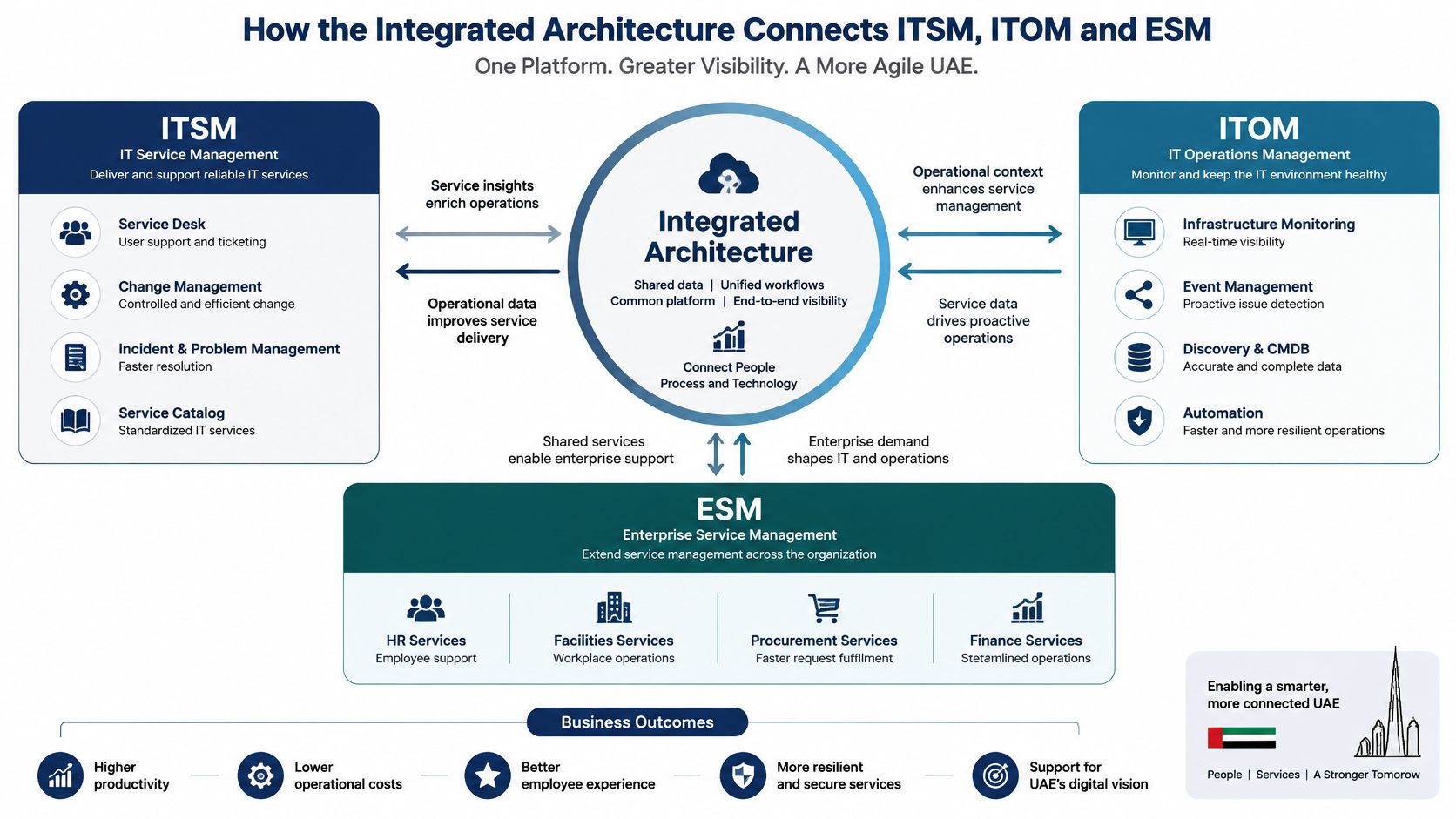
The Six Layers and What They Exchange
Layer | Primary platform | Data exchanged | Integrated action |
|---|---|---|---|
Supplier master | GRC, IRM, procurement or vendor management | Legal entity, ownership, tier, contract, contacts, subcontractors, data location | Creates the single supplier record and links every later control to it |
Service and dependency map | CMDB, ITOM and service catalogue | Business service, application, infrastructure, fourth party, recovery objective | Shows which services depend on the supplier and how far an outage could spread |
Intake and workflow | ITSM or ESM | Requests, approvals, tasks, SLAs, renewals, offboarding | Routes due diligence and renewal work to the right owner with an audit trail |
Control evidence | GRC, document repository and attestation portal | Questionnaires, certificates, audit reports, test results, AI assurance | Validates residual risk and opens remediation when evidence expires or fails |
Continuous monitoring | ITOM, SIEM, attack-surface management and risk intelligence | Incidents, vulnerabilities, outages, authentication anomalies, posture changes | Triggers reassessment, incident review or executive escalation without waiting for the annual cycle |
Reporting and regulatory returns | BI, risk dashboard and board pack | Exposure, KRIs, materiality, losses, exceptions and remediation status | Gives the risk committee and regulator one consistent view of supplier exposure |
The joins matter more than the platform labels. The supplier master defines who the organisation depends on. The service map defines what breaks if that dependency fails. Intake and workflow put assessment, renewal and exit work in front of the right owner. Control evidence shows whether residual risk is still acceptable. Monitoring feeds catch changes between review dates. Reporting turns those live joins into a view the board and regulator can challenge.
A concrete example keeps the joins honest. A payment API used by a bank has a cloud subcontractor, a data-residency obligation, an ITOM dependency and an incident queue. When the subcontractor changes, four records should update together: the supplier record gains the new fourth party, the service map records the dependency change, the contract review checks whether subcontractor disclosure was required, and the risk score recalculates. In a siloed model, two of those four updates happen, and the other two surface months later during an audit. For teams running MSP-style workflows, MSP workflow guidance from Vight covers the operational side of joining PSA, RMM and service records, which is the same integration logic applied to managed-services delivery.
Design choices still create trade-offs. A CMDB that feeds the service desk directly gives teams live context, but only if dependencies are mapped and kept current automatically. DataLunix followed that pattern in the FUJIFILM ITAM setup, reconciling OT and non-OT assets into a single CMDB that feeds the service desk directly. Teams starting from a Freshservice base can review Freshservice pricing and licensing options before committing to a design, especially where workflow and CMDB capability affect the operating model.
The minimum viable architecture is five joins: supplier record, service map, contract obligation, incident link and monitoring feed. Everything else scales on top.
The Vendor Lifecycle from Intake to Exit
The UAE Central Bank requires licensed financial institutions to manage third-party risk as part of operational risk rather than as a separate procurement exercise. Each licensed financial institution must maintain a board-approved strategy, policies and processes covering the assessment, monitoring and management of third-party risk. Before entering any third-party arrangement, the institution must perform a risk assessment and appropriate due diligence on the provider, as set out in the Central Bank's third-party risk management article. That creates a defined lifecycle: governance approval, pre-contract assessment, provider due diligence and continuing oversight. The lifecycle below applies the same discipline to any enterprise, with evidence and ownership at every stage.
1. Intake and business case. A new spend, renewal or changed use starts the process. Capture the business owner, data class, contract value, service hours and intended use. Intake is not a formality; it is the first place where the service owner states what the supplier will touch. If the owner cannot name the business service, the supplier should not proceed.
2. Criticality tiering. Score data sensitivity, operational criticality, regulatory exposure, concentration and fourth-party depth. Set tiers 1 to 4. A tier-1 supplier supports a critical business service or holds regulated data and a downstream dependency chain. A tier-4 supplier is transactional with no service dependency and minimal data exposure. The tier determines the depth of everything that follows.
3. Due diligence. Collect security, privacy, financial, resilience and AI evidence proportionate to tier. A tier-1 supplier needs independent audit reports, penetration test summaries, financial stability evidence, recovery test results and AI assurance where the supplier runs models or agents. A tier-4 supplier needs a short security questionnaire and a sanctions check. Proportionate means the evidence burden follows the exposure, not the contract value alone.
4. Contract controls. Translate risk requirements into audit rights, breach notice, data location, subcontractor disclosure, service credits, exit assistance and deletion obligations. The contract is where due diligence becomes enforceable. A supplier that passes every assessment but will not commit to a 24-hour breach notice or an exit-assistance clause has not passed.
5. Onboarding. Create the supplier record, link the CMDB service, scope access and set review dates. This is the stage where the integration starts to pay off: the same contract-event workflow that grants contractor access also creates the review schedule and the monitoring threshold. For teams handling sensitive access, contractor access for IT teams covers the practical controls for scoping, expiring and auditing contractor identities, which is the identity half of a clean onboarding record.
6. Continuous monitoring. Ingest incidents, vulnerabilities, SLA performance, posture changes and AI behaviour. A supplier review is no longer a calendar event; it is a trigger fired by a breach, a failed SLA, an expired certificate or a material change in the supplier's own stack.
7. Reassessment and exit. Renewal, material change, breach or exit decision starts this stage. Updated risk scores, remediation evidence, an exit test and data-deletion proof are all required before closure. Offboarding is not complete when the contract ends; it is complete when access is revoked, data is returned or destroyed, and the exit test confirms the business service continues without the supplier.
Lifecycle Stages, Evidence and Owners
Stage | Trigger | Key evidence | Platform record | Owner |
|---|---|---|---|---|
Intake and business case | New spend, renewal or changed use | Business owner, data class, contract value, service hours | Procurement request and supplier record | Procurement with business owner |
Criticality tiering | Intake approved | Service dependency, data sensitivity, regulatory exposure, concentration, fourth-party depth | Supplier register and CMDB service map | Risk and service owner |
Due diligence | Tier assigned | Security, privacy, financial, resilience and AI evidence proportionate to tier | GRC questionnaire and evidence repository | Security and risk |
Contract controls | Due diligence passed | Audit rights, breach notice, data location, subcontractor disclosure, exit assistance, deletion | Contract repository and obligation register | Legal and procurement |
Onboarding | Contract signed | Named contacts, access scope, asset records, service hours, review dates | ITSM supplier record, CMDB and ESM workflow | Service transition |
Continuous monitoring | Live service | Incidents, vulnerabilities, SLA performance, posture changes, AI behaviour | ITOM, SIEM, attack-surface and IRM dashboards | Vendor manager |
Reassessment and exit | Renewal, material change, breach or exit decision | Updated risk score, remediation evidence, exit test, data deletion proof | Supplier record, change record and incident record | Risk owner with business owner |
A customer-service platform often illustrates the concentration risk best. It enters as tier 3 because its data sensitivity is moderate and its initial contract is small. Over six months, three business units adopt it, one integration layer is built, and a fourth party starts handling transcript storage. The tier-3 classification is now wrong in a way the annual questionnaire cannot see. The lifecycle above catches this at continuous monitoring because the CMDB dependency change and the fourth-party disclosure both fire reassessment triggers. The control that prevents drift is simple: no supplier can be marked approved without a current service map, a contract obligation and a named business owner.
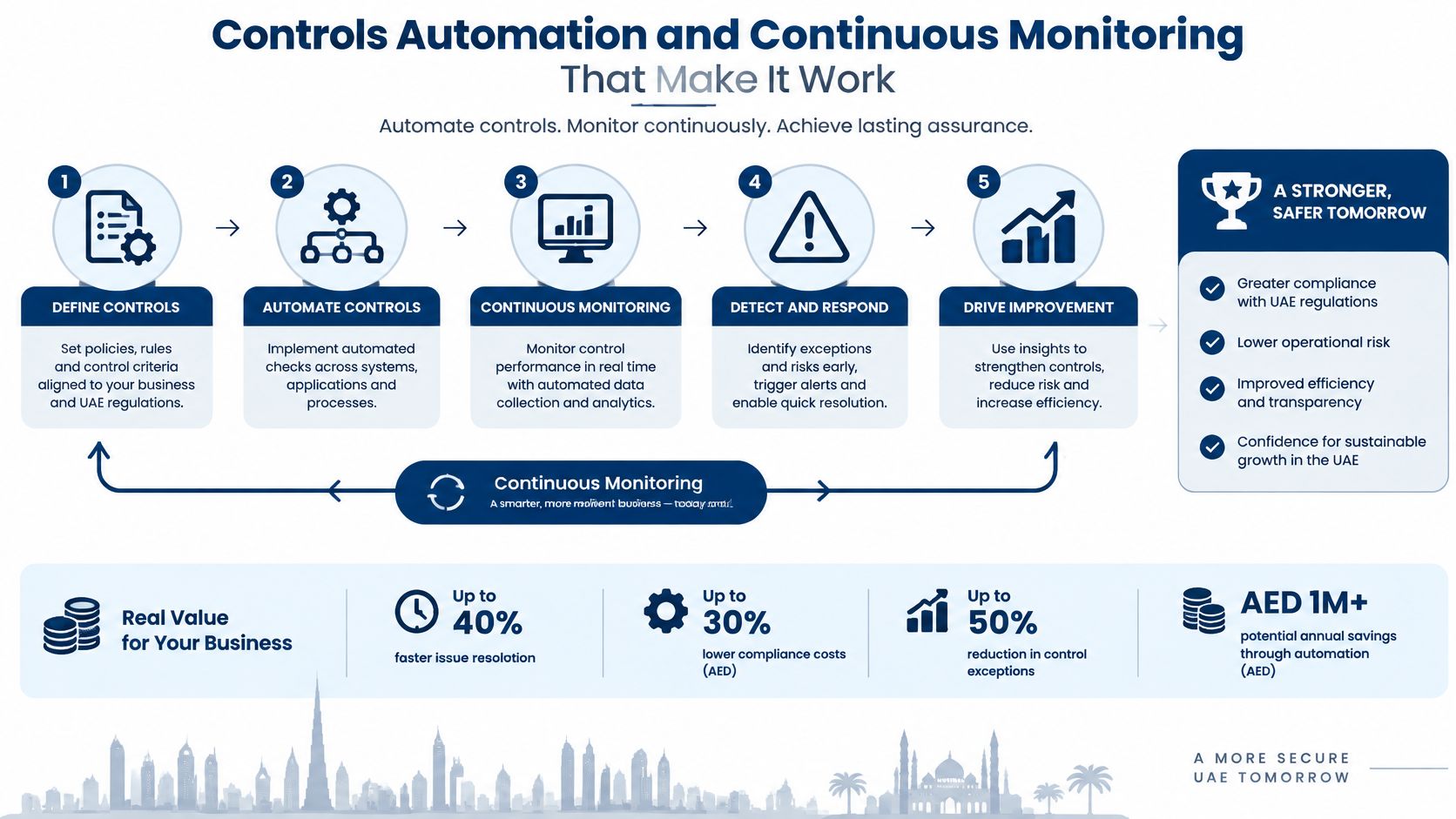
Controls Automation and Continuous Monitoring That Make It Work
Manual controls scale linearly with headcount, and most UAE teams don't have the headcount. Only 38% of surveyed UAE organizations conduct regular reviews of contractors' cybersecurity posture, 37% report that contracts lack clear IT-security obligations for contractors, and 40% identify a shortage of qualified security professionals as a major barrier, according to Gulf Business coverage of Kaspersky's UAE supply-chain findings. The answer is not more reviewers. It is six automated control domains, each with one trigger.
Identity and access. Contractor and privileged identities expire with the contract. The contract-end date is a live field on the supplier record, and the access review is a scheduled workflow, not a calendar reminder.
Data protection and residency. Location, encryption and cross-border safeguards are fields on the supplier record. When a supplier changes its data-location answer, the record flags a reassessment. This matters in the UAE, where confidential data may only leave the jurisdiction to providers that can demonstrate equivalent safeguards.
Vulnerability and patch. An unresolved high-severity finding opens remediation automatically. The finding is linked to the supplier, the affected service and the contract's patching obligations, so the risk owner sees the exposure in service terms.
Logging and monitoring. Authentication anomalies and newly exposed services enter the same queue as vendor incidents. A supplier whose public attack surface changes materially gets a posture-change event, not a note for the next annual review.
Incident response. A breach-notice clock or major outage opens a supplier review within five days. The review is a structured workflow with an owner and a deadline, not an email thread.
Exit and deletion. Termination proof is required before the record can close. No archive of a terminated supplier can sit in the approved population.
Third-party AI follows the same model. Nearly half of surveyed UAE executives report gaps in governance coverage for AI systems used by vendors, technology partners and supply-chain participants, while only 29% continuously monitor third-party AI risk and 16% require independent assurance or certification, according to IBM's study of UAE executives on AI incidents and agent autonomy. A compliance certificate for a SaaS platform does not establish safe operational behaviour when an agent can access sensitive records, trigger workflows, alter tickets or make decisions across connected systems. Controls need agent permissions, tool-call logs, prompt and model-change notice, human approval gates, rollback tests and retained evidence of who owns an agent action when the supplier hosts the model.
Six events should automate triage. A new request starts tiering. An expired certificate opens remediation. A critical incident opens supplier review. A CMDB dependency change re-scores criticality. A renewal pulls fresh evidence. An agent permission change needs approval. Inherent risk comes from data sensitivity, connectivity, criticality and regulatory exposure, and residual risk is calculated only after evidence is validated. No supplier stays in the approved critical population without a recent posture review; exceptions need compensating controls, executive acceptance or a deadline. Every trigger writes an audit log, which is the evidence a regulator asks for after an incident. Teams evaluating SysAid for the ITSM side of these workflows can review SysAid pricing and implementation options before committing to the monitoring stack.
Governance, KPIs and Regulatory Alignment
Governance makes the data trustworthy. A board-approved third-party risk strategy and policy, an executive owner, and a cross-functional council covering procurement, security, IT operations, legal, compliance, continuity and business service owners are the floor, not the ceiling. Three lines of defence apply directly: the business owns the service and the risk acceptance, risk and security set the framework and challenge, and internal audit provides independent assurance that the programme runs as designed.
Materiality must be decided before contract execution, not after. UAE banks must obtain Central Bank non-objection before outsourcing a material activity, and the same logic applies where disruption would hit critical operations. For confidential data leaving the UAE, do not contract with a jurisdiction that cannot match UAE safeguards, confirm personal-data compliance, define concrete security requirements and train the staff who handle that data. Record jurisdiction, data class and non-objection status on the supplier record so they appear with the top 20 in the board pack.
The monitoring baseline gives the KPI reason. With only 38% of organizations reviewing contractor cybersecurity regularly, 37% lacking clear IT-security contract obligations and 40% citing a skills shortage, targets must focus on coverage, evidence freshness and automation rather than reviewer output. A KPI that counts completed questionnaires rewards volume; a KPI that counts critical suppliers with a current service map and validated residual score rewards coverage where it matters.
KPIs for an Integrated TPRM Programme
KPI | Definition | 2026 target | Cadence |
|---|---|---|---|
Critical supplier coverage | Tier 1 and tier 2 suppliers with a current owner, service map and contract obligation | 100% within 12 months | Monthly |
Service map completeness | Critical business services mapped to technology, suppliers and fourth parties | 100% for all services rated critical | Quarterly |
Evidence freshness | Suppliers whose latest control evidence is inside the required review window | 95% for tier 1, 80% for tier 2 | Monthly |
Residual score completion | Tiered suppliers with a validated residual score after evidence review | 100% for tier 1 | Quarterly |
Time to onboard | Days from intake to approved supplier record for a low-risk supplier | Under 10 working days | Monthly |
Supplier-linked incidents | Major incidents and outages traced to a supplier or fourth party | 100% linked within 5 days | Monthly |
Concentration exposure | Suppliers or fourth parties supporting more than one critical service | Reassessed on every dependency change | Quarterly |
Exit tests completed | Critical suppliers with a tested exit and data deletion plan | At least one per year per tier 1 service | Annual |
Reporting cadence is monthly operations, quarterly risk committee and annual board. The test of a working governance model is whether the board can see the top 20 suppliers by service criticality, the exceptions, the financial exposure and the remediation deadlines without asking for a new spreadsheet. If the answer requires a manual reconciliation, the data joins have not been built.
Your 2026 Roadmap and First Pilot
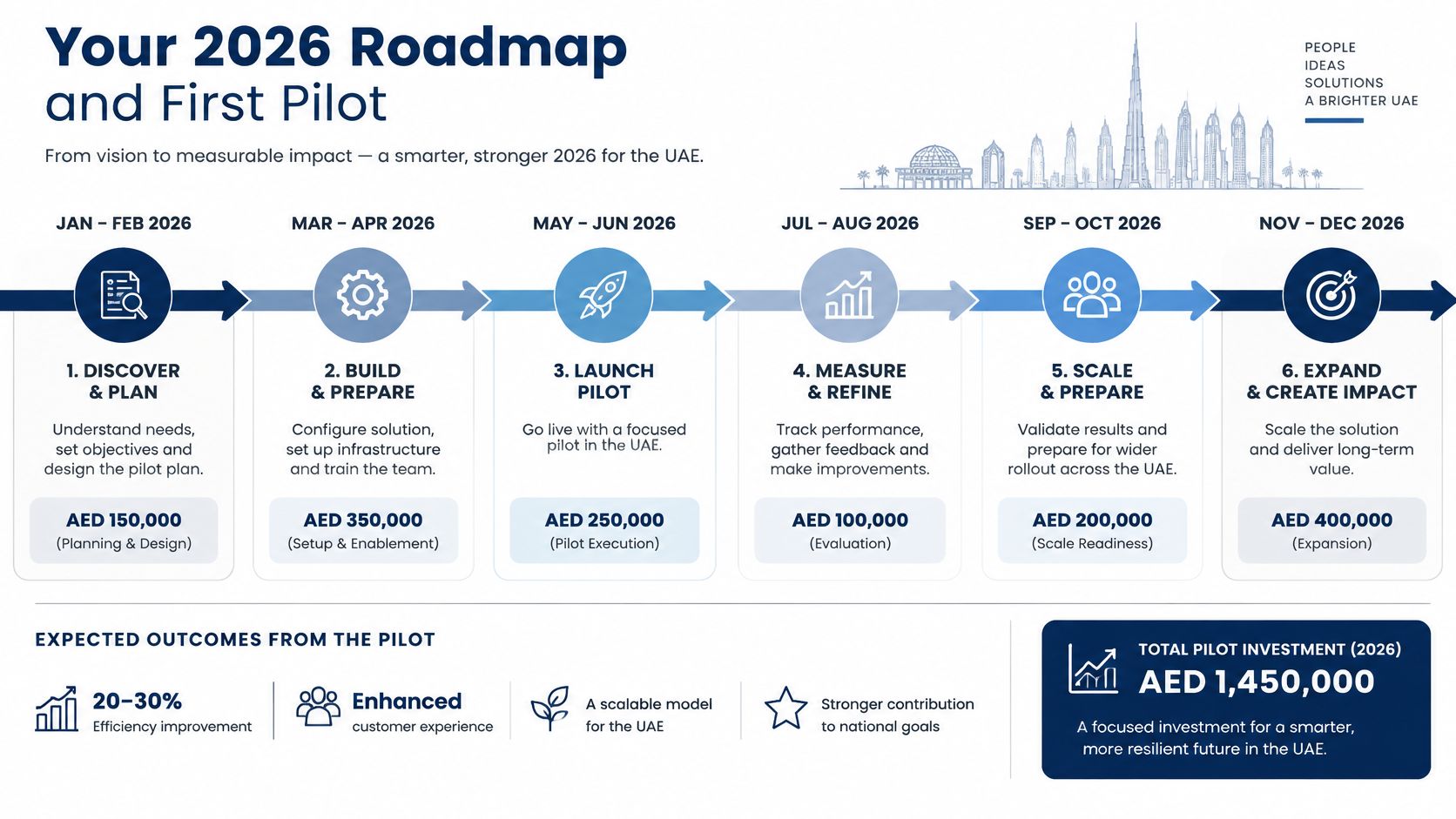
A first pilot should prove the operating model, not just produce a risk register. Take one service, bind the scope, and show how supplier records, contracts, service maps, incidents, continuity tests and AI-agent behaviour connect in the platform your teams already use. Four phases give the programme a clean handoff from sponsor decisions to board reporting.
Days 0–30: Name the sponsor and bound the problem. Name an executive sponsor, agree the pilot scope, pull the existing supplier inventory, map the top 10 business services, define four criticality tiers and choose one pilot service with 10 to 20 suppliers. The sponsor's first job is to settle ownership and scope. That forces the inventory conversation early, when gaps in supplier records, service ownership and contract visibility are still cheap to correct.
Days 31–90: Stand up the data model. Build the supplier master, link it to the CMDB, extract obligations from the top 50 contracts, configure due diligence and renewal workflows and set the first residual-score model. This is the phase where the supplier record stops being a form and starts being a data object with relationships. Each supplier should connect to a service, an owner, a contract obligation, a criticality tier and the technology it supports.
Days 91–180: Connect live signals. Bring in ITOM, SIEM and attack-surface feeds, launch the KPI dashboard, test one exit plan, add fourth-party and AI-agent registers and run a tabletop outage. The tabletop is the proof point. When the simulated supplier fails, the service map, incident queue and risk register should update without a manual email.
Days 181–365: Scale and report. Extend coverage to every tier 1 and tier 2 supplier, automate evidence refresh, embed materiality and non-objection checks, train business owners and report to the board. The board report at month twelve should come from the platform, with supplier exposure visible by service criticality, exception status, remediation deadline and business impact.
The pilot succeeds when the risk committee accepts six proofs: a complete service map, tiered suppliers, extracted contract obligations, one live monitoring feed, one tested exit and a KPI pack. Missing any one of the six means the integration did not happen. The team built a dashboard over the old questionnaire process. Carry the proof set into scale-up with a named owner, policy, inventory, tiering model, contract clauses, service map, monitoring feeds, incident linkage, exit tests, KPI pack and training plan.
Sequencing matters. Start with critical services and supplier data, then decide what the platform needs to automate. Every consulting engagement begins with discovery workshops, fit-gap analysis and readiness assessments, which map client requirements to technological capabilities, determine solution scope and identify organizational or technical gaps. In the FUJIFILM ITAM setup, DataLunix reconciled OT and non-OT assets into a single CMDB that feeds the service desk directly, with dependencies mapped and kept current automatically. That join pattern is the model for supplier data: keep one governed record, connect it to live operational objects, and let the service desk, risk team and board work from the same view. Review HaloITSM pricing and packaging if you are evaluating the platform side of the pilot, and leave the supplier data model as the first deliverable.
Integrated third party risk management starts with a current supplier list, a service map and the top 10 business services that keep the organisation running. DataLunix runs discovery workshops, fit-gap analysis and readiness assessments that turn those inputs into a pilot scope, a data model and a 90-day plan on the ITSM, ITOM and ESM platforms you already run. A senior consultant replies within one business day with next steps, from the first signs that change is needed to a full digital transformation roadmap. Visit DataLunix to start the discovery conversation and get supplier exposure visible before the next outage or regulator request.