
AI Powered Marketing Automation: Your 2026 Enterprise Guide

Updated: Oct 15
AI-powered marketing automation can increase marketing productivity by 5% to 15% of total marketing spending and bring campaigns to market up to 75% faster when it is built on the right data foundation. It works because AI moves marketing from static rules to predictive personalisation, real-time optimisation, and faster content creation.
Most CIOs are asking the wrong question. The issue isn't whether AI can automate marketing. It can. The question is whether your organisation has the data, governance, integration layer, and measurement discipline to make that automation reliable.
If you treat this as another martech purchase, you'll get fragmented tools and weak adoption. If you treat it as a strategic investment in data readiness, workflow redesign, and governance, you'll get operational efficiency and stronger decision-making across the customer lifecycle.
What Exactly Is AI-Powered Marketing Automation?
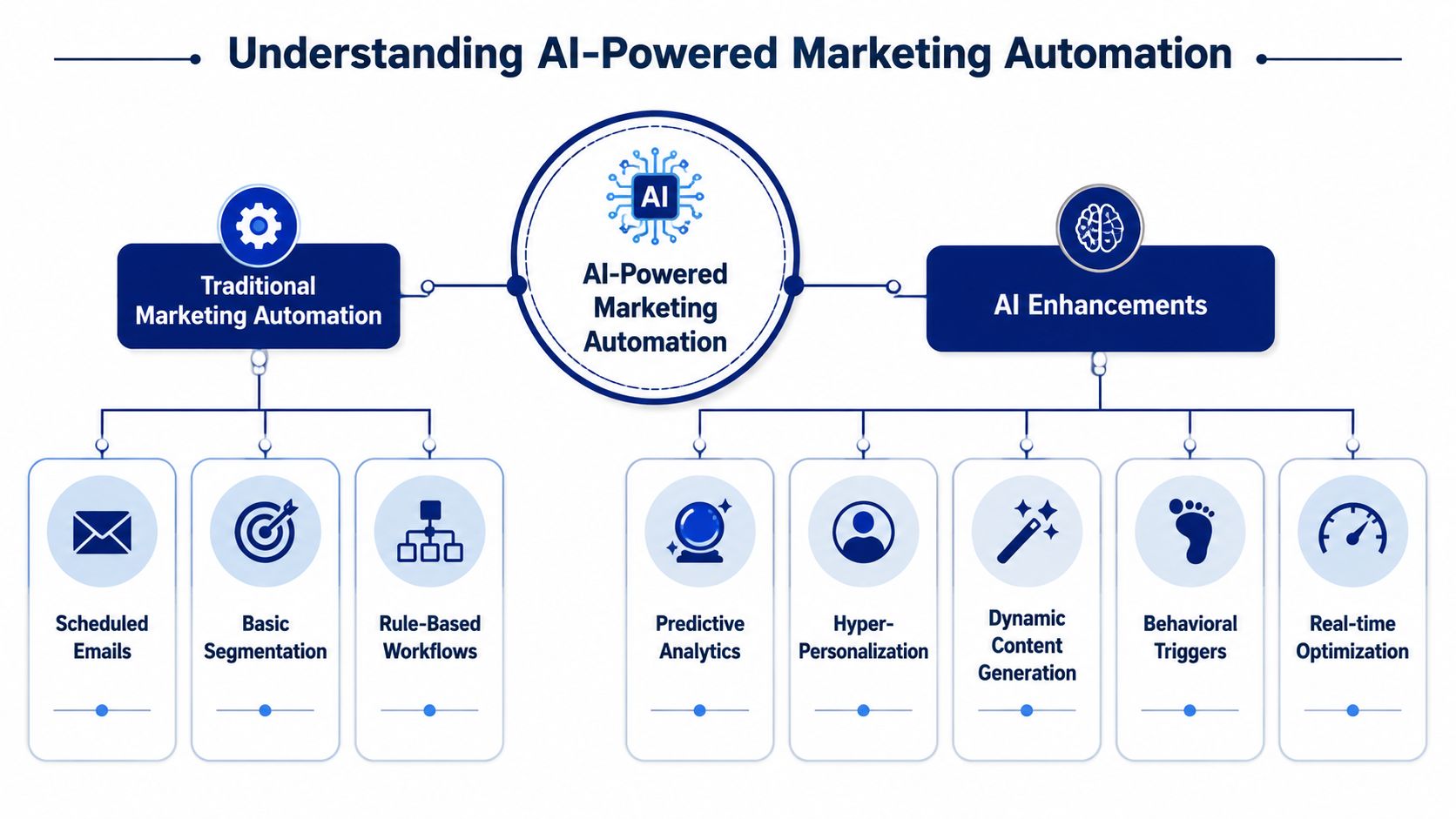
AI-powered marketing automation is the use of artificial intelligence to decide, personalise, and optimise marketing actions continuously. Traditional automation follows predefined rules. AI-driven automation learns from behavioural and transactional signals and adjusts what to send, where to send it, and when to act.
How is it different from traditional automation
Traditional platforms are useful, but limited. They execute workflows you already defined. AI systems improve the workflow itself.
A basic rule says: if a customer abandons a basket, send email A after two hours. An AI system goes further. It can evaluate intent, prior purchases, browsing depth, channel preference, language preference, and recent engagement, then choose the next-best action.
That changes marketing from campaign management to decision management.
Practical rule: If your platform only supports static triggers and fixed segmentation, you don't have AI-powered automation. You have workflow software with AI labels on top.
Which technologies actually matter
Three capabilities matter most in enterprise use:
Machine learning: It identifies patterns in behaviour and predicts likely outcomes such as response likelihood, churn risk, or conversion intent.
Natural language processing: It helps tailor communication, classify text, support chat interactions, and adapt content to audience context.
Generative AI: It accelerates content creation, variation production, and creative testing across channels.
The business consequence is simple. Your team stops spending most of its time building lists, adjusting rules, and rewriting content variants. It starts supervising models, setting guardrails, and improving performance.
Why this matters in GCC and European enterprises
The model only works if the underlying data is unified and consented. In the MENA region, AI performs best when it is fed rich, real-time first-party behavioural data, and success depends on unifying consented identity, event streams, and transactional data into a low-latency decision layer that can continuously re-score next-best actions, as outlined by Braze on AI marketing automation.
That's the line many enterprises miss. AI doesn't rescue poor data. It amplifies whatever data discipline you already have.
What Is the Real Business Value and ROI?
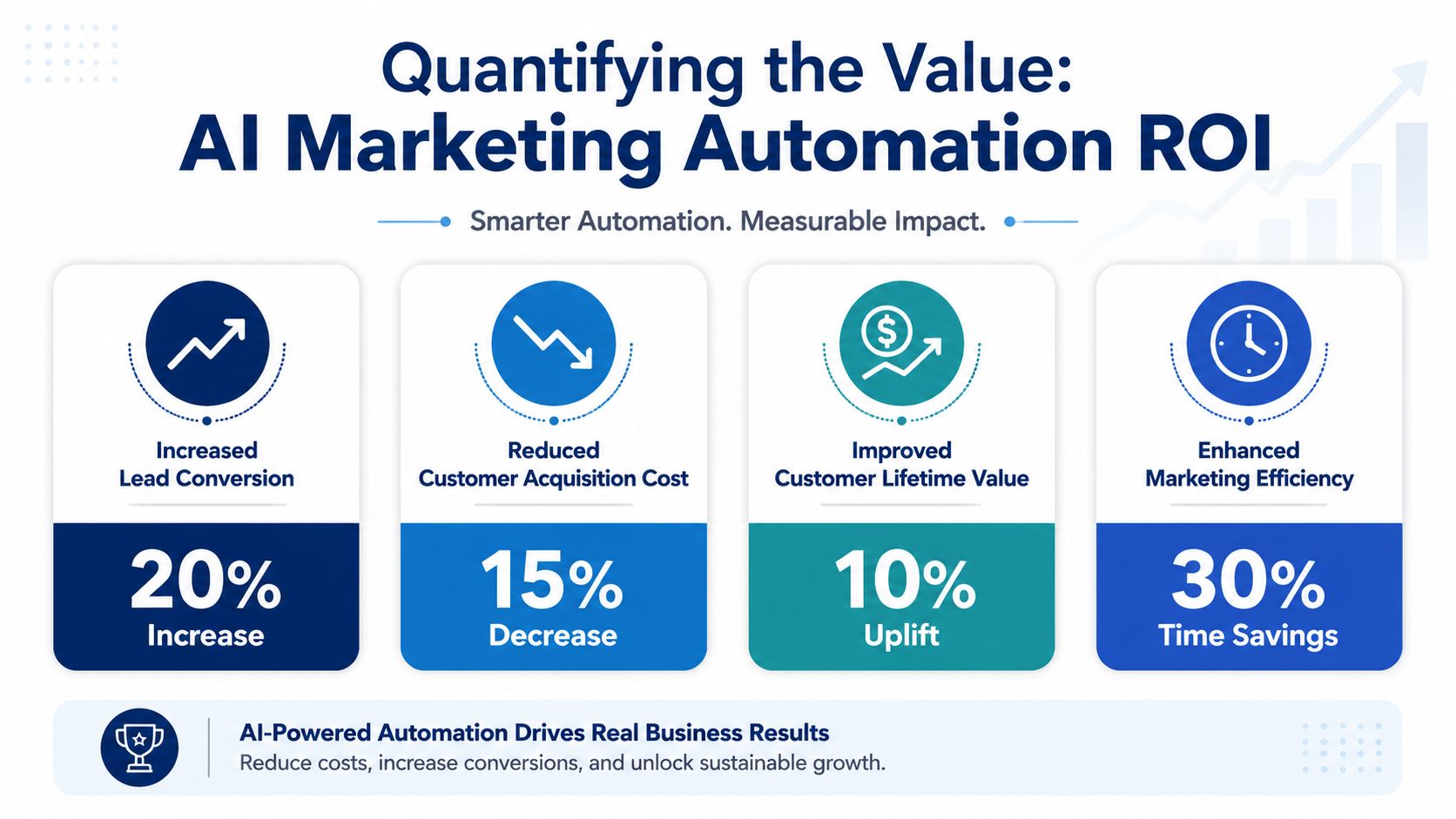
The value case is strong, but only if you define ROI correctly. This isn't just about more emails sent or more content produced. It's about reclaiming spend from repetitive execution and moving teams toward higher-value work.
According to a 2023 McKinsey report cited in this analysis of AI marketing automation, generative AI has the potential to increase marketing productivity by 5% to 15% of total marketing spending by automating complex tasks like content creation, predictive analytics, and real-time campaign optimisation.
Where the ROI actually comes from
Most CIOs should expect value from four areas:
Productivity gains: Teams spend less time on segmentation, reporting preparation, campaign adjustments, and repetitive asset production.
Faster execution: Response time to market signals improves, especially across multiple countries and languages.
Better allocation of budget: AI can support more dynamic prioritisation of channels, audiences, and offers.
Improved operating model: Marketing, data, compliance, and IT work from a shared decision layer instead of disconnected tools.
The biggest financial mistake is treating AI as a front-end content tool only. The deeper ROI comes from workflow compression and better operational timing.
What a CIO should demand before approving budget
Use a hard filter. Ask these questions:
Decision area | What to require |
|---|---|
Business case | A clear link to productivity, execution speed, and measurable operating impact |
Operating model | Defined ownership across marketing, data, IT, legal, and compliance |
Measurement | Closed-loop attribution, not dashboard vanity metrics |
Risk control | Governance rules for model outputs, data use, and approval paths |
You should also gain insights from The AI CMO if you want another practical perspective on how leaders are framing AI marketing economics heading into 2026.
For governance and procurement teams, the wider enterprise lens matters. Data, risk, and control design should align with broader IT GRC priorities, not sit as a disconnected marketing initiative.
If your ROI model ignores governance effort, data engineering work, and process redesign, the business case is incomplete.
What Enterprise Architecture and Data Is Required?
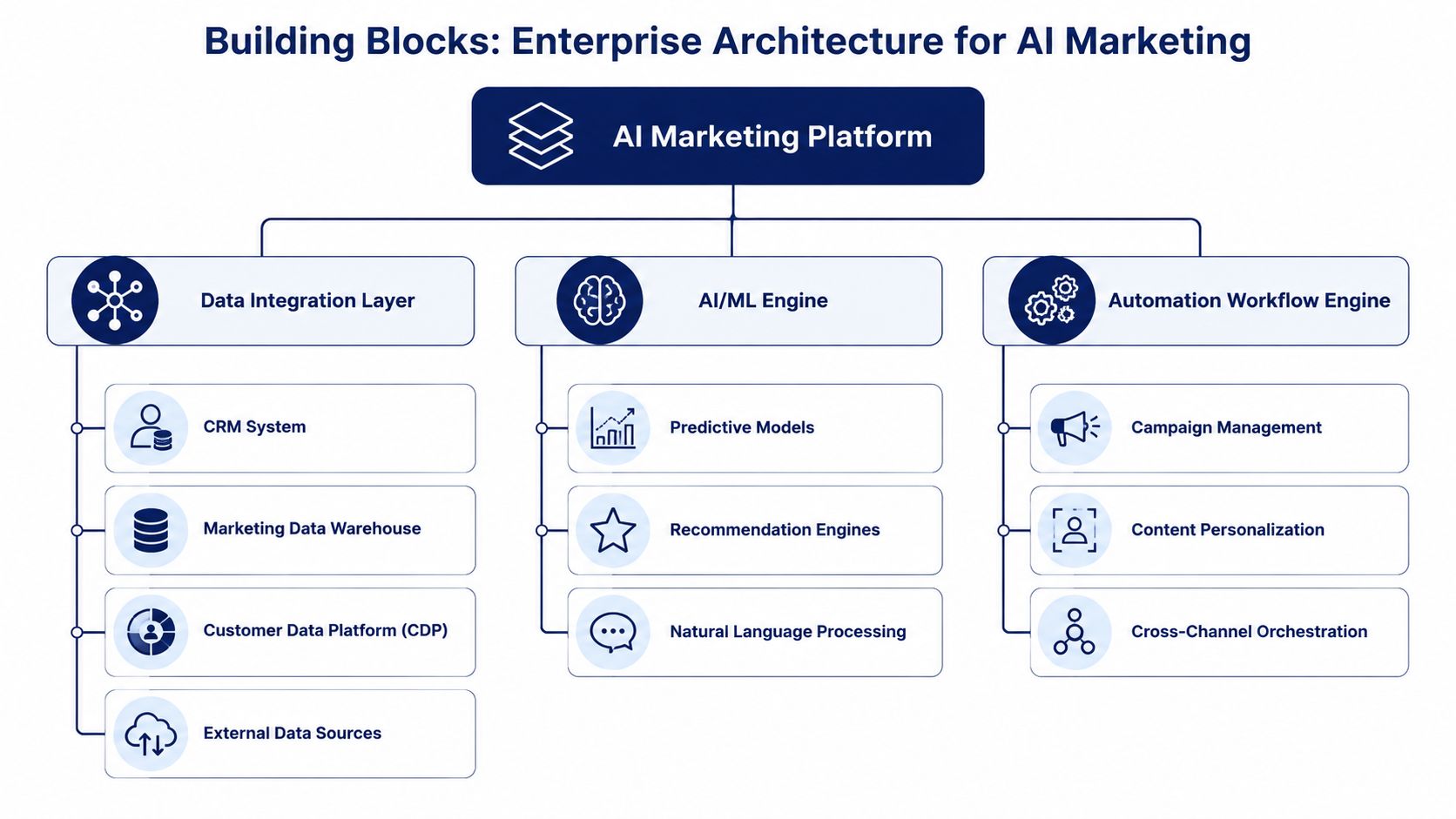
You need an architecture that supports low-latency decisions, governed identity, and traceable model behaviour. Anything less will produce noisy outputs and compliance headaches.
What data must be unified
The minimum viable input set usually includes:
Transactional history: Purchases, renewals, returns, service usage
Behavioural events: Browsing activity, app engagement, clickstreams, content interactions
Identity and consent records: Who the person is, what can be used, and under what permissions
Engagement outcomes: Opens, clicks, conversions, service interactions, suppressions
If these live in separate tools with inconsistent identifiers, AI will make inconsistent decisions.
What the architecture should look like
A workable enterprise design has four layers:
Source systems CRM, web analytics, e-commerce, app telemetry, service platforms, ad platforms, and content systems.
Integration and data unification Pipelines that standardise identity, resolve duplicates, normalise events, and enforce data quality.
Decision layer Models and rules that score next-best actions in near real time.
Activation and feedback loop Channels execute actions. Results flow back into the models for re-scoring and refinement.
This is why unification work matters so much. For organisations dealing with service operations and enterprise workflows, a broader unified data integration approach is often the prerequisite, not the follow-up project.
Why governance has to be designed early
Responsible adoption starts before the first campaign goes live. A 2024 BCG framework says successful AI marketing begins with AI-ready data management and requires responsible AI governance as teams scale, as explained by BCG's blueprint for AI-powered marketing.
That means you need:
Data lineage: You should know which systems feed which decisions.
Consent enforcement: Regional privacy obligations can't be retrofitted later.
Human review boundaries: Some decisions can be automated. Others need approval.
Model monitoring: You need to detect drift, poor recommendations, and output instability.
AI readiness is not a software checklist. It's a governance discipline supported by architecture.
What Are Some Concrete Use Cases and KPIs?
Use cases should be selected by operational pain and measurement clarity, not by vendor demos. If the KPI isn't clear, don't automate it yet.
How does journey orchestration improve
A retail or telecom enterprise can use AI to adapt the customer journey in real time. One customer gets a service reminder in Arabic through mobile messaging. Another gets a renewal prompt in English by email because that's where engagement history is strongest.
Relevant KPIs include:
Conversion quality
Retention trend
Engagement by channel
Time from trigger to action
The practical benefit is speed. AI tools can bring campaigns to market up to 75% faster by automating data analysis, campaign adjustments, and content creation, according to Improvado's guide to AI marketing automation. In multilingual, multi-market operations, that speed is often the difference between relevance and waste.
Where does AI help most immediately
The best early use cases are usually these:
Lead prioritisation: Sales teams get better-ranked opportunities instead of broad handoffs.
Churn prevention: Customers showing risk behaviours can receive more timely interventions.
Content variation: Teams produce language and audience variants faster without building each one manually.
Send-time and channel decisions: The system chooses where and when contact is most likely to work.
Which KPIs should a CIO track
Don't let the programme drown in channel metrics. Track KPIs that tie to enterprise value.
Use case | Better KPI choices |
|---|---|
Lead management | Pipeline progression, lead acceptance quality |
Retention automation | Renewal movement, re-engagement response |
Cross-channel orchestration | Trigger-to-launch time, action completion rate |
Content automation | Production cycle time, approval throughput |
The right KPI set should show whether AI is reducing latency, improving decision quality, and increasing the usefulness of marketing operations to the business.
What Is a Phased Implementation and Change Management Roadmap?
Most failures happen because organisations deploy tools before they redesign workflows. Start with readiness, then integration, then controlled use cases, then scale.
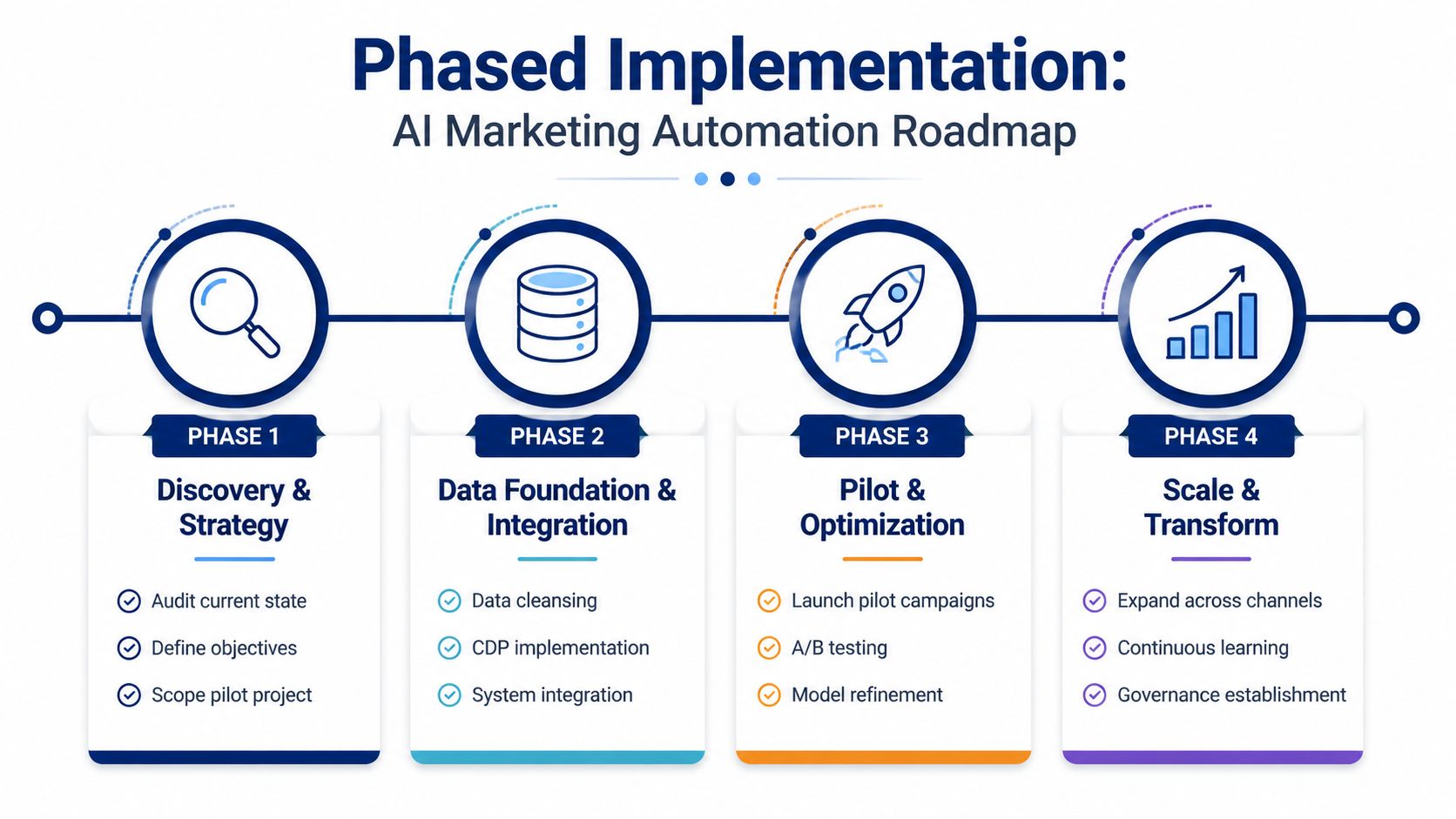
Phase one starts with readiness, not software
Begin by auditing:
Data sources and identifiers
Consent handling
Existing campaign workflows
Decision rights across teams
Current measurement maturity
If you skip this, your pilot will become a cleanup exercise.
Phase two fixes the foundation
This phase usually includes integration work, taxonomy alignment, data quality controls, and decision-layer design. The point is to make data usable, not merely available.
A change programme should run in parallel. Teams need to understand how responsibilities shift when AI starts making recommendations or automating actions. That applies especially to legal, security, and marketing operations.
For broader enterprise adoption, the same principles that improve platform rollouts also apply here. Strong change management for service transformation is directly relevant because adoption risk is usually organisational, not technical.
Phase three should stay narrow and measurable
Pilot one use case. Keep scope tight.
Good pilot characteristics:
Clear business owner
Known data inputs
Defined approval model
Closed feedback loop
Specific success criteria
Avoid launching with five channels, multiple business units, and broad personalisation ambitions. That isn't ambition. It's poor sequencing.
A pilot should prove operational trust, not just technical capability.
Phase four expands governance and operating rhythm
Once the pilot works, scale by standardising:
Model review cadence
Channel activation patterns
Exception handling
Executive reporting
Training for campaign, data, and compliance teams
BCG's framework is right to put AI-ready data management first and responsible governance alongside scaling. Enterprises don't become transformed because a platform goes live. They become transformed when AI decisions are governed, repeatable, and accepted across functions.
How Should You Approach Vendor and Licensing Procurement?
Don't buy on features alone. Buy on fit, transparency, integration strength, and commercial predictability.
What to evaluate beyond the demo
Every vendor can show a polished workflow. Your procurement team should focus on these points:
Integration depth: Can the platform connect to your CRM, service stack, data warehouse, and customer channels without brittle custom work?
Data portability: Can you extract data, models, logs, and output histories if you switch vendors?
Governance controls: Are approvals, permissions, and auditability built in?
Licensing logic: Is pricing based on users, contacts, usage, model calls, or channel volume?
That last point matters. A low entry price can become expensive fast if your model usage and activation footprint expand.
How to compare suppliers sensibly
Use a procurement scorecard, not brand familiarity.
Evaluation factor | What good looks like |
|---|---|
Commercial model | Predictable spend under scale scenarios |
Technical fit | Native alignment with current systems and data model |
Support model | Clear implementation and post-go-live responsibilities |
Risk posture | Transparent security, governance, and audit controls |
If your wider automation agenda includes channel-heavy execution, it's also useful to compare AI social media platforms to understand how specialist tools differ from enterprise-grade orchestration platforms.
Vendor risk shouldn't be an afterthought. Procurement and security leaders should apply the same discipline they use for software vendor risk management across AI marketing suppliers, especially where customer data and automated decisioning are involved.
How Can a Partner Like DataLunix Accelerate Your Transformation?
Most enterprises don't fail because they lack ambition. They fail because the initiative sits between too many teams with no owner for the whole system. That's where a specialist partner matters.
A strong partner should handle three things well. First, it should run discovery and readiness work that tests whether your data, workflows, and governance are fit for AI. Second, it should unify enterprise systems so marketing automation doesn't operate in a silo. Third, it should support change, not just deployment.
What the right partner should do
The right transformation partner should help you:
Map the operating model: Define ownership across IT, marketing, legal, and procurement.
Integrate source systems: Connect service, operational, and customer platforms into a usable data layer.
De-risk rollout: Set governance controls before automation scales.
Support adoption: Train teams, redesign workflows, and maintain a measured rollout pace.
For organisations modernising enterprise platforms, that often means combining AI ambitions with broader service and operations architecture. A regional ServiceNow transformation view is often relevant because customer and service data don't live in one department anymore.
Why execution capability matters more than slideware
A partner should understand licensing, integration, governance, and managed support in one programme. If it can only advise, you'll still have delivery risk. If it only implements, you'll still have strategy gaps.
You can see the agency-side angle in this discussion of AI-driven marketing for agencies, but enterprise buyers need a heavier focus on integration, controls, and long-term operating stability.
The best partner reduces uncertainty. That means fit-gap analysis, readiness assessments, integration planning, stakeholder communications, and post-launch optimisation. If those pieces are fragmented across multiple suppliers, your cost of coordination rises and accountability disappears.
Frequently Asked Questions
Is AI Powered Marketing Automation worth it for regulated enterprises?
Yes, but only when governance is designed up front. In regulated GCC and European environments, the business value depends on consent handling, auditability, and clear decision controls, not just automation features.
What data do you need before launching AI Powered Marketing Automation?
You need unified first-party behavioural data, transactional records, consented identity, and reliable engagement outcomes. If those inputs are fragmented, the automation will be inconsistent and difficult to trust.
How should you measure ROI from AI Powered Marketing Automation?
Use closed-loop measurement tied to business outcomes rather than vanity metrics. Aprimo's discussion of AI marketing automation benefits notes claims such as 84% faster content delivery, but real ROI tracking depends on data quality, feedback loops, and solid measurement design.
What is the biggest implementation mistake?
Buying the platform before fixing the data and operating model. Enterprises that start with software instead of architecture usually end up with weak personalisation, poor attribution, and low adoption.
How long should rollout take?
There isn't a universal timeline worth trusting. The right pace depends on data readiness, integration complexity, governance maturity, and whether you're launching a controlled pilot or a multi-market programme.
If you want to invest in AI Powered Marketing Automation without creating governance debt or integration chaos, work with DataLunix. DataLunix helps GCC and Europe enterprises assess readiness, unify data across core platforms, design responsible AI workflows, secure cost-effective licensing, and manage rollout through discovery, integration, change management, and ongoing optimisation.