
GRC Residency in the UAE: A Strategic Guide for Enterprises

What breaks first in a UAE enterprise, the server location or the access chain behind it? GRC residency is the answer to that blind spot. It treats residency as a governance model, not a hosting label, and it forces CIOs to prove where data sits, who can touch it, which rules apply, and whether those controls still hold across hybrid operations.
Defining GRC Residency in the Modern Enterprise
A lot of teams still confuse data residency with data sovereignty. That mistake is expensive because a UAE cloud region can look compliant on paper while support access, privileged administration, backups, or AI processing still cross borders in practice. The right reading of GRC residency is broader, it is the control environment that binds location, access, evidence, and regulatory fit into one auditable model.
In the UAE, that conversation also intersects with residence governance at the people layer. The official Golden Residency framework is a renewable residence visa valid for 5 or 10 years and is available to qualifying investors, entrepreneurs, specialised professionals, exceptional talents, scientists, students, and other eligible groups, according to the UAE government and the ICP. The point for enterprise leaders is simple, long-term residence creates long-term operating stability for the talent pool that runs digital programmes, risk functions, and regulated platforms. See the official overview from the UAE authorities on Golden Residency eligibility and validity.
Practical rule: If you cannot show who administers the environment, where they work from, and what data paths they can reach, you do not have residency control. You only have hosting.
What the control model has to prove
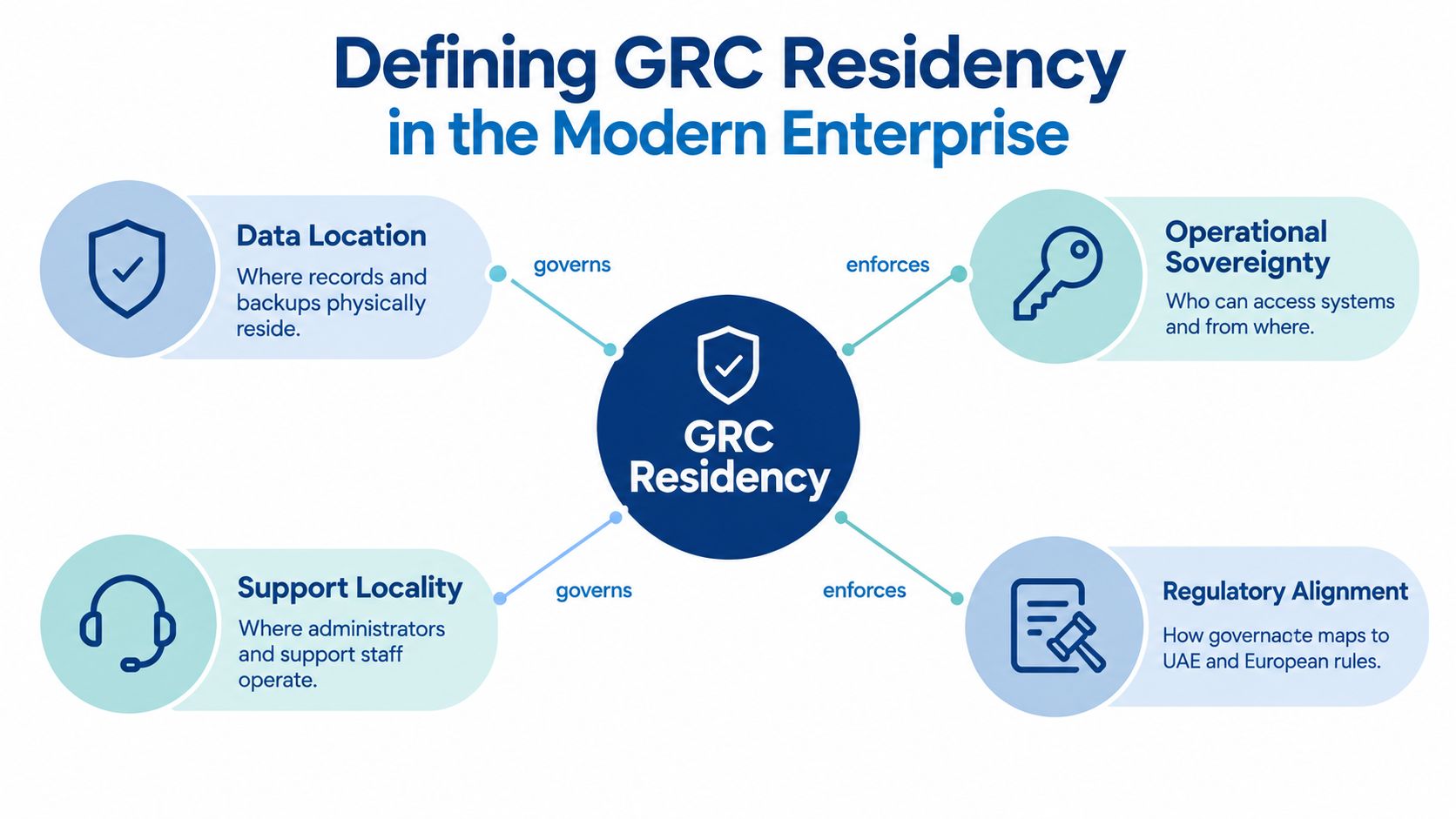
A usable GRC residency design has four proof points. First, data location, meaning where records, replicas, and backups physically reside. Second, operational sovereignty, meaning who can access systems and from which jurisdictions. Third, support locality, meaning where engineers, administrators, and incident responders operate. Fourth, regulatory alignment, meaning the controls map to UAE and, where relevant, European obligations.
That is why a residency register should not stop at a cloud region name. It should separate immutable identity data from frequently changing compliance fields, keep role-based access around passport and Emirates ID records, and show renewal dates, permit validity, and dependant sponsorship status where relevant to the business. For a practical cloud governance angle, the internal guide on GRC cloud controls is useful because it frames residency as an operating discipline rather than a procurement checkbox.
The recommendation is direct. Treat GRC residency as a governance layer that sits above infrastructure, identity, legal review, and service delivery. If you only localise the server, you have not localised the risk.
The Intersection of Talent Stability and IT Governance
The UAE's long-term residency system matters because enterprise control frameworks depend on people staying in role long enough to own evidence, approvals, and remediation. Dubai reported 151,666 Golden Visas issued between 2019 and 2022, which is a strong signal that the residency model is now embedded in the emirate's talent infrastructure rather than treated as a niche pathway. That scale changes how CIOs plan onboarding, privilege assignment, and succession for regulated teams. The relevant Dubai open-data portal is here.
Why stable residence changes control design
A short-term, sponsor-dependent model encourages reactive administration. A longer-term residence model allows you to build cleaner control chains, because the same specialist can own evidence collection, support renewal, and answer auditors across multiple cycles. That is especially important for HR, ITSM, security, and government-facing workflows, where employee status becomes part of the compliance record.
A residency framework is only as strong as its audit trail. If eligibility evidence sits in email threads, the control is already weak.
The practical implication is that your enterprise should validate eligibility as a recurring process, not a one-time gate. Build an evidence chain that links the applicant category, capital or qualification proof, approval authority, permit validity, and any family sponsorship dependencies. That chain should be visible to HR and compliance, but not broadly exposed to the rest of the business.
What CIOs should standardise
Use a small, disciplined set of controls:
Separate identity from status: Keep core identity records distinct from changing compliance attributes such as permit expiry, dependants, and sponsor references.
Restrict privileged access: Limit passport and Emirates ID visibility to the smallest practical group.
Tie alerts to expiry: Trigger alerts before permit renewal dates, not after the deadline.
Document ownership: Assign a named owner for each record type and each renewal step.
For teams building internal capability, the GRC in banking guide is a helpful reference point because banking-style evidence discipline is exactly what residency governance needs. The broader lesson is that talent stability is not just an HR benefit, it is a control enabler.
Navigating Sector-Specific Compliance Requirements
Which rule governs the workload in front of you? That is the question CIOs should ask before they move a single dataset.
The UAE does not apply one universal localisation rule, and treating it that way produces weak architecture. Financial institutions, healthcare operators, and government environments face different expectations, while the personal-data framework still applies across sectors through its own rules on collection, processing, access, and transfer. For mixed datasets, the right design is dataset by dataset, not a blanket policy.
Build the matrix before you move anything
Start with a decision matrix for each dataset. Record the legal basis, regulator, storage location, processing location, support access route, backup location, disaster-recovery site, and whether AI tools touch the data. That is the line between controlled residency and an invisible compliance gap.
Cloud modernisation makes this harder, not easier. Some personal data can move across borders lawfully, while financial, health, or classified material can face tighter limits. Deletion and disposal belong in the same control chain, so if you need a practical lens on end-of-life handling, the compliance-focused overview from Beyond Surplus ITAD services is a useful external reference.
Know which law controls which dataset
The UAE Personal Data Protection Law applies to electronic processing whether it happens wholly or partly inside or outside the UAE. It requires confidentiality and privacy protections and governs collection, use, and processing. Cross-border transfer then depends on adequacy or a recognised safeguard, including contractual protections, consent in specific cases, legal necessity, or judicial cooperation, as set out in UAE guidance and trade references on data transfers.
A workable compliance model should answer four questions for every dataset:
Can it leave the UAE at all?
If yes, under what legal basis?
Who can access it during support or administration?
What happens in backup, recovery, and AI processing paths?
The sharper point is this. A UAE cloud region does not make every workload compliant. Build residency rules that track the dataset, the regulator, and the actual operating path, and review them every time a vendor or workflow changes. For banking-specific governance patterns, the internal GRC in banking resource gives a useful internal reference for how regulated controls are structured in practice.
Building a Resilient GRC Residency Framework
The strongest residency programmes start with evidence, not policy slogans. If your organisation cannot show where data flows, who supports it, and which exceptions are approved, then your residency position will not survive scrutiny. The UAE Personal Data Protection Law makes that clear by tying compliance to collection, use, storage, access, and transfer, not just the physical location of a database.
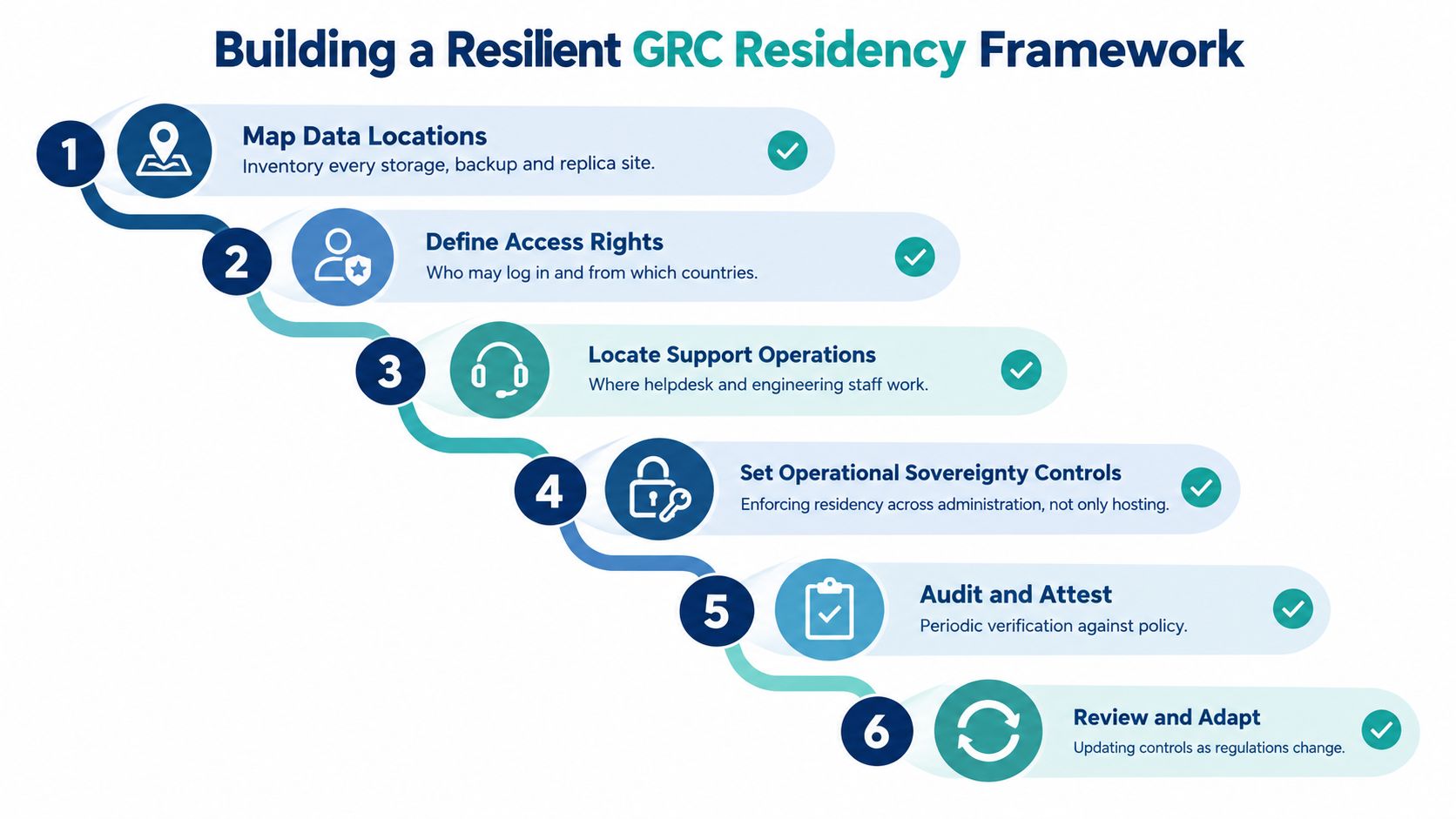
Step one through step six, in the order that works
Map data locations. Inventory every storage, backup, and replica site. If you miss one copy, you miss the control.
Define access rights. List who may log in, what role they hold, and which countries they operate from.
Locate support operations. Identify where helpdesk, engineering, and incident response staff work.
Set operational sovereignty controls. Enforce residency across administration, not only hosting.
Audit and attest. Test the control design on a fixed cycle and keep the evidence.
Review and adapt. Reassess when regulations, vendors, or workflows change.
Why the technical split matters
Separate immutable identity data from changing compliance attributes. That gives you cleaner governance and fewer accidental exposure points. Apply role-based access to passport, residence, and Emirates ID records, and keep those records out of broad operational folders and generic collaboration tools.
Operational rule: If a support engineer can solve the issue only by seeing regulated personal data, the access design is wrong.
You also need transfer-by-transfer justification for anything that leaves the country. Where the destination is not clearly adequate, UAE guidance points to contractual safeguards that bind the overseas recipient to UAE-equivalent protections, alongside other narrow exceptions such as consent, contractual necessity, or legal claims. That is why a residency register must track the exception, the recipient, the purpose, and the accountability route, not just the cloud region.
For implementation, the internal GRC integration guide is relevant because residency controls fail quickly when ITSM, HR, identity, and ticketing systems do not share the same approval logic. Build the framework once, then enforce it through every connected workflow.
Choosing Between Staff Augmentation and Managed Services
Most enterprises underestimate the delivery burden. They think the hard part is writing the policy. The hard part is keeping the control environment alive when staff change, vendors rotate, and audit evidence has to be rebuilt every quarter.
Pick the model that matches your maturity
Staff augmentation gives you direct oversight, but you still own the operating burden. Managed services reduce that burden because the provider carries defined responsibilities under service levels and operating procedures. For a residency programme, that difference matters. A model that depends on every individual hire's location is fragile. A model that contractually guarantees in-country operations is more defensible.
Comparison articles on outsourced delivery often focus on headcount economics, but the core issue is control consistency. The practical guide from IT Cloud Global on outsourced IT is useful because it highlights the same decision tension, control versus speed versus cost, that residency programmes face.
Where DataLunix fits
DataLunix is one option when you want onshore leadership with offshore delivery capacity for implementation and ongoing operations. It is not a licence to ignore governance, but it does give you a delivery pattern that can combine local accountability with scalable execution. For GRC residency, that hybrid model makes sense when the internal team wants to keep ownership of policy and risk while offloading execution, documentation, and workflow build-out.
The internal comparison on managed services versus staff augmentation is worth reading before you choose. My recommendation is blunt. If the programme is strategic, regulated, and tied to long-lived evidence, managed services usually beat DIY. Augmentation helps when you already have mature governance and only need extra hands.
Sample SOW and Roadmap for Enterprise Implementation
A mid-to-large enterprise rollout should begin with discovery workshops, fit-gap analysis, and a residency inventory. That sounds familiar because it is the same discipline used in other transformation work, but here the outputs are more specific, data-flow maps, transfer rules, access boundaries, and evidence owners. A smart team also checks practical support costs early, and a guide such as the Dubai PRO services costs overview helps frame the administrative overhead around residence workflows and government interactions.
A workable sequence for the first engagement
Start with a short scoping phase. Define which business units handle personal data, which systems support those units, and which transfers need legal review. Then move into a fit-gap assessment that compares the current state against UAE personal-data rules, sector rules, and the operating model for support and administration.
After that, build the control design and execute change management together. If you separate policy drafting from stakeholder communications, you usually end up with a neat document and a weak rollout. Bring HR, legal, security, IT operations, and procurement into the same programme cadence so that permits, access rights, vendor clauses, and deletion procedures move together.
Implementation advice: Deliver residency governance as a controlled transformation, not a compliance memo. Memo-driven change dies in shared folders.
What the roadmap should produce
The final deliverables should include a residency register, an exception workflow, renewal alerts, a transfer decision matrix, and a clear set of escalation paths for vendor, support, and AI-related processing. The internal GRC implementation roadmap is relevant here because implementation only works when discovery, documentation, workflow build, and adoption are treated as one chain.
For enterprises that want this done properly, DataLunix can support the discovery, fit-gap analysis, workflow design, and managed delivery needed to operationalise residency controls across hybrid environments. The goal is not just to host data in the right place, it is to prove control over access, support, transfer, and evidence every time an auditor or regulator asks.
If you want a hard-edged residency assessment, DataLunix can help you map the control chain, identify gaps in operational sovereignty, and turn scattered compliance checks into one usable framework. Visit DataLunix to start a structured discussion about your GRC residency posture, implementation roadmap, and managed delivery options.