


GRC Module ServiceNow

ServiceNow GRC is a single-platform suite that unifies risk, compliance, audit, policy and vendor risk workflows. It still requires careful control mapping, regional data residency design and partner-led procurement rather than a simple out-of-the-box installation.
The counterintuitive part is that the platform is often easier to demonstrate than to localise. A team can show policy records, risk registers and audit workflows quickly, but the harder work starts when one UAE entity must answer federal requirements, DIFC or ADGM obligations, supplier controls and European reporting expectations through a coherent evidence model.
That practical tension is visible in the market. A dedicated ServiceNow risk workshop took place in Dubai on 3 October 2024, evidence that these use cases are being discussed and operationalised in the Middle East, not only described in global product material. ServiceNow's GRC product documentation positions the suite around continuous monitoring, real-time visibility and standardised remediation workflows.
The right question, therefore, isn't just whether ServiceNow can manage GRC. It's whether your organisation can design the control library, ownership model, data residency pattern and reporting layer that make the platform useful.
Why ServiceNow GRC Matters for Modern Enterprises
Most large organisations don't have one compliance problem. They have a coordination problem. Risk assessments sit in a spreadsheet, policy approvals move through email, audit evidence is stored in shared folders and vendor questionnaires live in separate point tools. Each team may perform its task, but nobody has a dependable operating view of how policy, control, risk and remediation connect.
The GRC Module in ServiceNow addresses that fragmentation by placing governance workflows on a shared platform. ServiceNow describes GRC as a single-platform approach for replacing manual risk and compliance processes with automated monitoring across business, security and IT functions. Its documentation also describes centralised compliance visibility and vendor remediation workflows through the same environment.
That changes the executive conversation. GRC stops being a periodic reporting exercise and becomes a control fabric:
Policy links to control. Internal policies and standards can be connected to the controls that implement them.
Control links to risk. Control performance provides context for risk assessments and exceptions.
Risk links to action. Issues and remediation activities receive owners, workflows and follow-up.
Vendor risk joins enterprise risk. Third-party obligations can be assessed alongside internal control requirements.
Practical rule: If a GRC record doesn't lead to an accountable owner, a defined evidence action or a remediation decision, it's probably documenting risk rather than managing it.
This matters particularly in the UAE and GCC, where data protection, cybersecurity and supplier governance requirements continue to create work for risk and technology leaders. A unified workflow helps you maintain a central policy map and respond to changes without asking every department to rebuild its own compliance tracker.
The platform also becomes more valuable when it connects with the operational systems your teams already use. A risk exception that has no relationship with a service, asset, change or supplier remains abstract. A risk exception attached to an accountable operational record can enter the same workflow as the work required to resolve it. This is why keeping GRC beside, rather than within, core service operations often produces fast adoption but weaker long-term value.
For a useful perspective on the adjacent challenge of governing AI systems, see this resource on agentstack ai governance compliance. The same principle applies to broader GRC design: governance becomes sustainable when it is connected to the systems and decisions it governs.
A practical starting point is to define the enterprise control model before configuring every available application. The GRC in control guide is useful background for framing that operating model around ownership, evidence and remediation.
ServiceNow GRC Architecture and Core Products
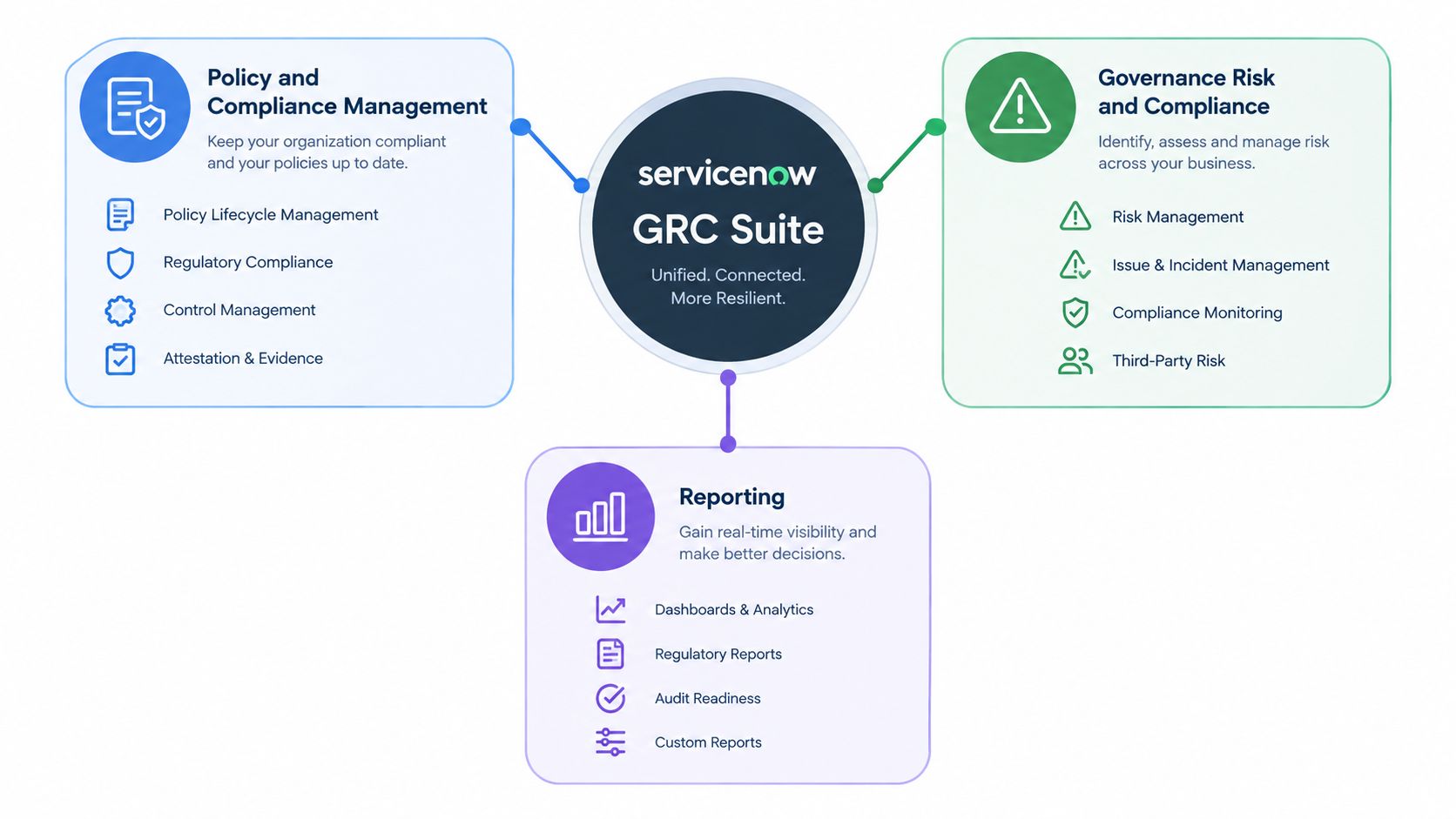
ServiceNow GRC works best when you treat its products as connected parts of one control system, not as separate applications purchased by separate departments. Policy and Compliance Management provides the organising layer. It centrally manages policies, standards and internal control procedures, then cross-maps those procedures to external regulations and benchmarks, as described in ServiceNow's Policy and Compliance Management documentation.
The architecture normally brings together four capability areas:
Policy and Compliance Management
You establish policy lifecycles, authority documents, citations, standards and internal controls here. The important design choice is to avoid creating one duplicate control for every regulation. Where a single internal control satisfies several obligations, map the control to each applicable requirement and preserve one accountable owner.
Risk Management
Risk workflows give the control library business context. They should identify the affected entity, risk statement, assessment method, treatment decision, owner and review point. A risk register without those relationships becomes another list. A risk record connected to controls, issues and business ownership can support decisions by risk committees and operational leaders.
Audit Management
Audit Management gives internal audit a structured process for scheduling audits, planning resources and scoping engagements. The product documentation confirms those mechanics in ServiceNow's Audit Management reference. Reusing control evidence and issue workflows can reduce repeated requests, although evidence still needs review and professional judgement.
Vendor Risk Management
Third-party risk belongs in the same governance model as internal compliance. Supplier tiering, due diligence, contractual obligations, assessment findings and remediation should connect to the services and risks those vendors support. Don't create a vendor programme that reports separately from enterprise risk.
The ServiceNow IRM architecture overview provides a related way to think about the suite. Start with shared reference data, then decide which workflows should remain standard and which gaps justify an extension.
How GRC Integrates with ITSM, ITOM and ITAM
The strongest ServiceNow GRC design turns operational records into evidence without pretending that every event is a compliance event. Incidents, changes, infrastructure observations and asset records can provide useful context, but only when the control owner has defined what signal matters and what action follows.
Consider a change control. A change record can support evidence for a control concerned with authorisation, segregation of duties or production risk. That doesn't mean every change should create an audit task. The implementation team must define the relevant change classes, approval conditions and exceptions, then route only meaningful failures into GRC workflows.
The same discipline applies to ITOM and ITAM data. Infrastructure and service information can help identify affected entities, while asset ownership can improve accountability for controls. If the underlying records are incomplete or duplicated, automation moves poor data into a formal compliance process.
Three integration patterns that work
Evidence pull is appropriate when a source system already contains a reliable result. A scheduled transfer can attach a control result or evidence item without forcing an analyst to copy information between tools.
Exception routing works when an operational failure requires governance attention. A failed condition should create an issue with a clear owner, due date and escalation path, not a flood of low-value audit tasks.
Context enrichment helps risk and audit teams understand scope. Linking a control to the relevant service, asset or supplier makes review more useful than a detached policy record.
The boundary matters. Don't duplicate control logic across ITSM, ITOM and GRC. Define the authoritative source for each data element, establish naming and ownership rules, and test the failure path before automating the success path.
The practical value of integration is not a dashboard filled with live data. It's the ability to answer which control failed, what business service is affected, who owns the response and whether the remediation is complete. The ServiceNow GRC integration guide offers a useful starting point for structuring those dependencies.
Implementation Roadmap and Fit-Gap Planning
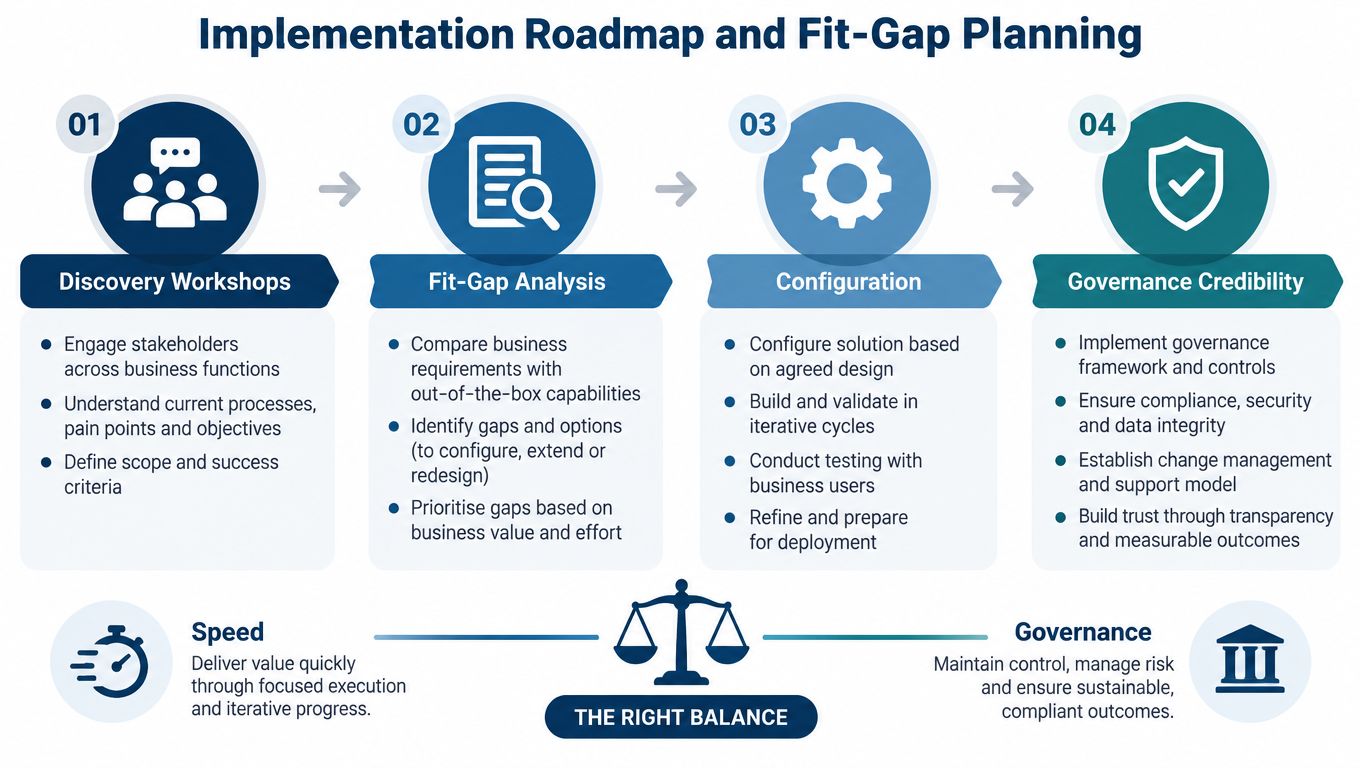
Implementation should begin with governance design, not screen configuration. The first workshops need representatives from risk, compliance, internal audit, security, IT operations, procurement, legal and the business units that own regulated services.
Start with discovery
Document the current control library, regulatory sources, evidence repositories, issue processes and reporting commitments. Identify duplicate controls, unclear ownership and evidence that depends on manual collection. This gives you a factual baseline for prioritisation.
Run fit-gap analysis before customisation
Compare the desired process with the standard ServiceNow model. Classify each difference:
Adopt: Use the standard workflow when it meets the business requirement.
Configure: Adjust fields, roles, notifications or routing without changing the core model.
Integrate: Connect an external source when that system remains authoritative.
Extend: Build custom behaviour only when a regulatory or operating requirement cannot be met another way.
Customisation should be the last option, not the first response to an unfamiliar process. Excessive extensions raise upgrade and ownership concerns, while a rigid standard rollout can leave local obligations poorly represented.
Localise the control model
UAE and GCC programmes need a regulatory calendar and control library that reflect the entities and jurisdictions in scope. DIFC and ADGM organisations operate under separate data-protection regimes in addition to UAE federal law. Regional implementations may also require mapping to frameworks such as the SAMA Cybersecurity Framework, NCA ECC-2:2024 and UAE information assurance requirements, as discussed in this regional GRC framework analysis.
ServiceNow supports cross-mapping and Regulatory Change Management for tracking upcoming changes, assessing impact and managing remediation. The platform doesn't remove the need for local interpretation. Your legal, compliance and control owners must decide which obligations apply, what evidence proves compliance and how quickly a change must be assessed.
The two-thirds compliance reference often cited in UAE coverage should not create complacency. Even where organisations report compliance with national data-protection laws, AI governance, vendor complexity and international obligations can remain difficult areas. Treat that as a programme-design signal, not a reason to reduce oversight.
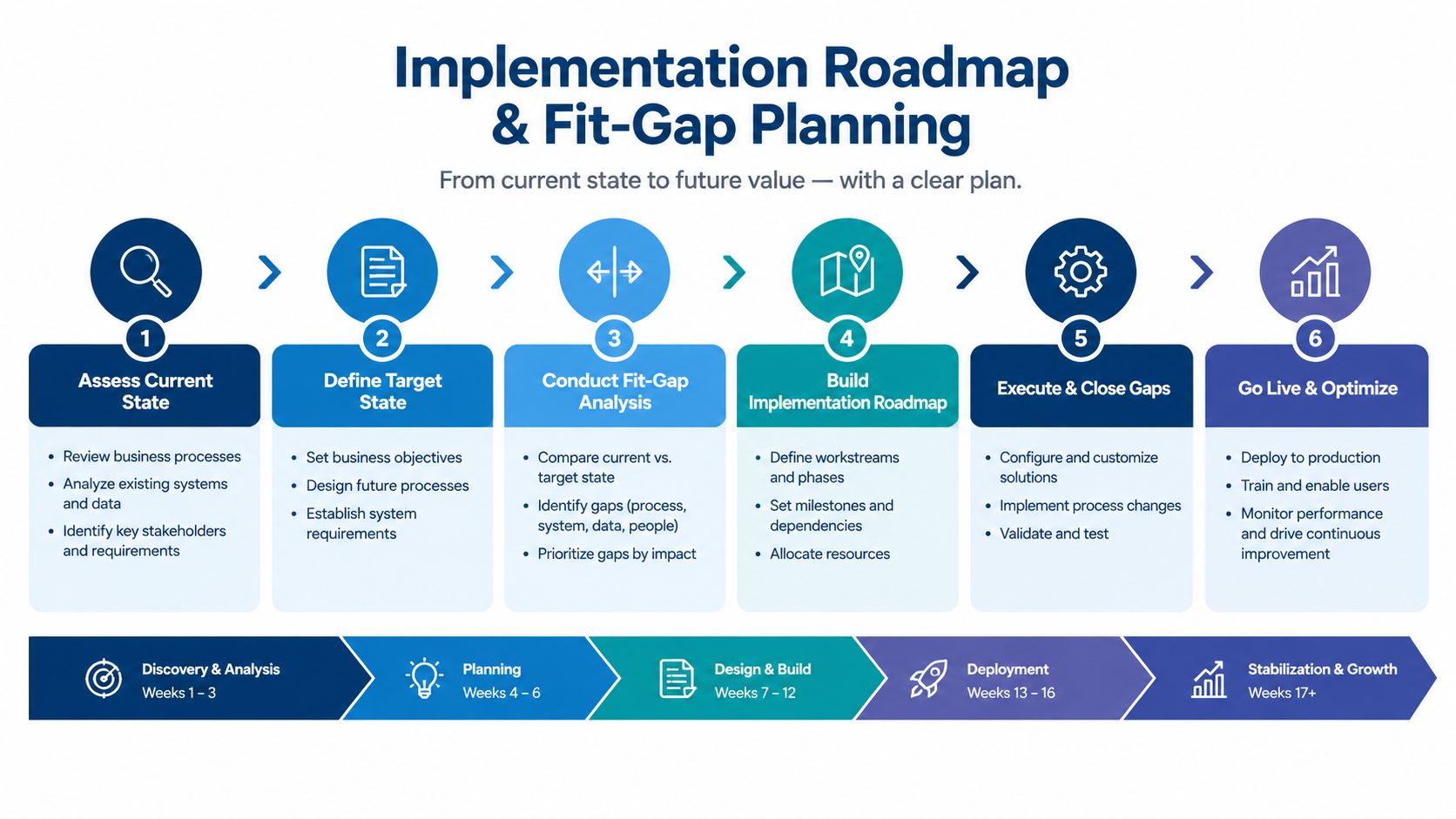
Roll out a bounded scope first, establish evidence cadence and measure whether owners complete their activities. The ServiceNow GRC implementation roadmap can help structure discovery, fit-gap decisions, configuration, enablement and ongoing optimisation.
Licensing, Procurement and Partner Options
Procurement for ServiceNow GRC should evaluate more than the subscription line. You're buying a platform capability, implementation effort, integration design, control-library work and an operating model that someone must maintain after go-live.
A direct vendor route may suit an organisation with an established ServiceNow commercial relationship and a large internal architecture team. A specialist partner route can be more practical when you need regional design support, delivery capacity, licensing guidance and a managed transition. Reseller economics and commercial terms can vary, so procurement should compare the complete proposal rather than assuming list price tells the whole story.
Ask each supplier to make these items explicit:
Procurement question | Why it matters |
|---|---|
Which GRC capabilities are included? | Scope can differ across policy, risk, audit and vendor workflows. |
Which user types require access? | Occasional approvers and regular practitioners may have different requirements. |
What integrations are assumed? | Evidence automation depends on source systems, connectors and ownership. |
What is standard versus custom? | Custom work affects support, upgrades and future change. |
What happens at renewal? | A low initial commitment may not reflect the long-term commercial model. |
Data residency deserves its own technical and contractual review. ServiceNow's UAE GeoEnclave is designed for UAE commercial and enterprise customers that need data kept in-country. Its architecture uses Microsoft Azure UAE North availability zones, Advanced High Availability design, backup procedures, customer and ServiceNow access controls, plus encryption in transit and at rest, according to the UAE GeoEnclave white paper.
That is not the same as generic European hosting. A UAE entity should validate which records are covered, where support access occurs, how backups are handled and whether the residency model satisfies its internal and regulatory requirements.
For commercial preparation, use a structured ServiceNow licensing buying guide, then ask the vendor and partner to confirm current packaging in writing.
Real GRC Pain Points and Reporting Gaps
A unified platform doesn't eliminate manual compliance work. It relocates the difficult work from scattered administration to data modelling, evidence quality, attestation design and regulator-ready reporting.
One recurring gap affects AE-based organisations with European exposure. Independent user feedback identifies missing xBRL import and export functionality and shortcomings in attestation synchronisation. One reviewer reported that an out-of-the-box DORA accelerator lacked xBRL export and had to be rebuilt, as recorded in the ServiceNow GRC user review collection.
That doesn't make the platform unsuitable. It changes the design assumption. If a regulator, parent company or auditor expects a particular spreadsheet, PDF or machine-readable format, you need to test the output before signing off the implementation.
Where teams underestimate the work
Evidence packaging can require transformation, filtering and approval beyond the standard record view. An evidence item may be valid internally but still need a different structure for an external submission.
Attestation synchronisation becomes difficult when subsidiaries use different review cycles, identity sources or policy versions. A central workflow needs clear rules for status, expiry, reminders and exceptions.
Accelerators can speed up the first configuration while still leaving framework-specific gaps. Treat them as starting assets, not proof that every reporting requirement is covered.
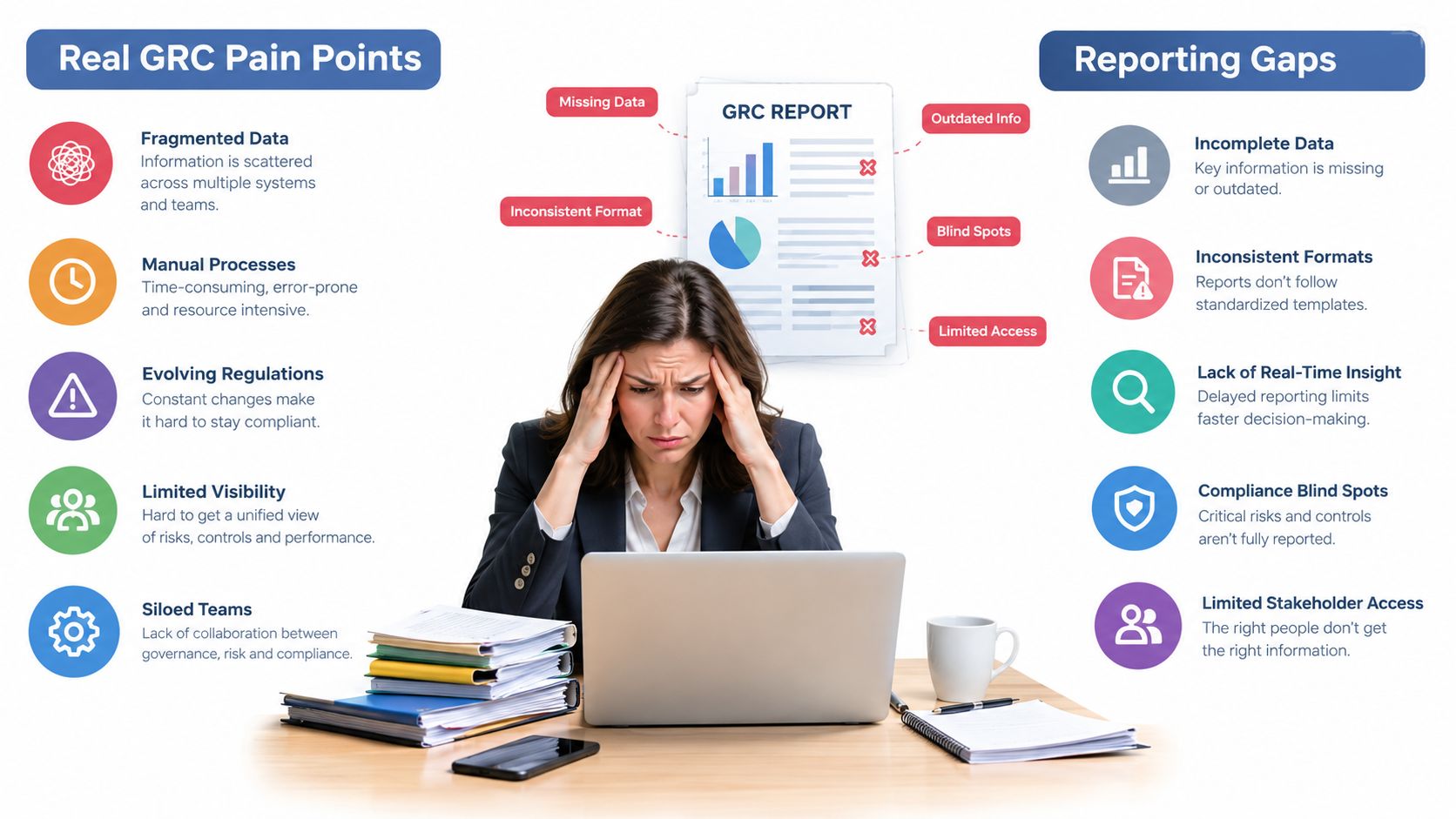
The right response is a reporting fit-gap assessment. List every regulator-facing output, identify its required fields and format, then test whether the platform can produce it through configuration, integration or a controlled manual step.
Reporting reality: Automation is valuable only when the resulting evidence is acceptable to the person who reviews it.
For multi-subsidiary groups, keep the control model central where possible, but preserve local applicability, ownership and evidence. A single global record that obscures jurisdictional differences is not simplification. It's a new audit risk.
Managed Services and Staff Augmentation for GRC
A GRC programme needs more than a project team. After implementation, someone must maintain authority documents, review regulatory changes, manage control owners, monitor evidence, triage issues and prepare audit responses. Many organisations struggle to provide that coverage across UAE, GCC and European jurisdictions with internal staff alone.
Managed services and staff augmentation solve different problems.
Managed services provide an operating capability with an agreed scope, service cadence and escalation model. This can suit organisations that want support for regulatory watchlists, control testing, evidence administration, reporting and platform optimisation while retaining risk acceptance and policy decisions internally.
Staff augmentation adds specialist capacity to your existing team. It can be useful during discovery, data migration, integration testing, control mapping or a major audit cycle, especially when internal stakeholders understand the business but lack ServiceNow GRC delivery experience.
Neither model should transfer accountability for governance decisions. The organisation must retain ownership of risk appetite, policy approval, control acceptance, regulatory interpretation and remediation priorities.
A partner evaluation should cover:
Jurisdictional knowledge: Can the team distinguish UAE federal obligations from DIFC and ADGM requirements?
Control-library skill: Can consultants map regional requirements to internal controls without creating unnecessary duplication?
Platform capability: Can they configure workflows, roles, integrations and reporting without excessive customisation?
Delivery model: Can they provide onshore leadership, offshore capacity or a hybrid team where appropriate?
Knowledge transfer: Will internal owners understand the process after the engagement?
Regional mapping may also involve SAMA Cybersecurity Framework, NCA ECC-2:2024 and UAE information assurance requirements. That work demands more than generic platform administration. It requires someone to translate obligations into accountable controls, repeatable evidence and workable remediation.
The strongest arrangement is usually hybrid. Internal leaders make governance decisions, while a partner supplies delivery capacity, specialised configuration and operational support. That keeps ownership clear without forcing the organisation to hire every skill permanently.
Deciding Whether to Adopt or Mature ServiceNow GRC
ServiceNow GRC is a strong strategic fit when your organisation needs one operating model across compliance, risk, audit and third-party governance. It becomes more compelling when you already rely on ServiceNow operational workflows and want governance records connected to the services, assets and teams they affect.
Adoption deserves caution when the requirement is narrow. If you only need a basic policy repository or a limited framework checklist, a full enterprise programme may introduce unnecessary platform and operating overhead. The decision should follow scope and maturity, not an assumption that a broader platform is automatically better.
Use these questions with your CIO, IT director, risk leader and procurement team:
How many jurisdictions must the control model cover? Include UAE federal, DIFC, ADGM, GCC and European obligations where relevant.
Do we have accountable control owners? A platform can't compensate for unclear ownership.
Can we define acceptable evidence? If evidence is ambiguous, automation will produce noise.
What must remain in-country? Document residency, access, backup and encryption requirements.
Which regulator-ready outputs are mandatory? Test PDF, spreadsheet and machine-readable reporting needs early.
Are we prepared to operate the system? Plan for regulatory change, attestation, issue management and upgrades after go-live.
Where do we need partner capacity? Decide whether the gap is implementation, architecture, licensing, managed services or staff augmentation.
Proceed when the business can agree on scope, ownership and evidence. Pause when stakeholders are asking the platform to resolve undefined policies or contradictory jurisdictional interpretations. Restructure when the proposed design relies on extensive customisation before the control library and source data are stable.
The most defensible programme starts with a focused discovery workshop, followed by fit-gap analysis and a pilot that tests local regulatory mapping, evidence collection, audit packaging and residency requirements. Once those decisions work in practice, expand the model across entities and suppliers.
DataLunix offers discovery workshops, fit-gap analysis, ServiceNow GRC implementation, regional delivery, staff augmentation and managed optimisation for enterprises operating across the GCC and Europe. Visit DataLunix to discuss your control model, residency requirements and the right procurement path before committing to a rollout.