
GRC Program Blueprint for GCC Enterprises in 2026

Updated: 8 hours ago
The UAE has made the case for a real GRC program bluntly clear. Labour-market compliance levels rose by 34% in 2025 compared with 2024, alongside more than 695,000 inspection visits and over 3,000 joint campaigns with government partners (UAE Ministry of Human Resources and Emiratisation). That is not a documentation problem. It is an operating model problem.
A GRC program is governance, risk, and compliance run as one system, not three separate binders. Governance sets who decides, risk determines where to focus, and compliance proves the controls worked as intended. In the GCC, that difference matters because regulators, suppliers, and service owners all move at different speeds.
If your organisation is still treating GRC as annual policy maintenance, you are already behind. The enterprises that hold up under pressure are the ones with jurisdiction-mapped controls, time-bound incident response, and measurable resilience outcomes. Everything else is paperwork.
Why GCC Enterprises Need a GRC Program Now
The enforcement signal in the UAE is loud. When compliance checks rise that sharply, leadership can't rely on static policies and periodic attestations to stay credible with regulators, auditors, and customers. They need evidence that exists when the regulator asks for it, not after a scramble.
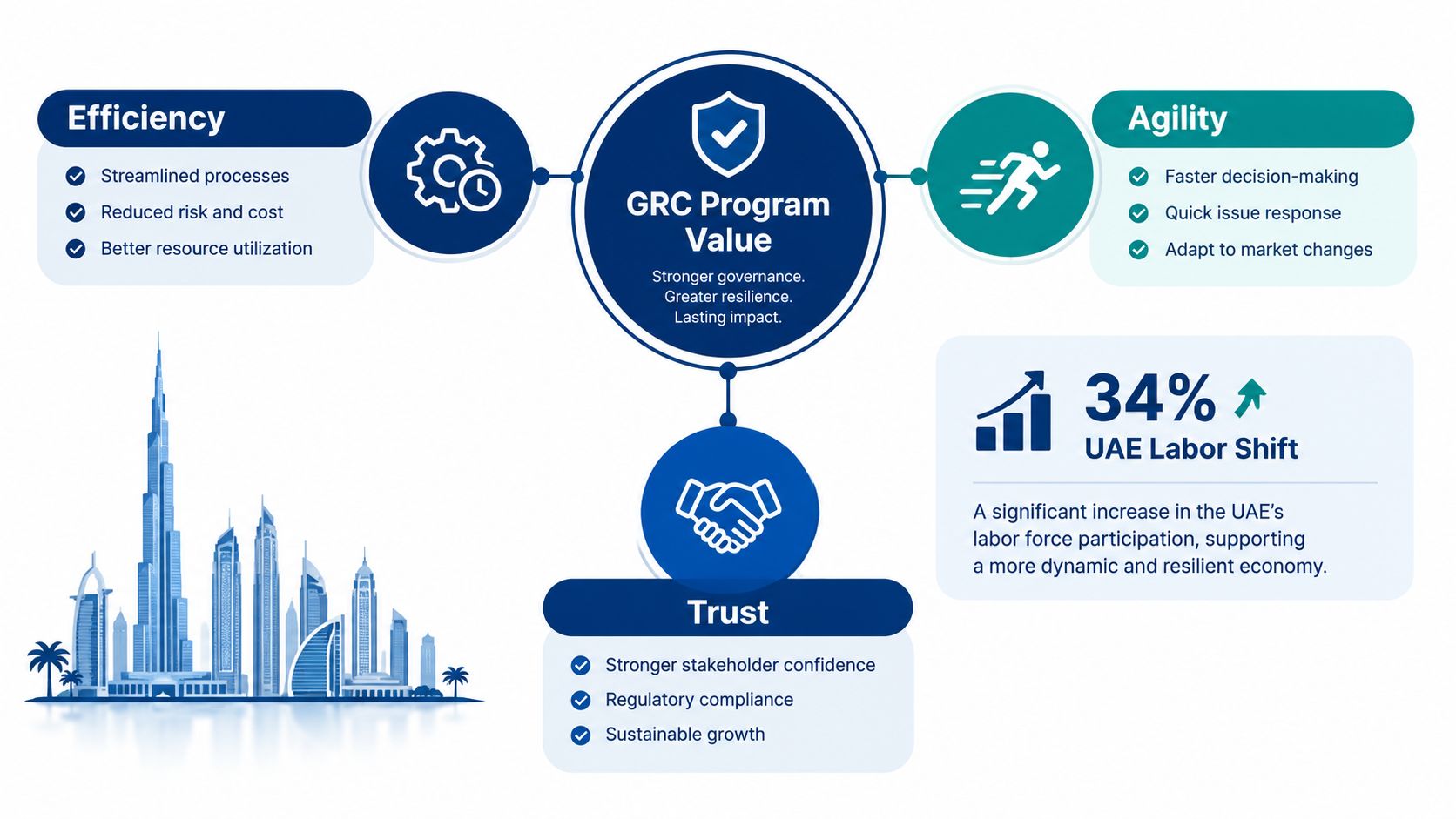
A GRC program is the operating layer that connects decisions, controls, and evidence. It should do three things well. It should map obligations to the right jurisdiction, it should force incidents through a clocked response path, and it should show whether controls improve resilience instead of just producing audit PDFs.
Pillar | Owns | Produces | Evidence artefact |
|---|---|---|---|
Governance | Decision rights and oversight | Accountable direction | Board or committee record |
Risk | Prioritisation under uncertainty | Risk choices | Risk register and acceptance memo |
Compliance | Control evidence | Proof of adherence | Test results and incident logs |
Practical rule: if an issue can't be tied to an owner, a deadline, and a regulator-specific obligation, it isn't under control yet.
That is why a GRC program now sits beside budget, hiring, and architecture decisions. The hard drivers are obvious, regulatory pressure, third-party exposure, cloud dependencies, and AI-led process change. The soft driver is reputation. Once evidence is missing, every other conversation gets harder.
For a broader baseline on how the discipline is framed, see governance, risk and compliance fundamentals. The mistake many teams make is treating GRC as a document set. The better approach is to treat it as a control system.
Governance Risk and Compliance as Connected Disciplines
Treating governance, risk, and compliance as separate workstreams is the most common failure pattern. Governance without risk becomes bureaucracy. Risk without governance becomes analysis. Compliance without either becomes checklist theatre.
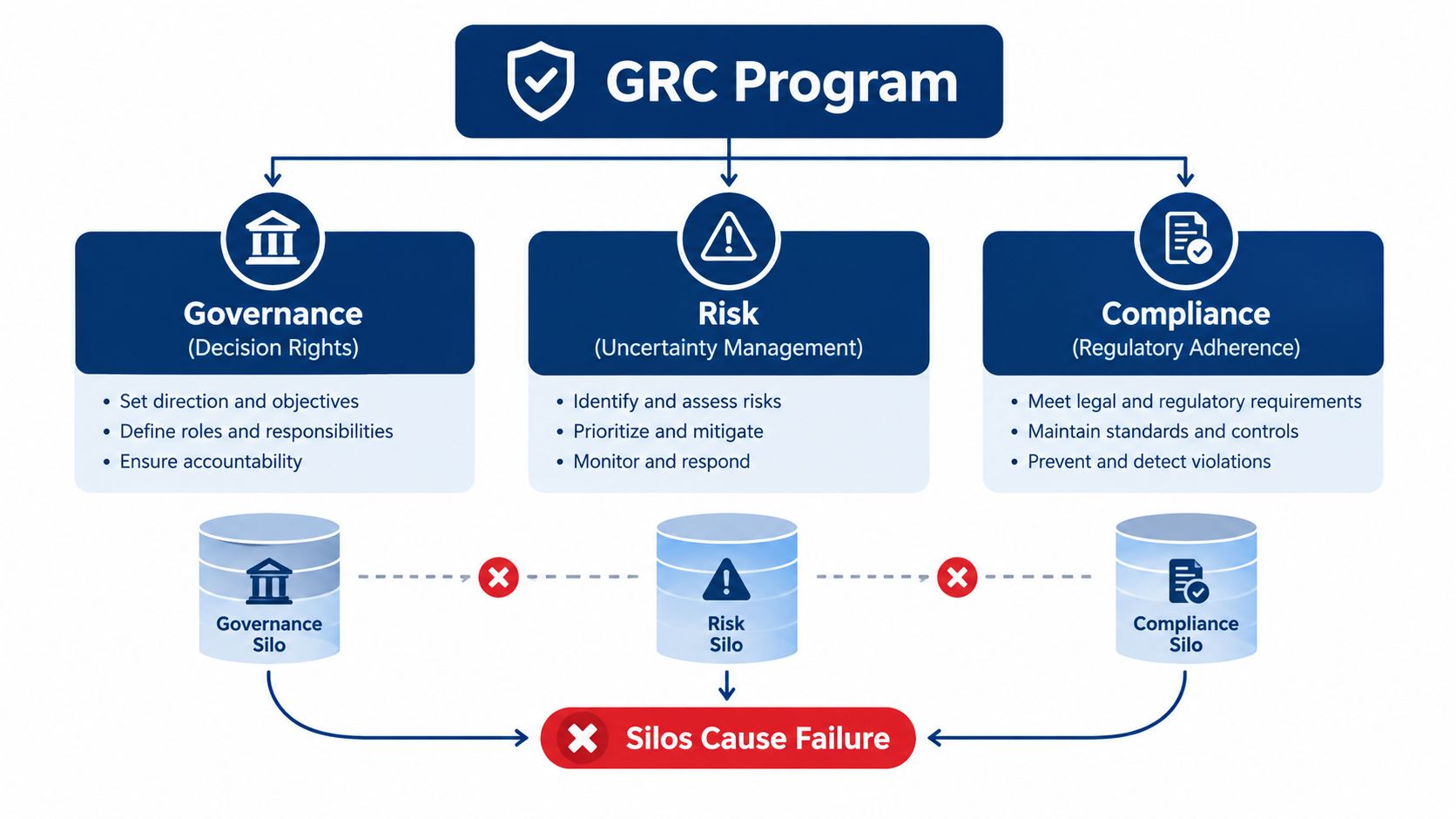
Governance sets the decision model
Governance is decision rights, not slogans. In the UAE financial sector, the Central Bank's Corporate Governance Regulation turned board oversight into recurring disclosure and review work, which is exactly what mature governance should do. Independent analysis of UAE corporate governance also found that listed companies subject to formal governance controls rose from an average of roughly 89 during 2015–2019 to 106 during 2020–2023, while around 87 listed companies submitted governance reports on average during 2015–2019 (study on UAE corporate governance).
That shift matters because it shows governance is now testable. It's no longer enough to say the board “oversees” risk. The board has to evidence oversight through approvals, reporting, and follow-up.
Risk decides where effort goes
Risk is prioritisation under uncertainty. A strong GRC program does not try to test everything equally. It spends assurance effort where harm is most likely to hit financial, regulatory, or reputational exposure. That means risk acceptance records, scenario thinking, and explicit owner sign-off.
Operator's test: if the highest-risk activities look identical to the lowest-risk ones in your control library, your scoping model is broken.
Compliance proves control execution
Compliance is not a periodic checkbox exercise. It is the evidence layer. In a real program, that means each obligation has a control, each control has a named owner, and each test has a freshness date. One useful external reference point on how teams handle this in practice is navigating compliance in data platforms, because the same logic applies whether the evidence lives in a warehouse, service desk, or vendor file.
For self-assessment, keep these artefacts current:
Risk acceptance memos for any exception that matters.
Owner records for each control and processing activity.
Evidence freshness dates for critical controls.
Board reporting packs that show unresolved actions, not just closed items.
Documented escalation paths for incidents, breaches, and supplier failures.
That is the line between governance theatre and an operating discipline. For a comparison point on regulatory alignment, DORA implementation patterns are useful because they show how resilience, accountability, and evidence need to sit together.
UAE and GCC Regulatory Map That Drives a GRC Program
A GCC GRC program fails fast if it treats the UAE as one uniform rulebook. A company active in mainland UAE, DIFC, and ADGM has to map controls to different data protection regimes, keep data inventories current, and document processing activities across entities and locations (UAE data protection laws). Generic global control libraries break here because they ignore jurisdiction, regulator, and evidence trail.
Map the authority to the obligation
Different regulators own different obligations. Financial governance sits with the Central Bank of the UAE. DIFC and ADGM each bring their own data protection regimes. Labour, health, and consumer-facing activity add separate reporting expectations. A GRC program has to tie each entity, data set, and obligation together cleanly.
Regime | Applies to | Core obligation | Evidence to maintain |
|---|---|---|---|
Federal UAE PDPL | Personal data processing in the UAE | Lawful processing, rights, retention, security | Processing records and privacy controls |
DIFC data protection law | DIFC entities and processing | Control over personal data and breach documentation | Incident register and control tests |
ADGM data protection rules | ADGM entities and relevant processing | Timely breach notification | Notification log and regulator correspondence |
Saudi listed-company governance | Listed entities in Saudi Arabia | IFRS reporting and board governance structures | Financial statements and committee records |
The Saudi example is a useful contrast. It shows why a GCC-wide governance policy is not enough. Different jurisdictions require different evidence trails, and the control library has to reflect that reality.
If you want a practical view of where UAE submissions break down in labour-related filings, Goodhand's UAE compliance insights are worth reading because they reflect how rejection risk shows up in operations, not just in policy text.
Build the minimum viable regulatory map
Before scale, the program needs four basics:
Regulatory mapping by entity, jurisdiction, and obligation.
Data inventories that show what is processed and where.
Accountability assignment so every control has a named owner.
Processing-activity records that support reviews, audits, and breach response.
That structure makes the rest of the program work. Without it, every incident becomes a search exercise. For a separate European comparison, DORA-style resilience patterns show why structure must precede tooling. See the GRC implementation approach for the same sequence in a different regulatory setting.
Implementation Roadmap from Assessment to Adoption
A GRC program works only when rollout follows a hard sequence. Skip the sequence and you get tool sprawl, spreadsheet shadow work, and controls that look tidy on paper but fail in operations.
Start with assessment that tells the truth
Assessment should be a fit-gap exercise. Its job is to show where current processes, evidence, and ownership fall short of the target operating model. If the output is just a long answer pack with no clear maturity gap, the exercise has missed the point.
Design the operating model before the controls
Design the control hierarchy, ownership model, review cadence, and policy structure before you load controls into a tool. Each control needs one accountable owner and one testing path. Shared ownership sounds collaborative, but in practice it turns into no ownership.
Translate policy into testable controls
Keep the first control set practical and risk-based. Encryption, authentication, privileged access monitoring, immutable audit logs, vulnerability remediation, backup recovery testing, and access recertification are the controls that show whether the environment can stand up to scrutiny. They are not decorative language for an audit deck.
Operational advice: if a control cannot be tested by a clear owner with a clear record, it is not ready for audit or board reporting.
Wire in tooling only after the model is clear
Tooling should unify records, not create another silo. A credible GRC program should pull evidence from ITSM, ITOM, ITAM, HRSD, and CSM records so teams are not rekeying the same issue three times. In the UAE context, DIFC guidance expects controllers and processors to protect personal data against accidental loss, destruction, alteration, unauthorised disclosure, and unlawful processing, while taking the nature, scope, context, purpose, and risks of processing into account (DIFC data protection guidance). That is a control design problem, not a privacy-policy exercise.
Treat change management as the adoption engine
Change management keeps the program alive after go-live. Stakeholder communications, training, executive sponsorship, and adoption metrics are not soft extras. They separate a live operating model from a stalled rollout.
For teams that need a broader transformation lens, DORA-style implementation discipline is a useful reference point because it forces sequence, ownership, and evidence.
Integrating GRC with ITSM, ITOM, ESM and Managed Services
The fastest way to kill a GRC program is to isolate it from service operations. If risk and compliance data lives in one system and incidents, assets, suppliers, and HR cases live in another, nobody gets a reliable view of control health. Integration is what turns compliance from a file cabinet into a live control environment.
Use the systems you already trust
Control exceptions should attach to configuration items in the CMDB. Audit evidence should come from incident, change, and problem workflows. Supplier due-diligence results should flow into procurement and contract records. That way, the control trail follows the work instead of trailing behind it.
Breach handling is the clearest example. Under UAE federal PDPL, controllers must notify the competent authority when a breach is likely to affect privacy, confidentiality, or security, while ADGM rules require notification within 72 hours of becoming aware of a qualifying breach (Chambers Practice Guides on UAE data protection). That only works if detection time, legal triage, and deadline tracking sit inside the same workflow.
Make managed services part of the control design
Outsourced operations should not sit outside the control model. Managed-service SLAs need evidence SLAs, exit planning, data-localisation clauses, and escalation rules. If a vendor can't produce evidence on demand, the service is not really controlled.
That is why teams should evaluate service partners on operational integration, not just implementation promises. A useful industry view on outsourcing engineering outcomes shows how delivery expectations change once the work is measured as an outcome, not a staffing event.
For a practical architecture pattern, GRC integration with service platforms is the right place to look if you want GRC records to connect cleanly with ITSM, ITOM, HRSD, and CSM. DataLunix also fits naturally into that conversation because it unifies governance records with service operations across those platforms.
KPIs and Operating Model That Prove Resilience
Most GRC dashboards are vanity dashboards. They count policies, closed issues, and passed audits, then claim success. That does not prove the organisation is more resilient.
Measure outcomes, not activity
PwC's 2025 Middle East Digital Trust survey found that 55% of business and technology leaders prioritised digital and technology-risk mitigation over the following 12 months, and 21% said new regulations improved resilience by enforcing an industry-wide framework (PwC Middle East Digital Trust survey). That tells you where the board conversation should go. Not control volume. Outcome quality.
Vanity metric | Operational KPI | Why it matters |
|---|---|---|
Policies approved | Percentage of critical controls with fresh evidence | Shows whether controls are being maintained |
Audits passed | Time to regulator notification | Shows whether the response is timely |
Issues closed | Recovery time within agreed tolerances | Shows whether services stay resilient |
Training completed | Supplier evidence SLA compliance | Shows whether third parties remain visible |
Reports delivered | Share of risk decisions tied to business priorities | Shows whether risk is driving real decisions |
Use a three-line accountability model
The first line owns the control. The second line sets standards and monitors performance. The third line tests independently. That structure works only if the committee calendar, board dashboard, and issue escalation path are all clear. Otherwise, the program turns into meeting theatre.
A mature GRC program should refresh its risk register on a schedule that matches operational change, not annual convenience. If supplier exposure, regulation, or service architecture is moving, the register has to move too.
Board-level rule: if the dashboard doesn't show overdue actions, unresolved exceptions, and business impact, it's a status report, not a risk report.
What to Fix First and How to Choose a Delivery Partner
Start with the basics. In the first 90 days, fix jurisdiction mapping, create a single source of truth for processing activities and assets, and build the three workflows that matter most, privacy-breach response, supplier due diligence, and access recertification. Don't try to roll out the entire framework at once.
A delivery partner should be able to work across UAE, DIFC, and ADGM, integrate GRC with ITSM, ITOM, HRSD, and CSM, and support implementation on platforms such as ServiceNow, HaloITSM, HaloPSA, and Freshservice. You also want onshore, offshore, or hybrid delivery options, plus access to certified staff augmentation when the internal team is thin.
The market is already moving towards direct third-party monitoring, too. A 2025 YouGov survey found that 62% of UAE IT and business decision-makers directly monitor compliance across all third-party providers, 60% update compliance reviews when UAE laws change, and 55% do so when global laws change (YouGov survey on UAE data sovereignty). That means your partner has to help you operationalise evidence, not just write policy.
For teams that want the full advisory path, GRC consultancy support is relevant because it covers discovery, fit-gap analysis, implementation, and change enablement. DataLunix does that work across governance, IT operations, and service workflows, which is the right shape for GCC enterprises that need one control picture across multiple systems.
If you want a GRC operating model that holds up in the GCC, visit DataLunix and use it to scope your jurisdiction map, evidence workflows, and rollout plan. The right move is to fix the control architecture first, then scale the tooling, then measure resilience. That sequence is what keeps the programme credible with regulators and useful to the business.