


GRC Consultancy for GCC and Europe Enterprises

Updated: 1 hour ago
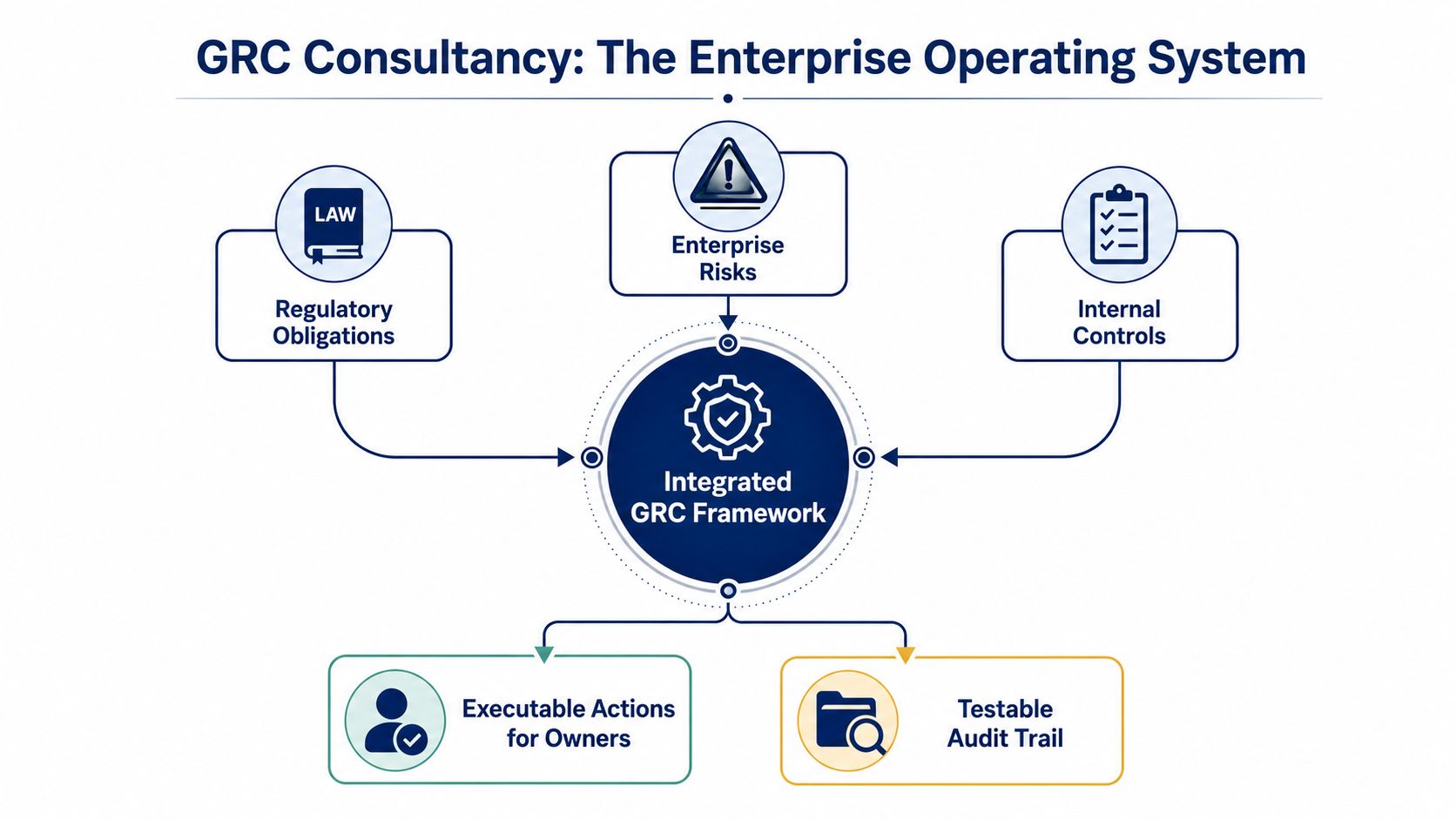
Your board wants assurance, the regulator wants evidence, and your technology team is still reconciling spreadsheets, policies and disconnected risk registers. GRC consultancy should resolve that operational gap. It should turn UAE and European obligations into owned controls, tested workflows, board reporting and evidence that remains usable after the engagement ends.
What a GRC Consultancy Does for Mid-to-Large Enterprises
A regulator requests evidence, the board wants assurance, and technology teams are reconciling spreadsheets, policies and disconnected risk registers. GRC consultancy should close that operational gap by converting UAE and European obligations into owned controls, tested workflows, board reporting and evidence that remains usable after the engagement ends.
The adviser should identify the jurisdictions, licences, business activities and regulatory duties affecting each legal entity. It must then assign owners, define control activities, specify evidence, set escalation routes and connect the design to systems that teams already use. A policy library without operating evidence is not a GRC programme.
For a UAE group, the scope may include Central Bank requirements, Securities and Commodities Authority expectations, AML/CFT obligations, federal data protection requirements, and rules applying in ADGM or DIFC. European operations add GDPR, DORA, NIS2, sector supervision, outsourcing requirements and local employment constraints. The work is to rationalise overlap while preserving accountability across entities and jurisdictions.
A UAE enterprise market assessment valued the eGRC market at USD 746.6 million in 2024 and projects it to reach USD 1,296.0 million by 2029, representing an 11.7% CAGR over that period. The UAE eGRC market breakdown also projects energy and utilities growth from USD 129.2 million in 2024 to USD 265.1 million by 2029, while government rises from USD 96.5 million to USD 154.2 million, indicating demand beyond financial services.
Where the work creates value
A useful engagement leaves an operating model, not a gap report. It should:
Map obligations: Link each requirement to a process, entity, system and accountable executive.
Define risk architecture: Set risk categories, appetite statements, assessment criteria and escalation thresholds.
Build controls: Specify frequency, owner, evidence, exceptions and remediation.
Configure workflows: Connect controls with ServiceNow, HaloITSM, Freshservice or ManageEngine where appropriate.
Test performance: Sample completed controls and determine whether they operated effectively.
Prepare reporting: Show executives and committees exposure, overdue actions and control effectiveness.
UAE requirements continue to develop across privacy, AI, cloud security and cybersecurity. The IDC MarketScape assessment referenced by EY identifies the UAE Personal Data Protection Law and National Cloud Security Policy, alongside comparable developments in Saudi Arabia and Qatar. Your framework therefore needs controlled change management, versioned obligations and evidence of implementation, rather than a static policy repository.
Practical rule: If a consultant cannot show who owns a control, what proves it operated and who reviews exceptions, the engagement has not delivered an operating model.
For a practical view of how governance connects to risk ownership, use governance in risk management. The finished environment should let business teams operate controls repeatedly while assurance functions challenge performance with traceable evidence.
The Three Lines of Defence and Why Independence Is Non-Negotiable
The three lines model fails when the same people design, operate and approve a control. Your organisational chart may show separate departments, but supervisors will examine reporting rights, access to evidence, incentives and the ability to challenge management.
The first line is the business. Operations, process owners and technology teams perform controls and own the risks created by their activities. The second line includes risk, compliance, information security and privacy functions. These teams set standards, monitor adherence and challenge first-line decisions. The third line, internal audit, provides independent assurance to the board or audit committee.
What UAE-regulated entities must demonstrate
The Central Bank internal controls regulation requires banks to maintain an independent, permanent compliance function and an independent, permanent internal audit function. It also requires the internal audit plan to receive approval from the Board audit committee and to be based on a risk assessment of material risks.
That requirement changes the design of a consultancy engagement. The adviser must document reporting lines, board oversight, annual risk assessment methods, audit scope, issue escalation and evidence access. A compliance officer shouldn't approve the effectiveness of controls they designed. Internal audit shouldn't report operationally to the executives whose work it reviews.
Independence must operate in practice
The SCA governance environment also makes effective oversight and sound governance central to accountability. A committee that meets periodically but lacks authority, information or funding isn't an effective control.
Use these tests during design:
Reporting: Second-line and third-line leaders should have direct access to the board or relevant committee.
Scope: Internal audit must be able to investigate material risks without management narrowing the mandate.
Evidence: Reviewers need unfiltered access to systems, records, incidents and remediation status.
Incentives: Performance goals must not reward reviewers for approving their own work or suppressing findings.
Response: Management actions need owners, due dates, acceptance authority and escalation for overdue remediation.
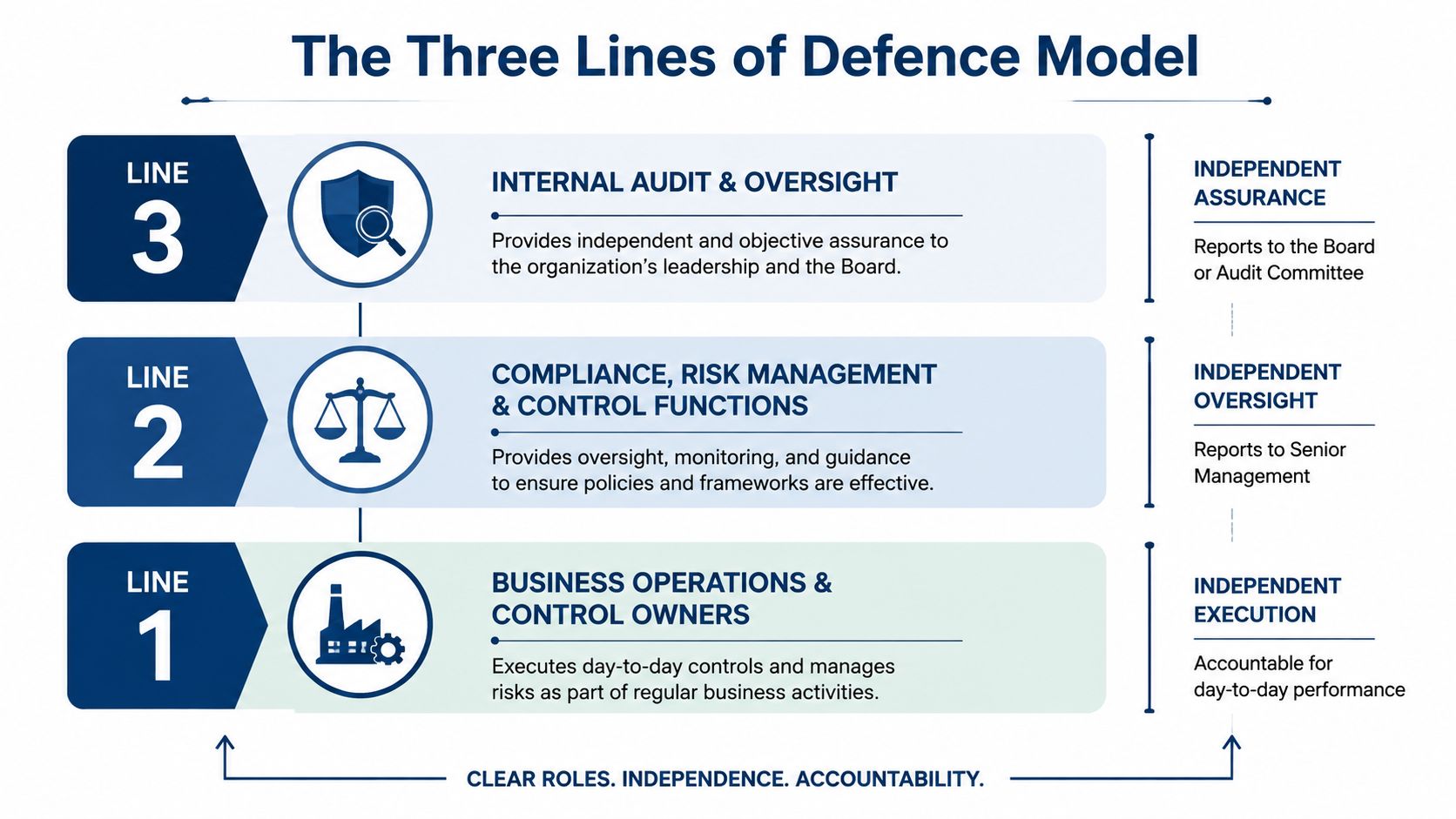
A useful governance and cybersecurity framework should make these relationships visible in charters, RACI matrices, committee calendars and workflow permissions. Independence is not a label. It's the demonstrated ability to deliver an objective opinion.
Core GRC Deliverables That Survive Supervisory Review
Supervisory review is evidence-led. A policy can describe a sound process, but it won't prove that anyone performed the control, reviewed the result or resolved the exception. Your consultant should leave behind linked artefacts that an auditor can trace from obligation to risk, control, evidence and management response.
Four artefacts form the foundation
The risk assessment records inherent and residual risk by business process, legal entity, jurisdiction and accountable executive. It should show the basis for the rating and connect material risks to the controls intended to reduce them.
The control library translates obligations into testable activities. Each control needs an owner, frequency, threshold, evidence specification, review status and remediation route. Map one control to several requirements where it addresses the same risk. Don't create duplicate controls merely because different regulations use different language.
The policy stack replaces an unmanaged folder with a hierarchy of group standards, local procedures, process guides and controlled templates. Each document should include an owner, approval date, effective date, version, review cycle and change history.
The evidence trail records who performed the activity, which system or record proves completion, when review occurred and how exceptions were handled. Evidence assembled after an incident is weaker than contemporaneous records captured through normal workflows.
For AI-heavy environments, the control library should also cover model ownership, data lineage, human oversight, access, monitoring, incident handling and third-party dependencies. Teams assessing security for enterprise AI deployments can use that topic as a useful technical input when defining AI control requirements.
Deliverable | Required Contents | Review-Ready Evidence |
|---|---|---|
Risk assessment | Process, entity, jurisdiction, owner, inherent and residual risk | Approved assessment, rationale and risk acceptance |
Control library | Control statement, frequency, owner, threshold and test method | Completed samples, exceptions and remediation records |
Policy stack | Standards, procedures, versions, approvals and review dates | Controlled documents and change history |
Evidence trail | Performer, system record, timestamp, reviewer and exception outcome | Exportable evidence package and issue closure |
A regulator should be able to select a control and follow its evidence without asking your team to reconstruct history. That is the standard described in GRC audit preparation guidance, and it should shape the implementation from the first workshop.
Engagement Models and Pricing Structures Compared
GRC consultancies generally sell three models. The right choice depends on whether you need a decision, a functioning system or sustained second-line capacity. Our GRC pricing breakdown shows where implementation costs hide.
Dimension | Advisory | Implementation | Managed Services |
|---|---|---|---|
Primary output | Assessment, framework and board recommendations | Configured controls, workflows and evidence processes | Ongoing risk, compliance or internal audit operations |
Pricing logic | Fixed fee or time and materials | Milestone-based fixed fee, with change control | Recurring retainer based on scope and service levels |
Best fit | Boards requiring posture clarity | Greenfield or fragmented GRC environments | Organisations short on specialist capacity |
Main risk | Elegant recommendations with no owner | Scope disputes over data and integrations | Dependency on the provider's taxonomy and tooling |
Buyer scrutiny | Methodology and senior involvement | Deliverables, acceptance tests and knowledge transfer | Exit rights, continuity and independence |
Advisory work suits a board that needs a clear view of exposure, regulatory applicability and target-state governance. It breaks down when leadership expects the consultant to configure workflows or remediate controls without a separate implementation scope.
Implementation is the right choice when you need a control library, platform configuration, integrations and evidence automation. Fix the boundaries early. Data lineage, ERP integration, identity access management and IT service management connections can consume effort that a low fixed fee excludes.
Managed services can provide practical capacity for risk, compliance or internal audit functions, including operations supporting DIFC or Riyadh-based teams. They become dangerous when the provider performs management's accountability, approves its own outputs or makes exit difficult.
Common pricing traps include:
Low daily rates: A junior-heavy team can make the headline price attractive while senior review remains limited.
Platform mark-ups: Licence resale can appear inside implementation pricing, obscuring the cost of configuration and integration.
Taxonomy lock-in: A managed provider may require you to adopt its risk categories, workflows and reporting model.
Unclear change control: “Minor” scope changes can create substantial additional fees.
Use GRC as a service as a reference point when comparing recurring operating models. Demand named resources, acceptance criteria, assumptions, exclusions and a usable handover.
Business Benefits and ROI You Can Defend to the Board
A board will not fund GRC because a framework sounds mature. It will fund an execution programme that connects control performance with lower exposure, faster decisions, reduced audit friction and stronger resilience.
Start with outcomes the business can verify. A disciplined evidence process reduces time spent finding records and reconciling inconsistent versions. Clear control ownership limits repeat findings. A mapped regulatory inventory helps legal, compliance and technology teams assess change without commissioning a separate review for every obligation.
Build the business case around measurable indicators
Track indicators management can influence:
Evidence coverage: Percentage of priority controls with complete, current and exportable evidence.
Testing quality: Number of controls sampled, failed, remediated and independently retested.
Issue ageing: Time material findings remain open, segmented by accountable owner.
Exception handling: Number of exceptions with approved rationale, expiry and compensating control.
Regulatory response: Time required to assemble a complete response package for supervisory requests.
Third-party readiness: Percentage of critical suppliers assessed against defined security, resilience and data requirements.
Enterprise investment in UAE eGRC continues to grow, but spending alone creates no return. The return appears when the programme produces reliable decisions, independent control testing and evidence that can withstand supervisory or audit review.
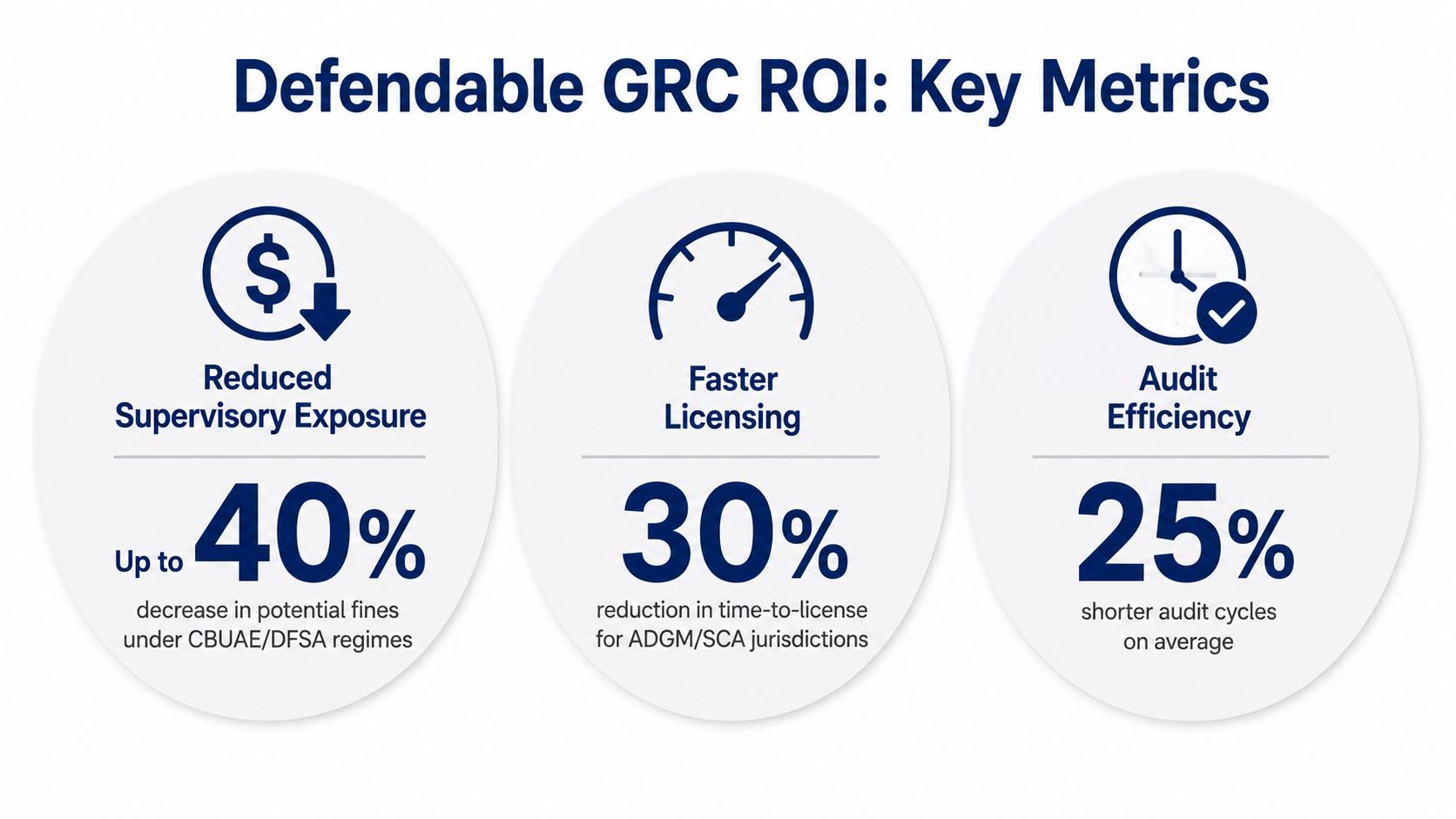
Separate hard and soft returns. Hard returns can include lower external audit effort, avoided remediation waste and reduced operating costs from removing duplicate controls. Soft returns include stronger board confidence, faster product approval, better customer assurance and improved procurement outcomes.
For GCC and European enterprises, include evidence quality and response speed in the business case. A policy library has limited value if owners cannot produce current records, explain exceptions or demonstrate that remediation was independently verified.
Board test: Every claimed benefit needs a baseline, an owner, a measurement method and a date for review.
Do not promise an invented percentage saving. Set the measurement framework first, then report results after the controls have completed a full testing cycle.
A 12-Month GRC Implementation and Readiness Roadmap
A credible roadmap sequences governance, control design, technology and assurance. Don't start with a platform demonstration. Start with regulatory applicability, risk ownership and the evidence you need to produce.
Months 1 and 2 build the foundation
Run discovery workshops with the board office, legal, compliance, risk, internal audit, security, privacy, procurement and business owners. Baseline the regulatory and control taxonomy against CBUAE, SCA, DORA, ISO 42001 and the rules relevant to each entity.
The exit artefacts should include:
RACI matrix: Named accountable executives, control owners, reviewers and escalation routes.
Risk-control taxonomy: Agreed risk categories, obligation mapping and control hierarchy.
Board risk appetite statement: Approved boundaries for material risk and exception acceptance.
Current-state assessment: Documented gaps, dependencies, data sources and remediation priorities.
Months 3 to 5 connect design to systems
Build the control library and rewrite the policy stack. Configure the selected GRC workflows and integrate core ERP, IAM and ITSM data where that integration supports ownership, evidence capture or workflow automation.
Do the evidence design before tool go-live. If the team configures a workflow without deciding what constitutes acceptable evidence, the platform will produce more incomplete records.
The phase should close with a configured platform, mapped controls, initial data load and approved policy hierarchy. Make business owners sign off on control wording before the implementation team treats the library as complete.
Months 6 to 8 prove the operating model
Pilot with selected business units, train first-line owners and run the control testing cadence. Use real evidence, real exceptions and real escalation routes. A demonstration environment cannot reveal whether an owner can complete the control during a busy operating period.
The team should produce a pilot completion report, control test results, training records and a refined workflow backlog. Fix role conflicts before expanding to more entities.
Months 9 to 12 prepare independent assurance
Complete enterprise rollout, establish recurring reporting and conduct an independent control effectiveness review. Build the audit-ready evidence vault, close priority remediation and obtain a signed-off opinion suitable for external audit or supervisory inspection.
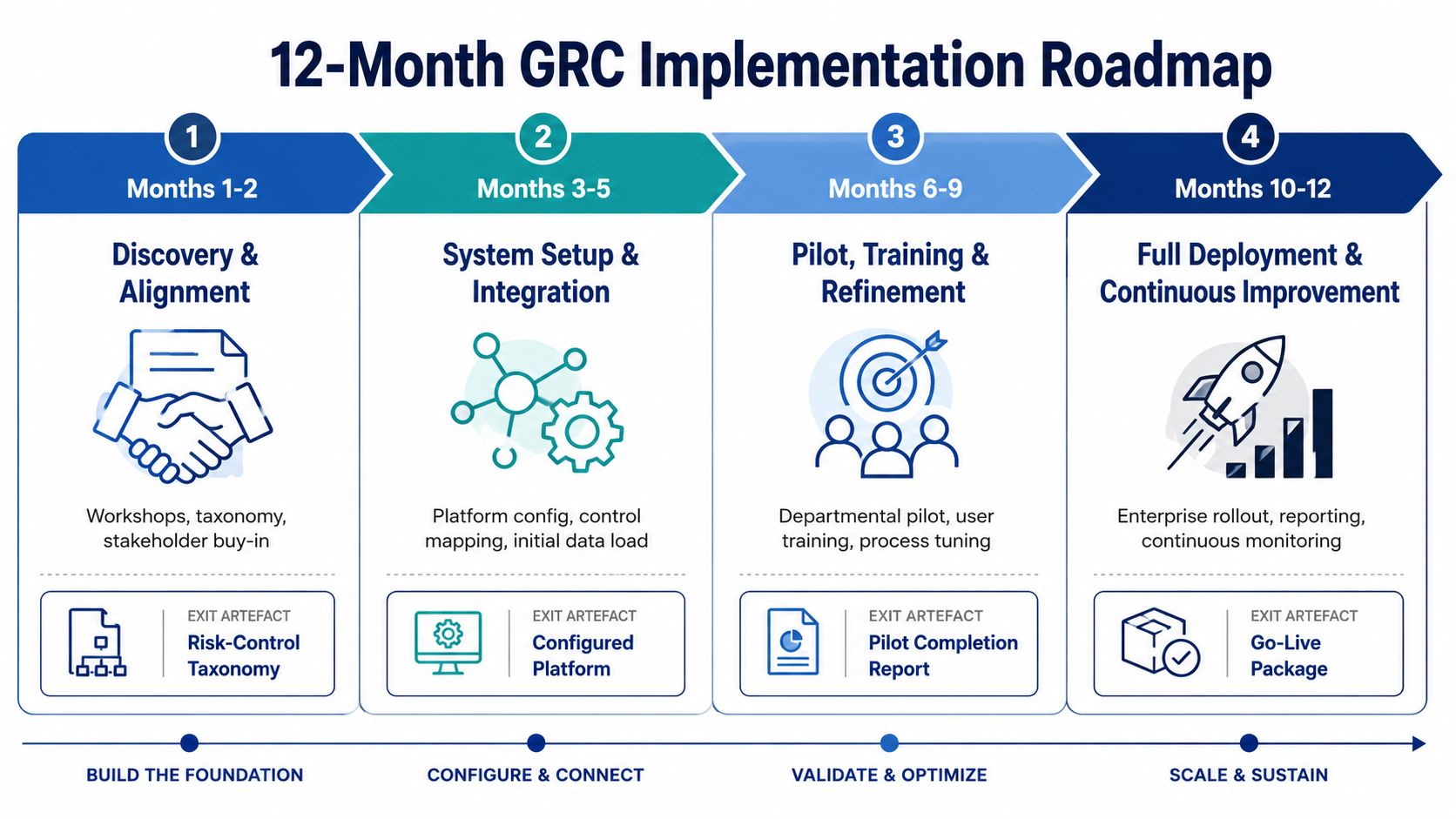
A CIO should hold the consultancy to a go-live package containing the final RACI, control-effectiveness report, evidence catalogue, unresolved-risk register, training record and board reporting pack. Keep testing before policy sign-off and evidence automation before platform launch. Those sequencing decisions prevent a polished system from hiding weak execution.
How to Pick the Right GRC Consultancy and Avoid Common Pitfalls
Choose a consultancy by inspecting its work, not by accepting its capability brochure. Ask for a redacted risk register, control library export, evidence trail and sample board report before you sign. The artefacts reveal whether the team understands operational control design or only produces presentation material.
Your shortlist should test regulatory depth across UAE Central Bank, ADGM, DFSA, ESMA, DORA, privacy, AML/CFT and sector-specific requirements. It should also test whether the proposed team can handle AI governance, vendor risk, resilience, data lineage and local operating constraints.
Selection Criterion | Weight (%) | What to Verify | Red Flag |
|---|---|---|---|
Regulatory depth | 25 | UAE, ADGM, DFSA, ESMA and DORA experience | Generic global framework with no local mapping |
Evidence methodology | 20 | Redacted registers, test scripts and evidence exports | Slide deck presented as the final deliverable |
Delivery talent bench | 15 | Named senior advisers and implementation resources | Senior partner sells, junior team delivers |
Platform capability | 15 | ServiceNow, HaloITSM, Freshservice or ManageEngine integration experience | Tool-first proposal before process discovery |
AI and third-party governance | 15 | Model, supplier, resilience and data controls | Cybersecurity treated as the entire risk universe |
Cultural and regional fit | 10 | GCC and European stakeholder experience | No consideration of local governance or Shari'a overlays |
The weights are a starting structure, not a universal score. Adjust them to your regulatory exposure and operating model, but keep the verification column evidence-based.
Watch for fixed-fee proposals that underestimate data lineage, legacy records and integration work. Off-the-shelf frameworks can also ignore Shari'a compliance overlays, entity-specific governance and the practical differences between UAE and European operations.
Contractual protections matter:
Fixed deliverables: Define registers, mappings, workflows, tests and reports.
Knowledge transfer: Require administrator training, documentation and reusable configuration.
Independence: Prevent the provider from approving its own implementation or assurance work.
Exit rights: Ensure you can export data, evidence, workflows and taxonomy.
Quality review: Reserve the right to commission an independent review of the consultancy's work.
For an operating model aligned to technology-enabled governance, review governance, risk and compliance services. Treat the provider as an accountable delivery partner, not a permanent substitute for management ownership.
What Does GRC Consultancy Need to Cover in AI, Vendor Risk and Resilience?
A modern programme must govern the dependencies that can interrupt operations or create decisions your board cannot explain. AI systems, cloud providers, outsourced processes and critical suppliers belong in the same control conversation as policies and audits.
The UAE regulatory environment already includes privacy, cloud security and cybersecurity requirements, while European operations may fall within GDPR, DORA and NIS2 obligations. The EY and IDC regional assessment describes this broader regulatory direction and reinforces why an integrated framework matters.
AI governance requires accountable decisions
Your AI register should identify the business owner, purpose, data sources, model provider, users, decision impact, human review and incident route. Controls should address approval before deployment, access, monitoring, change management, explainability where relevant and retirement.
Don't treat an AI policy as evidence of governance. Evidence includes approval records, model evaluations, access reviews, monitoring results, incident tickets and documented decisions when humans override or accept model output.
Vendor risk must connect to operations
A supplier questionnaire is only the start. Critical vendor controls should connect due diligence to contract terms, access permissions, resilience testing, incident notification, subcontractor visibility, exit planning and ongoing performance review.
For financial services in ADGM, the Cyber Risk Management Framework requires board-level cyber oversight, incident reporting within 72 hours, and regular resilience testing with documented results, as described in the ADGM-focused compliance overview. Your GRC workflow should therefore track the reporting clock, escalation path, test evidence and board visibility.
Resilience needs proof
A continuity plan that has never been exercised is an assumption. Link business impact analysis, recovery priorities, crisis roles, technology dependencies, tabletop exercises, test results and corrective actions in one evidence trail.
The same execution principle applies to climate reporting. The UAE Climate Change Law includes a mandatory emissions reporting regime with full obligations stated for 30 May 2026, subject to extension. PwC's legal alert on the UAE climate reporting regime notes that implementation details, including emissions-source designation, regulations and an MRV platform, remain under development. Your programme should assign data owners and reporting controls now, rather than wait for every implementation detail to settle.
What Should UAE Insurance and DNFBP GRC Programmes Operationalise?
Regulated sectors need workflows that connect front-office activity to supervisory reporting. Traditional policy reviews won't satisfy that requirement.
For accountants, auditors and similar DNFBPs, UAE guidance requires registration with the Ministry of Economy and the goAML portal, appointment of a qualified MLRO or compliance officer, continuous sanctions screening and STR or SAR filing when suspicion thresholds are met. The UAE DNFBP compliance guidance describes the operational stack, including onboarding, transaction monitoring, escalation and reporting evidence.
That means your control design needs:
Entity onboarding: Capture beneficial ownership, customer risk and required approvals.
Screening: Record sanctions checks, updates, matches, review decisions and escalation.
Monitoring: Define scenarios, thresholds, investigation ownership and case closure.
Reporting: Preserve submission records, approvals, rationale and supporting evidence.
Quality assurance: Test files, sample decisions and identify recurring control weaknesses.
Insurance firms face a separate change-management challenge. Federal Decree-Law No. 6 of 2025 repealed Federal Decree-Law No. 48 of 2023 effective 16 September 2025, with transition running to 16 September 2026 while existing CBUAE regulations and standards remain in force until replaced. The UAE insurance-sector guidance also states that licensed insurers must maintain an effective Enterprise Risk Management framework and lists controls covering CDD, sanctions screening, goAML reporting and AML/CFT compliance.
Your implementation should create a rule-transition register, map legacy requirements to replacement obligations, assign accountable owners and sequence remediation. Don't delete old controls until you can prove that the new framework covers the same risk.
What Questions Should CIOs Ask Before Approving GRC Consultancy?
The best discovery call ends with sharper questions, not a larger slide deck. Ask whether the proposed engagement changes how your teams perform controls, capture evidence and escalate decisions.
How does GRC consultancy differ from a compliance review?
A compliance review identifies gaps against obligations. GRC consultancy should also design ownership, workflows, testing, evidence, reporting and remediation so the organisation can operate the framework continuously.
Should we buy a platform before appointing a GRC consultancy?
No. Define obligations, risk taxonomy, control requirements and evidence standards first. Then select or configure a platform that supports the operating model, rather than forcing the organisation into a vendor's categories.
What evidence should a consultant hand over?
Require the risk register, obligation map, control library, policy hierarchy, RACI matrix, test scripts, evidence catalogue, issue register, workflow configuration and administrator documentation. Password-protected presentation files aren't sufficient.
Can a managed service replace internal audit?
It can provide capacity or co-sourcing, but the board remains responsible for independent assurance and oversight. Confirm reporting rights, conflicts, evidence access, independence safeguards and exit arrangements before outsourcing any assurance activity.
How should we measure success?
Set baseline measures for evidence coverage, control testing, overdue issues, exception quality, response preparation and third-party readiness. Review those measures after controls have operated, not immediately after the consultancy delivers documents.
DataLunix offers discovery workshops, fit-gap assessments, target-state GRC design, policy and control development, and implementation support across platforms such as ServiceNow, HaloITSM, Freshservice and ManageEngine. Visit DataLunix to discuss an evidence-led GRC roadmap for your UAE, GCC or European operating environment.