


GRC Cyber for GCC and Europe Enterprises

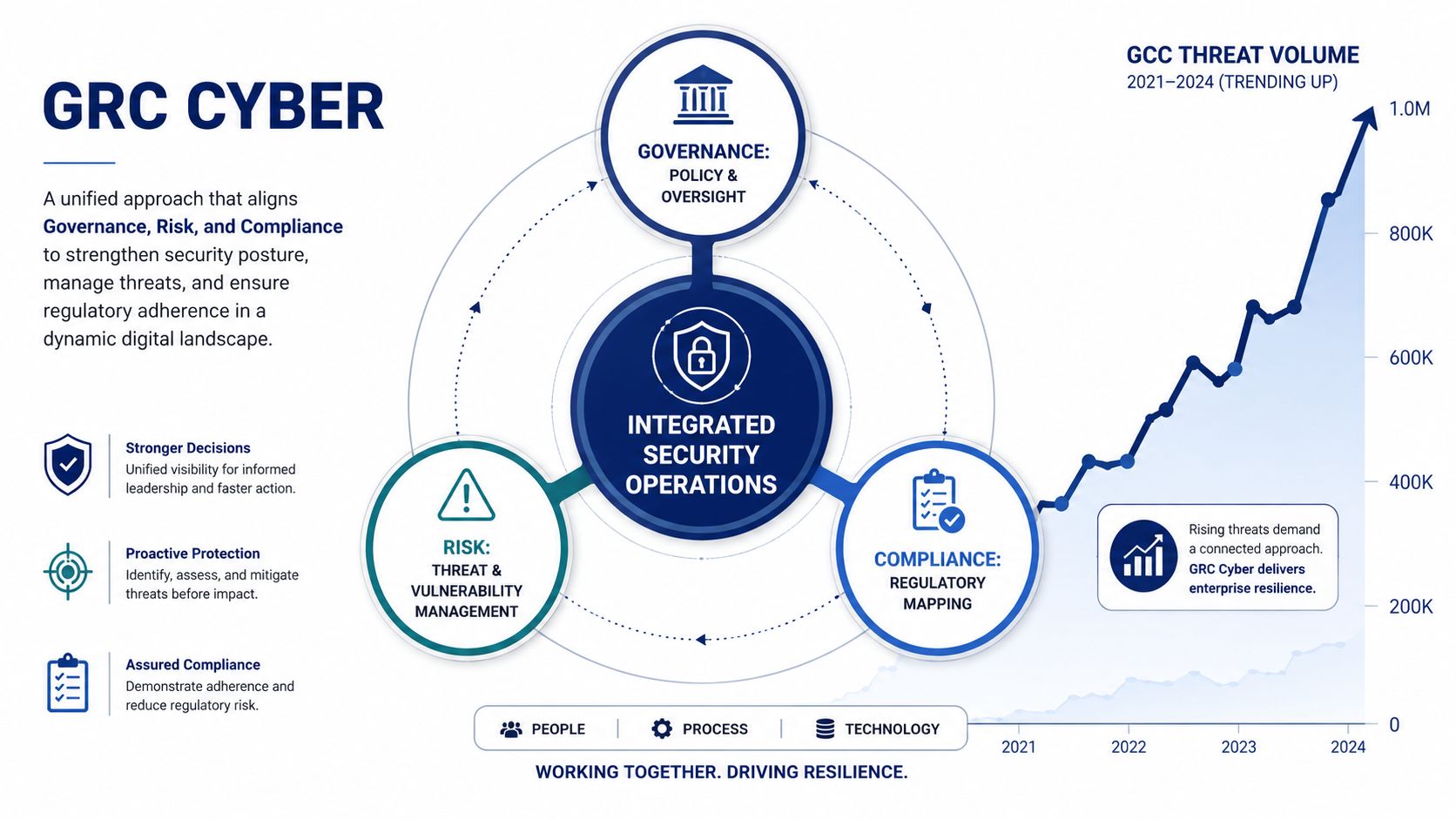
Your security team has a risk register, your auditors want evidence, and each regulator asks for a different view of the same controls. Meanwhile, the UAE threat environment has reached an estimated 600,000 to 800,000 attack attempts per day in 2026, compared with roughly 90,000 to 200,000 daily attempts before the regional conflict, according to regional UAE cybersecurity reporting. GRC cyber must therefore operate inside your service, asset, change, vulnerability, and incident workflows, not sit in a folder waiting for an audit.
What GRC Cyber Means for a Modern Enterprise
A security incident reaches the CIO's desk, the auditor requests control evidence, and regulators in Riyadh, Abu Dhabi, and Frankfurt ask for different reports on overlapping safeguards. GRC cyber gives the enterprise one operating model for that pressure. It connects governance, risk, and compliance to the ITSM, ITOM, and ESM workflows where services, assets, changes, vulnerabilities, and incidents are managed.
Governance assigns decision rights and policy ownership. Risk turns threats, weaknesses, and business dependencies into ranked work. Compliance confirms that controls operate, assigns evidence to accountable owners, and makes records available for review. That operating model matters across the GCC and Europe, where a single enterprise may answer to national cybersecurity authorities, sector regulators, privacy rules, and contractual requirements.
Saudi Arabia's National Cybersecurity Authority framework sets a useful governance expectation through policies, governance rules, frameworks, standards, directives, and compliance monitoring. Apply the same discipline internally. Name each control owner, define the control objective, set escalation paths, and record how exceptions expire.
Why policy documents fail without operational records
A policy may require privileged-access reviews. Audit readiness depends on the associated record: who completed the review, which accounts were checked, which exceptions were approved, and whether remediation closed. Store that evidence in workflows already used by IT and security teams:
CMDB records identify the service, asset, owner, data classification, and business dependency.
Incident records capture detection, triage, escalation, notification, and recovery.
Change records show whether security-impacting modifications were authorised and tested.
Vulnerability workflows connect scanner findings to accountable remediation owners.
Problem records show whether recurring control failures received root-cause treatment.
Practical rule: A control needs an owner, task, due date, and evidence record to be operationally governed.
A CIO should design those workflows before choosing a platform. Define how a risk becomes a control objective, how a failed control creates a task, how exceptions receive approval and expiry dates, and which evidence reaches the audit committee. ServiceNow, Halo, Freshservice, and ManageEngine can support this model when their configuration connects governance records to service and security operations.
For a grounded view of governance and cyber security operating principles, review how governance decisions translate into operating practice. The target is one control environment that produces regulator-specific views for UAE, Saudi, wider GCC, and European obligations, without maintaining separate binders for each authority.
The Core Frameworks Every GRC Cyber Program Should Know
No regulated enterprise should treat frameworks as a collection exercise. ISO 27001, NIST CSF 2.0, CIS Controls v8, GDPR, and PDPA serve different purposes, so your selection should reflect audit obligations, implementation capacity, and the way your technology estate is operated.
ISO 27001 earns its place when certification is commercially or contractually important. It provides a globally recognised certification route and gives auditors a formal management-system structure. It demands disciplined scope, risk treatment, internal audit, management review, corrective action, and continual improvement. That makes it powerful, but heavier to implement than a practical baseline.
NIST CSF 2.0 works well as the executive operating language. Its functions and outcomes map cleanly to board dashboards, risk registers, security roadmaps, and service ownership. It's usually faster to adopt than a certification-led management system, especially for cloud-heavy organisations that need an actionable structure before pursuing formal certification.
CIS Controls v8 is the operational starting point when budget and speed dominate. It gives security teams a pragmatic baseline around inventory, access, vulnerability management, logging, configuration, and incident response. It isn't a legal regime or a certification scheme, so use it to improve execution, not as a substitute for regulatory mapping.
GDPR and PDPA are legal regimes, not security frameworks. They shape privacy governance, data subject rights, records of processing, breach handling, processor oversight, and evidence obligations. Your control library should map security controls to these requirements, but you shouldn't confuse a privacy obligation with an ISO control.
Framework | Type | Audit Acceptance | Time to Implement | Best Fit |
|---|---|---|---|---|
ISO 27001 | Certifiable management system | Strong for certification and regulated contracts | Longer and structured | Enterprises needing formal certification |
NIST CSF 2.0 | Cybersecurity framework | Strong for governance and risk communication | Faster to adopt | Cloud-heavy estates and executive dashboards |
CIS Controls v8 | Operational security baseline | Useful supporting evidence | Fastest practical starting point | Teams building foundational control execution |
GDPR | Legal privacy regime | Regulator and contractual relevance | Depends on data and process scope | European operations and personal data processing |
PDPA | Legal privacy regime | Regulator and contractual relevance | Depends on jurisdiction and processing scope | GCC and regional personal data governance |
Your decision rule should be simple. Use NIST CSF 2.0 to organise the operating model, CIS Controls v8 to drive foundational execution, ISO 27001 where certification or procurement requires it, and GDPR or PDPA mappings wherever personal data obligations apply. For broader context on UAE corporate governance best practices, keep governance ownership connected to board accountability rather than leaving it with the security team alone.
European resilience obligations also deserve a dedicated operational view, particularly where ICT risk, incident reporting, testing, and third-party oversight affect critical services. Your platform design should support that model, as outlined in Digital Operational Resilience Act requirements.
Running a Risk Assessment That Produces Real Controls
A useful risk assessment ends with work assigned in an ITSM platform. It doesn't end with a PDF and a risk score that no service owner sees.
Begin with the CMDB. Identify business services, supporting applications, infrastructure, cloud resources, data stores, suppliers, and accountable owners. Then classify the data and service impact. A payment gateway, public portal, employee directory, and internal test server shouldn't receive the same treatment because a scanner reports a similar technical weakness.
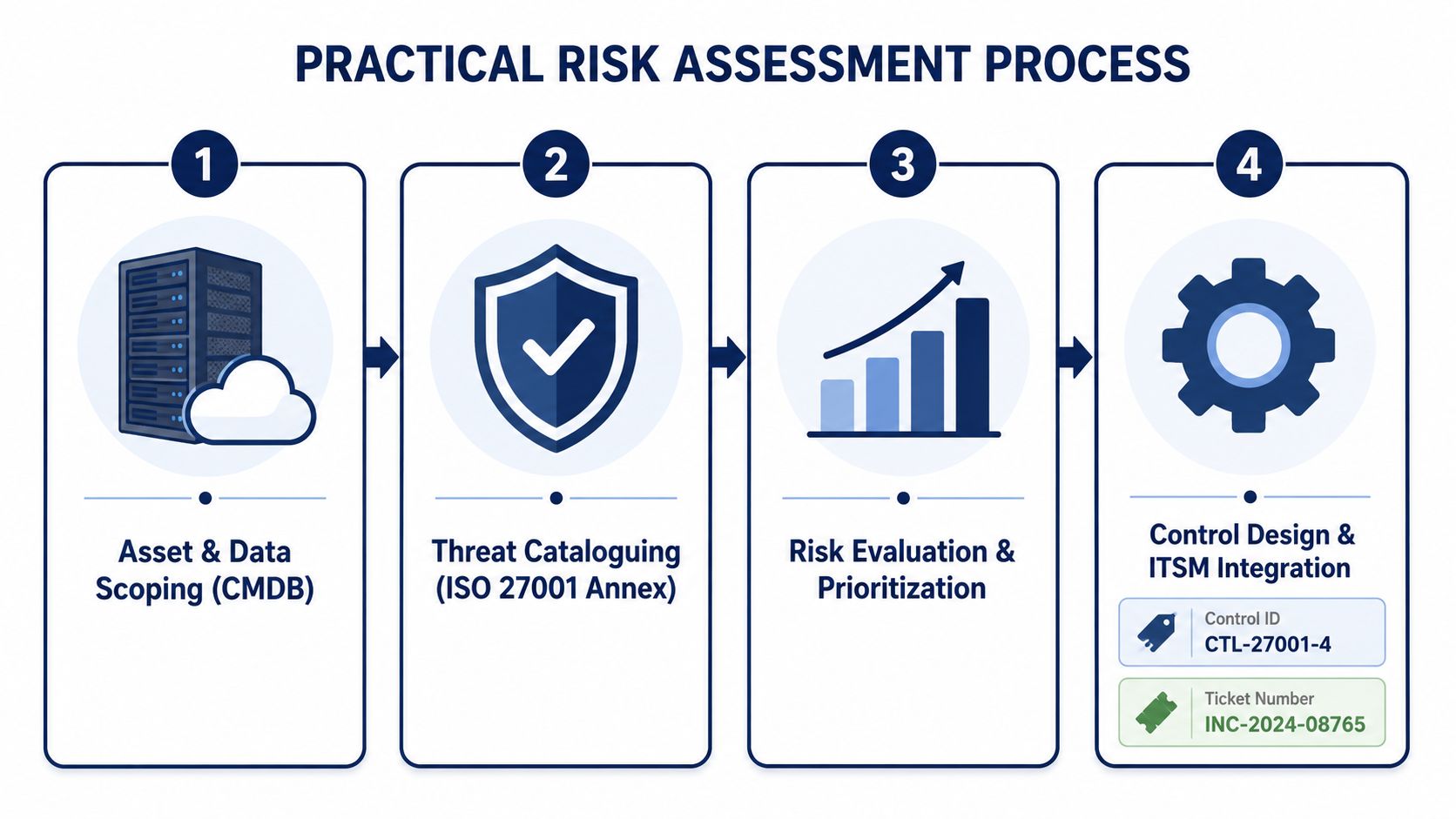
Four steps from exposure to remediation
Scope assets and data. Record ownership, business criticality, data type, dependencies, and external exposure in the CMDB.
Catalogue credible threats. Use ISO 27001 Annex A as a control reference and MITRE ATT&CK as a threat-behaviour lens. Include phishing, credential abuse, ransomware, web exploitation, DDoS, supplier compromise, and operational technology exposure where relevant.
Score business impact. Combine likelihood with consequences such as regulatory action, service interruption, customer harm, contract loss, and recovery complexity. CVSS can inform technical severity, but it shouldn't decide the business risk alone.
Create a control objective and workflow. Translate each high or critical risk into a control, owner, due date, evidence requirement, and escalation route. Link the work to incident, change, problem, or vulnerability management.
Consider a UAE bank whose internet-facing payment gateway fails a web application firewall control. The risk owner shouldn't receive a generic request to “fix security”. The system should create a control failure, identify the gateway and business service, assign the application and security owners, open a remediation task in ServiceNow or ManageEngine, require a change record for implementation, and retain test evidence after deployment.
The risk rating should reflect the gateway's business importance, exposure, exploitability, transaction dependency, and notification obligations. If the owner accepts the risk, the exception needs an expiry date, compensating controls, executive approval, and a scheduled reassessment. That is defensible governance. An unreviewed spreadsheet entry isn't.
The audit committee should receive a risk-to-control register, overdue remediation report, exception register, control test results, evidence status, and trend view by business service. Build the evidence model with the same discipline described in GRC audit preparation guidance.
How ServiceNow, Halo, Freshservice and ManageEngine Operationalize GRC
The best GRC platform is the one your security and IT teams will configure, maintain, and use. A long feature list won't compensate for weak CMDB data, unclear ownership, poor integration, or licensing that prevents critical teams from accessing workflows.
ServiceNow Integrated Risk Management is the strongest fit for complex enterprise estates that need deep links across ITSM, ITOM, ITAM, security operations, third-party risk, policy, and audit. It can support audit-grade evidence, risk-control relationships, exception workflows, and executive reporting, but the implementation model requires disciplined architecture. Over-customisation and module sprawl can inflate total cost and delay adoption.
HaloITSM and Freshservice are usually more attractive for mid-market organisations that need speed and a lighter operating model. Their value depends on how effectively you connect service ownership, change, incident, asset, and vulnerability workflows to the control library. They can reach operational value quickly, but highly complex multi-entity regulatory reporting may require careful integration and data design.
ManageEngine ServiceDesk Plus suits organisations that prefer a broad operational suite, on-premises deployment options, or tighter control over data residency and infrastructure. Its fit improves where endpoint, network, identity, and systems-management tooling already sits within the ManageEngine ecosystem. Validate the depth of control mapping, exception governance, and evidence retention before treating it as a complete GRC answer.
Capability | ServiceNow IRM | HaloITSM | Freshservice | ManageEngine |
|---|---|---|---|---|
Control mapping | Deep enterprise mapping with broader platform integration | Practical mapping with configuration effort | Accessible mapping for smaller control libraries | Stronger when aligned to its management ecosystem |
Risk register linkage | Mature relationship model across services and suppliers | Suitable for focused programmes | Suitable for straightforward risk workflows | Useful for operationally centred programmes |
Exception management | Detailed approvals, owners, expiry, and evidence | Effective when configured clearly | Simple to moderate workflows | Practical with governance discipline |
Continuous control monitoring | Strong integration potential with ITOM and security data | Depends on connectors and design | Depends on connectors and automation | Strong where existing tools supply operational evidence |
Licensing risk | Module and user expansion can increase total cost | Review feature and agent boundaries | Review plan limits and add-ons | Review edition, deployment, and integration scope |
The platform must connect to vulnerability scanners, SIEM, identity systems, cloud controls, endpoint tools, and procurement records. Your team should test a real control journey before signing, from failed evidence to ticket creation, remediation, retest, approval, and audit export.
For the wider ITSM operating model, see IT service management solutions. DataLunix can be evaluated alongside other implementation partners where organisations need to unify operational data across these platforms and build GRC workflows around existing service processes.
The GRC Cyber Maturity Model and a Realistic 12-Month Roadmap
A board audit committee doesn't need a maturity label by itself. It needs proof that the label reflects operating capability.
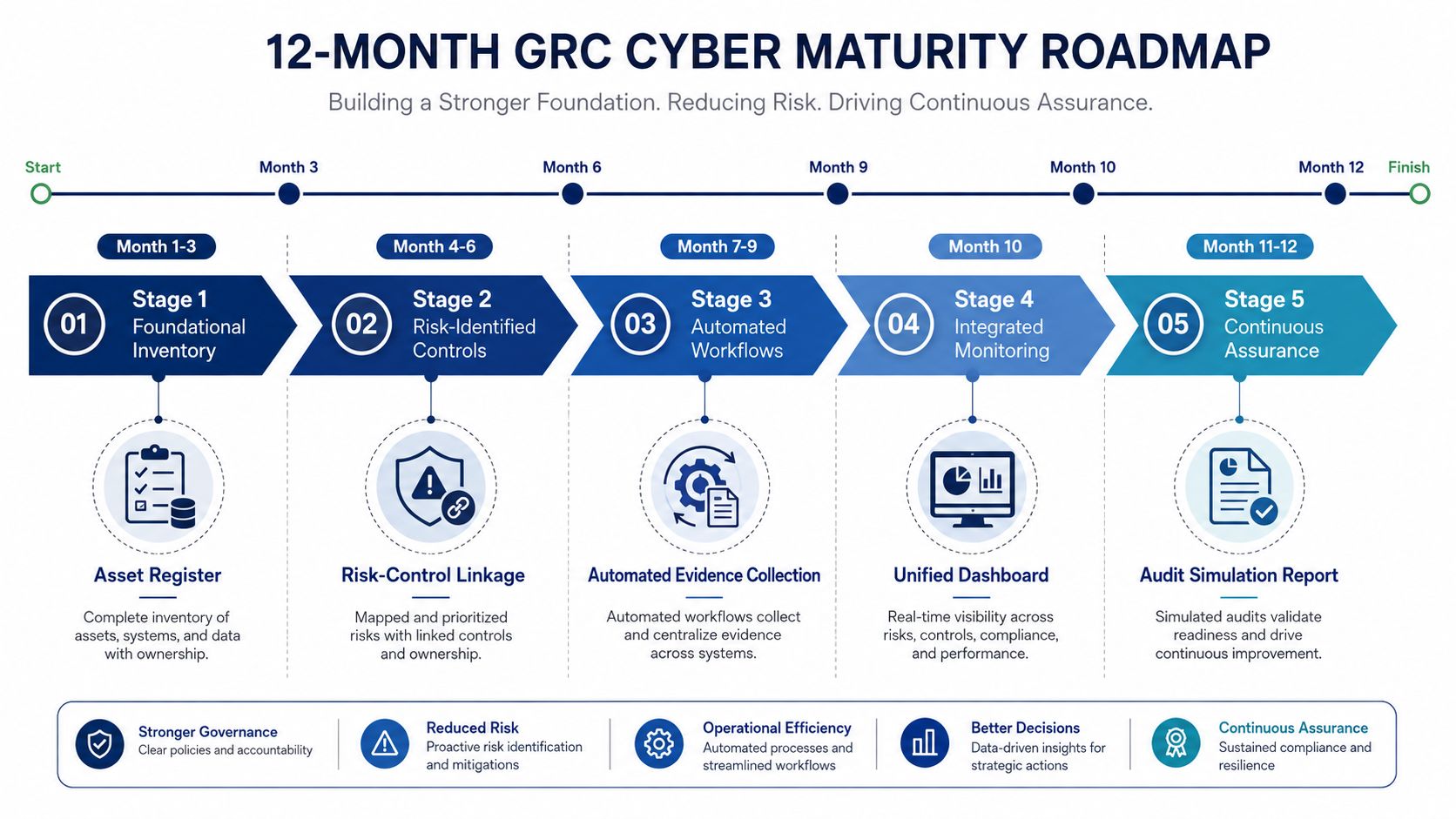
The five-stage model below gives each level a concrete proof point:
Stage 1, inventory and ownership. The organisation can identify critical assets, services, data, suppliers, and accountable owners.
Stage 2, mapped controls and risk. Risks connect to control objectives, frameworks, owners, treatment plans, and due dates.
Stage 3, integrated workflows. Failed controls create incidents, changes, problems, vulnerability tasks, or supplier actions.
Stage 4, evidence automation and exceptions. Evidence flows from operational systems, while exceptions have compensating controls, approvals, and expiry.
Stage 5, continuous assurance. Dashboards show control health, business exposure, overdue actions, exception ageing, and resilience indicators.
A practical 12-month delivery sequence
Months 1 to 2 should establish scope and baseline. Select the entities, services, jurisdictions, regulators, and data domains that matter. Reconcile the CMDB with cloud, identity, endpoint, vulnerability, and supplier records.
Months 3 to 5 should settle the framework and configure the platform. Choose the primary control language, define risk scoring, build mappings, configure ownership, and test the evidence path. Don't customise every exception before the core workflow works.
Months 6 to 9 should roll out controls and complete the first internal audit. Prioritise critical services, regulated processes, access, vulnerability, backup, incident response, supplier oversight, and change management. Use audit findings to correct workflow design, not merely to close individual observations.
Months 10 to 12 should prepare for external scrutiny and executive reporting. Run an audit simulation, validate evidence retrieval, review management inputs, and publish KPIs tied to business risk.
Common stall points are predictable:
Scope creep: starting with every entity and every framework.
Tool over-customisation: designing screens instead of fixing ownership and evidence gaps.
Skipping the risk register: mapping controls without understanding which services matter most.
Track control pass rates, overdue high-risk actions, exception age, evidence freshness, remediation ownership, and unresolved critical-service findings. Those indicators show progress. A dashboard full of green statuses without traceable evidence is theatre.
Building Audit-Ready Compliance Workflows Across Regulators
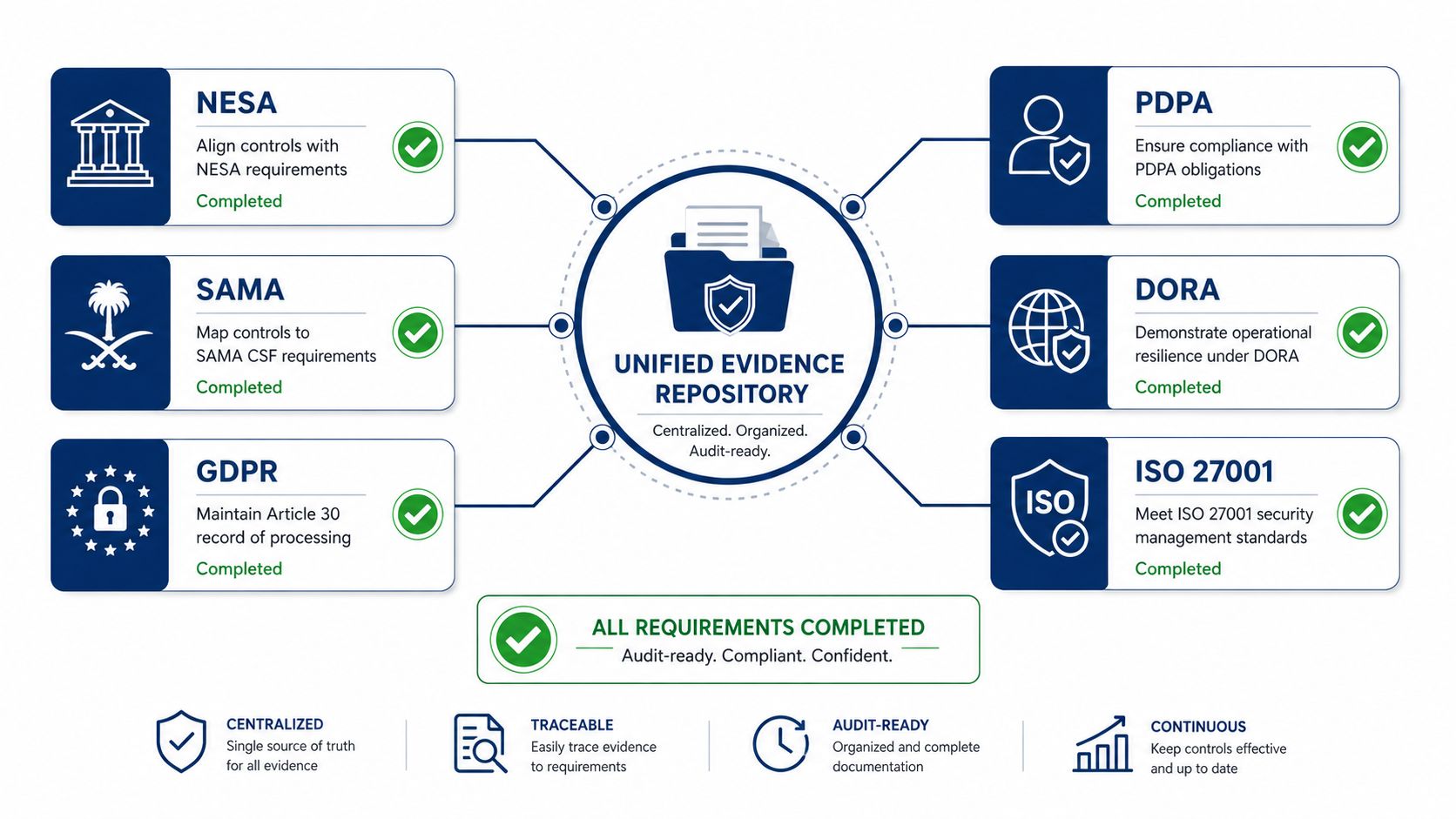
Audit readiness means an auditor or regulator can trace an obligation to a control, an owner, an operational record, and evidence. It doesn't mean storing a large policy library.
Build the workflow around a unified control catalogue. Map NESA, SAMA, GDPR, PDPA, DORA, ISO 27001, and relevant national or sector requirements to common control objectives. Where obligations differ, preserve the jurisdiction-specific requirement instead of forcing false equivalence.
The UAE's official National Cyber Security Governance Framework supports a national model built around coordinated governance, reporting, lifecycle management, and response orchestration. UAE organisations should therefore design continuous control assurance, not a periodic audit checklist.
The evidence workflow
Assign control ownership. Every control needs a business owner, technical owner, reviewer, evidence source, testing frequency, and escalation route.
Collect evidence from operations. Pull configuration, access review, vulnerability, backup, incident, change, supplier, and training evidence from source systems where possible.
Manage exceptions as risk. Require a rationale, compensating control, approving authority, expiry, and reassessment trigger. An open exception without an end date is an unmanaged risk.
Preserve change history. Auditors need to see what changed, who approved it, how it was tested, and whether the control remained effective afterwards.
Test the notification playbook. GDPR has a 72-hour supervisory-authority notification requirement for qualifying personal data breaches, as set out in the European Commission GDPR guidance. Other regulators may impose different reporting windows, so your legal, security, risk, and communications teams need pre-agreed decision paths.
UAE organisations should also recognise the legal baseline established by Federal Decree Law No. 34 of 2021, which took effect on 2 January 2022, as described in UAE cyber safety and digital security information. ADGM regulated firms face an additional operational requirement because the FSRA Cyber Risk Management Framework became mandatory on 31 January 2026, including recurring testing, third-party ICT oversight, and material incident notification no later than 24 hours after awareness, according to FSRA cyber risk requirements.
Keep these artefacts retrievable inside 30 minutes during an external audit or regulator inquiry:
Scope and ownership: entity, service, asset, data, supplier, and control-owner records.
Control assurance: test results, evidence links, failed checks, corrective actions, and retests.
Risk governance: current risk register, treatment plans, exceptions, approvals, and expiry dates.
Incident readiness: severity criteria, notification decisions, communications records, and recovery evidence.
Management oversight: review minutes, KPI packs, audit findings, and remediation status.
An independent review, such as the SeanNoCode audit review, can help challenge whether your evidence is retrievable and defensible before a regulator does.
Next Steps for GCC and European Enterprises and Where DataLunix Fits
Start with execution, not another framework workshop. Your first objective is to create a working control loop across a limited scope, then expand it without duplicating evidence.
The first 30 days
Choose two regulators or obligation sets that create the greatest business exposure. For a GCC organisation, that may mean NESA and SAMA, with ADHICS added where healthcare operations apply. For a European estate, prioritise GDPR and DORA, then address NIS2 where the organisation falls within scope.
Select a small group of critical services and establish the baseline against NIST CSF 2.0 or ISO 27001 Annex A. Reconcile assets, owners, suppliers, data flows, and open high-risk findings before you build dashboards.
Days 31 to 60
Choose one platform integration track. Connect the selected ITSM or ESM platform to the CMDB, identity provider, vulnerability scanner, SIEM, cloud environment, and change system. Configure one complete workflow for a failed control, including assignment, escalation, exception handling, retesting, and evidence retention.
Licensing decisions matter. Validate module boundaries, agent requirements, connector charges, data residency, regional support, and the cost of extending the workflow to security, IT operations, employee services, and customer operations.
Days 61 to 90
Instrument continuous evidence collection for the highest-priority controls. Publish a board-level view showing business service risk, control health, overdue remediation, exception exposure, and incident readiness. Run an audit simulation and make owners retrieve the evidence without assistance.
DataLunix is one implementation option for this model. The Dubai-based company works across HaloITSM, HaloPSA, Freshservice, ManageEngine, and ServiceNow, with services covering readiness assessment, platform implementation, integrations, managed optimisation, upgrades, outsourced operations, and staff augmentation. Its regional delivery model supports GCC and European organisations that need ITSM, ITOM, ITAM, ESM, and GRC workflows connected to operational data.
For organisations that need ongoing ownership after implementation, GRC as a service provides a useful reference point for structuring managed evidence collection and audit support. The deciding question remains practical: can the partner map controls, configure workflows, validate licensing, support your jurisdictions, and leave your internal owners capable of operating the system?
The strongest programme will sequence GCC and European obligations separately, but maintain one shared control architecture. It will use common evidence where requirements overlap, preserve jurisdiction-specific differences, and make every exception visible to the people accountable for business risk.
DataLunix can help you assess your current GRC cyber maturity, map controls across GCC and European obligations, and connect evidence to ServiceNow, HaloITSM, Freshservice, or ManageEngine workflows. Visit DataLunix to arrange a readiness assessment and build an audit-ready operating model around the platforms your teams already use.