


GRC Implementation Playbook for Enterprise Success

Your board wants clearer risk reporting, auditors want traceable evidence, and operational teams are still managing control testing in spreadsheets. That tension is familiar across GCC enterprises. GRC implementation succeeds when governance, risk, compliance, people, processes, and technology operate as one measurable system, not as disconnected policy projects.
The practical sequence is straightforward: assess readiness, map obligations to a manageable framework, design accountable workflows, select tools around those workflows, deploy in controlled phases, and measure whether controls remain effective. UAE organisations also need to treat regulatory change as part of the operating model, especially across listed-company governance, commercial-company law, and AML/CFT obligations.
Understanding Implementation Readiness
A common readiness gap appears when an enterprise buys a GRC platform before it understands who owns risks, where evidence is stored, how exceptions are approved, or which regulatory obligations matter most. The platform then reproduces unclear processes at greater scale. A readiness assessment prevents that expensive outcome by establishing the current operating baseline before configuration begins.
The UAE has a strong digital foundation for this work. In the UN E-Government Survey 2024 results for the UAE, the country ranked 11th globally with an EGDI score of 0.9533 and ranked 1st globally in the Institutional Framework sub-index. That maturity supports digital reporting and automation, but it doesn't remove the need to assess internal capability.
What should a readiness assessment examine
Start with interviews involving the CIO, chief risk officer, compliance leadership, internal audit, legal, information security, finance, business-unit owners, and board or committee secretariat. Ask operational questions rather than broad questions about “compliance maturity”:
Ownership: Who accepts a risk, approves an exception, tests a control, and closes a finding?
Evidence: Which system contains the authoritative record, and can an auditor trace it to a control?
Cadence: How often do teams update risk registers, test controls, review exceptions, and report to leadership?
Dependencies: Which processes depend on identity, procurement, finance, IT service management, vendors, or data platforms?
Decision rights: Who can tolerate a risk, extend a remediation date, or escalate a breach of risk appetite?
Score each capability by maturity and business impact, then rank the gaps. A weak evidence trail for a high-priority regulatory control should outrank a cosmetic dashboard enhancement. Define risk appetite and exception authority before selecting workflows, otherwise the tool will contain tasks without decision logic.
Practical rule: A useful readiness output names the owner, source of evidence, review cadence, dependency, and decision authority for every priority control.
Document quick wins separately from foundational work. A central issue register, named control owners, standard evidence requirements, and a repeatable approval path often create more value than broad automation. For a deeper change-readiness lens, use this change management readiness assessment alongside the GRC baseline.
Selecting and Mapping a GRC Framework
A framework chosen from a vendor presentation can leave UAE teams with duplicated controls and unclear accountability. Start with risk appetite, regulatory scope, and business objectives. ISO 31000 offers broad risk-management terminology, COSO ERM links risk with enterprise objectives and performance, while NIST RMF supports structured cybersecurity risk decisions. Most UAE enterprises need a controlled combination, not a stack of overlapping frameworks. For a comparison of frameworks used across regions, see this guide to top GRC frameworks in the EU, US, and UK.
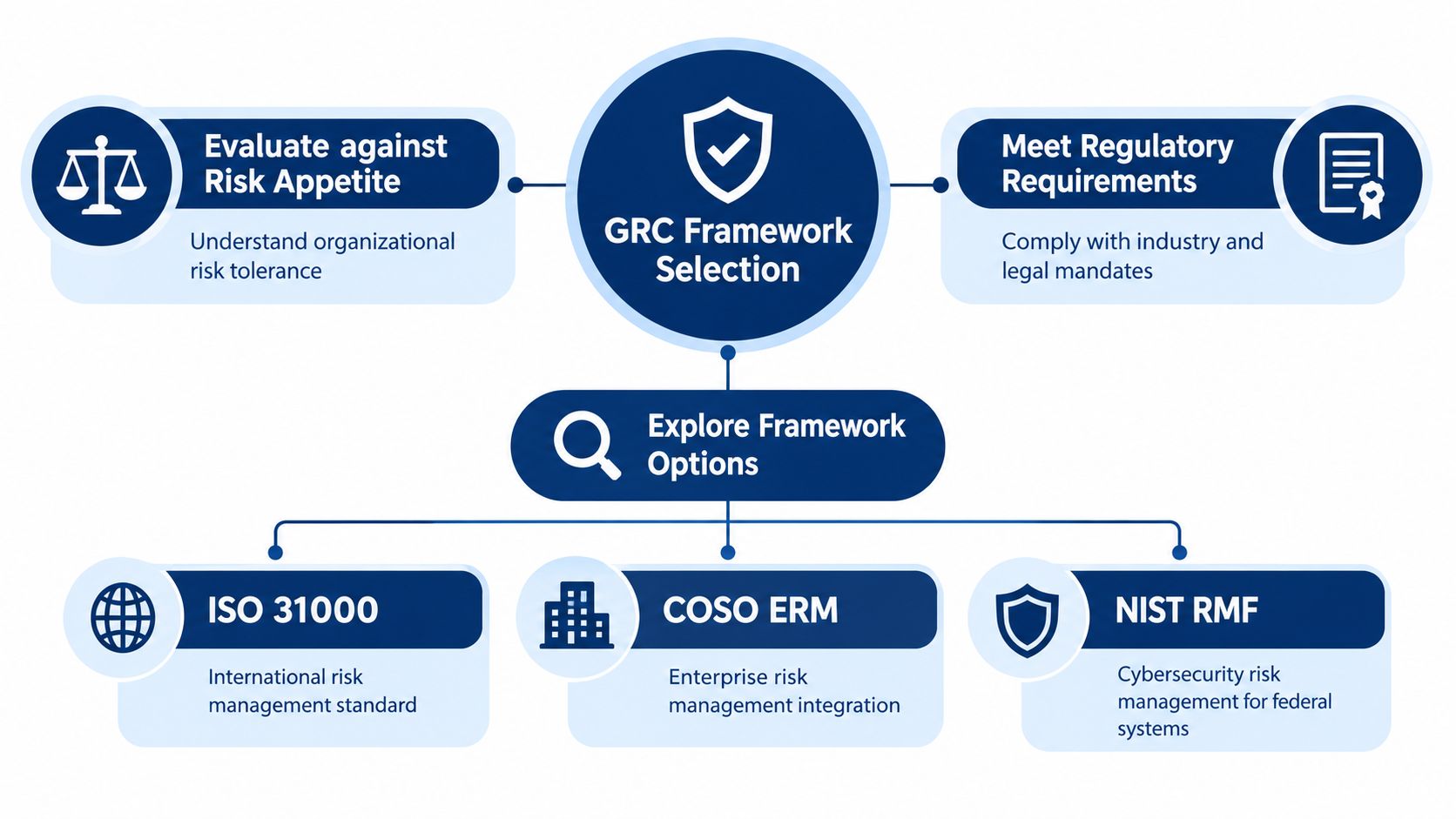
How to build a practical mapping matrix
Use one primary framework as the organising structure. Treat local obligations as requirements, then map each one to objectives, controls, owners, evidence, and review frequencies.
Define the risk outcome. State what the organisation must protect or achieve, such as reliable financial reporting, resilient services, or controlled third-party access.
Identify the obligation. Include applicable SCA requirements, the commercial-company baseline, sector rules, and AML/CFT instruments.
Create one control objective. Convert the obligation into an observable outcome rather than copying legal wording into a task.
Assign evidence. Name the record that proves operation, such as an approved risk acceptance, access review, committee minute, or test result.
Set authority and escalation. Record who approves exceptions and when unresolved issues reach executives or the board.
Test for duplication. Consolidate controls serving several obligations, while retaining separate evidence where regulators require distinct accountability.
For UAE listed public joint-stock companies, board risk oversight is a concrete implementation obligation. The SCA updated its governance framework under Board Decision 2/RM of 2024, as summarised in KPMG's UAE risk-management and listing requirements briefing.
The legal baseline also shapes workflow design. Federal Decree-Law No. 32 of 2021 on Commercial Companies entered into force on 2 January 2022, so mainland-company processes should reflect the post-2022 framework. For public companies, PwC's briefing on the SCA amendments identifies effectiveness from January 2024, with application for relevant financial years ending from 30 June 2024 and 31 December 2024 onward.
Make extension decisions explicit. Add a framework only when it introduces a distinct obligation, risk lens, control objective, or assurance requirement. Otherwise, consolidate terminology and reduce repeated testing. Revisit the matrix as UAE obligations, business activities, and board reporting needs change.
Designing Governance and Risk Processes
A policy becomes useful only when a person knows what to do, which system to use, what evidence to attach, and who decides when the control fails. Governance design therefore starts with accountability, not software screens. Create a RACI model for risk identification, assessment, treatment, monitoring, reporting, and assurance.
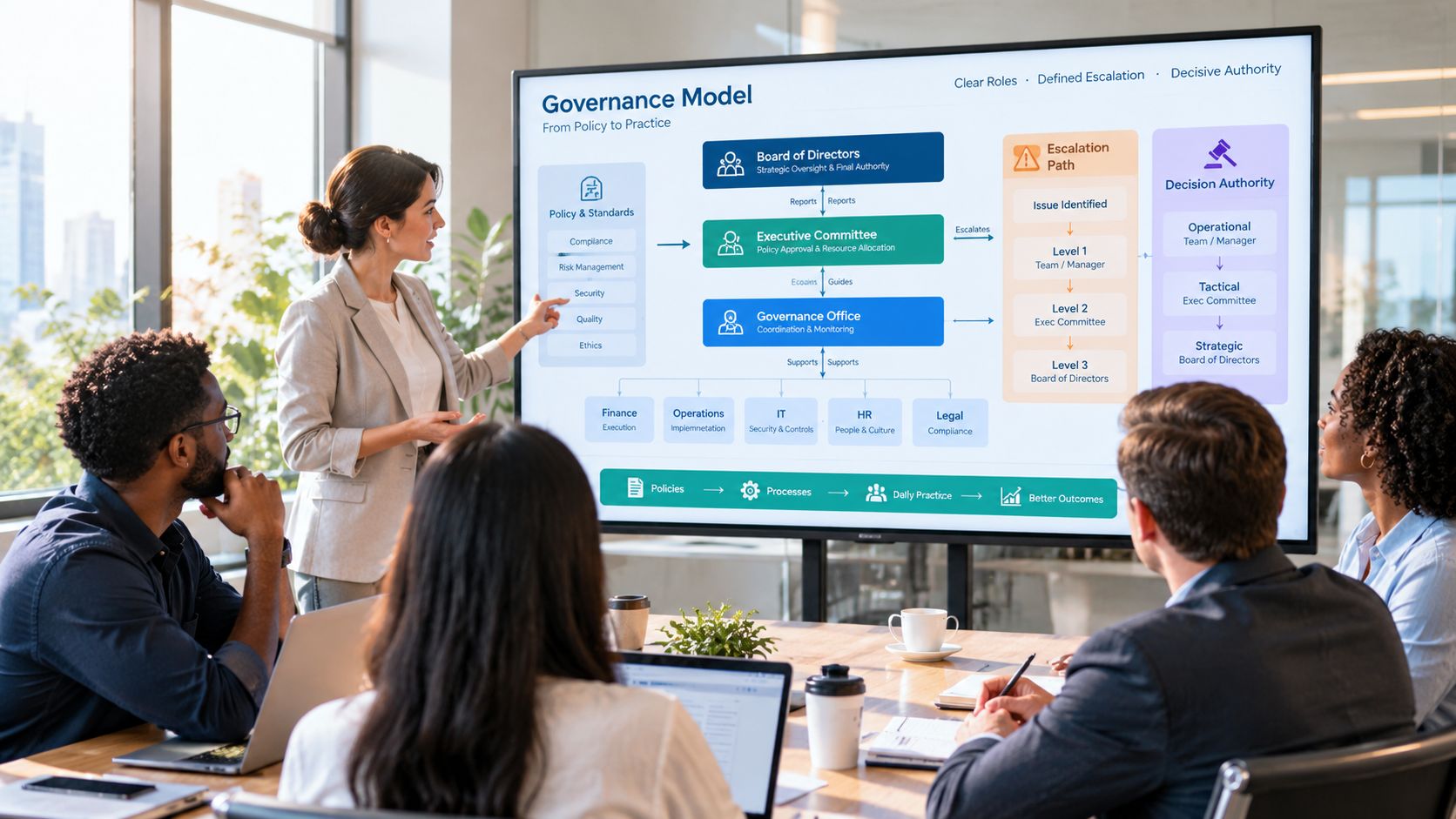
What a workable operating model contains
The board or relevant committee sets risk appetite and receives evidence-based reporting. Executive risk owners accept accountability for material risks. Control owners operate and attest to controls, while testers challenge design and operating effectiveness. Internal audit remains independent and shouldn't become the owner of management controls.
Design the risk workflow around explicit states:
Identify: Capture the risk, affected objective, process, asset, obligation, and accountable owner.
Assess: Record inherent exposure, existing controls, residual exposure, and confidence in the evidence.
Treat: Choose mitigation, transfer, acceptance, avoidance, or monitoring, with an approved target date.
Monitor: Track indicators, control attestations, incidents, exceptions, and changes in the risk environment.
Report: Present material changes, overdue actions, appetite breaches, and emerging exposures to the correct authority.
Use a standard risk-register record with fields for cause, event, impact, owner, appetite position, treatment, evidence source, review date, and escalation route. Refresh the register monthly where the operating context demands it, and refresh the heat map for each board risk session. The board pack should show movement, ownership, decisions required, and evidence, rather than a static list of red, amber, and green labels.
The UAE insurance market illustrates why process design must precede automation. A 2025 ICFR survey of UAE insurance firms found that 92% still relied on spreadsheets, even as ICFR frameworks had been adopted widely. That pattern points to a process problem, not merely a software problem. Assign dedicated owners and testers, replace spreadsheet-based issue tracking with workflow, automate review reminders, and preserve human judgement for exceptions and risk acceptance.
The DataLunix governance, risk, and compliance process resource can support process mapping across business, IT, audit, and board layers.
Evaluating and Integrating GRC Tools
Choose the platform that fits your operating model, data sources, integration constraints, and ownership capacity. A feature-rich tool won't fix an undefined control objective. A lighter platform may be the better choice when your priority is issue workflow, evidence collection, and accountable approvals.
Tool | List Price | DataLunix Price | Integration Strength | Best Use Case |
|---|---|---|---|---|
ServiceNow | Confirm with vendor | Confirm with partner | Broad enterprise integrations, CMDB, ITSM, workflow and service data | Large enterprises requiring integrated enterprise workflows |
HaloITSM | Confirm with vendor | Confirm with partner | Strong service-management workflow and configurable integrations | Organisations connecting service operations to risk and control activities |
Freshservice | Confirm with vendor | Confirm with partner | Accessible integrations for service and asset information | Teams seeking a practical, service-led starting point |
ManageEngine | Confirm with vendor | Confirm with partner | Broad IT operations and management ecosystem | Enterprises consolidating operational and infrastructure controls |
List prices and partner pricing vary by modules, users, geography, contract structure, and implementation scope. Don't publish a purchasing decision from a generic price sheet. Request a fit-gap demonstration using your own risk register, control attestation, exception approval, audit evidence, and reporting scenarios.
What integration should achieve
Start with the source of truth. A ServiceNow CMDB can provide configuration and service context for technology risks. ITSM incidents and changes can feed risk records, control evidence, and exception workflows. HaloPSA or Freshservice records can support operational attestations when the process has defined data ownership and validation rules.
The strongest integration pattern is selective. Automate repeatable evidence and status updates, but require human approval for risk acceptance, material exceptions, and board-level decisions. DataLunix describes delivery across ServiceNow, HaloITSM, Freshservice, and ManageEngine, including workflow automation, integration mapping, and implementation support. Review its GRC tools comparison when evaluating platform fit.
Deploying Phases with Change Management
A phased rollout gives you a controlled way to test ownership, evidence quality, escalation logic, and user experience before expanding across the enterprise. The first release should solve a visible operational problem, such as overdue findings, fragmented attestations, or unreliable regulatory evidence.
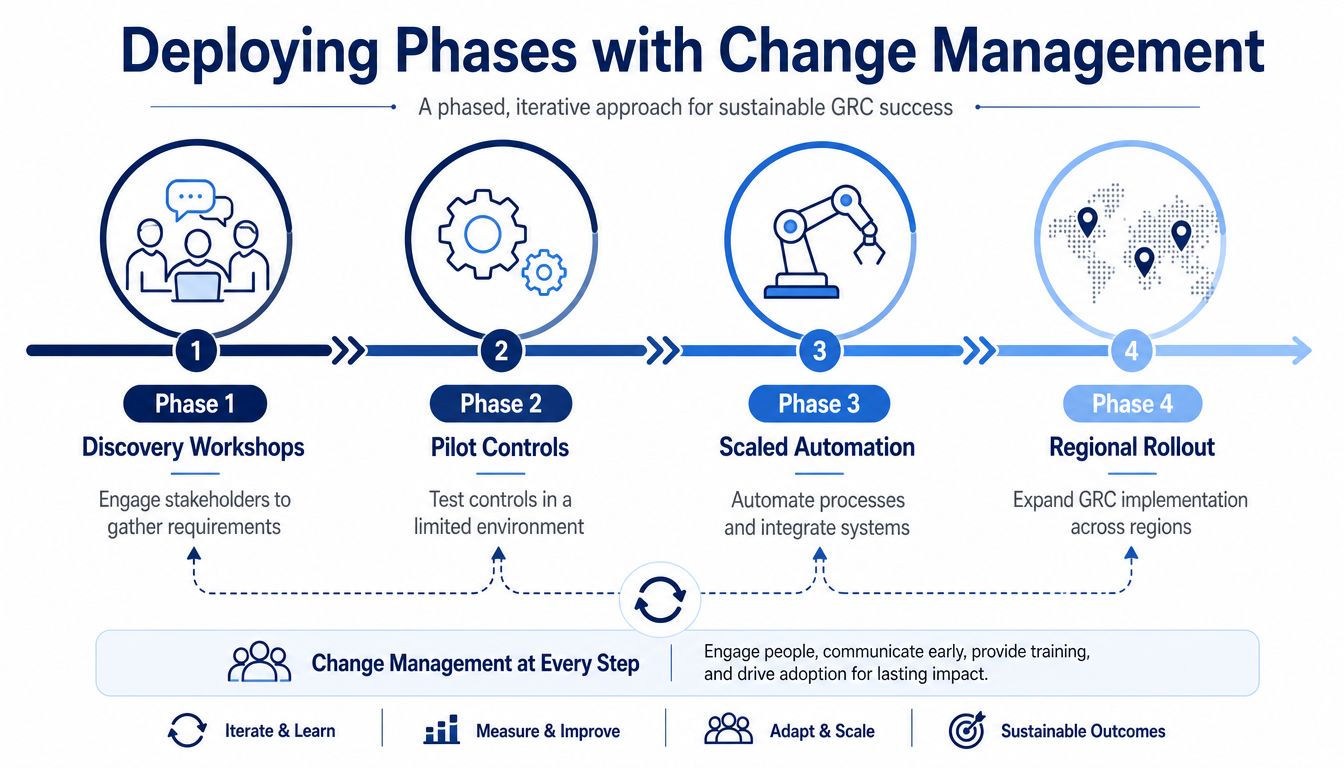
A controlled deployment sequence
Discovery workshops bring business, risk, compliance, audit, technology, and legal stakeholders into the same design conversation. Capture current workflows, pain points, mandatory decisions, data sources, and adoption risks. Secure written approval for the target process before configuration begins.
Pilot controls test a limited set of obligations and control owners. Select controls with clear evidence and visible business value. Measure whether users understand the task, whether the evidence is sufficient, and whether escalation reaches the right person.
Scaled automation connects approved workflows to source systems. Automate reminders, evidence requests, issue routing, approval records, and dashboard feeds. Keep exception authority explicit, because automation should accelerate governed decisions rather than hide them.
Regional rollout adapts terminology, ownership, legal obligations, language needs, and support arrangements across GCC entities. Use a common data model where possible, but don't force every jurisdiction into identical workflows when local requirements differ.
The FATF follow-up report on the UAE records movement from 11 Compliant and 23 Largely Compliant ratings in the 2021 follow-up to 15 Compliant and 24 Largely Compliant ratings in the 2023 follow-up, with 1 Partially Compliant recommendation remaining. That regulatory context supports a control-focused rollout. UAE organisations should prioritise demonstrable ownership, evidence quality, issue closure, and auditability over a large catalogue of unused modules.
Change communications should answer three questions for each audience: what is changing, what action is required, and how the organisation will support the person doing it. Train control owners in the workflow they will use, not in every feature the platform contains. Give executives a concise dashboard showing decisions, appetite breaches, overdue actions, and material trends.
Defining KPIs and Ensuring Continuous Improvement
GRC implementation isn't complete at go-live. It becomes effective when the organisation can detect control drift, assign action, verify closure, and show the board how risk is changing. A dashboard should measure the health of the operating model, not reward teams for creating more policies.
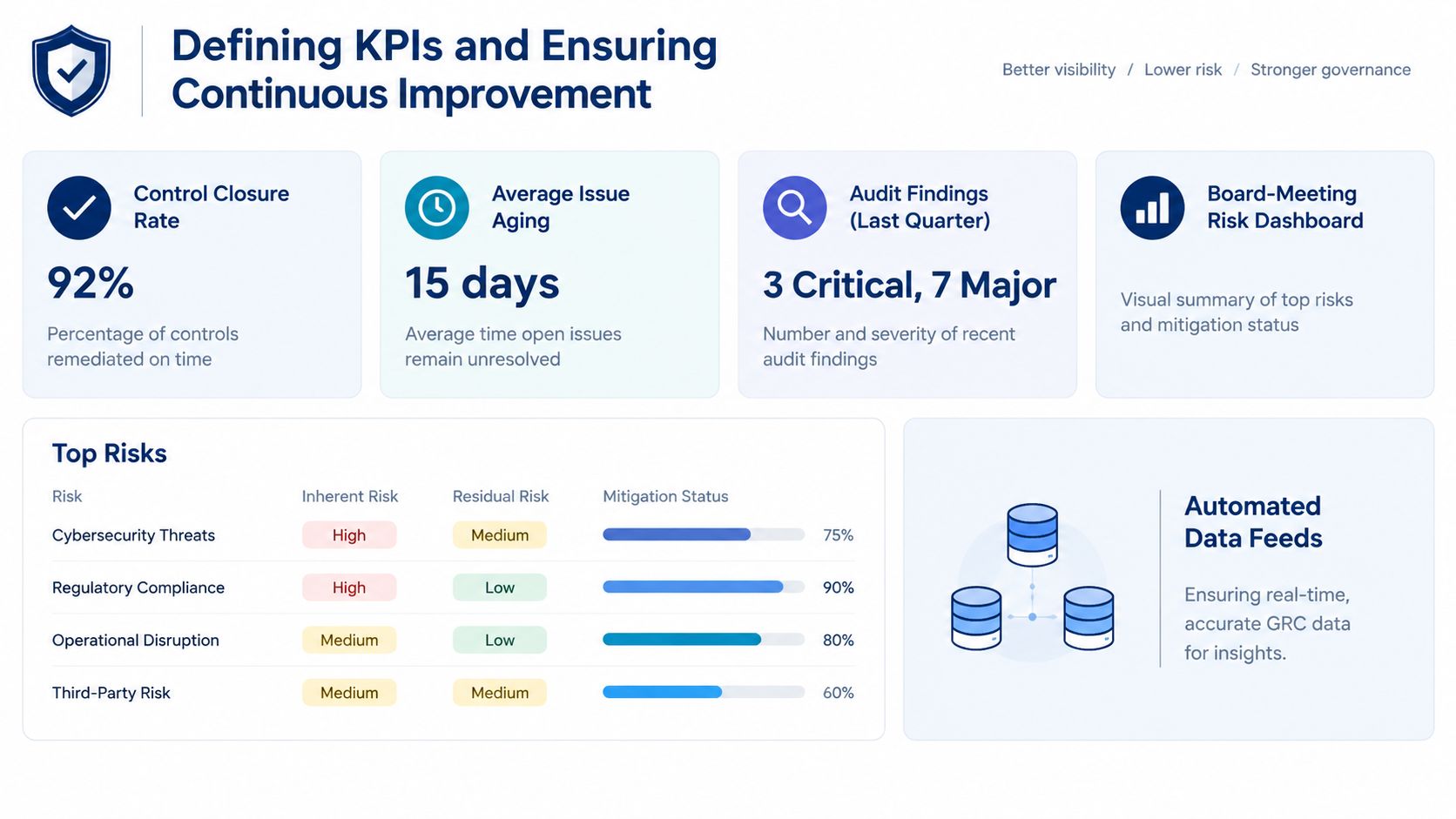
Which indicators belong in the management rhythm
Use a small set of measures tied to decisions:
Control performance: Track attestations completed, failed tests, overdue reviews, and evidence quality.
Issue discipline: Monitor open issues, ageing, accepted exceptions, remediation ownership, and missed target dates.
Assurance quality: Compare internal-audit findings, external-audit requests, repeat findings, and evidence retrieval effort.
Board visibility: Show the most material risks, appetite position, mitigation status, emerging exposures, and decisions required.
Regulatory responsiveness: Record obligation changes, impacted controls, assigned actions, and approval of implementation evidence.
Refresh risk registers monthly when the operating environment requires that cadence. Use dedicated, evidence-based board risk sessions and refresh heat maps at every board meeting. The dashboard should draw from authoritative systems wherever possible, because manually re-keyed status creates uncertainty about whether a reported improvement is real.
A 2026 academic analysis found that listed-company compliance disclosure in the UAE rose to 95.8%, while average governance-control coverage increased from about 89 companies in 2015–2019 to 106 companies in 2020–2023. The same analysis reported 2023 general-assembly compliance activity across 146 meetings, indicating a recurring operational governance cycle rather than one-time policy adoption. See the academic analysis of UAE listed-company governance compliance.
Use a continuous improvement loop: review performance, investigate exceptions, update the control or workflow, validate the change with owners, and report the result to the appropriate committee. The continuous improvement methodologies guide provides a useful reference for turning findings into a managed improvement backlog.
A mature programme treats regulatory change, new technology, business expansion, audit findings, and user feedback as inputs to that loop. The result is a living GRC operating model with traceable ownership and regulator-ready evidence.
Frequently Asked Questions About GRC Implementation
What does GRC implementation involve?
It involves aligning governance decisions, risk management, compliance obligations, controls, evidence, workflows, reporting, and accountability. Successful programmes connect people and processes before automating them in a platform.
How should a UAE enterprise begin GRC implementation?
Begin with a readiness assessment covering ownership, processes, evidence, technology, risk appetite, and regulatory scope. Then prioritise a small set of controls with clear owners and measurable evidence before expanding.
Which GRC framework should a UAE company choose?
Use one primary framework that matches your risk profile, then map UAE obligations to its control objectives. ISO 31000, COSO ERM, and NIST RMF can serve different purposes, but combining them without a clear architecture creates duplicated controls and confusing accountability.
Should GRC implementation replace spreadsheets immediately?
Replace spreadsheets first where they create material risks, such as evidence tracking, issue closure, attestations, or regulatory reporting. Preserve controlled exports during transition, but move the authoritative workflow into a system with ownership, approvals, audit trails, and escalation.
How does a board know whether GRC implementation is working?
The board should see whether material risks remain within appetite, whether controls produce reliable evidence, whether issues close on time, and whether exceptions receive proper authority. A useful dashboard supports decisions rather than presenting an undifferentiated volume of compliance activity.
DataLunix helps GCC and European enterprises assess readiness, map controls, configure GRC workflows, integrate ServiceNow, HaloITSM, Freshservice, and ManageEngine data, and support adoption through change management and managed services. Visit DataLunix to discuss a practical GRC roadmap built around your regulatory obligations, operating model, and evidence requirements.