
GRC in Banking Explained for GCC and Europe Banks

Updated: 10 hours ago
A bank can have a strong AML policy, a capable risk team, and an experienced board, yet still struggle to answer a regulator's basic question: who owns this control, what evidence proves it works, and what happens when it fails? That gap is why GRC in Banking has moved from an annual compliance exercise to an integrated operating model covering governance, risk, compliance, cyber-fraud, outsourcing, technology and daily operations.
What does GRC in Banking mean for a modern bank?
What GRC in Banking Really Means Today
A fragmented bank often looks orderly from the outside. The board receives a risk report, compliance maintains an obligations register, information security monitors incidents, and procurement manages vendors. Yet a failed supplier assessment may never reach the operational risk committee, while a cyber incident may sit in an IT queue without being linked to a regulatory obligation or customer-impact assessment.
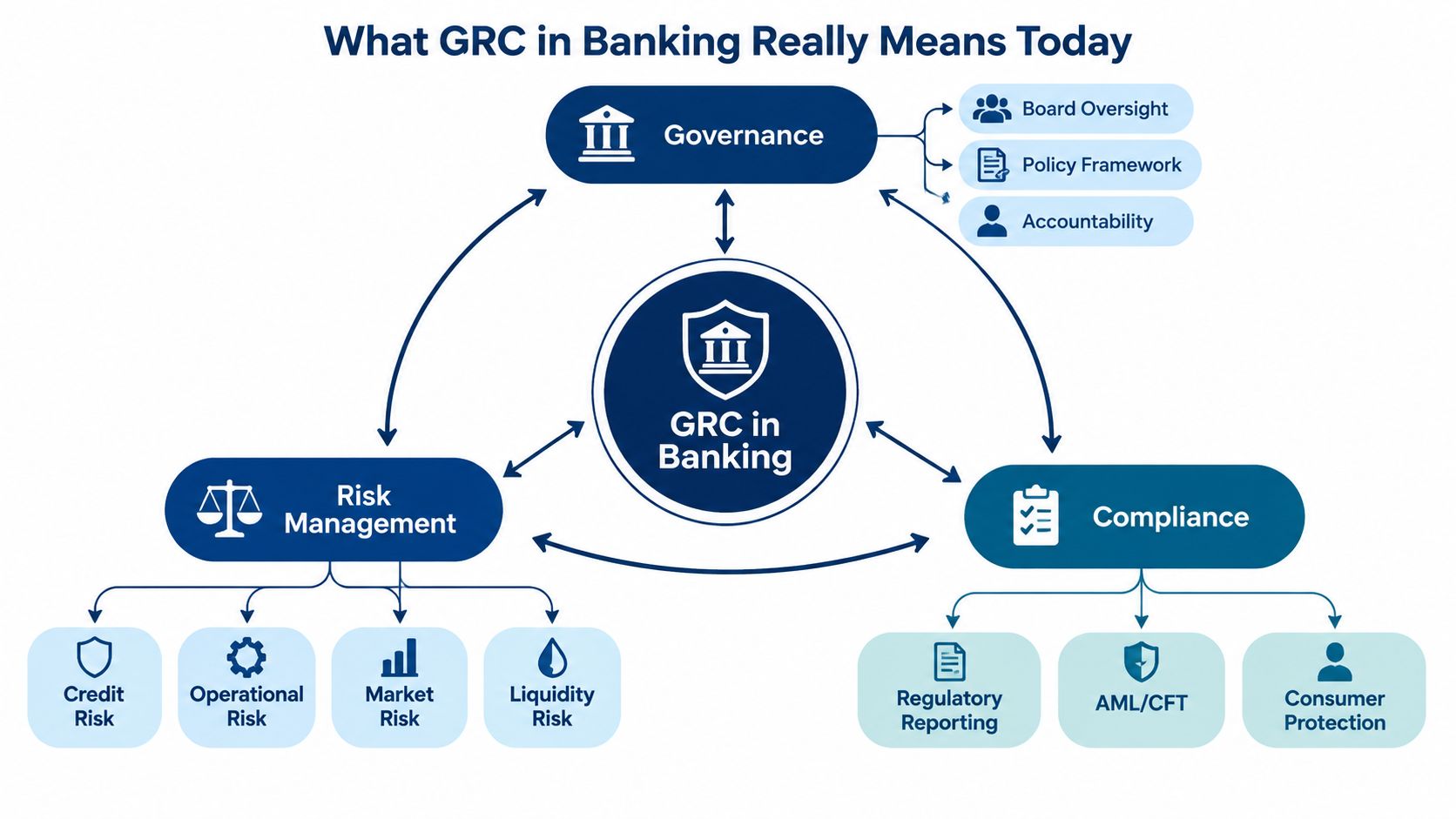
That is the practical problem GRC in Banking solves. Governance defines who makes decisions and accepts risk. Risk management identifies what could prevent the bank from meeting its objectives. Compliance translates external obligations and internal policies into controls that people can operate and evidence.
One operating system, not three departments
Think of a bank as a city. Governance is city planning, setting priorities, ownership and boundaries. Risk management is the traffic system and emergency planning, helping leaders understand where disruption may occur. Compliance is the rulebook, inspections and evidence that show whether the city is operating within its obligations.
The analogy matters because the systems depend on one another. A board-approved risk appetite has little value if business teams don't know which thresholds apply. A compliance requirement remains theoretical if no owner, workflow or test supports it. An incident record becomes much more useful when it connects to the affected service, supplier, control, policy and regulatory obligation.
For UAE banks, this connection is reinforced by the Central Bank's requirement for a bank-wide or group-wide risk governance framework that identifies, measures, monitors, reports and controls material risks on a timely basis. The framework also requires an independent risk function led by a chief risk officer or equivalent, with direct reporting to the board or board risk committee. The Central Bank's risk-management and governance rules make clear that risk governance must operate through policies, processes, systems and controls.
Practical rule: If a control can't be linked to an accountable owner, a business process and current evidence, it isn't yet an operational control.
Mature GRC gives executives a common language for resilience and decision-making. It helps the board see whether risk appetite is being respected, helps control owners understand their responsibilities, and helps regulators trace decisions to evidence. The journey starts with fundamentals, then moves through regional pressure, frameworks, risk taxonomy, implementation, automation and partner selection.
Why GCC and European Banks Face Stronger GRC Pressure
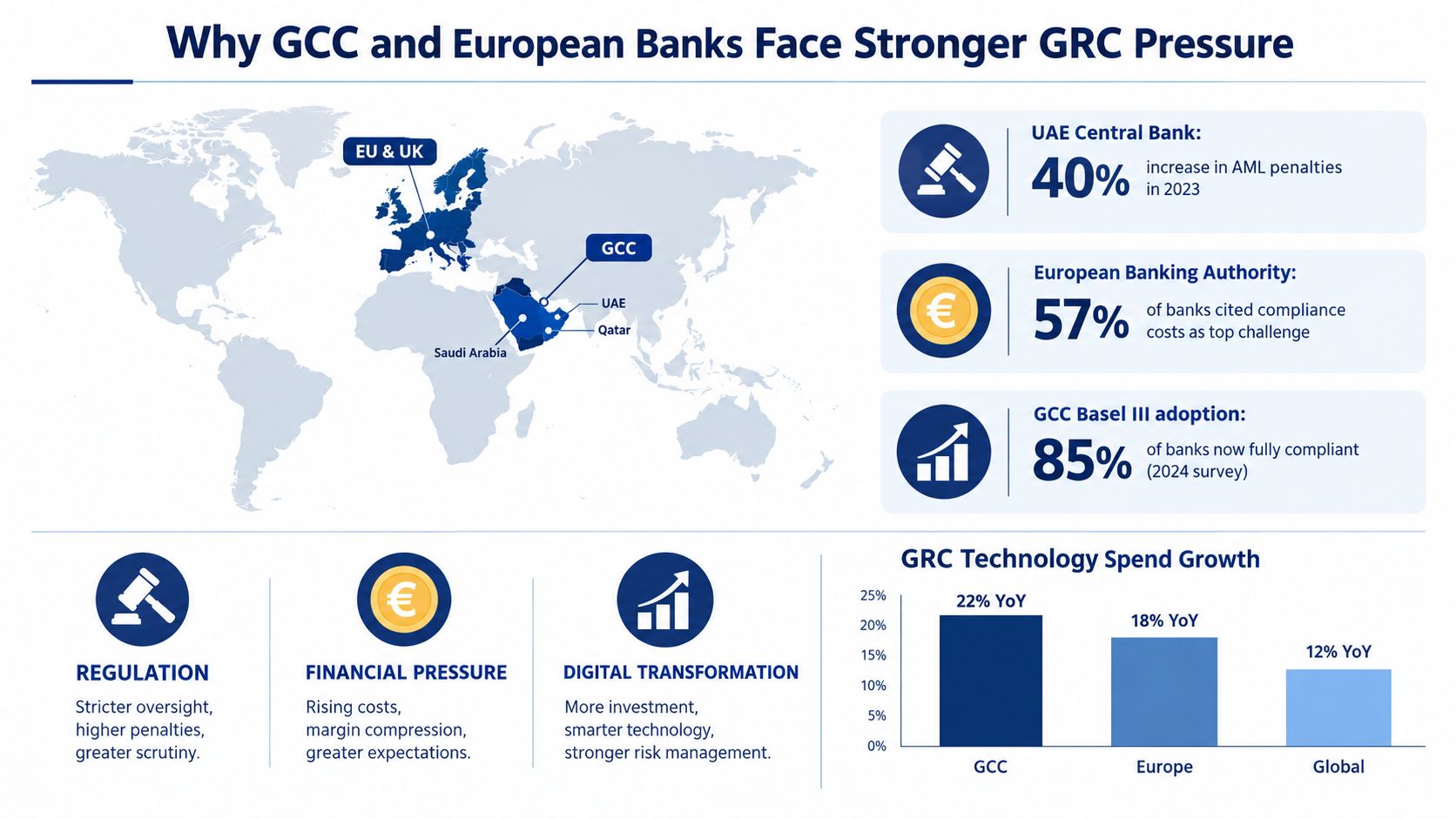
A bank can pass an AML review and still carry serious exposure through a weak supplier, an untested recovery plan, or an unmonitored digital channel. GCC and European banks therefore face pressure from several connected directions: financial crime, operational resilience, cyber-fraud, outsourcing, data protection, technology dependence and cross-border services.
These pressures work like three interlocking gears. Governance assigns accountability and sets risk appetite. Risk management measures exposure and determines where treatment is required. Compliance maps obligations, tests adherence and reports exceptions. A failure in one gear can slow the others, leaving executives with fragmented evidence and delayed decisions.
Start with the UAE control environment
The UAE banking sector operates at substantial scale. Banks held about AED 4.075 trillion in assets at the end of 2023, approximately USD 1.11 trillion, according to Facephi's UAE banking compliance overview. At that scale, a governance weakness can affect more than one process or business unit. It may become a matter of wider supervisory concern.
The UAE's national risk assessment classifies the banking sector's inherent money-laundering and terrorist-financing risk as High, residual risk as Medium-High, and control effectiveness as “Largely effective”, as reported in the UAE Financial Intelligence Unit's 2024 National Risk Assessment. Controls reduce exposure, yet they require continuous monitoring, escalation and improvement.
Reporting deadlines create a direct test of operating discipline. The suspicious activity report filing deadline was shortened to 35 working days from 90 working days previously. An institution that depends on email reminders and disconnected spreadsheets may struggle to prove that cases were assigned, reviewed and filed on time. A GRC workflow can connect the obligation to an owner, due date, approval record and evidence package.
Connect regional obligations to operating resilience
European and GCC banks often depend on the same vendors, platforms, payment rails and customer journeys. A control built for one jurisdiction may need different ownership, evidence or reporting in another. European requirements may stress resilience and data protection, while UAE and Saudi expectations may place particular weight on AML, outsourcing, capital, liquidity and board oversight.
The practical response is a shared control model rather than a separate programme for every rule. It should identify common requirements, preserve jurisdiction-specific differences and show executives one view of exceptions. ServiceNow can support this pattern by linking obligations, controls, incidents, supplier records and remediation tasks in connected workflows.
For a focused view of cyber-resilience planning, CIOs can review DataLunix's DORA and cyber-resilience perspective. The same operating model can bring fraud signals, ITSM records and third-party issues into risk decisions, so GRC supports resilience instead of remaining an AML-only reporting exercise.
Core Frameworks and Controls That Shape Banking GRC
A bank's payment platform may satisfy security requirements while its capital reporting, privacy controls and supplier oversight remain disconnected. Frameworks work best as coordinated layers rather than competing checklists. COSO connects internal control and enterprise risk with strategy and performance. ISO 31000 sets principles for risk management, while ISO 27001 structures information-security governance. Basel III addresses capital, liquidity and resilience. PSD2 shapes payment security and customer authentication in applicable European contexts. GDPR governs personal-data protection and accountability.
The architecture should answer one practical question: which decision does this framework support? Each framework becomes useful only after translation into policies, control objectives, evidence requirements, testing routines and escalation paths. That translation turns regulatory expectations into work that owners can perform and auditors can verify.
Banking GRC framework comparison
Framework | Primary Focus | Banking Application |
|---|---|---|
COSO | Internal control and enterprise risk | Board oversight, financial controls, control ownership and assurance |
ISO 31000 | Risk-management principles | Risk assessment methods, treatment decisions and reporting |
ISO 27001 | Information-security management | Security governance, access, monitoring and continual improvement |
Basel III | Capital, liquidity and banking resilience | Financial-risk oversight, capital planning and supervisory reporting |
PSD2 | Payment services and customer protection | Payment security, authentication and third-party payment access |
GDPR | Personal-data protection | Customer-data governance, privacy accountability and breach response |
Avoid duplicate control inventories
A bank does not need a separate control for every framework when one well-designed control addresses several obligations. A privileged-access review, for example, can support information security, operational resilience, privacy and audit requirements. The activity can remain shared, but its evidence and testing criteria may need to differ where regulators expect different outcomes.
COSO also gives leaders a way to connect control decisions with business performance. DataLunix offers a detailed perspective on integrating COSO enterprise risk management with strategy and performance.
Regional assurance requires the same discipline. The Basel Committee's assessment found the risk-based capital framework fully compliant across all 14 components, while Liquidity Coverage Ratio implementation was only largely compliant. That comparison shows why a bank should connect capital, liquidity and AML workflows without treating maturity in one risk domain as proof of strength in another. A shared evidence model can preserve those distinctions while giving boards a clearer view of control performance.
Understanding the Banking Risk Taxonomy in Practice
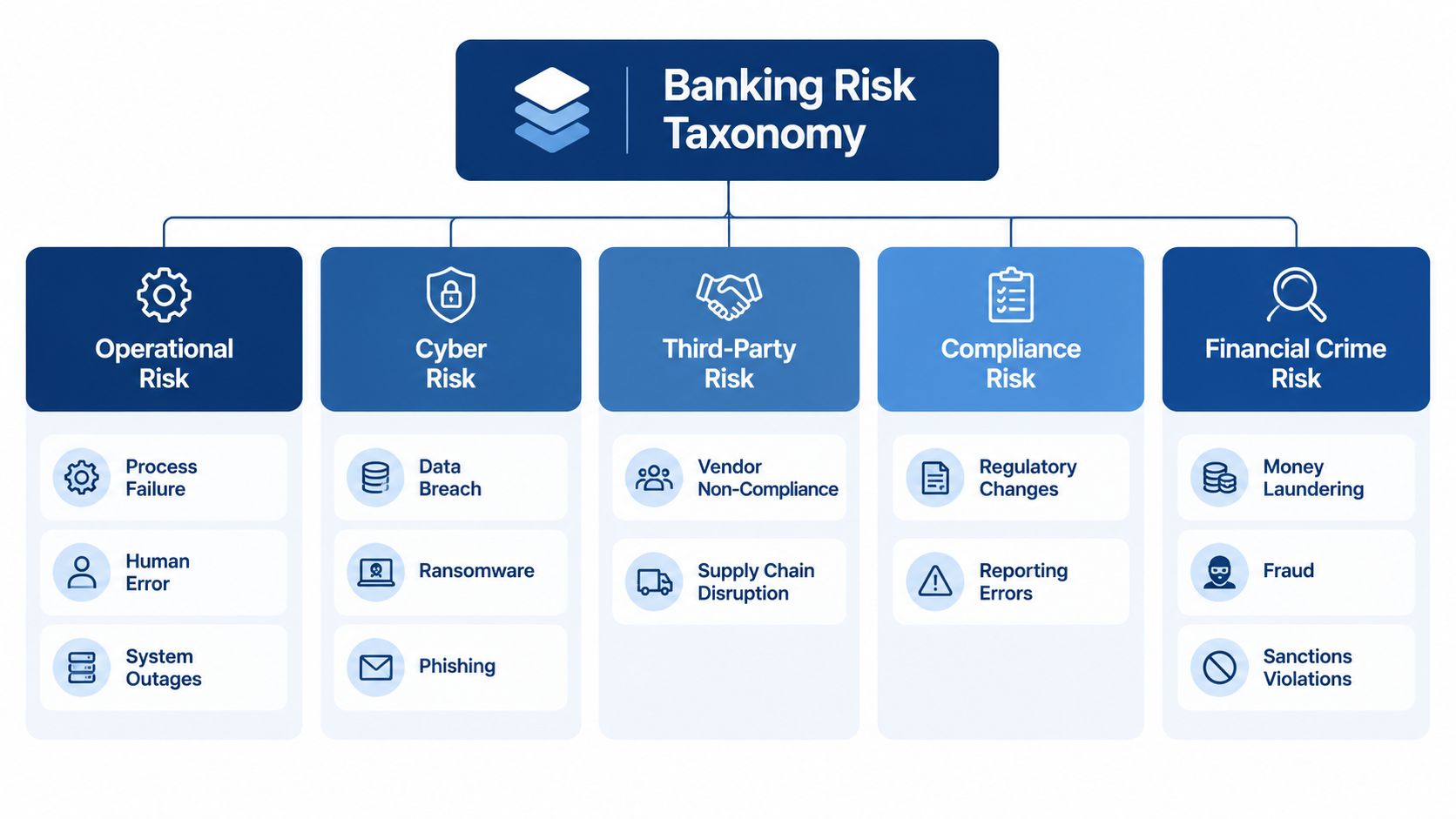
A risk taxonomy is the bank's shared filing system for uncertainty. Without one, a vendor outage may be classified as an IT issue by technology, an operational event by risk, a compliance concern by legal and a customer-impact incident by operations. Each team may be correct, but leadership still lacks one coherent view.
Classify the event, then trace the cascade
Consider an outsourced payment service that becomes unavailable. The immediate event is operational. The supplier relationship creates third-party risk. If customer data or transaction integrity is affected, cyber and compliance risks may follow. If suspicious activity monitoring is interrupted, financial-crime exposure may also increase.
That cascade is why a taxonomy should include both risk categories and relationships:
Operational risk: Process failure, human error and system outages.
Cyber risk: Data breach, ransomware and phishing.
Third-party risk: Vendor non-compliance and supply-chain disruption.
Compliance risk: Regulatory changes and reporting errors.
Financial-crime risk: Money laundering, fraud and sanctions violations.
The categories aren't competing labels. They are different lenses applied to the same business event. The risk owner should record the primary exposure, affected services, dependencies, obligations, controls and escalation route.
Make cyber-fraud a GRC responsibility
Cyber-fraud often gets assigned exclusively to IT security. That approach misses the governance questions: who approves the control, which policy requires it, which business service depends on it, and what evidence goes to the board?
Regional email-authentication data illustrates the problem. DMARC adoption among GCC banks fell from 96% in 2024 to 77% in 2025, and only 60% were enforcing the strictest reject policy, according to Khaleej Times' report on GCC bank fraud defences. These figures are not merely technical indicators. They raise questions about control ownership, exception approval, monitoring and fraud accountability.
The same report states that CBUAE Notice 2025/3057 requires the phase-out of SMS and email one-time passwords by 31 March 2026, with liability and penalties attached. Risk leaders should connect that change to policy updates, authentication architecture, customer communications, incident response and evidence of implementation.
For vendor governance methods that connect supplier exposure to operational controls, see this practical guide to third-party risk management.
Building Your GRC Implementation Roadmap That Works
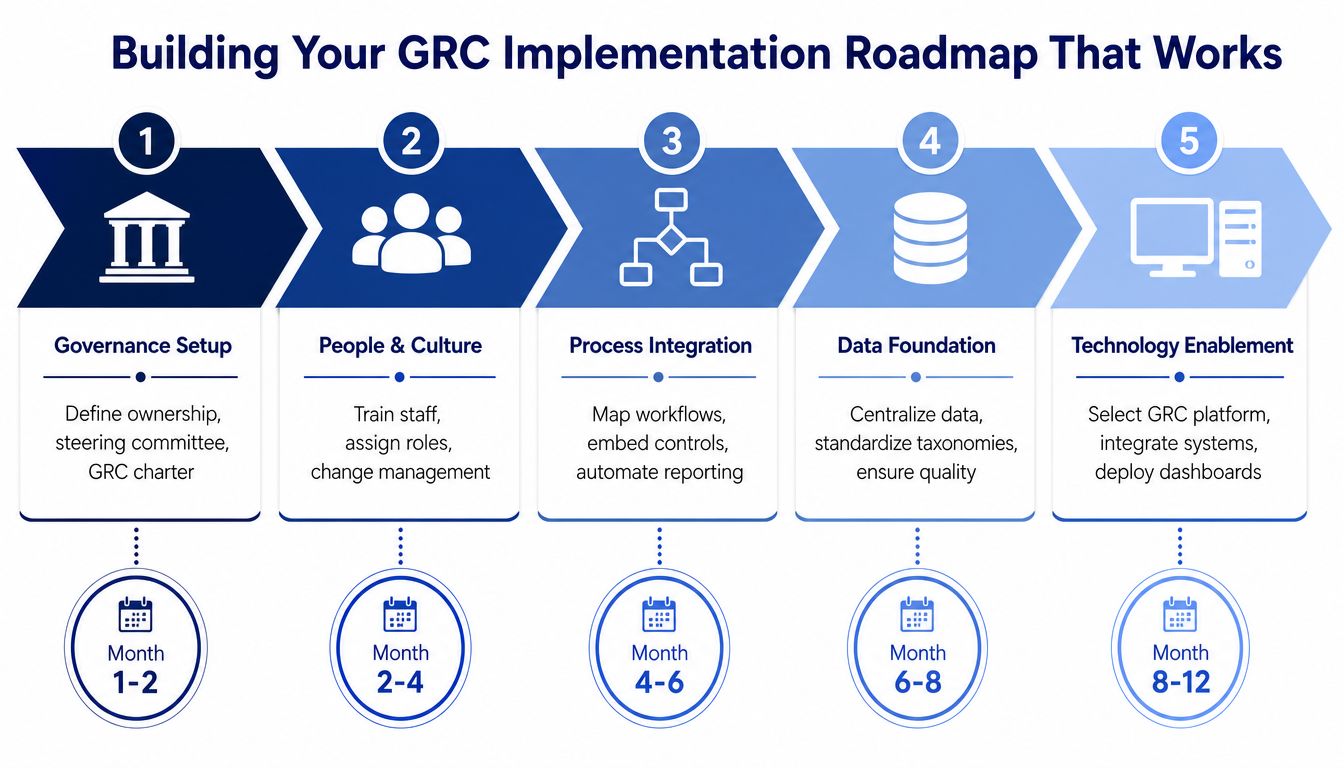
A GRC programme fails when the bank buys a platform before deciding who owns risk, what evidence matters and how exceptions move through the organisation. Technology should make a sound operating model faster and more visible. It can't supply accountability by itself.
Establish the decision model first
Begin with a GRC charter approved by the board or an appropriate board committee. Define the relationship between business ownership, independent risk oversight and internal audit. The Central Bank's UAE framework requires an adequately resourced risk function led by a chief risk officer or equivalent, with direct reporting to the board or board risk committee, so the reporting line must be explicit rather than implied.
Then define:
Risk appetite: Which thresholds trigger escalation, additional approval or activity suspension?
Control ownership: Which executive is accountable for design, operation, testing and remediation?
Lines of defence: How do business teams, risk and compliance, and internal audit divide responsibilities?
Evidence standards: What records prove that a control operated, and where will the bank retain them?
Standardise before automating
Create one risk taxonomy, one control library and one issue-severity model. Map policies to obligations, obligations to controls, controls to processes and processes to evidence. This prevents each department from inventing its own vocabulary.
Useful measures should test operating quality, not activity volume. Track whether owners complete attestations, whether overdue issues receive escalation, whether control evidence is accepted without rework and whether risk indicators reach the right committee. The exact targets should reflect the bank's risk appetite and supervisory commitments.
Build the data foundation
Bring together the records that explain how the bank operates:
Services: Critical banking and customer services.
Assets: Applications, infrastructure and information stores.
Suppliers: Contracts, dependencies, assessments and remediation.
Controls: Owners, frequency, evidence and test results.
Issues: Root cause, business impact, due date and acceptance decision.
Only after this foundation is stable should the bank select integrations and dashboards. The outcome should be traceability from a board risk statement to a control, from that control to daily work, and from daily work to evidence.
How ITSM and Automation Power Modern Banking GRC
The strongest GRC workflow is often already present in ITSM. Incidents record failures, change records show what was altered, asset records identify affected technology, and service records show business impact. The opportunity is to connect those operational records to risk, compliance and audit without forcing staff to re-enter the same information.
A bank can implement this through a simple chain:
Link services to risks: Associate critical services with operational, cyber and third-party risks.
Link changes to controls: Require approvals or testing evidence when a change affects a controlled service.
Link incidents to obligations: Escalate incidents that may affect regulatory reporting, privacy or resilience.
Link suppliers to evidence: Pull assessment results, contract obligations and incidents into third-party risk records.
Link tests to remediation: Create owned tasks when control monitoring identifies an exception.
ServiceNow GRC and Integrated Risk Management can support these patterns when configured around the bank's taxonomy and operating model. HaloITSM and Freshservice can also contribute operational data, provided the integration preserves ownership, timestamps, approvals and evidence context.
Automate repeatable control work
Good automation removes handoffs, not judgement. It can schedule policy attestations, request evidence from control owners, calculate vendor risk indicators from defined attributes, open remediation tasks and orchestrate breach-response activities. Human decision-makers should still approve risk acceptance, determine materiality and assess regulatory significance.
DataLunix works with platforms including HaloITSM, HaloPSA, Freshservice and ServiceNow, and its GRC automation guidance describes ways to connect control activity with operational workflows through GRC automation patterns. The right design depends on the bank's existing systems, data quality, integration constraints and supervisory evidence requirements.
Automation principle: Automate the evidence trail around a decision, but don't automate accountability away.
Avoiding Pitfalls and Choosing the Right GRC Partner
The most common mistake is treating GRC as an AML programme with a technology layer. AML and financial crime remain central, but modern banking GRC also needs control ownership for outsourcing, cyber-fraud, resilience, privacy, technology change and evidence quality.
Other warning signs deserve equal attention:
Tool-first delivery: A platform is configured before the bank agrees on taxonomy, ownership and risk appetite.
Weak accountability: Controls have team names instead of named accountable executives.
Fragmented evidence: Audit records remain spread across email, spreadsheets, ticketing tools and document repositories.
No operational connection: GRC findings don't create work in incident, change, asset or supplier workflows.
Insufficient adoption planning: Staff receive a system but not clear procedures, training or leadership reinforcement.
When comparing partners, ask for a fit-gap assessment before a product demonstration. Test whether the provider can map UAE obligations, cross-border requirements and internal policies into a usable control model. Ask how it will integrate ServiceNow or other ITSM platforms, preserve evidence, manage exceptions and support board reporting.
Also assess delivery capacity, local leadership, offshore or hybrid options, managed services, upgrade support and staff augmentation. A partner should explain what the bank must own internally, what it can operate externally and how knowledge will transfer to permanent teams.
The UAE AML/CFT programme must include policies, procedures, systems and controls designed to prevent money laundering and terrorist financing, according to the Central Bank AML/CFT Rulebook. The wider legal foundation includes Federal Decree-Law No. 20 of 2018, Cabinet Decision No. 10 of 2019 and Cabinet Decision No. 24 of 2022, identified in the UAE joint supervisory guidance. A capable partner should help translate those instruments into owned, testable and evidenced workflows, not list them in a compliance register.
For readers comparing governance models beyond banking, scalable compliance for RIAs offers useful context on designing compliance processes that can grow without relying on disconnected manual work.
DataLunix's governance, risk and compliance platform perspective is relevant when you need to connect risk and compliance records with operational delivery. The decision should remain evidence-led: choose the partner that can demonstrate a coherent architecture, realistic adoption plan and clear ownership model.
DataLunix helps GCC and European organisations connect ServiceNow and other ITSM platforms with GRC workflows, including risk, policy, compliance, audit, control testing and operational evidence. Visit DataLunix to arrange a discovery workshop and assess the fit, readiness and integration path for your bank.