


GRC IT Security: The 2026 Playbook for GCC and Europe

Updated: 7 hours ago
500,000 to 700,000 cyberattack attempts can hit UAE entities in a single day during periods of regional tension, compared with roughly 200,000 previously, according to the UAE cybersecurity threat assessment. An annual audit cannot manage that operating environment. GRC IT Security must run continuously, connect to live IT operations, and produce defensible evidence before an auditor, regulator, or board committee asks for it.
What GRC IT Security Actually Means in 2026
A static annual-audit programme cannot manage a live threat environment. An asset changes, a supplier gains access, a cloud workload moves, or a newly exposed weakness alters the control picture. GRC IT Security must therefore operate continuously, with decisions, remediation, and evidence tied to the systems where work happens.
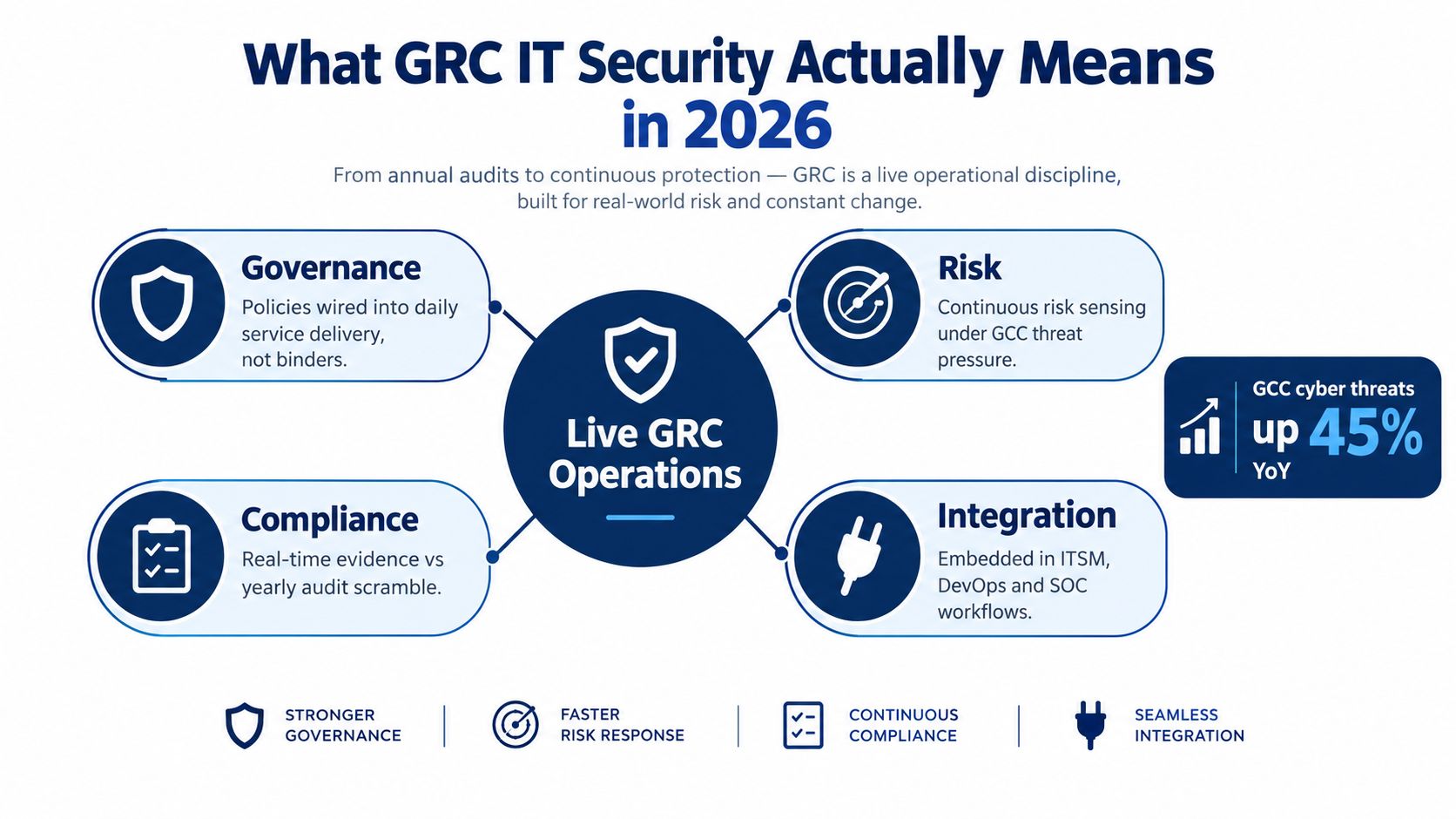
The UAE's threat pressure makes that requirement concrete. During heightened regional developments in Q1 2026, daily cyberattack attempts rose from roughly 200,000 to between 500,000 and 700,000, a 2.5x to 3.5x increase over the earlier level, according to the UAE Cybersecurity Council coverage. The same coverage identifies Law No. 34 of 2021 on Combatting Rumours and Cybercrimes, effective from 2 January 2022, as a compliance anchor for incident handling, evidence preservation, and governance.
The three operating pillars
Governance assigns decision rights. It records who accepts residual risk, owns each control, approves exceptions, and escalates incidents to executives.
Risk connects threats to business assets and services. A vulnerability on an isolated test server does not carry the same consequence as a weakness affecting a payment platform, identity provider, or critical supplier. Each risk record needs asset criticality, data sensitivity, business impact, and current threat context.
Compliance converts operational work into evidence. Access reviews, change approvals, vulnerability remediation, incident records, supplier assessments, and recovery exercises should create proof through normal workflows. Manual evidence reconstruction before an audit signals weak control design.
Practical rule: A control without an operational owner, system evidence, escalation path, and review cadence is a policy statement, not a working control.
The model supports DORA, NIS2, UAE PDPL, FSRA, NESA, and SAMA CSF, while implementation must follow each entity's regulatory scope. A UAE critical-infrastructure operator, Saudi manufacturer, and European financial institution will have different reporting routes, service dependencies, and supplier-risk tolerances.
The operating model should connect governance decisions to ITSM tickets, ITAM records, ITOM telemetry, security events, and board reporting. ServiceNow, HaloITSM, Freshservice, and ManageEngine can support that connection when ownership and workflows are designed first. A practical governance, risk and compliance operating model starts with service delivery and asset ownership, not a framework checklist.
Comparing the Frameworks That Matter
No single framework gives a GCC or European enterprise everything it needs. The right answer is a primary framework for operating discipline, a secondary framework for assurance or governance, and a crosswalk that removes duplicate controls.
ISO/IEC 27001 remains the certification and assurance anchor. Customers, procurement teams, and regulators commonly recognise its management-system structure, risk treatment process, internal audit discipline, and statement of applicability. Use it as the primary framework when certification, customer assurance, or multinational procurement drives the programme.
NIST CSF 2.0 gives engineering and security teams a practical vocabulary for identifying, protecting, detecting, responding, and recovering, with Govern placing leadership, supply chain, and risk strategy at the centre. It works especially well as the operational language beneath an ISO management system.
COBIT 2019 belongs in the board and audit committee conversation. It helps connect enterprise goals, governance objectives, management practices, accountability, and performance reporting. It shouldn't become another technical checklist.
SOC 1 and SOC 2 are customer-facing assurance artefacts rather than complete enterprise governance systems. SOC 1 focuses on controls relevant to financial reporting. SOC 2 addresses trust services criteria and is often useful for technology providers answering customer due diligence.
Framework | Primary Use | Best-Fit Buyer Profile |
|---|---|---|
ISO/IEC 27001 | Certifiable information security management system | GCC bank, European manufacturer, regulated supplier |
NIST CSF 2.0 | Operational cyber-risk communication | Engineering-led security team or hybrid cloud enterprise |
COBIT 2019 | Board governance and assurance oversight | Listed group, audit committee, complex shared-services organisation |
SOC 1/2 | Customer assurance and service-provider evidence | SaaS provider, outsourcing firm, technology supplier |
A GCC bank may use ISO 27001 as its management-system anchor, NIST CSF 2.0 for SOC execution, and COBIT 2019 for board reporting. A European financial firm may add DORA control requirements to the same structure. Running two frameworks in parallel is a sensible baseline, while FSRA- and DORA-regulated entities often need three connected views.
Framework scope must also include lifecycle controls that teams routinely overlook. For example, secure device disposal requirements can support asset retirement, data handling, and evidence expectations when ITAM records move from active service to disposal.
Choose the primary framework before selecting software. The comparison of leading GRC frameworks is useful only when it leads to a decision about ownership, evidence, and operating cadence.
Running a Risk Assessment and Control Mapping
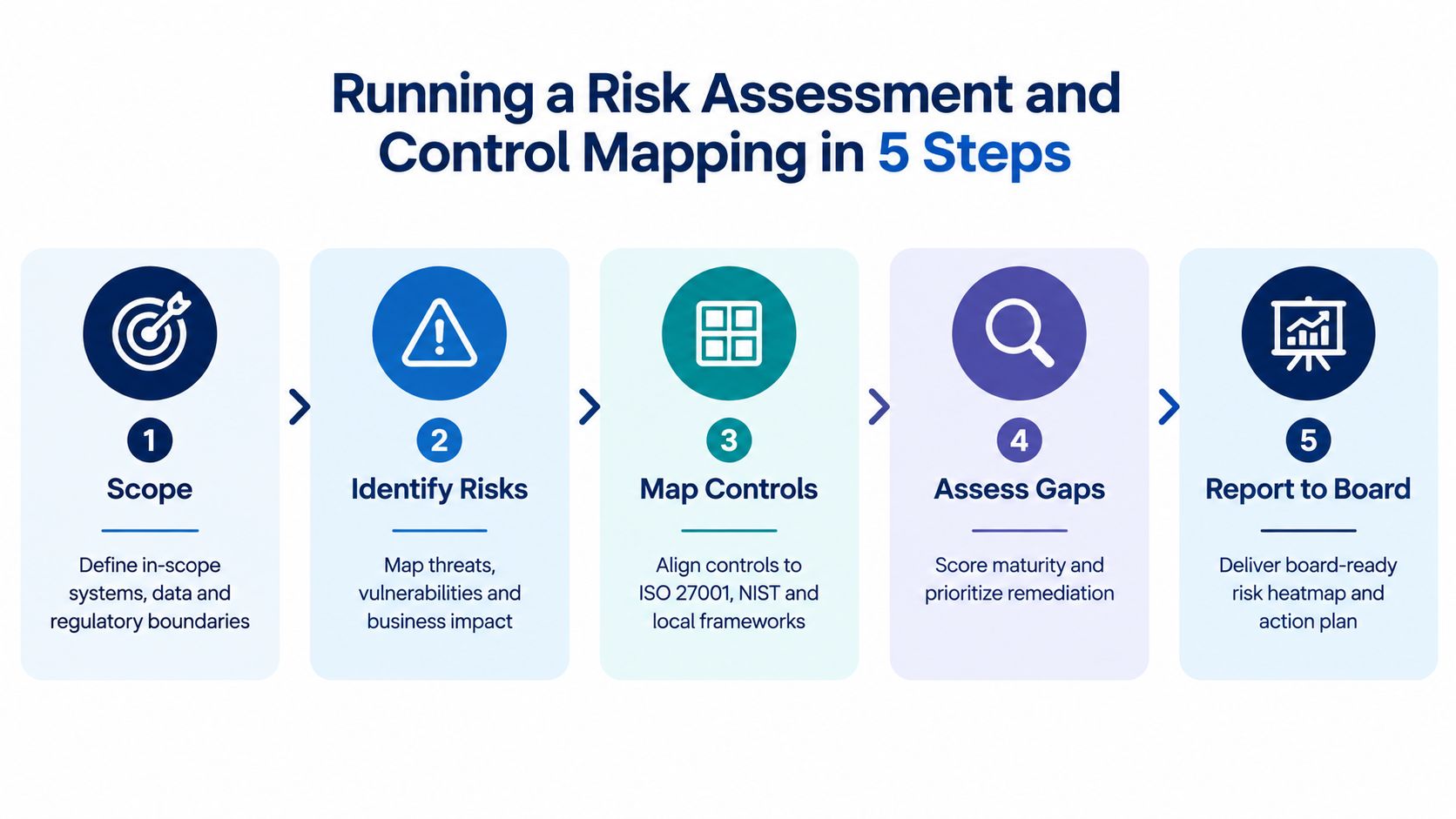
A risk assessment should produce board-ready decisions, not a colourful heat map with no owners. Use a five-step process that starts with reliable asset data and ends with residual risk, treatment decisions, and evidence sources.
Start with business scope
Step 1, scope. Identify in-scope systems, data flows, legal entities, suppliers, and crown-jewel assets. Pull the starting inventory from the CMDB and ITAM rather than asking departments to rebuild spreadsheets. Deliver an agreed scope statement, asset criticality register, regulatory boundary, and list of excluded systems with reasons.
Step 2, identify threats. Map credible threats against current intelligence and business exposure. Include ransomware affecting GCC operations, supply-chain compromise affecting EU manufacturers, privileged-access abuse, cloud misconfiguration, and service disruption. Mobile applications deserve their own treatment, so teams should use a focused resource on threat modelling for mobile teams when mobile services form part of the attack surface.
Turn risk into accountable control work
Step 3, score inherent risk. Use a 5x5 likelihood and impact heat map, document the assumptions behind every rating, and distinguish business impact from technical severity. The deliverable is an auditable risk register that explains why a scenario matters.
Step 4, map controls. Align each risk to ISO 27001 Annex A, NIST CSF 2.0 subcategories, and COBIT 2019 process goals. Remove duplicates instead of asking control owners to complete three versions of the same task. A single access-review activity can support several framework obligations if its scope, frequency, approver, exception process, and evidence are explicit.
Step 5, report residual risk. Produce the statement of applicability, residual risk score, treatment plan, accepted exceptions, and named control owner for every row. A board pack should show what remains exposed, who accepted it, what action is funded, and when the decision returns for review.
Every control needs an automated evidence source or a defined system-of-record query. That source might be an identity platform, endpoint manager, vulnerability scanner, change record, incident ticket, CMDB relationship, or supplier assessment workflow. Without it, the control won't survive rigorous DORA or SAMA review because the organisation can't demonstrate consistent performance.
Use GRC audit preparation practices to test whether evidence is complete, attributable, time-bound, and reproducible. A control owner should be able to answer what happened, when it happened, who approved it, what exceptions existed, and where the record is stored.
Wiring GRC into ITSM, ITOM and ITAM Platforms
GRC becomes operational when a risk record can reference a live service, an incident can create a control-gap task, a change can trigger risk scoring, and an asset can inherit criticality from its business service. Keep those relationships in one working environment wherever possible.
Platform fit matters more than feature count
ServiceNow GRC and IRM fit large GCC banks and European financial institutions with complex regulatory matrices, mature CMDB practices, and funding for deep configuration. Its strength is the connection between risk, controls, incidents, changes, assets, service ownership, and executive reporting. It demands disciplined data ownership and a realistic implementation budget.
HaloITSM suits mid-market European organisations that want ISO 27001 evidence collection inside an existing ITSM environment without purchasing a separate enterprise platform. Its practical value depends on configuring control workflows around incidents, changes, approvals, and asset records rather than creating a detached compliance workspace.
Freshservice is a strong fit for GCC SMEs and digital-native organisations that favour fast configuration and straightforward service management. It can support risk and evidence workflows, but organisations with intricate entity-level regulatory obligations may need additional architecture.
ManageEngine works well for cost-sensitive enterprises in Egypt, Pakistan, and Eastern Europe that already operate its ITOM stack. Existing monitoring, endpoint, directory, and asset data can provide a useful evidence foundation, provided the organisation formalises control ownership and review governance.
Platform | Best Fit Buyer | GRC Depth | Key Integration Strength | Cost Band |
|---|---|---|---|---|
ServiceNow GRC/IRM | Large GCC banks and EU financial services firms | Deep enterprise GRC | CMDB, risk, controls, incidents, changes, suppliers | Enterprise |
HaloITSM | Mid-market European firms | Practical and workflow-led | ITSM evidence, assets, approvals, audit tasks | Mid-market |
Freshservice | GCC SMEs and digital-native businesses | Fast, lighter-weight GRC | Service desk, assets, changes, evidence requests | Accessible |
ManageEngine | Cost-sensitive ITOM-led enterprises | Strong operational foundation | Monitoring, endpoint, ITAM, vulnerability evidence | Cost-conscious |
The integration points should be explicit:
Incident to risk: material incidents update linked risks, control failures, and treatment plans.
Change advisory board scoring: high-impact changes inherit service criticality and require risk review.
CMDB to asset criticality: business-service relationships determine which assets receive priority.
Vulnerability to control gap: unresolved exposure creates a tracked remediation task with an owner and due date.
A platform decision should also consider the evidence architecture. The ServiceNow GRC integration model shows why GRC can't operate separately from ITSM, ITOM, and ITAM. DataLunix can configure workflows across HaloITSM, Freshservice, ManageEngine, and ServiceNow, with implementation, optimisation, and managed operations delivered through UAE-led and hybrid delivery models.
The Implementation Roadmap From Discovery to Adoption
A workable programme needs named deliverables, fixed decision points, and adoption work running from the start. Don't make change management the final presentation after the platform has already been configured around assumptions.
Six phases with defined outputs
Phase 1, Discovery, 2 to 3 weeks. Map stakeholders, legal entities, services, assets, data flows, and regulatory obligations across UAE PDPL, FSRA, DORA, and NIS2. Reconcile the scope against the CMDB and produce the regulatory inventory, stakeholder map, asset baseline, and decision log. The failure mode is an unapproved scope that expands throughout delivery.
Phase 2, Gap Analysis, 3 to 4 weeks. Assess the current state against the selected framework and regulatory obligations. Build a control heat map and prioritised remediation backlog, separating missing controls from controls that exist but lack evidence. The failure mode is treating every gap as equally urgent.
Phase 3, Controls Design, 4 to 6 weeks. Draft policies, define control objectives, assign owners, build the control ownership matrix, and create an evidence taxonomy. Wire evidence requests into the chosen ITSM platform. The failure mode is writing elegant policies that don't match how teams work.
Phase 4, Automation, 6 to 10 weeks. Configure control-testing workflows, risk-register connectors, evidence collection bots, exception routing, and dashboards for the CISO and CRO. Connect identity, vulnerability, CMDB, incident, change, and supplier data where the source quality supports automation. The failure mode is automating unreliable records.
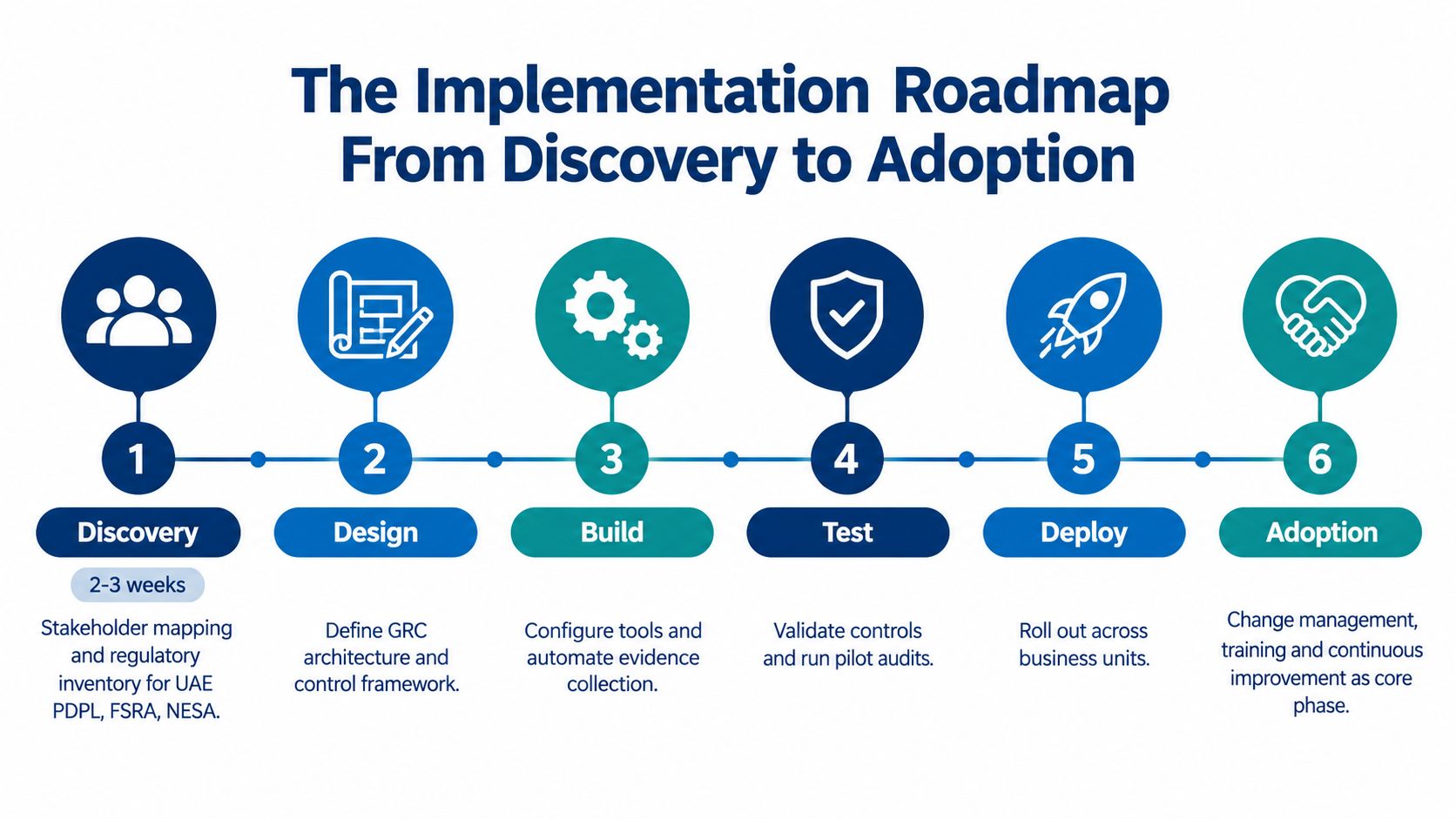
Phase 5, Metrics, continuous. Track control health, mean time to remediate control failures, audit-readiness scores, evidence completeness, and unresolved risk exceptions. Refresh executive dashboards through the operating platform instead of preparing a separate monthly spreadsheet. The failure mode is measuring activity rather than risk reduction.
Phase 6, Change Management, parallel throughout. Train users by role, certify control stewards, publish escalation guidance, run executive sponsorship rituals, and maintain stakeholder communications. The failure mode is treating adoption as a slide deck. That is the most common reason GCC and EU programmes stall. People need practice, ownership, feedback, and visible leadership decisions before the new control model becomes normal work.
A pilot should start with one critical service and a contained set of control owners. Prove the evidence path, exception route, dashboard, and audit trail before expanding to every business unit. The objective isn't a large configuration. It's a repeatable operating pattern that teams can trust.
Choosing a Vendor or Managed Services Partner
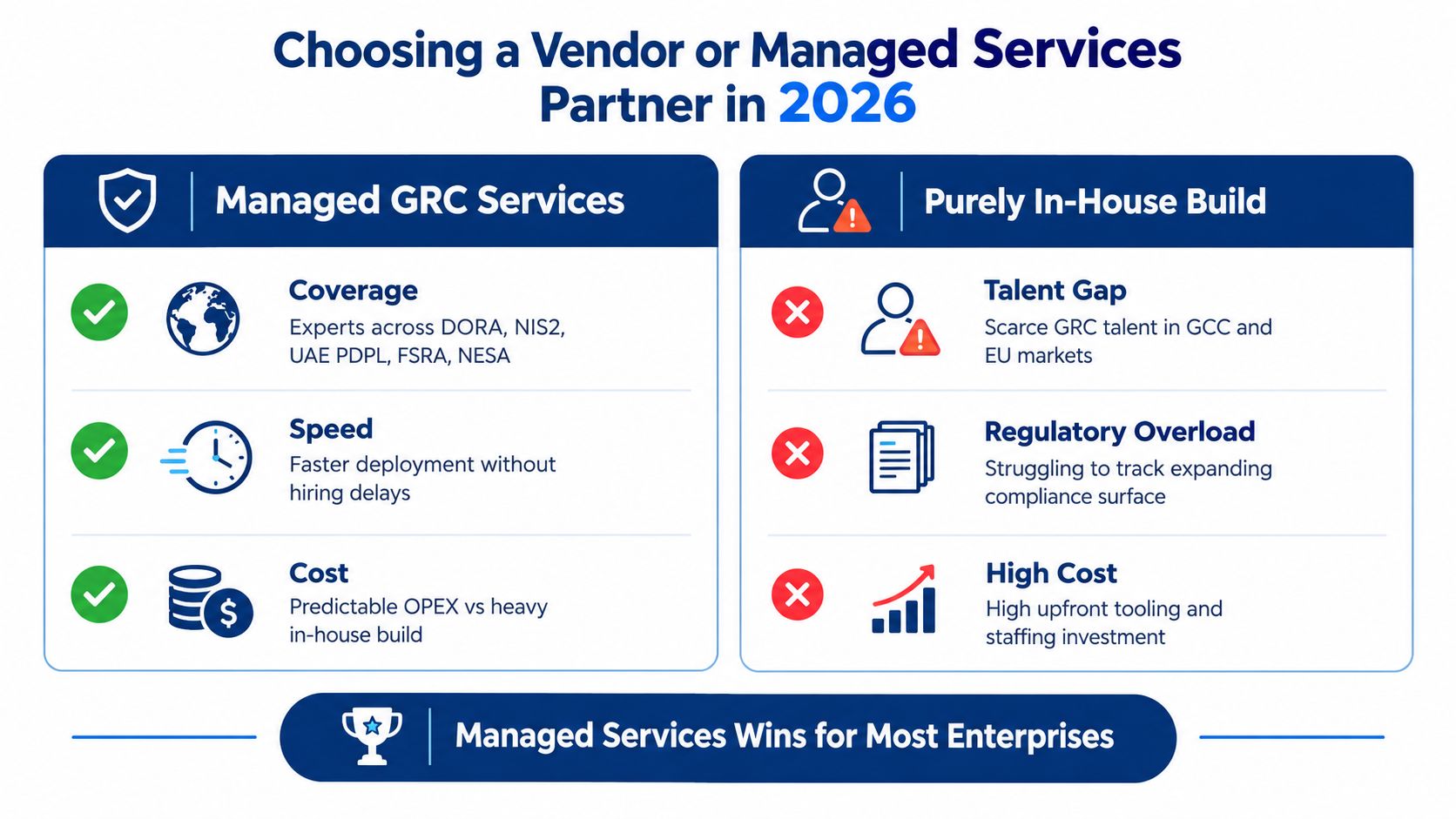
Most GCC and European enterprises should not attempt a purely in-house GRC build unless they already have mature platform ownership, regulatory expertise, control engineering capability, and enough capacity to maintain the programme. The combined surface of DORA, NIS2, UAE PDPL, FSRA, NESA, and SAMA CSF creates too many interacting obligations for a small CISO office to absorb while also running security operations.
Select the engagement model
Full managed GRC operations suit regulated financial institutions that lack internal GRC depth. The partner operates evidence collection, control testing, risk administration, reporting, and remediation coordination under agreed governance.
Co-managed delivery fits mid-market manufacturers, energy groups, and technology firms that have internal owners but need architecture, implementation capacity, and specialist assurance support.
Staff augmentation helps GCC groups that need UAE-resident expertise for PDPL, FSRA, data governance, or regulator-facing work while retaining internal decision authority.
Test the partner before signing
Ask for evidence against practical selection criteria:
Platform range: Can the team deliver across ServiceNow, HaloITSM, Freshservice, and ManageEngine rather than forcing one platform?
Named capability: Do the proposed consultants hold relevant framework lead-auditor or implementation credentials, and will those people deliver?
Residency options: Can the provider support UAE and EU sovereign-cloud or data-residency requirements where the engagement needs them?
Sector references: Can the partner demonstrate work in your subsector, especially banking, manufacturing, energy, government, or regulated outsourcing?
Knowledge transfer: Does the delivery plan certify internal control stewards and document the operating model?
Avoid Big Four advisory lock-in when the engagement would price the mid-market out of sustained execution. Avoid the freelancer model when the programme depends on one person's undocumented knowledge and collapses after that person leaves.
DataLunix offers GRC implementation, managed services, and staff augmentation connected to ITSM, ITOM, ITAM, and security workflows. Its governance, risk and compliance platform services can be evaluated alongside the selected platform, delivery model, residency needs, and internal ownership plan.
Ask every partner one question: Can you show us evidence that you made another client's programme audit-ready, not just slide-ready?
From Programme to Operating Discipline
A mature GRC programme replaces quarterly compliance snapshots with continuous control monitoring. SIEM and SOAR provide security signals, ITSM provides workflow and accountability, CMDB provides service context, and ITAM provides the asset record. GRC should correlate those streams into decisions that a control owner, CISO, CRO, and board committee can understand.
Put operational metrics in the board pack
Track metrics that expose control performance rather than document volume:
Mean time to remediate high-risk findings, segmented by service and owner.
Percentage of controls with automated evidence collection, showing where audit effort still depends on manual work.
Third-party risk exceptions aged over 30 days, with business owner and acceptance authority.
Weekly audit-readiness scores, supported by current evidence completeness and overdue testing.
COBIT 2019 goals should cascade into RACI dashboards. The board sees objectives, risk acceptance, trends, and decisions. The risk committee sees exceptions, remediation, supplier exposure, and control health. Control owners see assigned tasks, evidence requests, failed tests, and escalation dates. One data model can serve all three audiences without producing three conflicting reports.
Use AI as assurance support, not as governance theatre
AI-driven assurance can analyse access logs for anomalous behaviour, compare policies against DORA, NIS2, and UAE PDPL obligations, triage control evidence, and predict supplier risk from changing exposure signals. Those capabilities require clean asset relationships, consistent control definitions, reliable ownership, and human review. AI won't repair a fragmented CMDB or an unassigned exception.
Start with a focused 90-day checklist:
Appoint an executive sponsor with authority to resolve ownership and funding disputes.
Baseline one critical asset register and validate its service, owner, data, and supplier relationships.
Automate evidence for the top ten ISO 27001 Annex A controls selected for business relevance.
Stand up a weekly control-operations meeting with security, IT operations, risk, procurement, and service owners.
Pilot a managed GRC partner for Tier-1 findings within the first quarter, with knowledge transfer and measurable exit criteria.
The operating discipline matters more than the software label. A smaller platform with trusted data, active owners, and automated evidence will outperform a larger platform that nobody updates.
DataLunix helps GCC and European enterprises connect GRC IT Security with ServiceNow, HaloITSM, Freshservice, and ManageEngine through implementation, automation, managed services, and staff augmentation. Visit DataLunix to arrange a discovery workshop and turn your critical assets, controls, evidence, and regulator obligations into a live operating model.