
GRC Software Solutions That Actually Scale in 2026

Your auditor has just asked for evidence that a critical control operated all year, not just on the day someone completed a spreadsheet. IT has incidents in one system, HR has joiner records in another, and risk owns a register nobody in operations recognises. That gap is where most GRC software solutions programmes succeed or fail. The platform you buy matters less than whether controls generate work, evidence and escalation inside the workflows your teams already use. If they don't, you've bought an expensive filing cabinet.
What GRC Software Solutions Actually Do for Modern Enterprises
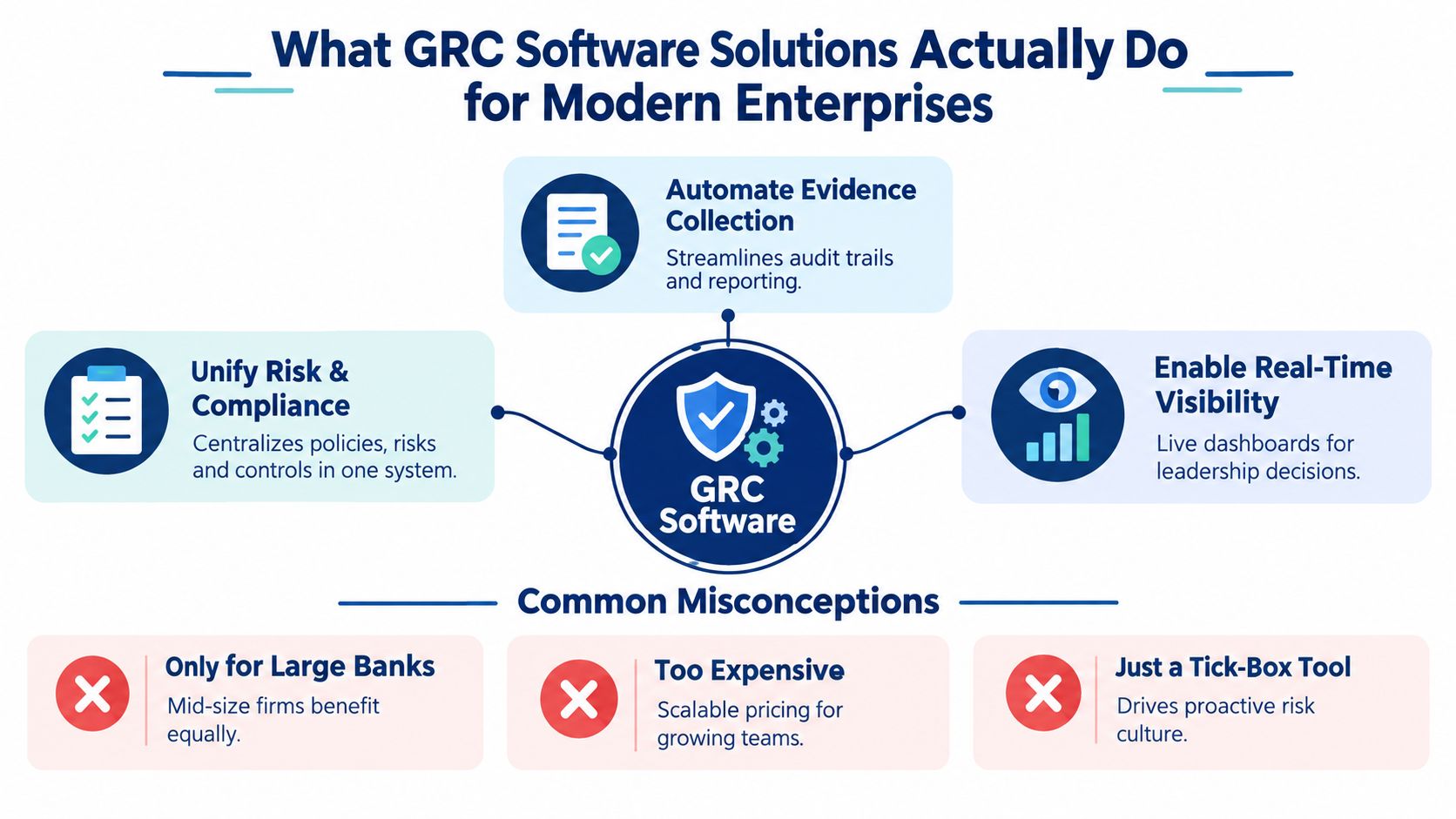
GRC software solutions connect governance, risk and compliance in one data model. They record policies, risks, controls, obligations, tests, issues and remediation, then assign each item an owner, due date and evidence requirement. When a control fails, the related risk rating changes and a task lands with the accountable person. That's the difference between a repository and an operational control fabric.
What do most vendor pitches get wrong
First, they sell policy storage as governance. A versioned document proves approval, not operation. Second, they treat GRC as an IT project, although boards own risk appetite and accountable executives own controls. Third, they promise framework coverage without explaining how incidents, changes, HR cases or customer complaints become evidence.
Demand is not theoretical. Saudi Arabia's SAR 13.3 billion cybersecurity spend in 2023, including SAR 7.5 billion on products and solutions, shows how much GCC organisations already invest in controls, assurance and monitoring. GRC turns that fragmented spend into traceable accountability.
Buy the workflow before you buy the dashboard. If a failed test can't create, assign and escalate remediation automatically, the dashboard is decoration.
Where should you draw the scope boundary
Put enterprise risks, regulatory obligations, controls, policies, audits, issues, third parties and exceptions inside the platform. Keep specialist execution in native systems where it belongs, then integrate the evidence. A construction business, for example, may still need dedicated safety compliance software for construction for site controls, while enterprise GRC tracks the obligation, owner and assurance result.
Agree that boundary with procurement, risk and IT before selection. Otherwise every department will expect the platform to replace its own tool, and your implementation will expand until it stalls.
The Five Core Modules That Define a Real GRC Platform
Don't evaluate modules by menu labels. Evaluate the decision each module helps an executive make, and the record it produces when challenged. Saudi Arabia's 100 out of 100 score and Tier 1 placing in the 2024 ITU Global Cybersecurity Index reinforces a useful point, governance maturity is now assessed as an organisational discipline, not a technical inventory.
Which five modules are non-negotiable
Risk register and scoring: Captures cause, event, consequence, inherent risk, residual risk, appetite and treatment owner. A bank should see which business service fails if a control weakens, not just a heat map.
Control library and mapping: Lets one control satisfy several obligations without duplicate testing. This matters when a firm must interpret overlapping duties, including specialist areas signposted by resources on crypto licensing compliance requirements.
Policy and attestation management: Manages drafting, approval, versioning, targeted acknowledgement and exceptions. Attestation must reach the affected population, not the whole company by default.
Regulatory compliance tracking: Converts obligations into assessments, evidence requests and change tasks. Healthcare and energy operators need jurisdiction, effective date and accountable function on every obligation.
Audit and issue management: Plans engagements, samples controls, records findings and tracks remediation through retesting. Closure requires evidence, not a manager's comment.
GRC Modules Mapped to Executive Questions
Module | Executive question it answers | Measurable outcome |
|---|---|---|
Risk register | What could stop this service or objective | Risks outside appetite with named owners |
Control library | Which safeguard addresses which obligation | Duplicate tests removed |
Policy management | Who accepted the current rule | Overdue attestations by population |
Compliance tracking | What changed and what must we do | Obligations assessed before deadline |
Audit and issues | Did remediation actually work | Findings closed after retest |
The integration layer is what makes these modules useful. Risks, controls, assets, services, vendors and issues must share identifiers. Without that, you've purchased five separate registers with one login.
Comparing ServiceNow, Halo, Freshservice and ManageEngine for GRC Workloads
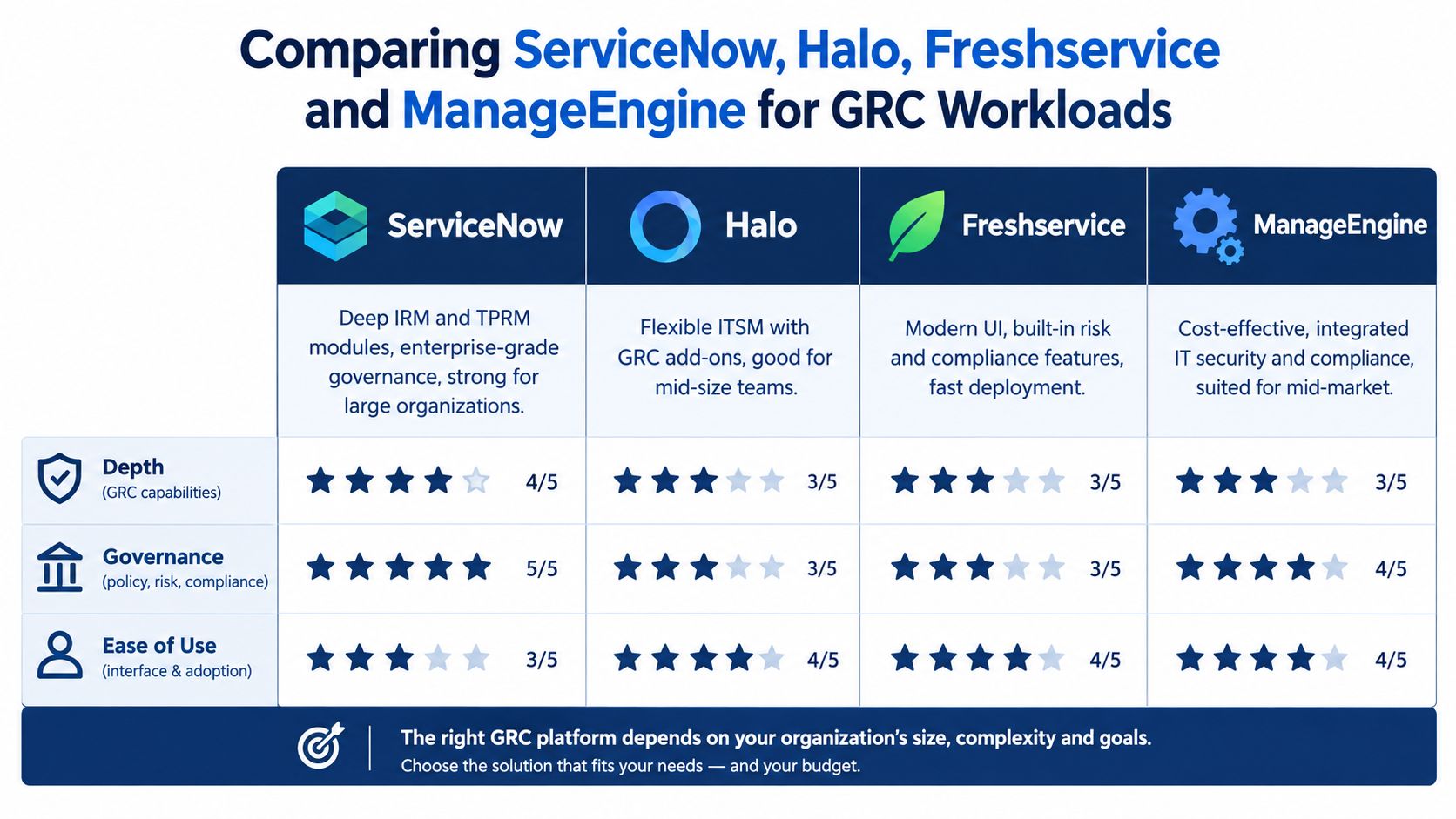
Choose from your operating model, not brand familiarity. The right answer changes if you already run enterprise ITSM, need on-premises control, or lack a dedicated GRC team. For UAE banks, the benchmark is demanding, Central Bank rules require a framework that can identify, assess, evaluate, monitor, mitigate and control operational risk across services and technology. Test every vendor against that full lifecycle.
Which platform fits which starting point
ServiceNow IRM and TPRM offer the deepest route when ServiceNow already runs ITSM, ITOM, HRSD or CSM. You gain a common data model, mature workflow and strong third-party risk capability. You also accept higher licensing, specialist administration and governance overhead. Don't buy it solely for GRC if the wider platform isn't part of your strategy.
HaloITSM and HaloPSA suit organisations that want fast deployment and ITSM-native controls without heavyweight programme structures. They're commercially attractive, but you must validate control testing, regulatory mapping and audit depth rather than assuming service workflows equal GRC. Review the current HaloITSM licensing and pricing model alongside the cost of any GRC extensions or integrations.
Freshservice works well for mid-market teams that value usability and Freddy AI assistance. It's a sensible operational front door, though regulated groups may need additional GRC capability for complex obligation mapping and independent assurance. ManageEngine is strongest where cost predictability, broad IT footprint and on-premises options matter. Its trade-off is a less unified enterprise GRC experience across product boundaries.
Decision rule: Pick ServiceNow for platform consolidation, Halo for speed and value, Freshservice for adoption, and ManageEngine for footprint and deployment control. Then prove the choice with your hardest control scenario.
Score the finalists on module coverage, integration depth, AI governance readiness, licensing and GCC regulatory fit. Make each vendor demonstrate a failed control moving through risk update, remediation, retest and board reporting. Slideware won't survive that test.
Integrating GRC With ITSM, ITOM, HRSD and CSM Workflows
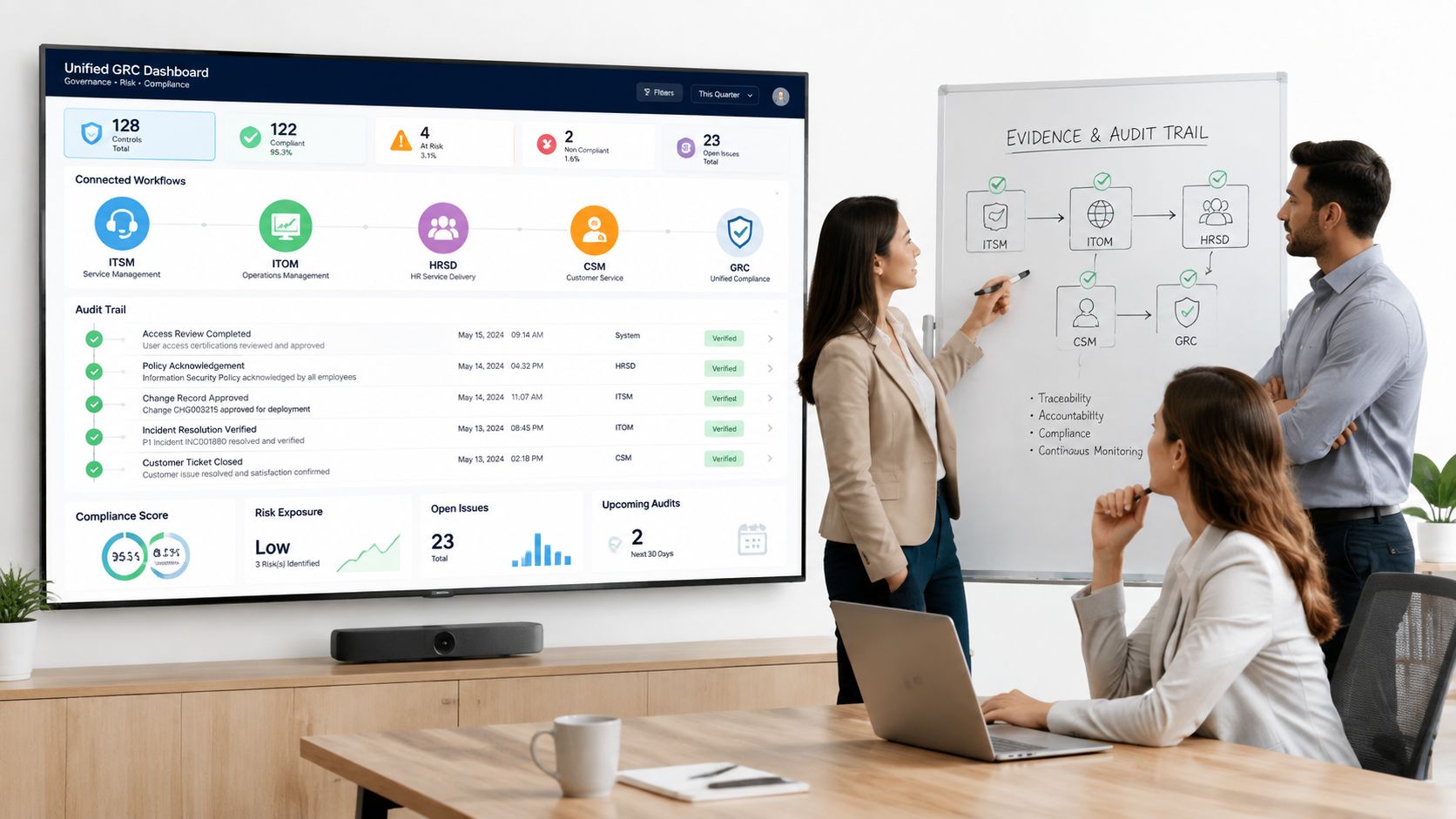
Integration determines whether evidence is created during work or reconstructed before an audit. Your GRC platform shouldn't ask teams to duplicate incidents and changes in a second queue. It should consume operational records, evaluate them against controls, and only create new work when something needs attention.
Which data objects must move between systems
ITSM records: Incidents, problems, changes, service requests and SLA breaches that indicate control failure or operational impact.
ITOM records: Configuration items, discovery data, vulnerabilities, availability events and service maps that define control scope.
HRSD records: Joiners, movers, leavers, training, policy cases and access-related approvals.
CSM records: Complaints, customer-impacting outages, contractual commitments and regulator-facing cases.
Risk records: Vendors, subprocessors, applications, data stores and AI systems with accountable owners.
In a ServiceNow estate, use native relationships between IRM, CMDB, vulnerability response and service workflows wherever possible. In Halo or Freshservice estates, define APIs or event flows that pass stable identifiers, timestamps, status, owner and evidence links. The practical ServiceNow monitoring guide from Fivenines is useful context for why integration design needs operational visibility, not one-way data dumps.
What does a working evidence trail look like
A privileged access review fails for a production application. GRC updates residual risk, creates remediation in ITSM, suspends the control attestation, notifies the service owner and records the retest result. Every step keeps its original timestamp and actor.
AI agents raise the bar further. UAE legal analysis identifies transparency, impact assessment, accountability, human oversight, privacy and safety as core AI governance expectations, with DIFC rules addressing autonomous and semi-autonomous processing. Record the agent owner, permitted actions, model or prompt change, human intervention and affected record. A summarisation agent doesn't need the same control as one that changes access, payroll or customer eligibility.
The Six-Phase Implementation Roadmap and Change Management
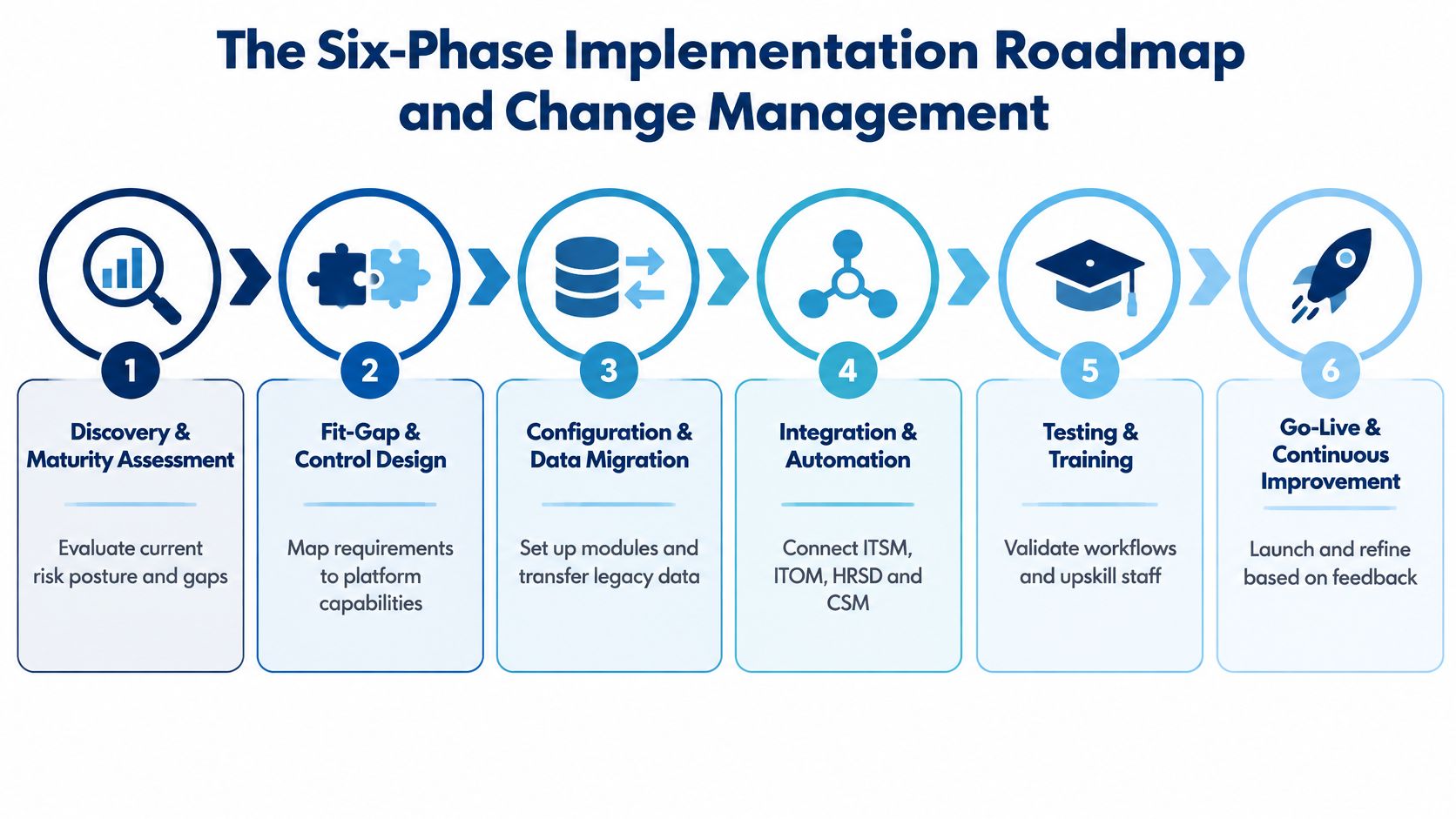
A credible roadmap has gates, owners and exit criteria. It doesn't move forward because the calendar says so. That discipline matters because UAE Central Bank technology-risk rules require board-level oversight, independent technology audit and incident response capable of isolating threats and restoring services. Your implementation must evidence those accountabilities from the start.
How should the six phases run
Discovery and maturity assessment: Inventory obligations, risks, controls, evidence sources and pain points. The failure mode is interviewing only the risk team and missing how operations work.
Fit-gap and control design: Map requirements to standard capability, simplify controls and agree data ownership. Don't recreate every legacy field.
Configuration and data migration: Build registers, scoring, workflows, roles and reports. Migrate active, quality records, not years of unresolved history without triage.
Integration build: Connect ITSM, ITOM, HRSD, CSM, identity and vulnerability sources. Test failure handling, duplicate prevention and audit logs, not just successful record creation.
User acceptance testing: Use realistic scenarios, including overdue evidence, control failure, exception expiry and regulator reporting. Business owners sign off outcomes, not screen layouts.
Change management and hypercare: Deliver role-based training, stakeholder communications, floor support and adoption reporting. Assign a product owner after go-live, or configuration requests will fragment the model.
Phase durations vary with scope and data quality, so set them after discovery rather than copying a vendor template. Your gate into build should be signed control design and data rules. Your gate into go-live should be trained owners, tested integrations and a support model.
Track adoption through completed attestations, overdue actions, evidence quality and use of dashboards by accountable managers. Training attendance alone tells you nothing. If users keep evidence in email, change management has failed, even if the technical launch succeeded.
Measuring ROI and KPIs That Hold Up to Board Scrutiny
Boards don't fund risk language indefinitely. They fund fewer losses, faster assurance, less duplicated work and clearer decisions. Build your ROI model before implementation, baseline it, and use platform data after launch rather than reconstructing benefits in a presentation.
Which KPI families should you measure
Risk reduction: Track risks outside appetite, overdue treatments, repeat findings and failed critical controls. Report residual exposure by business service, not only by department.
Audit efficiency: Measure evidence request cycle time, sample rework, finding closure time and audit preparation effort. The platform must timestamp requests, submissions and retests automatically.
Compliance cycle time: Measure time from regulatory change to obligation assessment, control update and attestation. Jurisdiction should be visible for GCC and European obligations.
Operational loss avoidance: Link incidents, complaints and service failures to controls and treatments. Use actual loss and remediation records where available, and label forecasts clearly as estimates.
Third-party oversight belongs in the model because manual reviews consume scarce specialists. A 2025 YouGov survey of 330 UAE senior IT and business leaders found 62% directly monitor third-party data-service providers, while only 66% reported full compliance with UAE data-protection and sovereignty requirements. That combination points to active oversight without complete assurance, exactly where continuous evidence workflows can reduce effort.
For a 5,000-employee regulated enterprise, monetise only what you can evidence, audit preparation hours removed, duplicate control tests eliminated, contractor evidence chasing reduced and penalties or losses avoided through documented prevention. Compare those benefits with licences, implementation, integration and product ownership. Include the full cost of your service platform too, starting with the relevant Freshservice licence pricing if that's your operational base.
If a KPI can't be produced from system records, it isn't a KPI yet. It's an opinion with formatting.
Five Common Pitfalls That Turn GRC Platforms Into Shelfware
Buying a recognised platform doesn't create accountability. I've seen strong products become document stores because ownership, data and operating rhythms were left unchanged. These five failure modes are predictable, and each has a corrective action you can start quickly.
What goes wrong most often
Over-customisation is the first trap. Teams recreate legacy approvals and fields, then discover upgrades and reporting become painful. Freeze non-essential customisation, adopt standard workflows, and require a business case for every deviation.
Weak control ownership follows. A control assigned to a department has no owner. Name one accountable person, one delegate and one evidence standard for every critical control. Escalate overdue ownership gaps to the same forum that reviews risk appetite.
AI governance as a side programme creates blind spots. Agents now read records, recommend outcomes and trigger actions inside service workflows. Bring AI systems into the asset inventory, classify them by consequence, and test human oversight like any other control.
Trusting vendor attestations is equally weak. Questionnaires tell you what a supplier claims, not where data flows, who can access it, or what changed after an update. Validate residency, privileged access, subprocessors and incident duties continuously through evidence linked to contracts and services.
Poor ITSM and HRSD integration forces duplicate work, so users bypass the platform. Connect the records that prove access, change, availability and training. Remove manual evidence uploads where a system record already exists.
The financial downside isn't abstract. Saudi Arabia's Personal Data Protection Law provides fines of up to SAR 5 million, possible doubling for repeat violations and up to two years imprisonment for intentional disclosure of sensitive data. Configure monetary impact bands, repeat-violation indicators and board escalation around that exposure. Then self-audit ownership, integration and evidence expiry before a regulator does it for you.
Tailored Recommendations for Mid-to-Large Enterprises in the GCC and Europe
Start with your constraint. If you're greenfield, prioritise a clean control model and fast adoption over maximum depth. If you already have ITSM, extend the platform that owns your services, assets and workflows unless its GRC capability fails a realistic control test. If you're heavily regulated across jurisdictions, prioritise obligation mapping, independent assurance and evidence quality over interface polish.
Jurisdiction can't be an afterthought. The UAE Federal Decree-Law No. 45 of 2021 applies to electronic personal-data processing inside or outside the UAE and requires defensible records of processing, data-subject requests, access controls and cross-border transfer approvals. Groups operating across mainland UAE, DIFC, ADGM, Saudi Arabia and Europe need jurisdiction-aware workflows, not one generic breach timer or control library.
Shortlist by scenario. Choose ServiceNow for deep platform consolidation, HaloITSM or HaloPSA for rapid ITSM-led deployment, Freshservice for mid-market adoption, and ManageEngine for cost and deployment control. Then run one proof using a real failed control, a third-party evidence request and an AI agent action. Score the complete trail.
DataLunix can support that selection and delivery as a certified reseller and delivery partner across those platforms, with discovery workshops, fit-gap analysis, change management, managed services and onshore-offshore delivery. Use a workshop to test scope, data and ownership before you commit licences. A generic demo won't tell you whether the operating model will work.
Book a discovery workshop with DataLunix to map your obligations, controls and service workflows, and to identify the platform route that fits your GCC or European operating model. You'll get a practical fit-gap view before committing to licences or implementation, so visit DataLunix to start the conversation.