
What Is Integrated Risk Software and Why Does It Matter?

92% of surveyed EME respondents saw attacks increase in 2024, yet only 19% said their organisation would follow a formal incident-response plan after an attack, according to the 2024 Thales Data Threat Report. Integrated risk software closes that operational gap by connecting exposure to accountable action, rather than collecting compliance documents.
Meta Title: Integrated Risk Software for GCC and European TeamsMeta Description: Learn how integrated risk software connects incidents, controls and AI governance, with practical buying advice for GCC and European enterprise technology leaders.Blog Title: What Is Integrated Risk Software and Why Does It Matter?
What Integrated Risk Software Actually Changes
Integrated risk software is a platform that links risk registers, controls, compliance obligations, third-party exposure, IT incidents and resilience evidence. It helps leaders act on current exposure rather than a spreadsheet assembled for the previous reporting cycle.
The Thales survey also found that 51% of surveyed organisations had experienced a breach at some point, while 15% reported a breach during the preceding year. Those figures describe the surveyed population, not a forecast for your organisation, but they establish why incident management and risk governance shouldn't operate independently.
A conventional GRC filing cabinet stores attestations. An integrated platform uses a failed control test, supplier warning or serious incident to initiate treatment, identify the accountable owner and track the deadline.
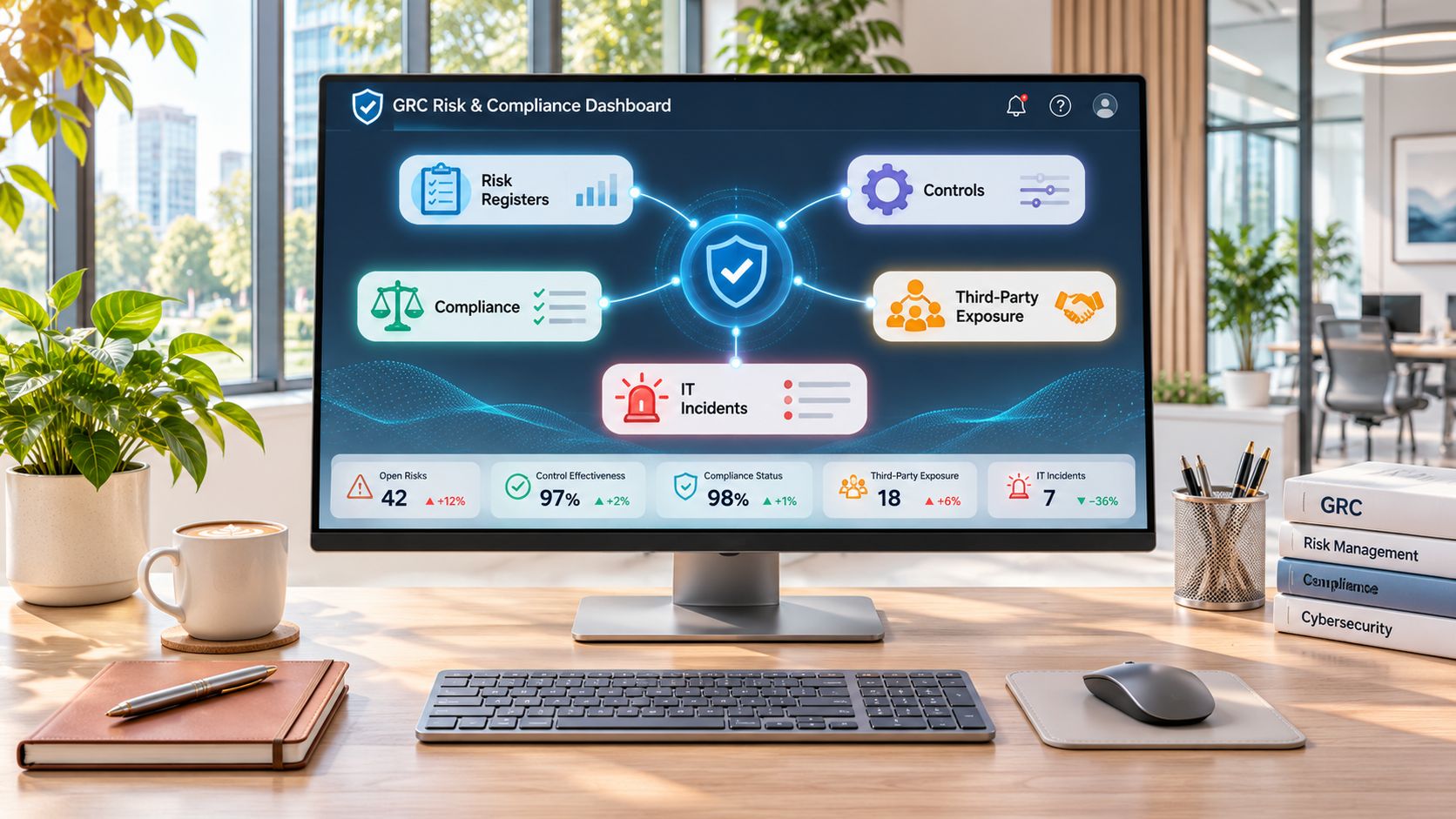
What makes integration operational?
The useful architecture has distinct layers:
Shared risk data: Assets, services, controls and obligations use consistent identifiers.
Cross-team workflows: Evidence moves between operations, security, HR, procurement and assurance without manual transcription.
Decision-focused reporting: Leaders can inspect risk concentration by entity, critical service and obligation.
People-related controls belong in that model too. Benely's guidance on mitigating benefits and compliance risks provides useful context for connecting HR responsibilities with wider organisational risk.
Integration doesn't repair unclear ownership. Nor does connecting poorly governed automation make it safe.
Practical test: Can live evidence create accountable action without spreadsheet re-entry?
If the answer requires an analyst to copy incident details into a register and email someone for a decision, you've centralised reporting, not integrated risk management.
Which Modules an Integrated Risk Platform Should Include
Core modules in an integrated risk platform
Module | Data it holds | Where it connects | |
|---|---|---|---|
ERM | Which enterprise risks threaten strategy and appetite? | Risk register, appetite limits, scenarios, KRIs, board actions | Board reporting, strategy, audit |
IT risk | Which technology assets and services carry exposure? | Asset and service risk, vulnerabilities, incidents, resilience gaps | ITSM, ITOM, CMDB, SIEM |
Third-party risk | Which suppliers create concentration, conduct or compliance exposure? | Contract clauses, assessments, SLAs, financial health, fourth parties | Procurement, legal, contract management |
Compliance | Which obligations apply and can we prove compliance? | Regulations, applicability, attestations, evidence, gaps | Legal, audit, regulatory reporting |
Controls | Are controls designed and operating effectively? | Control library, owners, tests, deficiencies, remediation | Audit, ITSM change, operations |
Metrics and reporting | What should leaders act on now? | KRIs, loss events, treatment SLAs, trend analysis | Dashboards, board packs, regulators |
AI and automation risk | Which agents act, who owns decisions and what evidence exists? | Agent inventory, prompts, permissions, model changes, human approvals | AI governance, ITSM, HRSD, CSM |
These modules should share records, not behave like separate products behind a common login. ERM establishes appetite and enterprise scenarios; operational modules supply the evidence needed to assess whether exposure remains acceptable.
Say a supplier's authentication service fails during a production change. IT operations records the incident, the control owner reviews the change approval, procurement checks contractual obligations, and compliance evaluates reporting implications. Each team needs its own workflow, but they shouldn't create competing versions of the event.
Evidence reuse isn't the same as universal access. A compliance reviewer may need a control result and timestamp without receiving confidential employee records or unrestricted security logs.
Why does AI-agent governance belong in the platform?
In the UAE study published by CPX and IDC, 98% of surveyed security teams had encountered at least one real AI-security risk in production, 92% reported AI systems processing sensitive data, and 54% had faced an AI decision that couldn't be explained or audited for compliance. Yet only 15% of UAE CISOs had mandatory approval authority over AI deployments.
That makes agent governance a buying requirement, not an optional dashboard.
Inventory the agent: Record its business purpose, deployment environment and accountable owner.
Constrain permissions: Specify which records it can read, change or approve.
Preserve decision evidence: Capture relevant prompts, model versions, tool calls and human approvals under an appropriate retention policy.
Provide human override: Make suspension and rollback operationally accessible.
An agent that closes incidents or changes access permissions can alter the evidence used to calculate risk. Its actions therefore need stronger scrutiny than a read-only reporting assistant.
More modules don't equal more control. Shared identifiers, explicit decision rights and enforceable permissions matter more than the length of the product catalogue.
How It Connects to ITSM ITOM CSM and HRSD
A risk platform earns its place when evidence arrives from the systems where people already work. The test is accountability: a live incident should update the linked risk, assign an owner, trigger an SLA and leave audit-ready evidence, with no spreadsheet re-entry in between. Prioritise connections according to the decisions they enable, not connector availability.
Priority integrations and the evidence they exchange
System | Data exchanged | Risk use case | Direction |
|---|---|---|---|
ITSM (ServiceNow, HaloITSM, Freshservice) | Incidents, problems, changes, SLAs, major-incident records | P1 incident updates linked IT risk and opens treatment action | Bidirectional |
ITOM and CMDB | Asset inventory, service maps, dependencies, monitoring events | Risk calculated by critical service and outage exposure | Inbound with status writeback |
CSM | Complaints, customer cases, product issues, resolution times | Conduct, customer harm and service-quality risk | Inbound |
HRSD | Access changes, training completion, employee relations cases, contractor onboarding | People risk, access control evidence and workforce exposure | Bidirectional |
SIEM and vulnerability management | Security events, vulnerability scores, remediation status | Cyber risk and control-effectiveness evidence | Inbound |
Procurement and contract management | Supplier assessments, contract clauses, renewal dates, financial health | Third-party concentration, exit and fourth-party risk | Bidirectional |
Which connections should come first?
Start with ITSM and the CMDB. Use APIs or webhooks to exchange incident severity, affected service, change references and remediation status. Use discovery and service-mapping feeds to establish dependencies, so the platform knows which service a failing asset supports.
A P1 incident should reach the appropriate risk owner through a controlled rule. Don't automatically increase every linked risk score because a ticket carries a high priority. Validate service impact, control failure and recovery context first. An outage on a redundant service and an outage on a payment channel deserve different risk treatment even when the ticket priorities match.
For CSM, consume case events and complaint categories through APIs. Link recurring service issues to conduct or customer-harm assessments without copying unnecessary personal information. The pattern matters more than the individual case: three complaint categories repeating across a quarter is evidence; a single case is an event.
For HRSD, use restricted event payloads for joiners, movers, leavers, training and contractor onboarding. Keep sensitive employee-relations details in the authorised system and expose only the evidence needed for the control, such as a completion flag or an access-change timestamp.
Security feeds: Consume validated SIEM alerts and vulnerability findings, then reconcile remediation against the operational task so the risk record closes only when the fix is verified.
Supplier feeds: Exchange assessment status and contractual obligations through procurement APIs, with ownership retained by the relevant business team.
Reference data: Reserve scheduled extracts for low-volatility information, such as approved organisational structures.
Our Freshservice pricing guide frames platform entitlement, while the integration work needed to maintain these exchanges should be scoped separately. Licence tiers tell you which APIs and modules you are entitled to; they say nothing about who builds the mappings, who owns failed-message queues, or who maintains the rules after go-live.
A one-way feed can make a report look current while leaving treatment disconnected. Every risk record should expose its source system, timestamp, accountable owner and linked evidence, with failures visible to a named integration support owner. If an audit cannot trace a risk figure back to the ticket or finding that produced it, the connection is decorative rather than functional.
What Changes for GCC and European Deployments
Regional deployment changes the evidence model, hosting decisions and approval structure, not just the interface language. Establish applicability by legal entity and regulated activity before configuring a common control library.
For UAE banks, the Central Bank's technology-risk requirements call for integrated identification, measurement, monitoring and management of technology risk, supported by governance, appetite limits and control monitoring. Its Operational Risk Management Regulation places ICT and cybersecurity risk within operational risk management and resilience.

The IIA's 2024 Middle East Risk in Focus ranked cybersecurity and business continuity as the leading organisational risks, followed by human capital, with governance and corporate reporting also among the five highest-priority risks. That supports a connected board view across technology, continuity, workforce and governance.
Which requirements need local configuration?
GCC entities: Validate residency, Arabic and English reporting, sector-specific obligations, entity dashboards and evidence access.
European entities: Assess DORA, NIS2 and GDPR applicability with legal advisers, alongside works-council engagement, cross-border transfers and supplier concentration.
Banking models: Connect model ownership, validation status and approvals while separating developers, validators and approvers.
CRISIL's analysis of UAE model-management requirements describes the need for a model-risk inventory, real-time monitoring, integrated controls and reporting dashboards.
Don't assume UAE or EU hosting alone establishes compliance. Test whether a UAE examiner and a European auditor can obtain appropriately scoped evidence without parallel spreadsheets or unauthorised cross-border disclosure.
How to Choose the Right Architecture and Delivery Partner
Choose the data model and operating model before the vendor. You need a normalised record structure, configurable workflow engine, integration layer, role-based reporting and security controls covering SSO, segregation of duties, audit history and hosting.
The UAE National Cybersecurity Strategy calls for identifying critical assets, establishing risk-management standards, and supporting reporting, compliance, response and cross-agency information sharing. Those principles support a continuously maintained inventory, but they aren't a product specification.
Selection criteria and the evidence to demand
Criterion | Must-have evidence | Why it matters | Red flag |
|---|---|---|---|
Risk data model | One record links asset, service, control, incident, obligation and owner | Prevents parallel registers and re-keying | Separate registers per module |
Workflow and accountability | Incident or failed control can open treatment, assign owner and trigger SLA | Turns evidence into action | Manual email reminders |
Integration depth | Prebuilt connectors to ITSM, ITOM, CMDB, CSM, HRSD and SIEM | Keeps exposure current | CSV imports only |
Audit evidence | Immutable, time-stamped history with role-based access | Supports regulatory examination | Editable history |
Regional fit | Arabic and English reporting, entity dashboards, UAE or EU data residency | Supports applicable regional obligations | Unknown hosting |
AI governance | Agent inventory, permission scope, human override and decision logs | Controls autonomous workflows | No named agent owner |
Commercial model | Licence, implementation, integration and managed-service costs separated | Avoids hidden integration spend | Bundled quote with vague scope |
What should the demonstration prove?
Give the vendor a realistic incident payload, not a prepared slide. Require the platform to create a treatment action, assign the accountable owner, start the applicable SLA, attach evidence and produce an executive view without spreadsheet re-entry.
Then change the scenario. Remove the asset owner, submit a duplicate event and interrupt the connector. Assess exception handling, replay, reconciliation and escalation, because successful-path demonstrations conceal operational weaknesses.
A connector isn't complete until someone owns its failures.
Ask whether residual-risk calculations use current control and performance evidence or merely repeat periodic attestations. Confirm how the platform versions scoring rules so an auditor can reconstruct an earlier decision.
How should you score the partner?
Use a weighted scorecard that gives the greatest emphasis to the data model, integration and workflow, followed by audit evidence, regional fit and commercial clarity. Define weights before demonstrations, and treat essential hosting or security failures as disqualifiers rather than weaknesses that attractive pricing can offset.
At DataLunix, we work across ITSM, ITOM, CSM, HRSD, ITAM, SPM (PPM), FSM, ESM, GRC (IRM) and SecOps. We can recommend a platform suited to your process, volume and budget, including one you already own.
We offer discounted licences for HaloITSM, HaloPSA, Freshworks, SysAid and Serviceware, plus ServiceNow implementation, for clients who plan their project with us. Use the HaloITSM pricing guide to frame licence discussions, then assess implementation and connector costs separately.
What a Phased Implementation Roadmap Looks Like
A phased implementation should release usable workflows behind explicit acceptance gates. Set dates after discovery, not before access, data quality and regulatory scope are understood; the roadmap is a delivery sequence, not a promise that every organisation can follow identical durations.
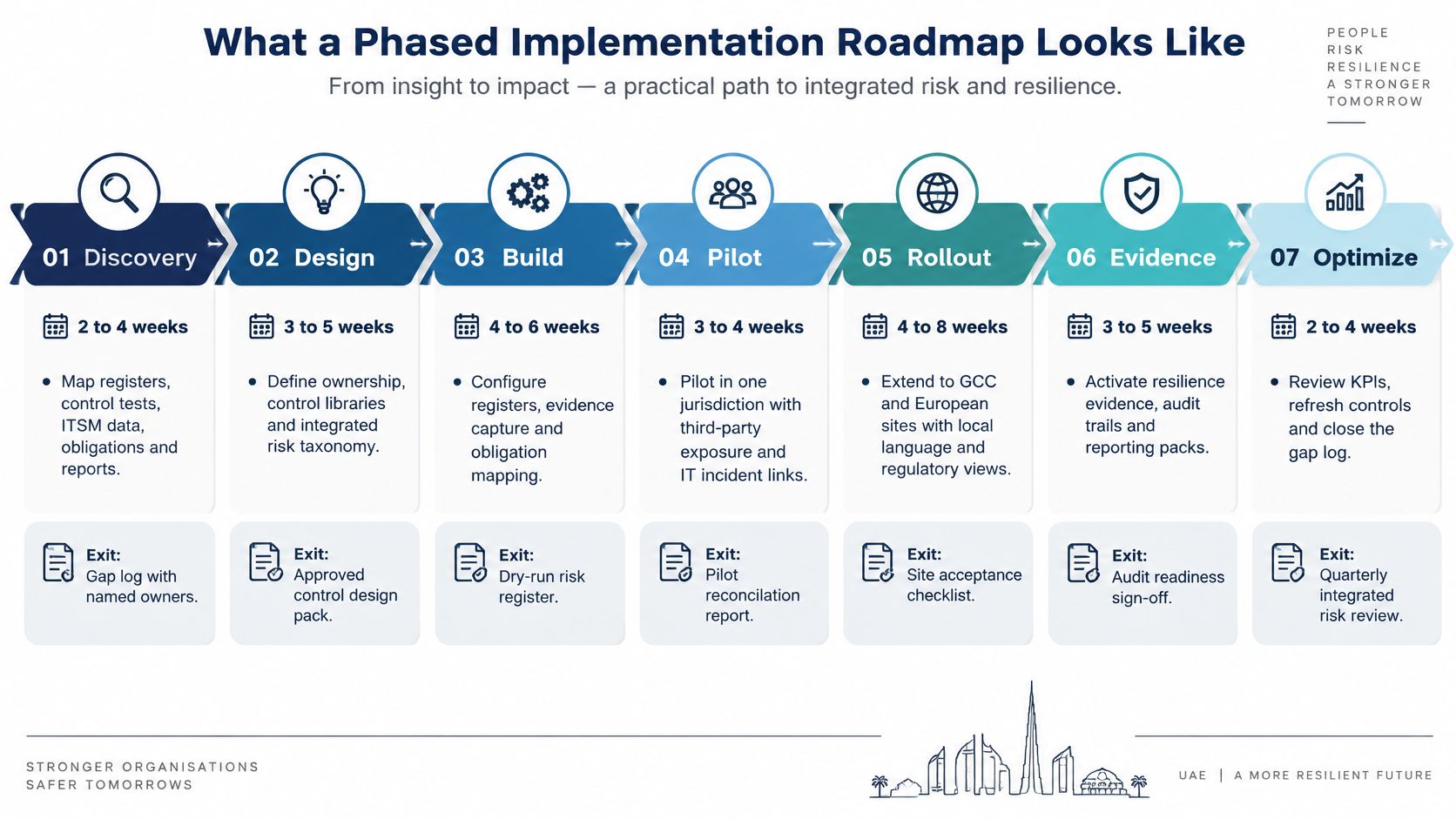
What should each phase deliver?
Discovery Map registers, control tests, ITSM data, obligations and reporting. Exit with a fit-gap log, named decision-makers and agreed scope. Bring operational owners into workshops rather than relying exclusively on compliance representatives.
Data-model design Approve taxonomy, scoring, appetite, ownership and identifier rules. Exit when representative records can be traced from critical service to asset, control and obligation. Run a terminology workshop so teams don't assign different meanings to the same category.
Core configuration Configure ERM, IT risk, controls, the compliance library and an entity dashboard. Exit after a dry run demonstrates assessment, approval, treatment and closure. Have control owners approve the workflow language before wider training.
First integrations Establish ITSM, CMDB and identity connections before expanding into customer or employee case data. Exit when event handling, permissions, replay and reconciliation pass. Assign an operational support owner to each connector.
Pilot Select a critical service with genuine supplier and incident dependencies. Exit when the business owner accepts the resulting treatment workflow and an assurance reviewer can reconstruct the evidence. Use pilot feedback to remove unnecessary fields and approval loops.
Change and rollout Complete impact assessments, stakeholder communications and role-based training. Reconcile historic records and open treatments against the legacy register before retiring it. Exit on entity-level acceptance, with unresolved exceptions explicitly owned.
Managed optimisation Monitor connector health, test control operation and refresh scenarios on an agreed cadence. Exit individual improvement cycles only when changes have evidence of acceptance. Maintain a prioritised backlog rather than treating every enhancement as urgent.
Every consulting engagement at DataLunix starts with discovery workshops, fit-gap analysis and readiness assessments. These map requirements to technological capabilities, establish scope and identify organisational or technical gaps.
What changes after go-live?
Go-live starts hypercare. Teams still need help resolving misrouted tasks, missing ownership, permission errors and mismatched historical records.
For McDonald's Saudi Arabia, our ITSM migration ran cutover in parallel with the legacy tool, migrated historic ticket data, and continued with hypercare after go-live. That demonstrates a migration practice, not a guaranteed timetable for risk-platform delivery.
We support change management through impact assessments, stakeholder communication plans and training enablement. Measure adoption through active owners, timely closures and attached evidence, not attendance at training sessions.
Release gate: Don't retire the legacy register while open treatments remain unreconciled.
Which Metrics Prove ROI and Resilience
ROI isn't licence cost avoidance alone. Integration must reduce the cost of late decisions, repeated evidence collection and incidents that never reach the appropriate risk owner.
Outcome metrics that prove resilience and ROI
Metric | Baseline question | 12-month target | Evidence source |
|---|---|---|---|
Signal-to-decision time | How long from P1 incident, failed control or supplier alert to a named owner? | Within approved severity-based decision limits | Workflow logs |
Critical services mapped | What share of critical services has an owner and dependency map? | Every service classified as critical has an approved map | CMDB and risk register |
Control testing completion | What share of key controls was tested on schedule? | All scheduled key controls tested or formally excepted | Control testing records |
High-impact exceptions closed | What share closed within SLA? | Meet approved appetite limits, with overdue items escalated | Remediation records |
Evidence reuse | How often is the same evidence reused across audits? | Reuse valid evidence wherever control scope matches | Audit findings |
Board reporting currency | How often do leaders see current exposure? | Agreed reporting cadence with event-driven escalation | Board packs |
These are proposed programme targets, not published benchmarks. Set numerical thresholds after establishing your baseline, service criticality and risk appetite.
What do these measures reveal?
Signal-to-decision time exposes approval bottlenecks. Service mapping tests agreement between operational inventories and risk records, while control testing and exception closure reveal whether owners perform the work.
Evidence reuse should reduce duplication without disguising stale or out-of-scope material. Board reporting currency matters only if the report supports a decision, such as funding recovery capacity, replacing a supplier or accepting a documented exception.
The Protiviti Middle East ERM survey found that only 29% of surveyed organisations had integrated AI into risk processes and decision-making, and 29% conducted formal AI-specific risk assessments. Those findings challenge the assumption that broad dashboard coverage means emerging risks are governed.
Calculate the business case as:
Net value = avoided audit effort + reduced expected incident losses + faster supplier onboarding + reduced insurance administration + avoided downtime, minus licence, implementation, integration, change and managed-service costs.
Separate realised savings from modelled benefits. Don't count reduced breach exposure and avoided downtime twice when they represent the same scenario, and don't report insurance savings until a commercial outcome supports them.
What to Confirm Before You Commit
What should an integrated risk software budget separate?
Separate licences, implementation, connectors and managed services, with assumptions for environments, data migration and support coverage. Our SysAid pricing guide can support platform comparison, but a licence quote isn't a complete integration budget.
When can integrated risk software increase exposure?
Risk increases when automation receives authority beyond its approved purpose or can alter evidence without traceability. Require an accountable business owner, restricted permissions, human override and a decision log before enabling record-changing agents.
Which residency arrangement fits integrated risk software across GCC and Europe?
Choose hosting and access arrangements after mapping entities, data categories, regulatory applicability and support locations. UAE or EU hosting, bilingual reporting and a common evidence model may support the design, but they don't remove the need to assess transfers and local restrictions.
Who owns integrated risk software outcomes after go-live?
Your organisation retains accountability through named risk owners and critical-service owners, not the integrator. We route a contact message to the appropriate specialist for licence pricing, implementation, managed support or an AI workflow build, so operational responsibility and delivery support remain distinct.
For CIOs and IT directors across the GCC and Europe, we offer a free, no-obligation 30-minute consultation with a senior consultant to map current tooling, licence position and process gaps. Visit DataLunix to book directly on our calendar, and bring your current platform list plus an incident-to-risk workflow so we can scope the integration, implementation or managed support you need.