
What Are Outsourced IT Support Services? a 2026 Guide

A staff augmentation engagement typically runs six to twelve months, long enough for weak residency controls, slow breach notice and missing exit terms to become real costs. Outsourced IT support services are contracted services in which an external provider runs part or all of your service desk, monitoring, endpoint support, backups, or security operations against agreed service levels. Price the contract against UAE residency duties, wider GCC expectations and European breach-notification timelines, then test how cleanly you can leave.
What Are Outsourced IT Support Services?
Rent a staffed operations room instead of building one. A typical contract covers Level 1 through Level 3 ticket handling, incident and request fulfilment, monitoring and alerting, patching, backups, and ITSM platform administration. The scope line matters less than the terms around it: which jurisdiction hosts your data, how quickly the provider must report a breach, and who owns your ticket history and configurations when the contract ends.
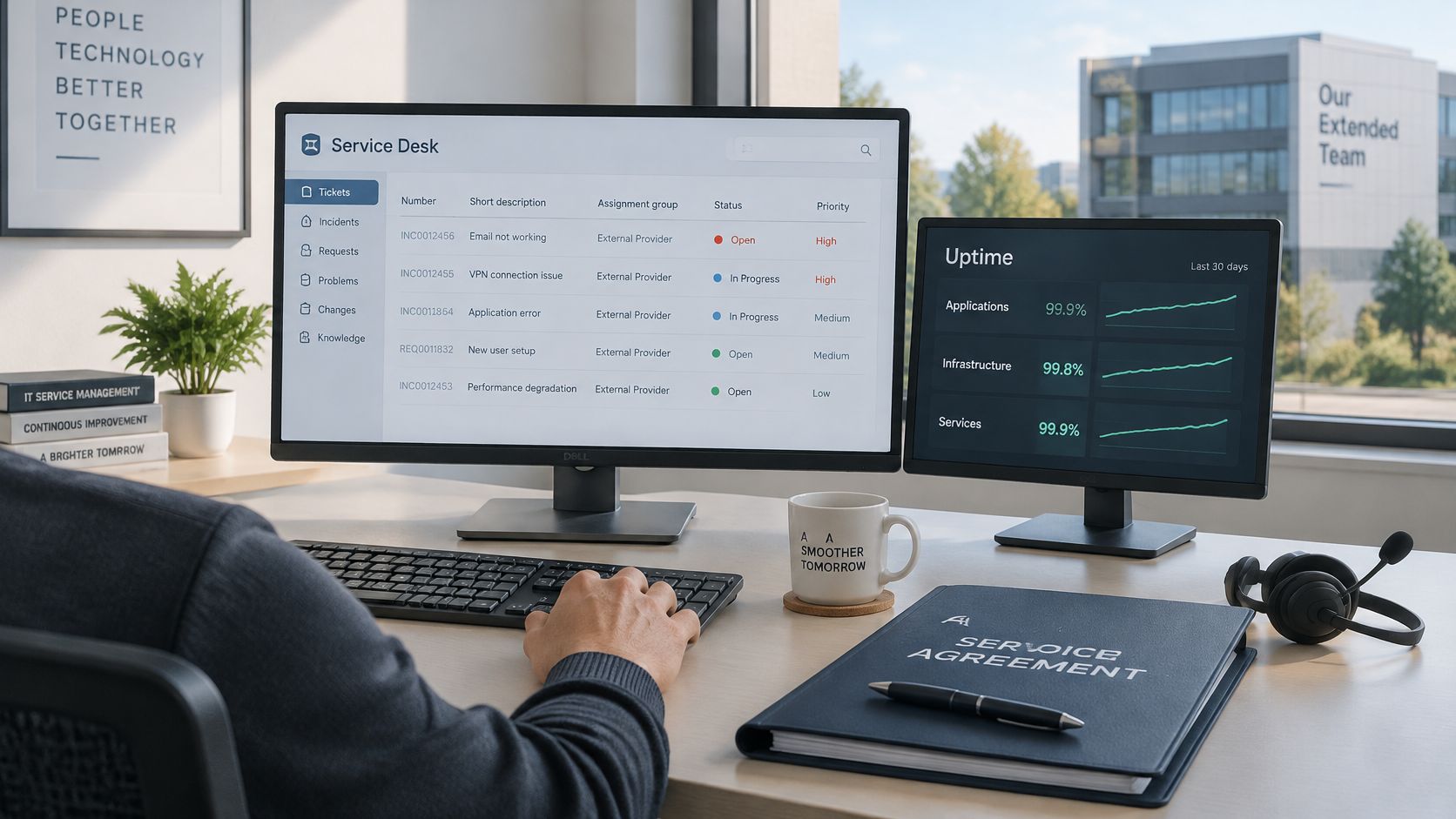
An in-house team keeps fixed headcount paid through quiet weeks. Break-fix support bills only after a failure, so nobody watches your systems overnight. Outsourcing trades that fixed cost for a contracted service level you can enforce. Grand View Research puts UAE IT services outsourcing revenue at US$6,045.4 million in 2025, and Deloitte's review of UAE outsourcing and shared services from 2019 to 2023 found IT was 62% of that spend. CIOs, IT directors, and MSPs buy the skills they will not hold fully in-house. On the hiring side, the LatoJobs career blog covers careers and recruitment content for context on the alternative.
Managed Services, Staff Augmentation or Hybrid?
Model | Who runs the work | Typical pricing basis | Best fit | Your control |
|---|---|---|---|---|
Managed services | Provider owns defined outcomes and day-to-day operations | Fixed monthly fee per user, device or service tier | Teams wanting predictable outcomes without new hires | Set through SLAs and reporting |
Staff augmentation | Named engineers join your team and work your queue | Hourly or day rate, typically six to twelve month engagements | Filling skill gaps and covering project peaks | High, you direct daily work |
Hybrid | Work split by shift, skill or task, for example provider covers night monitoring | Blended retainer plus hourly or project rates | Mid-sized teams needing 24-hour cover with in-house control | Shared, defined in a RACI matrix |
Managed services fit a stable outcome, such as patch compliance, on a fixed monthly fee. You get budget certainty only if the scope is tight. Staff augmentation places named engineers on your queue for six to twelve months, billed by the hour or day, and you direct the work. Hybrid splits the load, for example night monitoring outside and change approval inside. Fixed fees need a closed scope, hourly work needs time tracking, and a blended retainer uses both.
DataLunix managed services include post-implementation maintenance, upgrades, and complete operations outsourcing. Staff augmentation is hourly with no hidden charges. Hybrid delivery lets you keep control while we use India-based offshore teams. Mordor Intelligence forecasts managed security services to grow at an 18.70% CAGR through 2030. If license shape is part of the choice, compare HaloPSA pricing with the cover you need.
Pick managed services for stable, measurable work, augmentation for a skill gap, and hybrid when you need both control and 24-hour cover.
Benefits and Risks to Weigh Before You Sign
Outsourced IT support pays when scope is clear and the contract is measurable. It fails when either is vague. The hourly rate is rarely the true cost.
Specialists: Skills you can't hire this quarter.
Cover: Nights and weekends without a local night shift.
Scale: Extra capacity for go-lives and peaks.
Cost shape: A steadier bill than open overtime.
Tools: Faster onboarding of a new platform.
Pair each risk with a control:
Lock-in: Require data export and exit assistance.
Weak handover: Make runbooks a deliverable.
Privilege: Named accounts and logged sessions only.
SLA gaming: Freeze severity rules so tickets aren't reclassified.
Hidden change: Publish a rate card, and check Freshdesk pricing against real cover hours.
Time zones: One escalation path, not a shared inbox.
Say a 300-user firm waited until morning on an overnight outage because the contract covered business hours only. That example is illustrative, and it is a common miss. On staff augmentation, we handle contracts, compliance, and payroll, which cuts admin. You still need audit rights. Price out-of-scope rates, hours of cover, user or device count, and exit fees. Those lines often beat the headline rate.
SLA and KPI Checklist for Your Contract
A usable SLA defines what is measured, how it is measured, and what happens when it is missed. The targets below are negotiating anchors, not universal benchmarks.
KPI | Typical starting target | How to measure |
|---|---|---|
P1 response time | 15 minutes | Timestamp from ticket creation to first engineer action |
P1 restore time | 4 hours | Time from detection to service restored |
First-contact resolution | 70% | Tickets closed without reassignment |
Critical patch compliance | 95% of critical patches within 14 days | Vulnerability scanner report |
High-risk configuration drift remediation | 48 hours from detection | Drift scan against approved baseline |
Backup restore test success | 100% of quarterly tests | Test restore logs |
User satisfaction | 4 out of 5 | Post-ticket survey average |
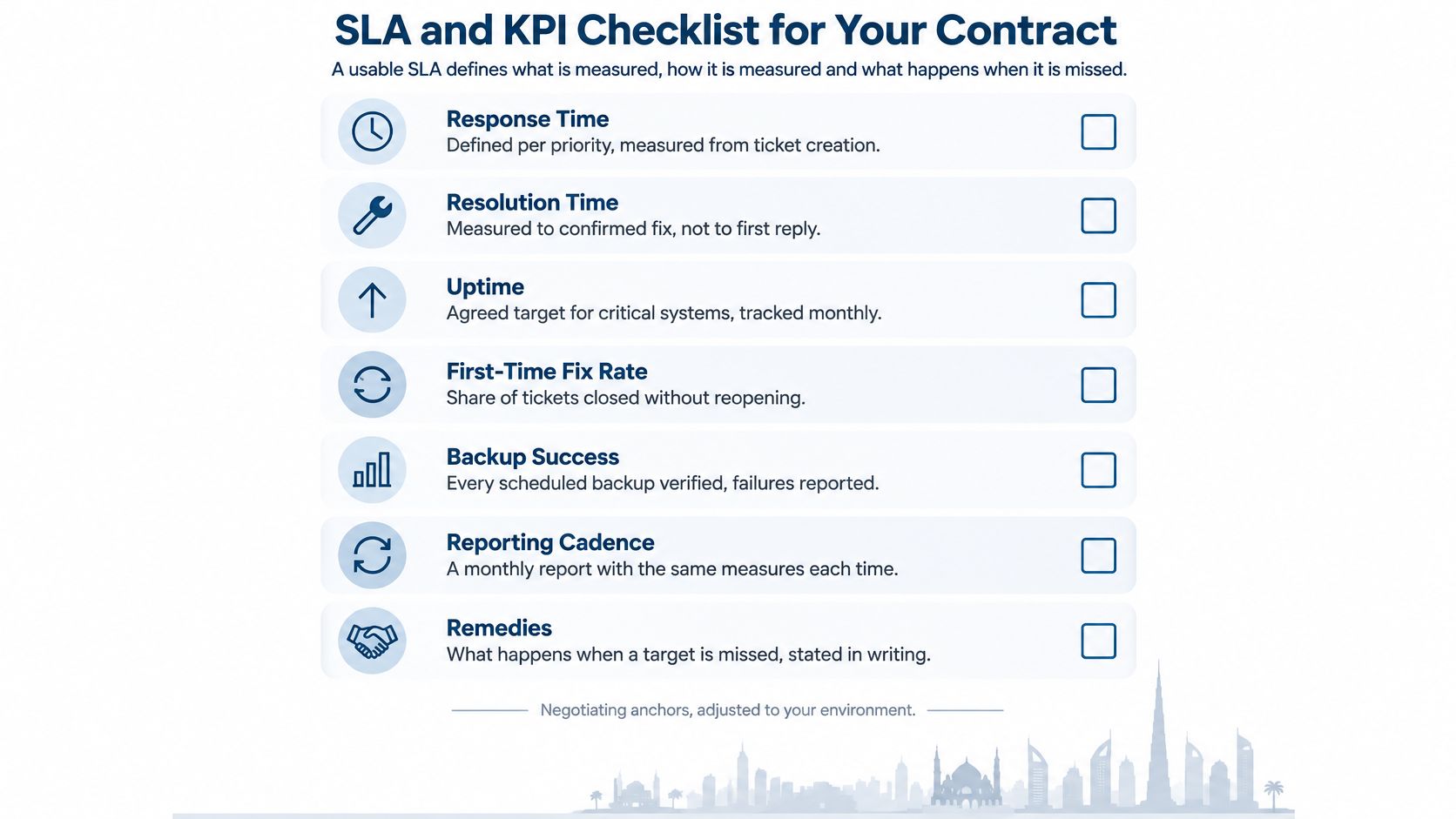
In order, write a P1 to P4 matrix with examples, separate response from restore, measure in your ITSM tool, set credits or a remediation plan, require monthly reporting and a quarterly review, and list exclusions. Epic's UAE governance analysis ties incorrect configurations to 27% of incidents, and another UAE cybersecurity report in that same review cites misconfiguration as 32%. Track configuration compliance, critical assets under monitoring, high-risk drift time, privileged-access review frequency, and rollback success. Tool choice matters here, including SysAid pricing, because the measure has to live in a system you own.
If you can't report a KPI monthly from your own tooling, it isn't enforceable.
Security Operations and Threat Readiness
Run security as tested runbooks, not only a ticket queue. A 2025 UAE cyber-threat analysis recorded more than 17,000 cyberattacks, with the public sector taking 70%, and IT-service firms among the most targeted technology groups. CPX recorded 2,301 DDoS attacks in the UAE in the first half of 2024. Peak bandwidth fell 67.7%, and the volume still creates load.
Telemetry: Continuous network monitoring and upstream filtering.
Escalation: Automated alerts tied to documented severity.
Runbooks: Rehearse incidents on a fixed schedule.
Access: Privileged accounts, multifactor authentication, and endpoint monitoring.
Handoff: A path from the service desk to security responders.
Score those controls with mean time to detect, mean time to acknowledge, and mitigation time.
Data Protection and Compliance in the GCC and Europe
Under the UAE Personal Data Protection Law, Federal Decree-Law No. 45 of 2021, you are typically the controller and the provider is the processor. Define permitted processing, access limits, and evidence duties. A processor must notify you as soon as it becomes aware of a personal-data breach, so detection can't wait for you to notice.
What the Bureau Notice Must Contain
The implementing text says that when a breach could prejudice privacy, confidentiality, or security, notice to the competent bureau includes the nature and form, the causes, the approximate number of affected records, data-protection officer details, and corrective measures taken or proposed. Name who collects facts, who keeps logs, and who drafts the notice.
The UAE National Cloud Security Policy prioritizes data security and lifecycle management. Sovereign cloud stresses in-country residency, so name a jurisdiction for each data class.
Offshore records: Which ITSM records may leave the country?
Admin access: How is remote administrator access logged?
Subcontractors: Where is the list, and who approves a change?
Retention: What are the deletion periods, and how is data returned at exit?
Federal entities, DIFC, ADGM, and other free zones don't share one rule set. Saudi operations sit under the PDPL. In Europe, processor terms follow GDPR Article 28, and supervisory notice follows Article 33.
How to Choose and Onboard a Provider in Six Steps
A sound buy is six steps, then a phased start, timed to your milestones rather than a stock duration.
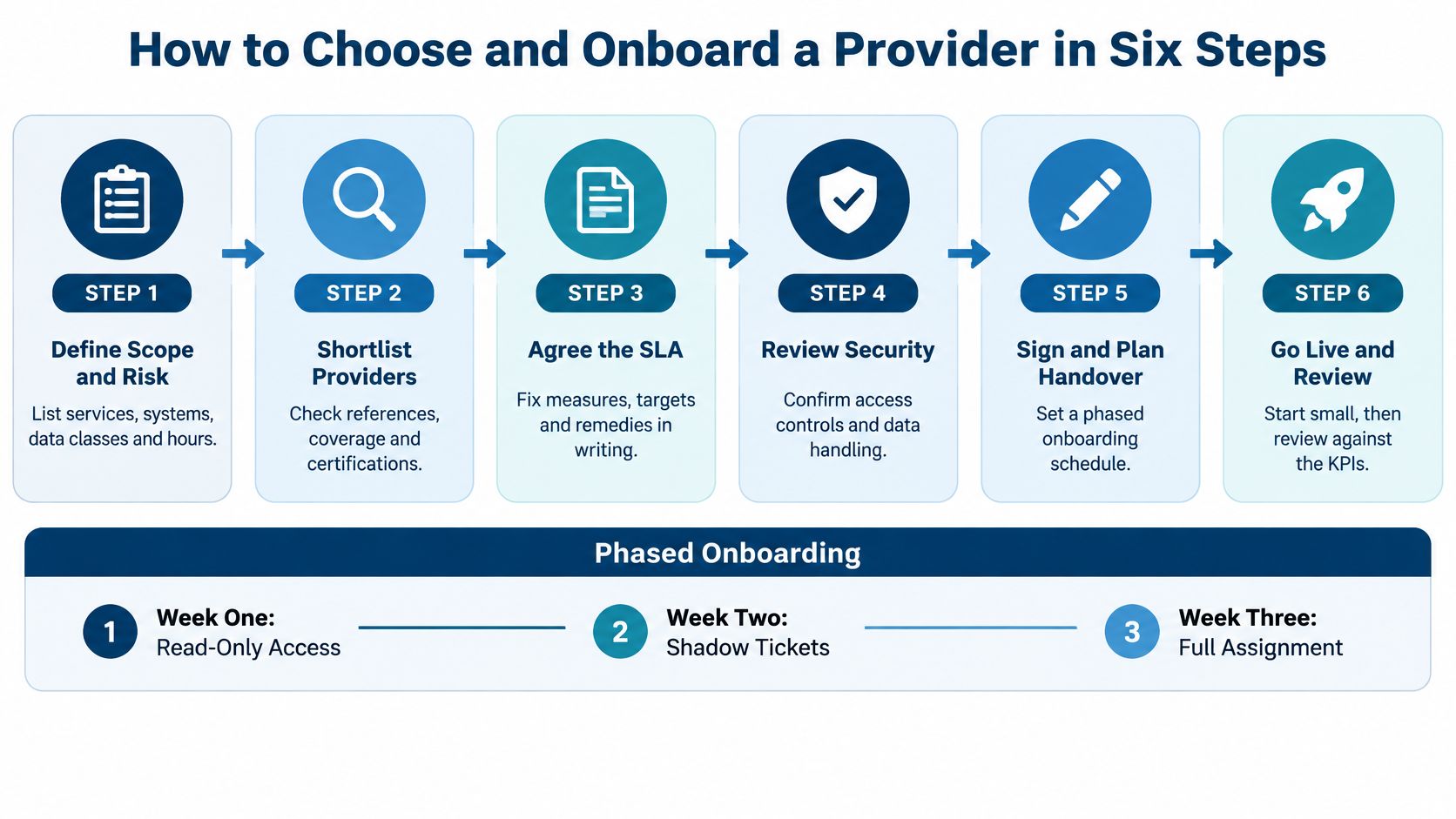
Define scope and risk. List services, systems, data classes, and hours. The miss is a one-line "full IT support" scope.
Shortlist and score. Weight certifications, regional presence, security, ITSM skills, references, and price. Scoring on rate alone fails.
Issue the RFP. Attach an SLA annex, processing terms, and real ticket volumes. Hiding the baseline wastes the bid.
Call references and run a paid pilot on one queue or site. Skipping the pilot is the expensive shortcut.
Negotiate. Exit assistance, audit rights, and step-in rights. "To be agreed" is not an exit plan.
Onboard in phases. Discovery and runbooks, a parallel run, hypercare, then steady reviews. A big-bang cutover drops context.
Name an executive sponsor, publish a RACI, brief users on the new routing, and train the escalation path. The same team should assess, configure, and then support the environment. If Freshservice is in scope, line the bid up against Freshservice pricing.
Connecting Outsourced Support to Your ITSM Platform
The provider should work inside your ITSM platform as an assignment group with its own SLAs, not in a separate ticket system.
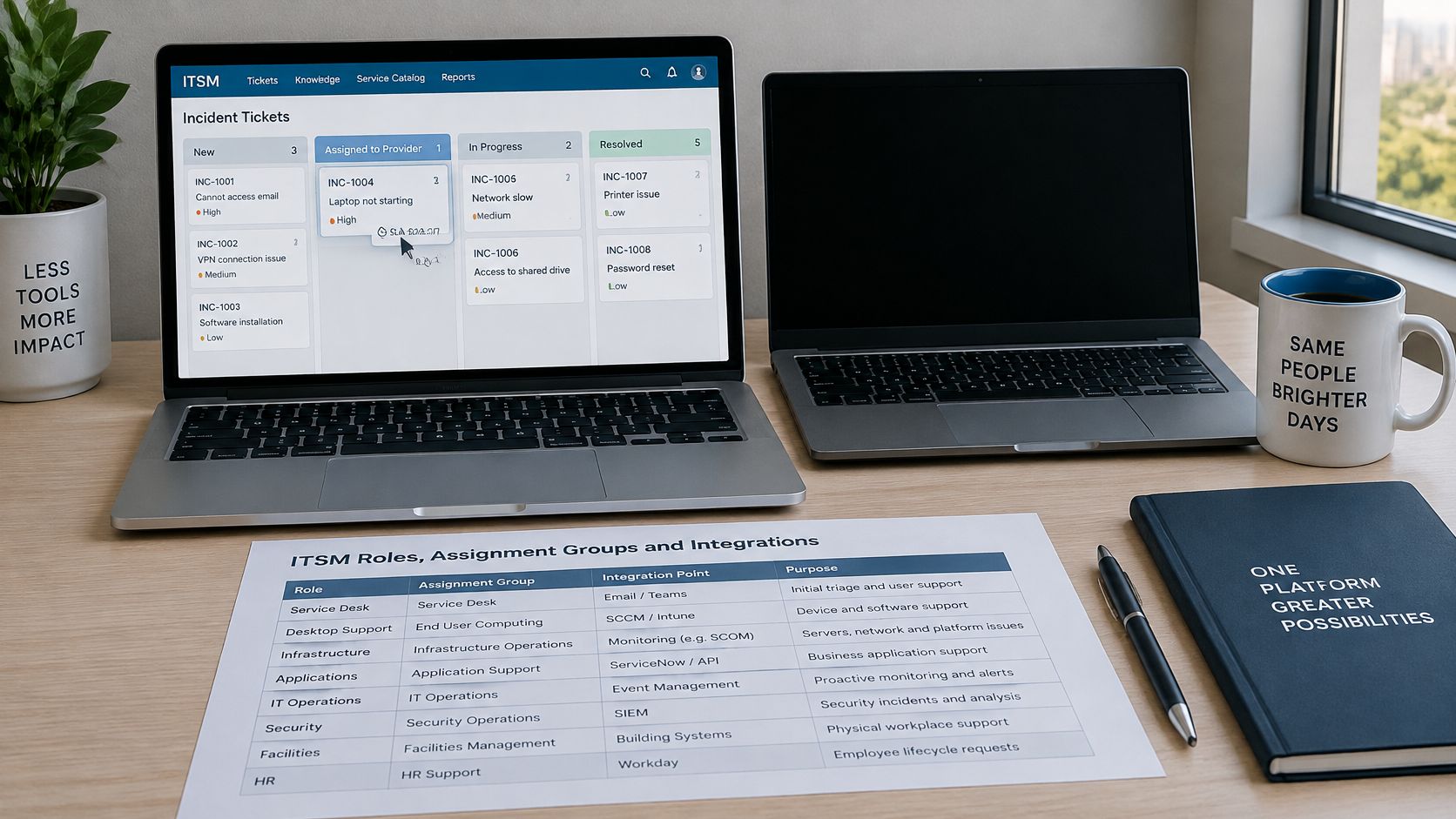
Platform | Typical role for outsourced support | Integration point to verify |
|---|---|---|
ServiceNow | Enterprise ITSM and ITOM, with the CMDB as shared source | Event-to-incident flow from monitoring and CMDB sync |
HaloITSM | Single-platform service desk with provider as an analyst group | SLA and OLA tracking mapped to contract terms |
Freshservice | Cloud service desk with self-service portal and asset management | Assignment groups and API access for provider staff |
ManageEngine | ITSM alongside ITOM and asset modules across the suite | Alert integration and single sign-on |
Roles: Provider staff sit in named groups.
SLA and OLA: Both mirror the contract.
CMDB: One shared source of truth.
Alerts: Monitoring opens a prioritized incident.
APIs: Webhooks feed the monthly report.
Access: Single sign-on plus an audit log.
On ServiceNow, remodel incident, problem, request, and change on the platform instead of copying the old flow. DataLunix is a reseller and partner of HaloITSM, HaloPSA, Freshservice, SysAid, and Serviceware, and we implement ServiceNow, so licenses and integration can move together. Start that check with HaloITSM pricing. Before you sign, have the provider run a P1 from alert to closure in your tool. Don't swap platforms during onboarding unless the business case is already clear.
Choose Your Model and Book a Scoping Call
Pick the delivery model that matches the control you need, then scope the work before you issue an RFP. For McDonald's Saudi Arabia, we migrated the full ITSM process set into ServiceNow ITSM Standard, remodeled incident, problem, request, and change, ran cutover in parallel with the legacy tool, moved historic tickets, and stayed on hypercare. We then set up an Employee Service Centre with a structured HR request catalogue and a Virtual Agent as first-line support, while SAP SuccessFactors stayed the HR system of record. In a separate engagement, niche ServiceNow and Salesforce roles an internal team had left open were closed within five days.
Choose managed, augmentation, or hybrid from the control you need to keep.
Bring baseline SLAs and ticket metrics to the call.
Book the free 30-minute consultation on the DataLunix calendar, where a senior consultant meets you.
Outsourced IT support services pay off when that choice is made before the RFP, not after the first missed restore.
DataLunix provides managed operations, staff augmentation, and ITSM implementation across ServiceNow, Halo, Freshservice, and related platforms for GCC and European teams. If you are weighing residency, breach notice, and exit terms against a support contract, bring your scope to a scoping call. Visit DataLunix to book the free 30-minute consultation with a senior consultant.