
Integrated Risk Management Tools: A 2026 Buyer's Guide

77% of incidents were classified as critical, high or medium severity in the 2025 State of the UAE Cybersecurity Report. Integrated risk management tools must turn that exposure into accountable action: a risk connected to a named owner, a tested control and the business service that could fail. A polished dashboard isn't enough.
For GCC and European technology leaders, the buying decision should start with traceability, not a feature checklist. Can the person responsible for a service explain the exposure, open its supporting evidence and initiate treatment without reconciling separate spreadsheets?
What Integrated Risk Management Tools Actually Do
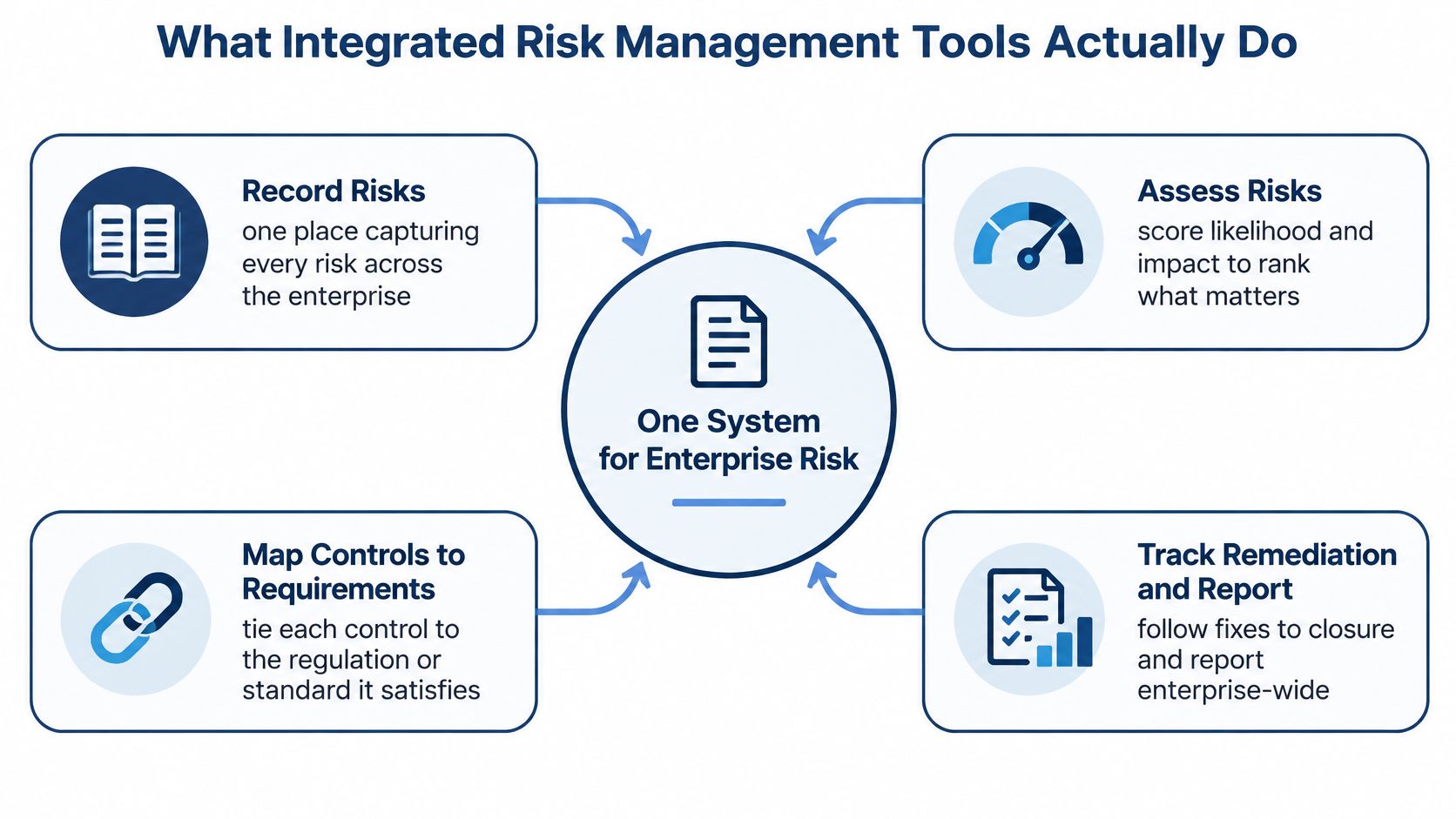
An integrated risk management tool is one system that records risks, assesses them, maps controls to requirements, tracks remediation and reports across the enterprise. It gives audit, cybersecurity, supplier and continuity teams a shared operating model instead of disconnected registers.
Apply the single-record test first. Open a risk and check whether you can follow its relationships to a named owner, a control and a business service without searching another application or interpreting free-text references.
Accounting moved from scattered cash books to a general ledger. IRM should do something similar for risk: maintain consistent records that different teams can use without repeatedly entering the same information.
What should a buyer be able to open?
Core capabilities of an IRM tool
Capability | What it records | Example output |
|---|---|---|
Risk register | Risk name, category, owner and linked business service | Register where every risk has a named owner |
Risk assessment | Inherent and residual scores using one documented method | Quarterly residual-risk heat map by service |
Control mapping | Control name, framework clause, linked risk, owner and latest test result | Coverage report showing gaps per framework |
Issue remediation | Findings, treatment tasks, due dates and approvals | Overdue actions by owner and age |
Reporting | Board and regulator packs with evidence references | Quarterly pack with trend lines and evidence links |
These capabilities need a shared data model, not merely a common login. When a control test fails, the relevant assessment and treatment task should reflect that result while preserving the previous decision and its evidence.
The operating model is illustrated below.
In the 2024 UAE internal-audit survey, published by Protiviti with the UAE Internal Auditors Association and discussed in DataLunix's IRM application guide, 59% of respondents conducted risk assessments annually, while 83% said unanticipated risks required management attention during the year. That doesn't measure how many events annual assessments missed, but it does show why a scheduled assessment can't replace event-driven updates.
Market expansion is another useful assessment scenario. GENTY recruitment's coverage of Prometeo's Chile market entry provides context for discussing how changing geographic exposure should enter a risk workflow.
If you're extending an existing service platform, review HaloITSM licensing considerations separately from risk functionality. A service-management subscription doesn't automatically establish an integrated risk model.
Practical rule: If the product can't connect a risk, owner, control and business service in one navigable record, treat it as a register rather than an integrated tool.
How IRM Tools Connect to ITSM, ITOM, CSM and HRSD
The most useful integration usually starts with incidents on a business service. Service desks, monitoring systems, customer-case tools and HR workflows already contain risk signals; integration should convert relevant events into decisions rather than copy every ticket into the risk register.
Integration patterns and the risk each one feeds
Integration pattern | Trigger event | Risk record it creates |
|---|---|---|
ITSM incidents to risk register | Repeated P1 or P2 incidents on one service | Operational risk linked to that service |
ITOM monitoring to risk indicators | Threshold breach on capacity, backup or patch age | Control check task for the service owner |
CSM cases to conduct risk | Complaint pattern or SLA breach in customer cases | Customer-impact risk with a remediation owner |
HRSD to access risk | Leaver or role change without matching access removal | Access control gap with review date |
ITAM and CMDB to dependency map | Asset added or changed without a linked service | Unmapped dependency raising the exposure score |
The last pattern needs care. An unmapped asset should raise a review task and a documented uncertainty flag, not inflate a score through an unexplained formula.
How should an incident reach the risk owner?
Say three priority-two outages affect a payments service within ninety days. Your configured correlation rule could create an operational-risk record, assign the payments service owner and attach the relevant continuity plan.
The next outage should update the existing exposure when it has the same underlying cause. A separate failure mode may justify another risk, but duplicate tickets alone shouldn't create duplicate assessments.
A configuration management database, or CMDB, supplies the dependency context. In our FUJIFILM ITAM setup, we reconciled OT and non-OT assets into a single CMDB feeding the service desk directly, with dependencies mapped and kept current automatically.
At DataLunix, we integrate client systems, software and tools to create agentic AI workflows and automations using HaloITSM, HaloPSA, Freshservice, SysAid, Serviceware and ServiceNow. Each integration still needs a verified API or connector design, ownership mapping and failure handling; the platform name alone doesn't guarantee interoperability.
Correlate before creating: Use service identifiers, event types and existing open risks to prevent duplicates.
Preserve provenance: Retain the originating ticket and integration transaction so an analyst can investigate an incorrect update.
Handle failed delivery: Route rejected events to a monitored exception queue instead of dropping them.
Use the Freshworks pricing breakdown to distinguish subscription scope from connector and implementation work. Before go-live, raise a test incident and confirm that the risk workflow receives it with the correct service, owner and evidence.
Selection Criteria That Separate Serious IRM Platforms
Feature lists look alike because vendors use similar labels. Judge the platform on your own service data, failed controls and approval scenarios, not a prepared demonstration where every relationship already works.
Selection tests that separate IRM platforms
Criterion | Buyer test | Pass signal |
|---|---|---|
Data model | Can one risk link to a business service, owner, asset, control and vendor? | All five links exist on a single record |
Integration | Are there native connectors to your ITSM, ITOM and HR platforms, plus API access and deduplication? | One outage creates one risk, not twenty |
Assessment method | Is inherent and residual scoring documented, with source, timestamp, assumptions and approver? | A board figure can be traced to its inputs |
Workflow | Are segregation of duties, approval routing and tolerance escalation supported? | Residual exposure above appetite routes to a named approver |
Reporting | Can packs show trends and evidence references, not only red, amber and green? | Quarterly pack cites the underlying tests |
Regional fit | Are Arabic and English, data residency and UAE regulator evidence supported? | Residency option and evidence fields match the licence |
Partner depth | Can the implementer discover the estate before configuration? | Discovery findings set scope before build |
Can the assessment survive scrutiny?
PwC's UAE Digital Trust Insights perspective found that 41% of UAE respondents used cyber-risk quantification, compared with 26% globally. That makes assessment transparency a practical buying consideration, not an optional reporting refinement.
Ask the demonstrator to change a control result and explain the revised residual exposure. A numerical answer isn't credible just because the platform calculated it; you need the assumptions, method and approval history.
For regional fit, distinguish a product capability from a deployment commitment. Arabic content support doesn't prove that an agreed hosting region, backup location or support-access arrangement is included in your contract.
A sophisticated loss model built on incomplete dependencies can be less useful than a simple, well-evidenced assessment.
Our practice covers ITSM, ITOM, CSM, HRSD, ITAM, SPM (PPM), FSM, ESM, GRC (IRM) and SecOps. The same team assesses the environment, configures it and supports it afterwards, so discovery decisions can remain connected to delivery.
Use SysAid pricing and scope considerations when comparing commercial proposals, but score operational fit first. As a buyer-designed exercise, rate each criterion from one to five and give your most important three greater weight; don't let an attractive aggregate score conceal a failed mandatory requirement.
Licensing and Managed Service Options for GCC and European Buyers
Comparing subscription prices without implementation and operating costs produces an incomplete business case. Your budget needs discovery, configuration, integrations, change management, training and the work required to keep assessments and controls current.
Buying models compared
Model | What you pay for | Best fit | Watch-out |
|---|---|---|---|
Direct software licence | Annual per-agent or per-module subscription | Teams with in-house platform administrators | Confirm which modules and user tiers are included |
Reseller licence | The same licence through an authorised reseller, often discounted | Buyers wanting lower licence cost plus local support | Check renewal terms and discount guarantees in writing |
Implementation project | Fixed-scope or time-and-materials rollout | One-off rollout with a defined scope | Scope creep unless discovery is completed first |
Managed service | Monthly fee for optimisation, upgrades and outsourced operations | Lean teams needing ongoing cover | Define service levels, exit terms and continuity evidence |
Staff augmentation | Day or monthly rate per specialist | Short capacity gaps during a programme | Knowledge stays with the individual when they leave |
We're a reseller and partner of HaloITSM, HaloPSA, Freshservice, SysAid and Serviceware, and offer ServiceNow implementation. Our managed services include post-implementation maintenance, upgrades and complete operations outsourcing.
Use the Freshservice pricing guide to frame licence questions, then obtain a current, scoped quote. Don't treat a service-desk agent price as the price of an enterprise risk capability.
What regulatory evidence belongs in the contract?
For UAE insurers, the Central Bank's enterprise-risk standards build on Circulars 25/2022, 24/2022 and 4/2023 and require an Own Risk and Solvency Assessment at least annually, on a solo basis and, where relevant, at group level. The platform and service arrangement should support repeatable assessments and cross-entity evidence.
For banks, the Operational Risk Standards require an integrated approach to identifying, measuring, monitoring and managing technology risk. Connect technology assets, controls, assessments, risk and performance indicators, owners and reports rather than commissioning separate reporting silos.
Before cloud or other outsourcing, the Central Bank's outsourcing assessment requirements call for consideration of service materiality, security, cybersecurity, information-security, operational, outsourcing and continuity risks, alongside changes to legal, compliance, reputational and concentration exposure. Capture those dimensions against the supplier and affected service.
The Outsourcing Regulation for Banks requires Board or Board-committee approval for material arrangements, timely Board reporting and continuity preparedness covering critical outsourced functions. Separately, the Operational Risk Management Regulation requires a Central Bank notice of non-objection before outsourcing an activity whose disruption could significantly affect critical operations.
Build these deliverables into the managed-service schedule:
Approval evidence: Materiality assessment, decision record and applicable regulatory correspondence.
Operational assurance: Provider continuity evidence, testing responsibilities and reporting obligations.
Exit readiness: Data export, configuration documentation, transition assistance and access revocation.
European buyers should map the same operational records to their applicable outsourcing and resilience obligations, not assume UAE requirements apply. Build a five-year planning model with separate lines for licences, implementation, managed support and internal time, and require staff-augmentation specialists to document knowledge before handover.
Implementation Checklist from Discovery to Hypercare
Start with a bounded service and an agreed evidence standard. Configuration should follow decisions about scope, accountability and scoring, not become the place where teams first discover that they disagree.
Our consulting engagements begin with discovery workshops, fit-gap analysis and readiness assessments. These map requirements to technological capabilities, determine scope and expose organisational or technical gaps before the build.
The implementation journey needs explicit acceptance gates.
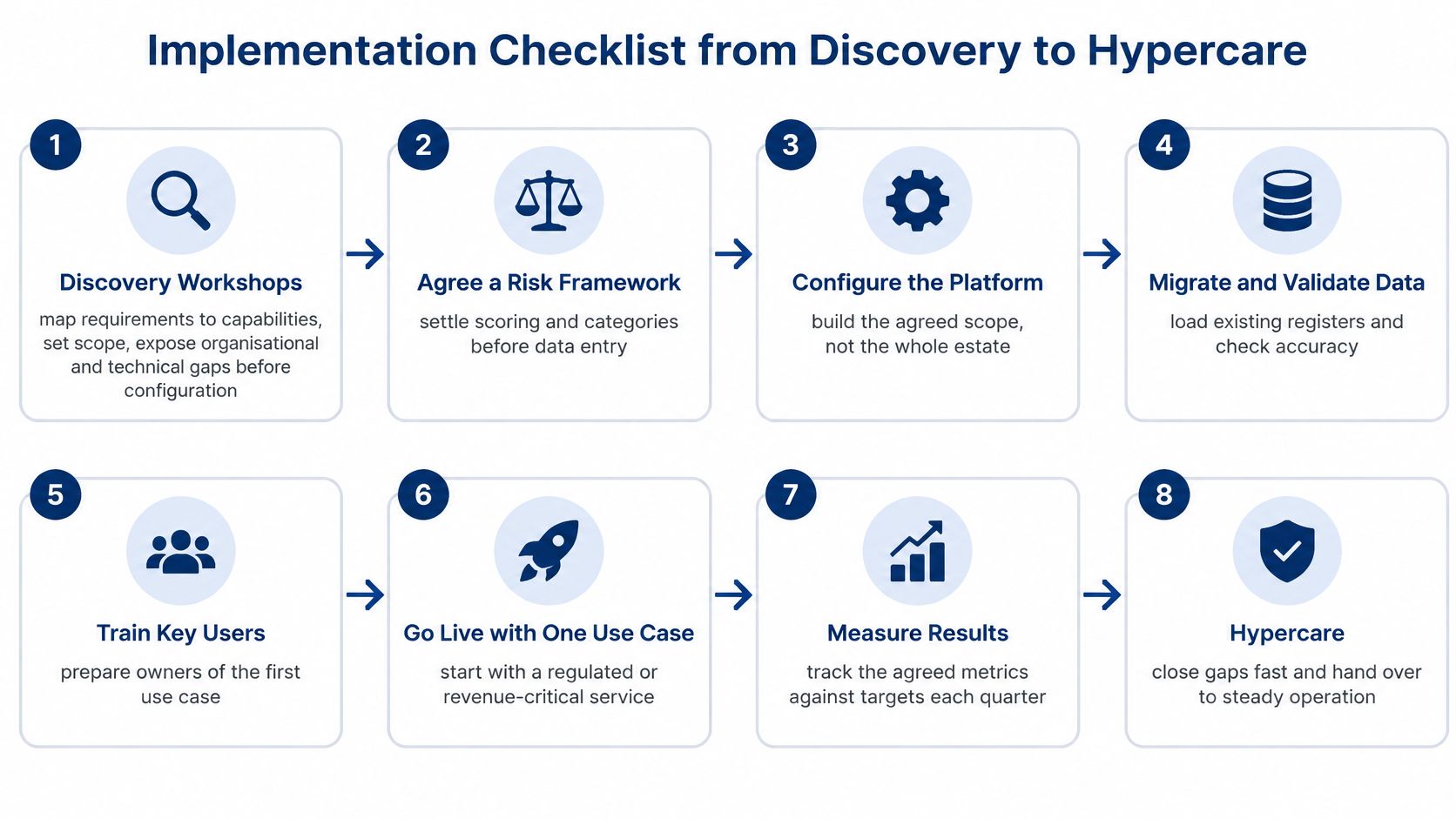
What should the delivery team complete?
Run discovery workshops. Map requirements to available capabilities, agree exclusions and record readiness gaps before configuration starts.
Agree the taxonomy and accountability. Name the accountable owner for each in-scope business service so treatment decisions don't sit in an unowned queue.
Map service dependencies. Connect the CMDB and asset register to applications, vendors and recovery objectives because an assessment cannot reliably describe dependencies nobody has identified.
Connect a limited set of priority sources. Start with incidents, monitoring alerts and third-party records, validating their quality before broadening ingestion.
Load the assessment and escalation rules. Test scoring, appetite thresholds and approvals against real risks, including a case that should trigger executive escalation.
Prepare people for the changed workflow. Complete a change impact assessment, stakeholder communication plan and role-based training so owners understand both their decisions and their evidence obligations.
Migrate and reconcile historic records. Run the new platform alongside the legacy tool for an agreed period, checking ownership, attachments and open actions before retiring the old workflow.
Maintain hypercare after launch. Review adoption and exceptions weekly, then transfer responsibility to steady-state support only when the acceptance criteria are met.
The sequence is operational, not merely technical. Teams need to know who handles an integration failure, who corrects a disputed score and who approves a treatment extension.
What evidence proves readiness?
For McDonald's Saudi Arabia, our ITSM migration ran cutover in parallel with the legacy tool, migrated historic ticket data and retained hypercare after go-live. That is a useful delivery pattern, not a claim that an ITSM migration alone proves IRM readiness.
Refact's discussion of enterprise workflow automation benefits and costs is a useful companion when deciding which repetitive tasks to automate. Keep approval accountability explicit even when the underlying routing becomes automatic.
Use a signed go-live checklist containing:
Data acceptance: Reconciliation results and approved migration exceptions.
Workflow acceptance: Successful assignment, approval and escalation tests.
Operational acceptance: Support ownership, training completion and recovery arrangements.
Each sign-off should link to evidence, not merely contain a checked box.
Common Pitfalls and How to Avoid Them
The costliest failure is a dashboard that describes risk but can't demonstrate recoverability. UAE resilience findings reported by Arabian Business found that only 19% of organisations had a formal disaster-recovery plan, 38% had defined recovery-time and recovery-point objectives for all critical processes, and 22% had fully mapped critical processes to supporting technology, third parties and supply-chain dependencies.
A completed assessment isn't a successful recovery test. Buyers should reject acceptance criteria that reward attractive heat maps while leaving service restoration untested.
Which failures need explicit controls?
Accepting unsupported residual scores: Block acceptance for a tier-one service until the owner attaches a tested recovery result and date. Where testing is incomplete, record the uncertainty and escalate it instead of presenting assumed effectiveness as fact.
Losing score lineage: Store the source system, timestamp, assumptions and accountable approver with the assessment. Preserve historical versions so an auditor can reconstruct what decision-makers knew at approval.
Letting AI agents approve their own work: Give each agent an accountable human owner and retain prompt, action and approval evidence. Monitor access, data quality, model changes and supplier dependencies, and provide a rollback route.
Starting without client responsibilities: Sign a responsibility matrix for access, information, decisions and permissions before kick-off. Clients must provide these inputs promptly; missing inputs may affect timelines and fees.
Treating outsourcing as contract storage: Maintain the measured exposure, reporting status and provider continuity evidence as active records. A filed agreement doesn't demonstrate that the outsourced service can recover.
The 2025 Cisco UAE Cybersecurity Readiness Index reported that only 6% of companies reached the Mature stage for identity intelligence readiness. That finding supports caution about autonomous permissions, not a blanket conclusion that every other company has the same access weakness.
Acceptance gate: Don't let an AI agent approve treatment until identity lifecycle controls, approval boundaries and action logging have been tested.
An agent may reduce manual handoffs while introducing more identities, permissions and decision paths to govern. Keep privileged actions and exceptions visible to the same operational owners who would investigate a human error.
Enter these pitfalls on the programme risk register and review them during hypercare. Assign remediation to people with authority to fix the underlying process, not just close the implementation ticket.
Pick Your First IRM Use Case and Measure It
Start with a revenue-critical or regulated service rather than the whole estate. A bounded pilot lets your service owner, risk lead and operations team agree what good evidence looks like before expanding the platform.
At DataLunix.com, we position discovery around current tooling, licence position and process gaps, not a predetermined replacement programme. Your existing platform may need integration and governance work rather than another subscription.
Use the pilot to inspect operational evidence together.
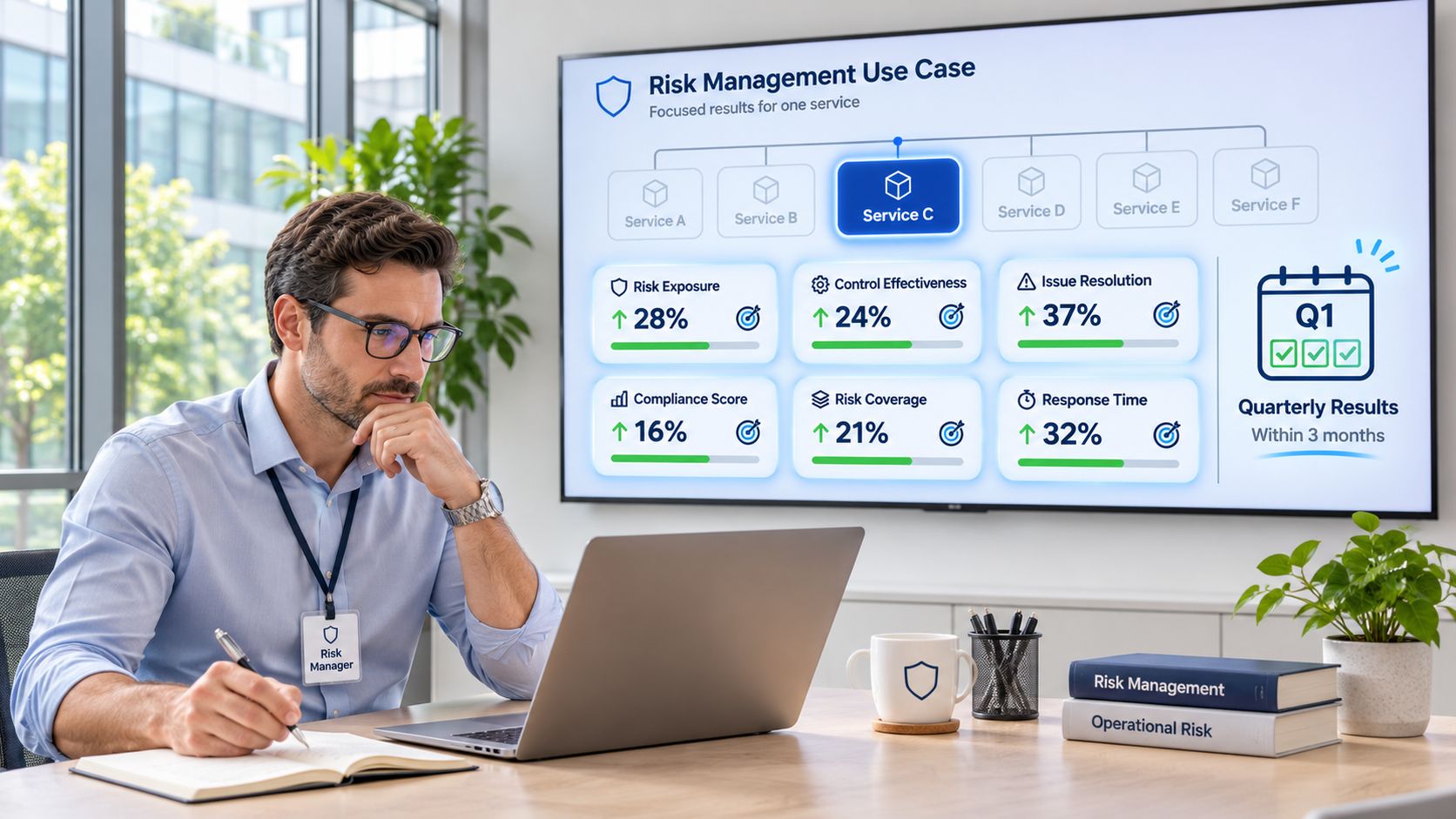
What should your pilot measure?
Set these as proposed acceptance targets, not published industry benchmarks:
Dependency completeness: Aim for 100% of in-scope tier-one services to have validated dependency maps.
Ownership coverage: Require 100% of in-scope risks to have a named accountable owner.
Detection and containment: Target falling mean time to detect and mean time to contain, reviewed quarterly.
Recovery-test coverage: Propose at least annual backup recovery testing for critical services, with recorded outcomes, then adjust frequency to obligations and criticality.
Treatment discipline: Reduce overdue actions and require an owner and due date for every exception.
Evidence availability: Agree a retrieval deadline in days before launch and meet it for every audit request in scope.
If customer complaints are the starting signal, use the Freshdesk pricing guide to examine the customer-service licence position without confusing case management with risk assessment.
Can integrated risk management tools replace ITSM?
No. ITSM manages incidents, requests and service changes, while IRM manages exposure, controls and treatment decisions. Connect their records rather than forcing service analysts to duplicate operational work.
Do integrated risk management tools require a complete CMDB?
You need dependable dependencies for the service you're assessing, not a perfect inventory of the entire enterprise. Record known gaps explicitly and assign validation tasks before accepting unsupported recovery assumptions.
How should you pilot integrated risk management tools?
Choose a service whose owner can approve treatment and provide test evidence. Connect a small set of trusted sources, then judge the pilot on usable decisions and measurable remediation rather than record volume.
For a proposed 90-day plan, select the service, validate its dependencies, connect two priority sources and report the six measures to the board. The intended outcome is a defensible service-level risk decision with visible treatment progress, not a claim that enterprise-wide transformation is complete.
DataLunix offers a free 30-minute consultation, bookable directly on our calendar, where a senior consultant meets you to discuss your risk and service-management priorities. Visit DataLunix to request a no-obligation discovery call mapping your tooling, licence position and process gaps, then define a first IRM use case you can measure before committing to a wider rollout.