


GRC Cloud for GCC Enterprises: A Practical Guide

A Dubai IT director can face three urgent requests on the same morning: a regulator needs evidence for a control test, a European subsidiary raises a data-access request, and a ServiceNow change ticket is waiting because its risk approval is missing. Spreadsheets, screenshots and email trails won't resolve that pressure reliably. GRC cloud connects ownership, controls, evidence and risk decisions so teams can respond from one governed operating model.
For GCC enterprises, the platform choice is only part of the decision. UAE and Saudi requirements make hosting location, control mapping, provider oversight and audit evidence collection architectural concerns, not procurement footnotes. The most useful design is usually a hybrid of automation, regional deployment controls and accountable owners across IT, security, procurement and business operations.
What Cloud GRC Means for Modern Enterprises
A Dubai IT director may need to answer a regulator's control test, approve a European subsidiary's data-access request, and clear a ServiceNow change ticket with missing risk approval before the morning ends. Spreadsheets, screenshots and email trails rarely provide reliable control ownership under that pressure. GRC cloud connects owners, controls, evidence and risk decisions in one governed operating model.
For GCC enterprises, the product is only one part of the design. Third parties, expanding SaaS estates and sovereign-cloud requirements determine where evidence sits, who can access it and how exceptions are escalated. A workable model assigns control ownership across IT, security, procurement and business operations, then links those owners to the systems where work occurs.
A platform should collect signals from ServiceNow, Halo ITSM, Freshservice, ManageEngine, cloud services and identity tools. It can associate a change record with a control, connect a cloud asset to an accountable owner, request evidence through an ITSM workflow and expose unresolved exceptions in a compliance view. The value comes from these relationships, rather than from storing additional policy documents.
The platform is not the operating model
Cloud GRC software does not create accountability by itself. Teams still need named control owners, evidence standards, escalation paths and rules for accepting risk. Without ownership after implementation, the platform becomes an organised archive of stale information. Continuous control ownership also needs a review rhythm for vendors and SaaS applications, especially when provider changes affect data access or service boundaries.
The regional context adds another constraint. The UAE's National Cloud Security Policy was developed in 2023 to establish principles for secure cloud services. Saudi Arabia's government cloud, Deem, is described as a national government cloud platform. For sensitive workloads, regional hosting, dedicated tenancy or hybrid deployment may therefore fit better than generic public SaaS.
The UAE cloud-based cybersecurity GRC platforms market was valued at USD 1.2 billion in a five-year historical analysis, according to Research and Markets' UAE cloud GRC analysis. The same source connects adoption with the UAE's 2023 National Cybersecurity Strategy, the UAE Data Protection Law and an expectation that over 65% of UAE businesses will invest in compliance solutions. Regulatory pressure is therefore a direct adoption driver.
What changes compared with legacy GRC
Legacy suites often depend on periodic assessments and manual evidence uploads. Cloud-native designs can support continuous control monitoring, API-based evidence collection and live exception views, provided integrations and ownership are configured properly.
For governance responsibilities, shared accountability and cloud control design, CloudCops GmbH's governance guide provides a concise foundation. DataLunix's GRC overview offers a broader explanation of governance, risk and compliance operating models.
Regional Regulations Driving Cloud GRC Adoption
GCC regulators have turned cloud governance into a compliance gatekeeper. The UAE's Information Assurance Regulation requires entities to define security requirements for cloud data retention, processing and storage, perform due diligence, include cloud environments in risk assessments and maintain governance procedures. It also addresses provider incident communication and, where possible, the organisation's right to audit provider security arrangements, as set out in the UAE Information Assurance Regulation.
Dubai adds a practical certification constraint for the public sector. Under Dubai law, organisations are prohibited from using cloud providers that haven't achieved DESC certification, making certification a prerequisite for serving government and semi-government entities, as described in this regional sovereign-cloud policy discussion.
Compliance is a layered control model
The UAE doesn't rely on one cloud law. Its cloud compliance framework combines the Federal Personal Data Protection Law, sector rules and government policies. Chambers' UAE technology, media and telecommunications guidance notes that cloud processing and cross-border transfers require lawful bases, security protections, appropriate transfer safeguards and breach-notification compliance.
That means your GRC design needs a control hierarchy, not a single checklist. A control may need to map to UAE IA requirements, a sector-specific rule, an internal policy and a supplier contract at the same time. Saudi and UAE deployment models also increasingly favour local hosting, dedicated environments or hybrid architectures for sensitive GRC data, because retention and residency evidence must be visible in the control plane.
Framework | Jurisdiction | Key GRC Requirement | Cloud GRC Capability Needed |
|---|---|---|---|
UAE National Cloud Security Policy | UAE | Secure cloud governance principles and lifecycle oversight | Policy mapping, supplier governance and evidence workflows |
UAE Information Assurance Regulation | UAE | Cloud due diligence, risk assessment, retention and provider oversight | Control ownership, provider attestations and audit records |
DESC certification rules | Dubai | Certified cloud providers for relevant public-sector entities | Hosting qualification, evidence retention and deployment controls |
Saudi government cloud, Deem | Saudi Arabia | National cloud context for government workloads | Sovereign deployment assessment and residency-aware architecture |
UAE PDPL and sector rules | UAE | Lawful processing, safeguards and breach obligations | Processing records, data-flow evidence and exception management |
European data protection obligations | European operations | Cross-border governance and privacy accountability | Data-flow registers, evidence linkage and transfer controls |
The source material doesn't establish that every framework requires a specific automated dashboard or a particular audit-trail article. The defensible position is narrower and more useful: manual evidence processes become difficult to sustain when controls span multiple jurisdictions, providers and hosting zones. Your platform should therefore preserve evidence location, control provenance and ownership history.
For public-sector and regulatory risk topics, DataLunix's government risk and compliance guidance provides a relevant implementation reference.
Integration Patterns with ITSM and ITOM Platforms
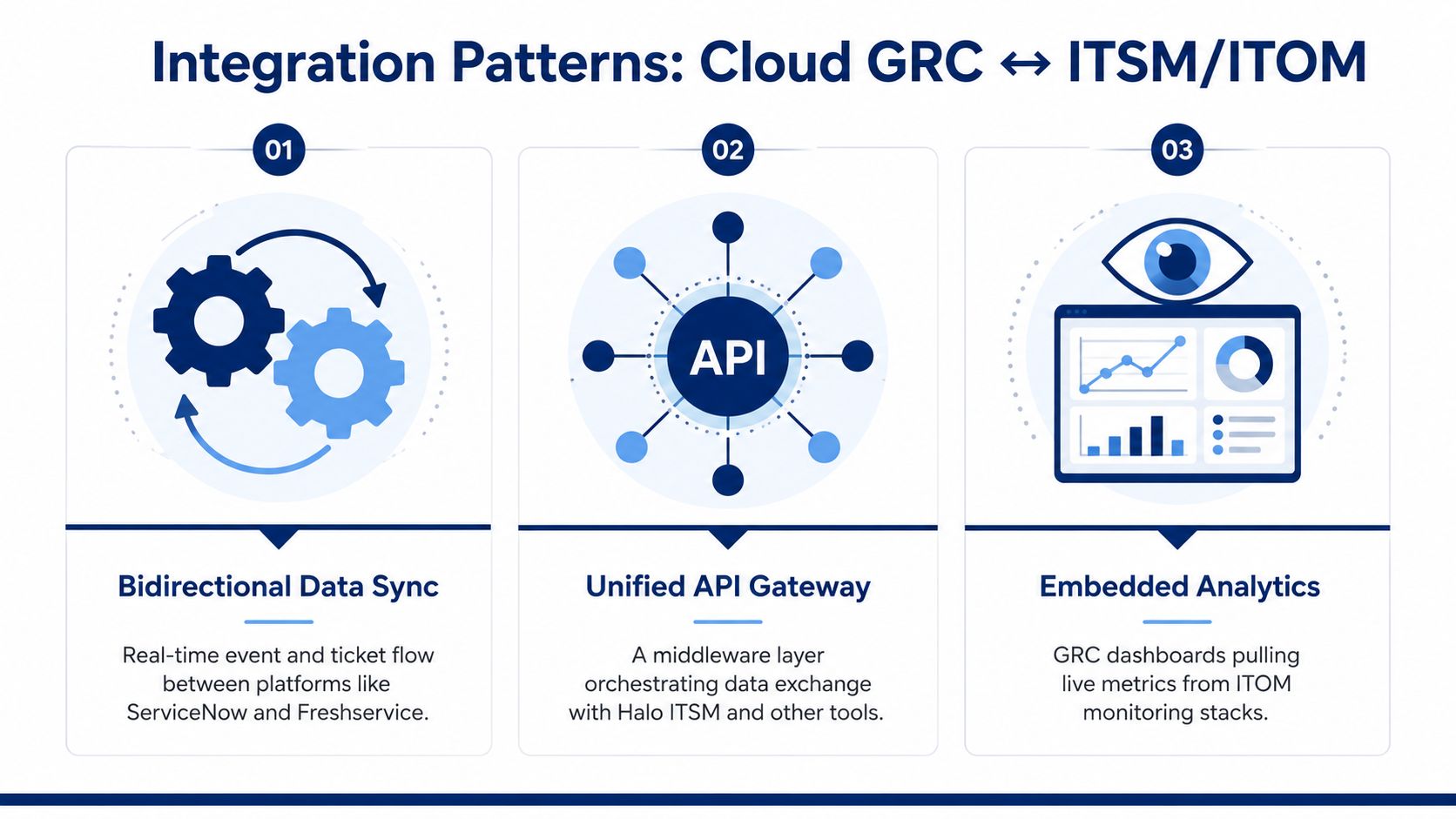
The right integration pattern depends on how fragmented your estate is. A ServiceNow-centric enterprise can often use a native approach, while a GCC conglomerate running ServiceNow in one business, Halo ITSM in another and Freshservice elsewhere may need API orchestration or middleware.
Three patterns with different trade-offs
Native module integration keeps GRC close to the ITSM platform. ServiceNow's integrated GRC and IRM capabilities can correlate change records, risk decisions, control tests and ownership without creating a separate system of record. The trade-off is tighter vendor coupling, possible licensing complexity and less flexibility when business units use different service-management platforms.
API-orchestrated integration lets a standalone platform consume REST data, webhooks and scheduled extracts from tools such as ServiceNow, Halo ITSM, Freshservice or ManageEngine. It supports heterogeneous estates, but teams must govern API rate limits, field mappings, duplicate records and bidirectional updates. A control status written back to an ITSM platform shouldn't overwrite a risk decision without validation.
Middleware-mediated integration uses platforms such as Boomi or MuleSoft to manage transformation, routing and security between systems. This is useful when CMDB data must be synchronised across sovereign and non-sovereign zones. It also introduces another operational layer, so ownership for failed messages, retries and reconciliation must be explicit.
Design the data relationships before the connectors
Map configuration items to business services, business services to risks, and risks to controls. Don't begin by importing every CMDB record. Start with the services and assets that affect regulated processes, then establish how an incident, change or vulnerability should alter the associated risk view.
A workable incident-to-risk workflow might follow this path:
Detect the signal: ITOM identifies an outage, configuration deviation or security event.
Classify the exposure: The integration attaches the event to a service, owner and relevant control.
Escalate material exceptions: GRC creates or updates a risk record when thresholds defined by the organisation are met.
Gate planned change: The change advisory board sees unresolved control exceptions before approving a high-impact change.
Preserve evidence: The platform records the source event, decision, approver and remediation outcome.
Practical rule: Keep evidence collection automated, but keep risk acceptance human-owned.
Sovereign hosting affects connector placement. A regional GRC instance may need a local integration gateway, filtered payloads or a hub-and-spoke federation model so that sensitive evidence doesn't cross a jurisdictional boundary unnecessarily. For a focused example of ServiceNow GRC architecture, see DataLunix's ServiceNow GRC resource.
Implementation Roadmap from Discovery to Adoption
A successful implementation transfers control ownership into daily work. It doesn't merely migrate an old spreadsheet into a new interface.
Start with discovery and architecture
Inventory existing policies, controls, audit artefacts, service records, cloud accounts, third parties and shadow SaaS. Interview risk owners in business units, not only central IT. Record where evidence lives, who approves exceptions and which data may be hosted outside the UAE or Saudi Arabia.
Then run a fit-gap analysis against the frameworks that apply. Avoid adopting every available control. A bank, healthcare provider, government entity and industrial company will have different priorities, even when they share broad cybersecurity principles.
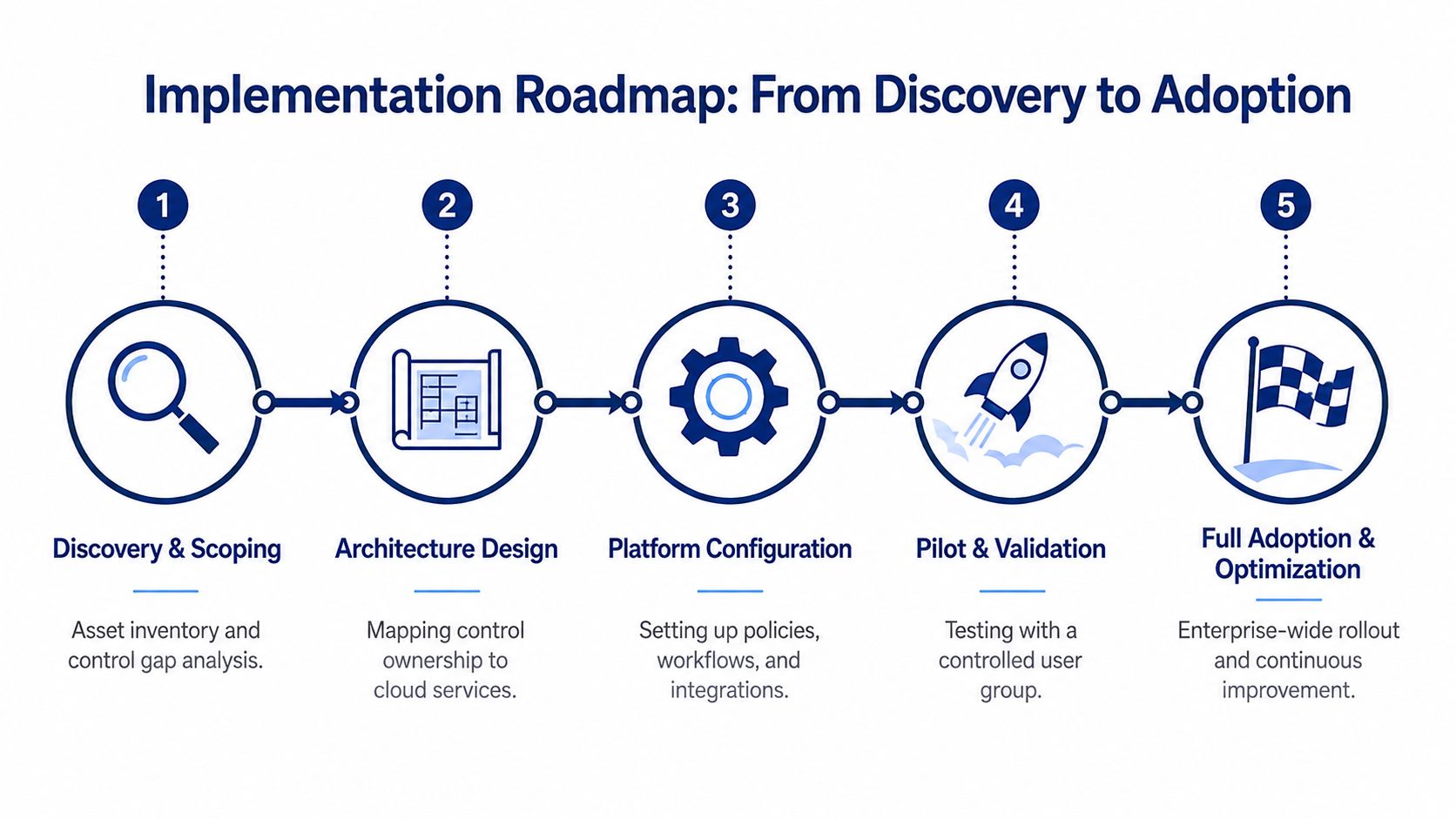
A practical rollout sequence is:
Discovery and scoping: Identify regulated services, owners, evidence sources and data-flow constraints.
Architecture design: Choose regional, dedicated or hybrid deployment and define integration boundaries.
Platform configuration: Build policies, workflows, control libraries, role models and exception paths.
Pilot and validation: Test with a controlled group, including risk owners and auditors.
Full adoption and optimisation: Expand by domain, monitor control decay and refine evidence rules.
Train the people who attest
Risk owners need short, role-specific workflows. A control owner should know what evidence is acceptable, when an attestation is due, how to record an exception and who can approve compensating measures. If the platform only trains administrators, adoption will stall outside the technology team.
The common failure is over-automation without accountability. Automate evidence retrieval from ITSM, identity and cloud tools, but require a human decision where business risk, legal interpretation or residual exposure is involved.
Why Cloud GRC Is Now an AI Governance Problem
Cloud GRC is no longer limited to servers, applications and vendor questionnaires. Employees can introduce generative AI tools into marketing, development, customer service and analysis without creating a formal asset record. That creates governance questions about data use, model ownership, human review, output reliability and access control.
The UAE regional conversation reflects this shift. A Khaleej Times report on UAE data compliance, AI governance and vendor risk states that 70% of respondents saw AI and automation as tools to mitigate third-party and multicloud risks. The same report says 34% ranked competition as a major risk, 32% cited economic uncertainty and 31% still placed cyber threats first among broader resilience concerns. These figures don't remove cyber risk. They show why resilience leaders are connecting technology, vendor and AI oversight.
Put AI assets inside the control model
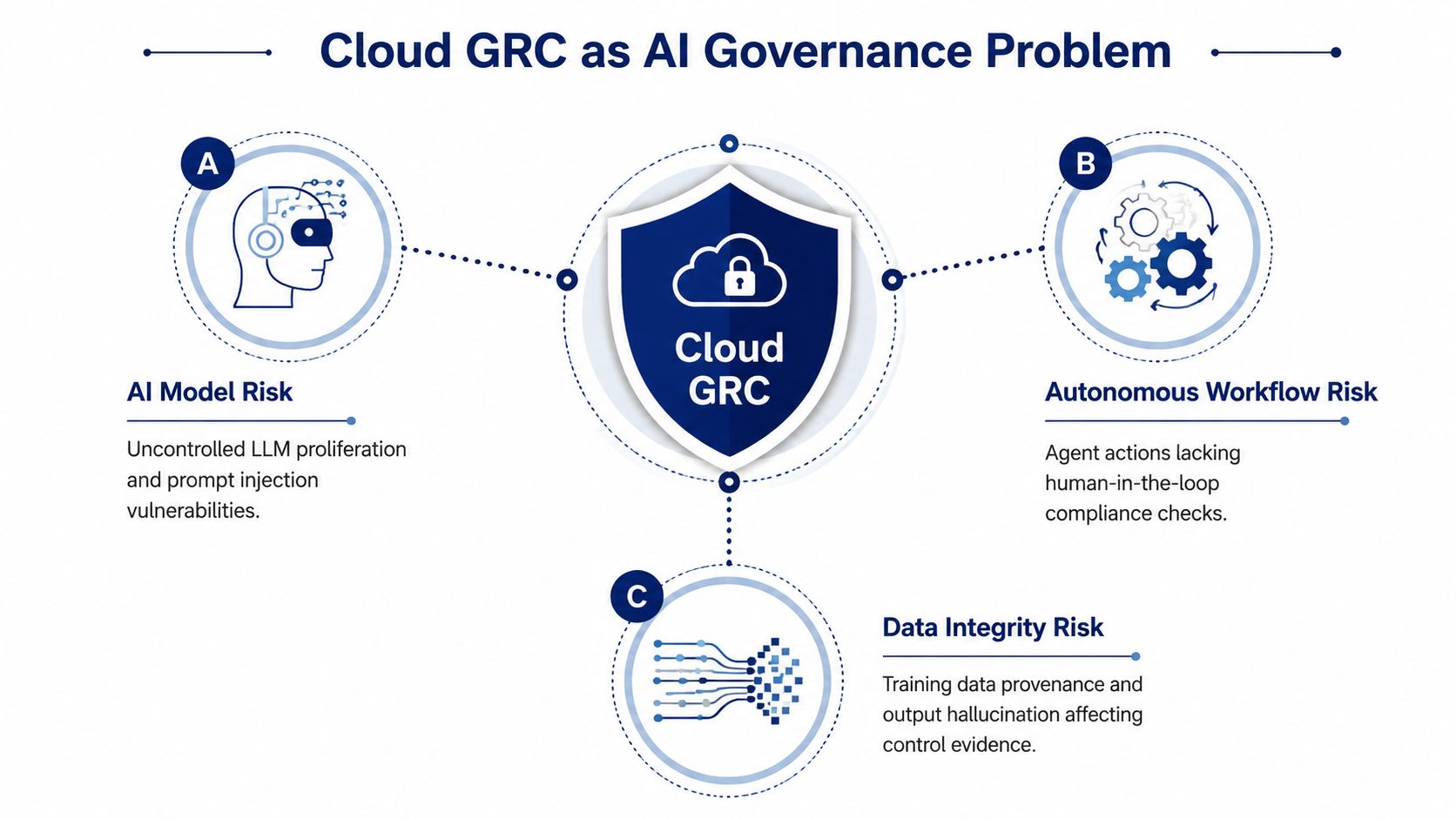
A GRC platform should be able to register an AI use case, link it to its data sources and owner, record approval conditions, and retain evidence of testing or review. Autonomous workflows need additional guardrails, especially where an agent can alter records, approve requests or produce evidence consumed by an auditor.
Useful AI governance controls include:
Model inventory: Record models, providers, owners, use cases and deployment zones.
Data provenance: Identify what information enters a model and whether it may cross borders.
Human oversight: Define decisions that require review before an agent acts.
Output assurance: Test for unreliable outputs before they become audit evidence or customer advice.
Supplier accountability: Require AI providers to explain security, retention and incident processes.
The Texas AI governance analysis from ELECTE's Newsletter offers a useful comparison point for how jurisdictions are developing formal AI governance expectations. In the GCC, the practical response is to extend existing ownership, evidence and exception workflows rather than create an isolated AI register.
For an operating-model view of this transition, DataLunix's compliance risk management guidance for the AI era is relevant.
Vendor Selection and Licensing Considerations
Vendor selection should begin with deployment constraints, not feature count. Ask where the GRC tenant, backups, logs, integration components and support access will operate. Then test whether the supplier can map UAE and Saudi controls, support the required languages and connect to the ITSM products already used by your teams.
Vendor | Sovereign Hosting | ITSM Integration Depth | Pricing Model | Regional Support |
|---|---|---|---|---|
ServiceNow GRC | Depends on the selected ServiceNow hosting and tenancy model | Deepest for ServiceNow estates | Module and entitlement based | Requires partner capability and regional delivery model |
LogicManager | Confirm deployment and residency terms during procurement | API-led integration for mixed estates | Vendor-specific subscription structure | Validate local control content and support coverage |
Diligent | Confirm tenant, data and support locations | Strong workflow and reporting potential, connector scope must be tested | Subscription and module structure may vary | Validate Arabic workflows and GCC regulatory mappings |
Regional platforms | Often offer dedicated or local deployment options | May suit local tools, but connector maturity varies | Vendor-specific, often negotiated | Potentially stronger localisation, verify scale and roadmap |
Read the licence beyond the headline
Common procurement mistakes include assuming API access is unlimited, accepting bundled modules that business units don't need, overlooking separate environments, and failing to define data extraction rights at renewal. Per-user pricing may work for a small risk team but become expensive when control owners across the enterprise need attestation access. Per-control or module pricing can be more predictable for some programmes, but it may restrict expansion.
Request a proof of value using your own ServiceNow, Halo ITSM or Freshservice data. Test evidence ingestion, CMDB mapping, exception approvals, Arabic-language requirements, role segregation and reporting for a regulator. Also confirm whether the vendor supports public, private or dedicated cloud options and whether those options satisfy the relevant UAE or Saudi deployment constraints.
DataLunix operates as a Dubai-based digital transformation and staff augmentation provider, with implementation and managed-service capabilities across ITSM and GRC environments. Its GRC platform guidance can be used as one regional reference point during vendor and delivery planning, alongside direct validation with each shortlisted supplier.
Measuring ROI and Planning Your Next Steps
The first useful ROI signal isn't a polished dashboard. It's the removal of fragmented evidence work from a live audit or risk review. Start by identifying which controls rely on spreadsheets, email approvals, screenshots or repeated requests to system owners.
A focused 90-day plan can create a credible baseline:
Days 1 to 30: Inventory controls, owners, evidence sources, third parties and regulated data flows across existing ITSM platforms.
Days 31 to 60: Run a fit-gap assessment against selected frameworks, then approve the target hosting and integration design.
Days 61 to 90: Pilot priority controls, connect evidence sources, measure exceptions and establish a steering committee with CIO, risk, security and operations representation.
Don't claim savings until you measure the current process. Record how many hours teams spend collecting evidence, how long third-party assessments remain open and how quickly owners remediate audit findings. Then compare the same measures after the pilot.
KPI | Baseline, Pre-GRC | 90-Day Target | Measurement Method |
|---|---|---|---|
Control automation rate | Establish during discovery | Increase from the confirmed baseline | Percentage of selected controls receiving system-generated evidence |
Audit finding remediation time | Establish from recent records | Reduce against the confirmed baseline | Time from finding creation to validated closure |
Third-party assessment cycle time | Measure current workflow | Shorten for the pilot supplier group | Elapsed time from questionnaire issue to approved assessment |
Evidence collection effort | Record team hours | Reduce manual effort | Time logs or workflow timestamps per assessment |
Control ownership coverage | Identify unassigned controls | Assign owners for all pilot controls | GRC ownership report and attestation status |
Treat the targets as programme baselines, not invented promises. Early improvements usually come from consolidating scattered evidence and clarifying ownership. Long-term value depends on whether control decisions become part of change, incident, procurement and supplier workflows.
Leadership test: If the CIO funds the platform but the Chief Risk Officer doesn't sponsor ownership, adoption will remain administrative.
Technology deployment is only part of the work. The rest depends on stakeholder enablement, clear escalation and continuous reinforcement after the pilot. For GCC enterprises, that discipline is what turns a regional hosting decision into an auditable operating model.
DataLunix can help you assess your current GRC, ServiceNow, Halo ITSM or Freshservice estate, map controls to GCC requirements, design a residency-aware architecture and implement evidence workflows. Visit DataLunix to discuss a discovery workshop, fit-gap assessment or managed-service plan for continuous control ownership.