


GRC Control Explained: Types, Lifecycle, and Best Practices

A GRC control is a specific, measurable mechanism that reduces a governance, risk or compliance gap to an acceptable level. In the UAE, listed companies face public internal control attestation from 2027, while only 19% of organisations have fully integrated GRC systems according to the 2026 State of Continuous Controls Monitoring report.
That combination changes the practical question. Boards and auditors don't need another policy library. They need proof that controls operate consistently, owners understand their responsibilities, exceptions are managed, and evidence can be retrieved without reconstructing the audit trail from emails and screenshots.
What Is a GRC Control and Why It Matters Now
A GRC control is a defined action, rule or automated mechanism that prevents, detects or corrects a governance, risk or compliance exposure. A policy states what the organisation expects. A framework organises the expectations. The control is the operational mechanism that proves people and systems followed them.
A simple analogy helps. Traffic laws are the policy, the road system is the framework, and the car's brakes and dashboard are controls. The law doesn't stop a collision by itself. The brakes, warning indicators and driver actions reduce the risk in real time.
The distinction matters because audit failures often begin with category confusion:
Policy: States the required behaviour, such as privileged access must be reviewed.
Framework: Groups requirements, owners and processes into a structured operating model.
Control: Performs and evidences the review, such as a quarterly access certification with approval records and exception tickets.
Test: Checks whether the control operated as designed and whether its evidence is reliable.
The UAE's expectations increasingly focus on that last layer. The Central Bank requires regulated entities to maintain a documented internal control system approved by the Board, sized to the company's business and volume and supported by information systems that maintain information accuracy. That expectation makes control design a governance responsibility, not an administrative exercise. The Central Bank rulebook on risk management and internal controls sets out this regulator-facing foundation.
Resource pressure makes the operating model even more important. The same 2026 report says 85% of organisations are rethinking traditional GRC approaches because of resource constraints, while only 19% have fully integrated GRC systems. Many teams still keep risk registers in one tool, access evidence in another, audit requests in spreadsheets and remediation in an ITSM queue.
A workable programme centralises the control library, connects each control to a process and asset, assigns accountable owners, and collects evidence from the systems where work happens. The governance, risk and compliance overview from DataLunix provides useful context, but the implementation test is straightforward: can a control owner show what happened, when it happened, who approved it and how exceptions were closed?
Preventive, Detective and Corrective Controls in Practice
Preventive controls reduce the chance of an event occurring. Detective controls identify an event that has already occurred or is occurring. Corrective controls restore an acceptable state and address the underlying failure.
In an ITSM environment, the categories become practical rather than theoretical. A preventive control can block a production change until the required approvers confirm risk, testing and rollback information. A detective control can compare identity records against privileged groups and raise an exception when an account no longer matches the approved role. A corrective control can create a remediation ticket, revoke access or trigger a configuration rollback after a failed check.
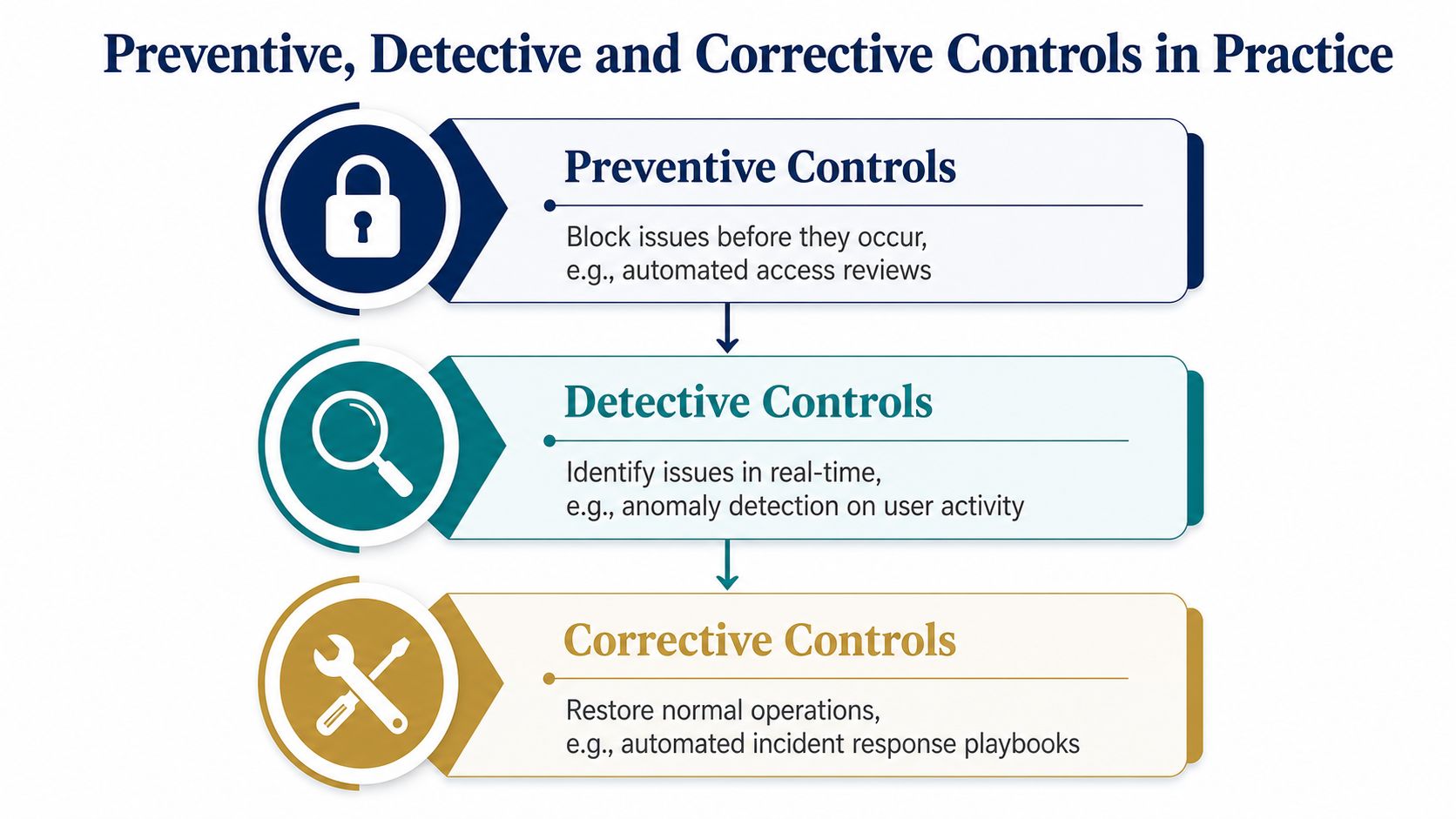
How each control type works in an ITSM workflow
Preventive controls answer, “How do we stop the issue before it reaches the business?”
Examples include:
Change approval gates: ServiceNow, HaloITSM or Freshservice can require risk classification and approval before a change moves to implementation.
Access provisioning rules: Identity requests can be matched to role criteria and routed for segregation-of-duties review.
Supplier onboarding checks: Procurement workflows can require due diligence and risk acceptance before a third party receives access.
The evidence should show the request, risk assessment, approval path, timestamps and implementation result. A policy stating that approval is required isn't evidence that approval happened.
Detective controls answer, “How will we know that the control environment has drifted?”
Examples include:
Access reconciliation: Compare active accounts with HR and identity records.
Segregation-of-duties scans: Identify incompatible permissions across finance, procurement or administration.
Configuration monitoring: Compare infrastructure or endpoint states against approved baselines.
Log review: Reconcile security or operational events with incident and change records.
Detection works only when the organisation defines who reviews the alert, how quickly they must respond and what counts as a false positive. An unassigned alert queue isn't a functioning detective control.
Corrective controls answer, “What happens after a failure is confirmed?”
A corrective workflow may open a ticket, assign an accountable owner, set a due date, record the root cause, attach the resolution evidence and require a re-test. For a serious access violation, the response could include immediate access removal, management notification and a review of related activity.
Practical rule: A control without a defined response to failure is only a monitoring activity. It doesn't complete the risk-management loop.
GRC control types compared
Control Type | Question It Answers | ITSM Example | Evidence Produced |
|---|---|---|---|
Preventive | How do we stop the issue? | Approval gate before a high-risk change | Request, approvals, risk assessment and implementation record |
Detective | How do we identify a failure? | Automated access reconciliation | Scan output, exception list, reviewer decision and timestamp |
Corrective | How do we restore control? | Remediation ticket and configuration rollback | Root cause, assigned action, closure proof and re-test result |
No single category is sufficient. The DFSA cyber risk management guidance describes a framework proportionate to the size, nature and complexity of the business. That expectation favours calibrated layers rather than a blanket control stack copied from a larger institution.
Mapping One Control Across ISO, NIST, SOC and GDPR
The expensive mistake is creating a separate test, owner and evidence request for every framework. A mature programme defines one control objective, then maps it to the obligations that control helps satisfy.
Take privileged access review. The objective is to ensure elevated access remains authorised, appropriate to the user's role and removed when the business need ends. One operating process can support ISO 27001 access control requirements, relevant NIST control families, SOC 2 logical access criteria and GDPR Article 32 expectations around appropriate security of processing.
That doesn't mean the frameworks are identical. It means the organisation should avoid repeating the same operational activity just because different assessors use different language.
A practical common-control method
Start with the control objective, not the framework wording. Then record the operating procedure, accountable owner, frequency, population in scope, evidence source, test method and exception process.
A common control record might contain:
Objective: Prevent unauthorised or excessive privileged access.
Owner: Identity and access management lead.
Population: Privileged accounts in production and corporate environments.
Evidence: Identity export, manager certification, exception approvals and closure records.
Test: Confirm the population is complete, approvals are valid and removals occurred within the defined process.
Mappings: ISO 27001, NIST, SOC 2 and GDPR security expectations.
The UAE Information Assurance Standard V2 gives this approach a useful regional anchor. It contains 15 families, 47 sub-families, 134 controls and 449 sub-controls, with 70 Always Applicable controls and 64 risk-based controls, as described in the UAE Information Assurance Standard V2 analysis. The structure requires scoping discipline. Each asset and process should be mapped to the applicable sub-family, then classified according to whether the control is always applicable or risk-based.
The standard is also integrated with the National Cyber Risk Management Framework 2025, which makes traceability important. Evidence should connect the asset, process, control, test and remediation record. Otherwise, teams collect documents without demonstrating how the control reduces a specific risk.
For broader governance design, organisations can also use resources on how to build a governance strategy with examples. The practical destination is a reusable control library, not a collection of disconnected compliance binders. A well-designed GRC audit process should let one test support several attestations while preserving each framework's scope and evidence requirements.
The GRC Control Lifecycle From Design to Remediation
A control lifecycle is a connected loop. Design determines what should happen, implementation puts the activity into operational systems, operation generates evidence, monitoring identifies drift and remediation closes the gap.
The UAE requirement for a documented, Board-approved internal control system supported by accurate information systems makes this lifecycle tangible. A control that exists only in a policy document hasn't been implemented, and a control that was implemented but never tested can't support a reliable assertion.
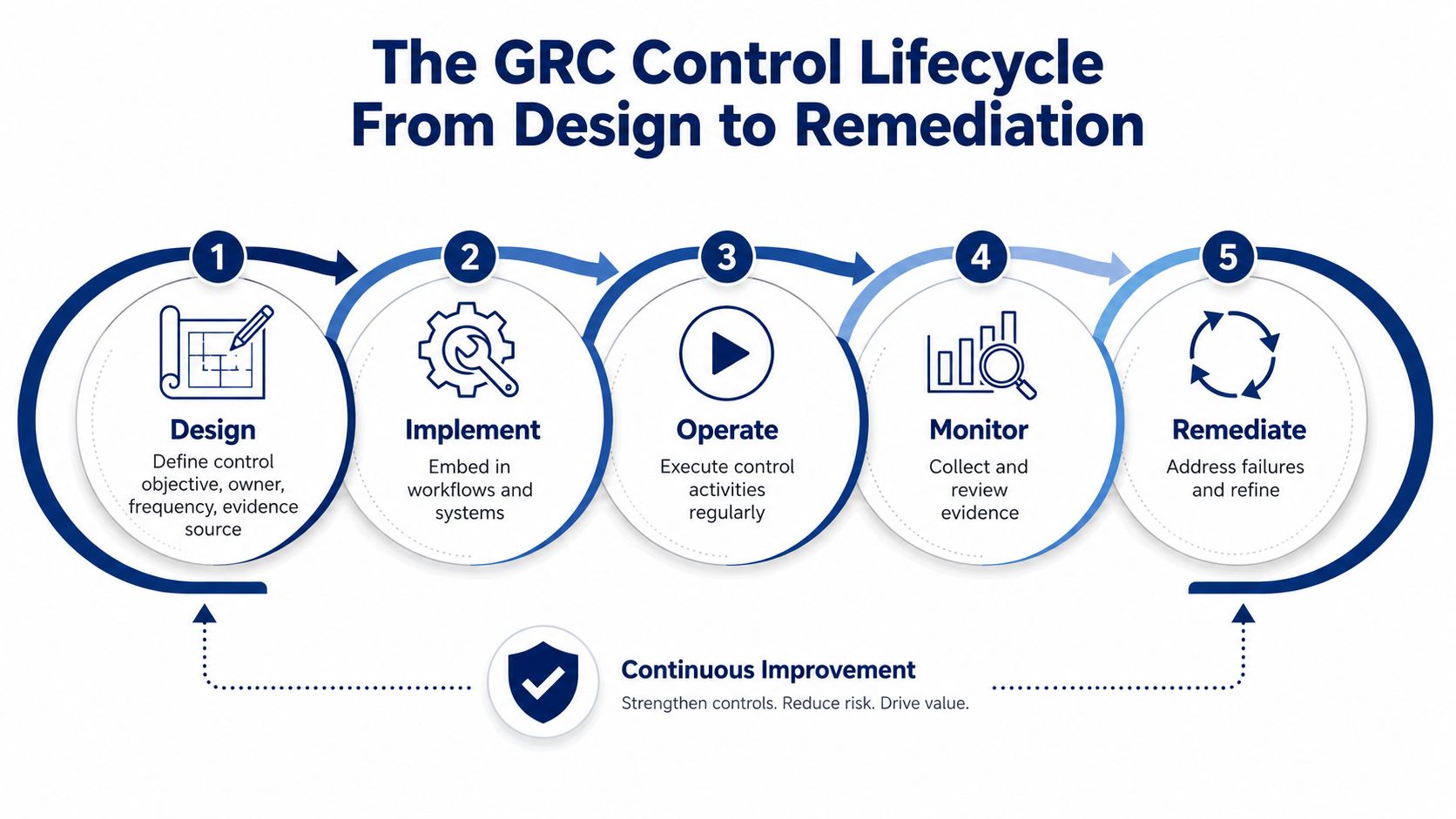
Design
Define the control objective in one sentence. Identify the accountable owner, supporting roles, frequency, population, trigger, evidence source and failure threshold.
A strong design is testable. “Review access regularly” is weak. “The access owner reviews the complete privileged-account population, records approval or removal decisions and escalates unresolved exceptions through the remediation workflow” gives an auditor something to test.
Design output: Control statement, owner, scope, frequency, procedure, evidence specification and test criteria.
Implement
Embed the control in the tools employees already use. A change gate belongs in the change workflow. An access review needs identity and HR data. A configuration control needs a reliable asset or CMDB population. A policy PDF can explain the requirement, but it can't enforce the operating step.
Implementation output: Workflow configuration, integrations, role assignments, notification rules and approval paths.
Operate
The control owner performs the activity according to the defined trigger or schedule. The platform should capture the action as it happens, rather than requiring the owner to recreate it later for audit.
Operating output: Completed review, approval, scan result, ticket, system record or exception decision.
Monitor
Monitoring checks whether the control continues to work and whether its population, owner, process or evidence source has changed. Continuous monitoring is valuable where source data is available, but periodic testing can remain appropriate for controls that depend on judgement.
Monitoring output: Pass or fail result, exception record, trend information and evidence lineage.
Remediate
Remediation is where many programmes lose credibility. Teams record a finding, assign it to a shared mailbox and later mark it closed without documenting root cause, compensating controls or re-test evidence.
A reliable remediation workflow records:
The failed control and affected population.
The risk and business impact.
The accountable owner and due date.
The immediate containment or compensating control.
The permanent corrective action.
Closure evidence and independent re-test.
A closed ticket isn't proof of remediation. The re-test is what demonstrates that the control now operates as intended.
The GRC process guidance from DataLunix reflects this operational emphasis. The lifecycle should return to design when recurring failures show that the control objective, procedure or system integration needs revision.
Metrics and Reporting That Prove Control Effectiveness
Running controls and proving they work are different management tasks. A dashboard showing that policies were published or training was assigned may demonstrate activity, but it doesn't establish control effectiveness.
Boards need a concise view of exposure, trend and accountability. Auditors need evidence lineage. Control owners need actionable exceptions, not a red status with no explanation.
Metrics that deserve management attention
Use measures that connect activity to risk:
Pass and fail results by owner: Shows where control performance is stable and where accountability needs intervention.
Failed-control remediation time: Measures how long material exceptions remain open.
Automated evidence coverage: Shows how much evidence comes directly from trusted systems rather than manual uploads.
Exception age: Highlights accepted or unresolved exposure that is becoming stale.
Repeat-failure trends: Separates isolated mistakes from a weak process or recurring system condition.
Population completeness: Tests whether the control examined the full set of relevant users, assets, suppliers or transactions.
Don't treat these as universal thresholds. The DFSA expectation that cyber risk management be proportionate to business size, nature and complexity means your KRIs should reflect the organisation's profile. A bank, a service provider and a smaller operating company won't need identical control depth or escalation rules.
Reporting for executives and auditors
A one-page Board view should contain the current control-health position, meaningful trend indicators, material exceptions, overdue remediation and decisions requiring management attention. It should also distinguish between a failed control, an accepted risk, a control not applicable to the assessed scope and an evidence collection problem.
The auditor view needs more depth. Each result should trace to the control version, population, evidence source, performer, reviewer, exception, remediation and re-test. If the evidence comes from ServiceNow, an identity platform or a CMDB, the report should preserve the source record and extraction context.
Operational teams may review control exceptions monthly, while Boards can receive a quarterly summary aligned to governance cycles. The precise cadence should match risk and regulatory expectations, not an arbitrary calendar.
The UAE's direction makes reporting discipline urgent. The SCA amended Article 14 of its Corporate Governance Guide in 2024 to require a COSO-aligned internal control and risk management framework. A 2025 circular introduced a two-phase ICFR timeline, with FY2024 management self-assessment and non-public auditor review, followed by FY2025 public auditor opinion on internal control and risk management effectiveness, according to this account of the UAE's control-attestation development.
Tooling and Automation Across ServiceNow, Halo, Freshservice and ManageEngine
The platform should serve the control model, not dictate it. ServiceNow, HaloITSM, Freshservice and ManageEngine can all support operational evidence, but they fit different environments and integration patterns.
Platform | Practical strength | Where controls commonly operate | Suitable context |
|---|---|---|---|
ServiceNow | Deep enterprise workflow and governance integration | Change, asset, risk, audit and remediation workflows | Large, complex enterprises with extensive integration needs |
HaloITSM or HaloPSA | Flexible service workflows and PSA alignment | Approvals, service requests, supplier activities and exceptions | Service providers and organisations wanting adaptable workflows |
Freshservice | Accessible ITSM workflows | Change, service request, asset and ticket-based evidence | Mid-market teams prioritising simpler administration |
ManageEngine | Asset and operations orientation | ServiceDesk Plus, monitoring, configuration and operational remediation | IT-centric environments with strong asset-management needs |
The important question isn't which logo appears on the contract. It's where the control is executed. Access certification should connect to identity data. Change controls should connect to the change record and affected configuration item. Supplier controls should connect procurement, risk assessment and service ownership. Remediation should use SLA-backed tickets with escalation and re-test fields.
What automation should actually do
Automated evidence collection can retrieve approvals, scan results, asset populations and ticket histories from source systems. Ticket-driven remediation can assign findings to the team that can fix them, rather than to a central GRC mailbox. AI-assisted triage can help group duplicate exceptions, identify likely owners and prioritise records for human review.
Automation doesn't remove accountability. A machine-generated pass can be wrong if the population is incomplete, the integration is stale or the control logic doesn't match the risk. Keep approval, risk acceptance and final closure decisions with accountable people.
DataLunix implements GRC consulting and platform services across ServiceNow, HaloITSM, Freshservice and ManageEngine, including control mapping into a central operational environment. Its delivery model can include discovery, fit-gap assessment, implementation, enablement and managed optimisation. The DataLunix GRC tools overview provides related platform context.
With only 19% of organisations reporting fully integrated GRC systems, integration is a more important selection criterion than feature volume. Choose ServiceNow when enterprise governance and integration depth dominate. Consider Halo when flexible service workflows or PSA alignment matters. Choose Freshservice where administrative simplicity is the priority. Consider ManageEngine when asset and IT operations data provide the strongest control foundation.
Implementation Best Practices for GCC and European Enterprises
UAE-listed companies should treat ICFR as an operating-model change, not a year-end documentation project. The SCA's first trial phase has been extended to 31 December 2026, public internal control reporting starts 1 January 2027, and risk management enters the assessment scope from 2028, according to the UAE ICFR transition update.
Practically, the sequence moves from management self-assessment to external auditor involvement and then public disclosure. “Good enough” evidence means the control has a clear objective, named owner, defined population, repeatable operation, retained evidence, documented exceptions and credible re-testing. Board reporting should show unresolved exposure and management decisions, not just a catalogue of completed activities.
European enterprises add another layer of scoping. GDPR-related controls need to reflect security of processing, access governance, incident handling and third-party arrangements, while the same control library may also support other obligations across jurisdictions. The answer isn't to create a new workflow for every country. It is to define a common control, document local variations and maintain traceable applicability decisions.
A practical adoption sequence
Run a discovery workshop. Inventory existing controls, systems, owners, evidence sources and open findings. Include audit, risk, security, procurement, finance and IT operations.
Scope by risk criticality. Use the UAE IA Standard V2 distinction between Always Applicable and risk-based controls. Map assets, services and processes before selecting test depth.
Create a common control library. Write one testable objective, then map it to COSO, ISO, NIST, SOC 2, GDPR and applicable UAE requirements.
Integrate the operating systems. Connect the control record to ITSM workflows, CMDB data, identity sources, procurement records and monitoring platforms.
Automate evidence and exceptions. Collect source evidence where possible, open remediation tickets automatically and preserve the link between failure and corrective action.
Enable control owners. Train owners on what the control requires, what evidence is acceptable and how exceptions must be handled.
Review and refine. Use recurring failures, stale evidence and population gaps to improve design rather than increasing the number of controls.
This approach challenges the assumption that compliance maturity always requires more headcount. Centralised controls and automated evidence can reduce duplicate requests across audit, security, procurement and risk teams, but only if the organisation first rationalises ownership and data.
The IT GRC implementation perspective from DataLunix is relevant for organisations connecting governance requirements to daily IT operations. GCC-based leadership, regional delivery capability, platform partnerships and managed optimisation can help translate the regulatory timetable into a working control environment.
Frequently Asked Questions About GRC Control
What is a GRC control?
A GRC control is a measurable preventive, detective or corrective activity that reduces a governance, risk or compliance exposure. It should have an objective, owner, scope, operating procedure, evidence source and test method.
How is a control different from a GRC framework?
A framework organises requirements, responsibilities and processes. A control is the specific activity that operates within that framework and produces evidence of performance.
What evidence does an auditor expect for a GRC control?
Auditors typically need evidence showing the control population, performance, approval or review, exceptions, remediation and re-test. A policy alone usually doesn't prove that the control operated.
Should every framework have separate controls?
Not necessarily. A common control library can map one operating control to multiple frameworks, provided local scope, test requirements and evidence differences remain documented.
Why is the UAE ICFR timeline important?
The UAE is moving towards public internal control reporting from 1 January 2027, with risk management added to the assessment scope from 2028. Listed companies therefore need operational evidence and Board reporting, not only policy documentation.
DataLunix helps GCC and European enterprises design common control libraries, map them to UAE and international requirements, and operationalise evidence and remediation across ServiceNow, HaloITSM, Freshservice and ManageEngine. Visit DataLunix to arrange a discovery workshop and turn your GRC control programme into an audit-ready operating model.