
GRC Google: Enterprise Compliance in the GCC

You're reviewing Google Cloud compliance documents for a UAE workload, while your legal team is asking where data will be stored, your security team wants incident evidence in ServiceNow, and the auditor wants controls mapped to local obligations. The practical answer is that GRC Google isn't a standalone product. It's the operating model you build around Google Cloud, Google Workspace, regional rules, provider evidence and your own ITSM processes.
For GCC enterprises, the difficult decision isn't whether Google publishes compliance information. It does. The difficult decision is whether that evidence, deployed in the right region and connected to accountable workflows, satisfies your organisation's regulatory and risk requirements.
What GRC Google Actually Means for GCC Enterprises
A CIO searching for GRC Google is usually trying to answer three questions:
Can Google Cloud support a regulated workload?
Which controls are provided by Google, and which must the customer implement?
Can the organisation prove compliance through repeatable evidence?
A UAE technology director might begin with Google Cloud's compliance documentation, then discover that global mappings don't settle questions about residency, retention, incident notification or local risk acceptance. That's where the evaluation changes from procurement to governance. GRC is a framework you implement, not a product label you can just switch on.
Google Cloud's compliance programme provides mappings of security, privacy and compliance controls to global standards, alongside tooling such as Compliance Manager for defining and deploying compliant configurations. The Google Cloud compliance programme is therefore a useful evidence and configuration foundation, but it doesn't replace your control ownership model.
The control boundary matters
Google manages parts of the underlying cloud service. Your organisation still decides how identities are approved, which data can be processed in a region, how long records are retained, how exceptions are accepted and how incidents reach regulators or customers.
That distinction is often missed in high-level assessments. A provider attestation may demonstrate that Google operates certain controls. It doesn't automatically demonstrate that your team configured Cloud IAM correctly, restricted administrative access, documented data flows or retained evidence in a form your auditor can review.
Practical rule: Treat every Google compliance mapping as an input to your control register, not as the completed control register.
For GCC and European enterprises, the best starting point is a shared responsibility matrix that names the provider, customer, system owner and evidence source for each requirement. Your governance model should also cover Google Workspace where business records, communications and user activity create a separate control surface. A useful foundation for terminology and ownership is this guide to governance, risk and compliance.
Core GRC Concepts in the Google Ecosystem
The Google ecosystem supports GRC through several connected capabilities. The value comes from assigning each capability to a specific governance, risk or compliance outcome.
Governance needs ownership and visibility
Governance answers who can do what, under which policy, and with whose approval. In Google Cloud, Cloud IAM is central to that work. You can structure roles around least privilege, separate administrative duties and make access requests traceable. Cloud Asset Inventory helps teams maintain visibility of resources, configurations and relationships across the environment.
Google Workspace adds governance questions around sharing, administrator privileges, retention and user lifecycle management. A sound design connects joiner, mover and leaver processes to identity controls rather than leaving access reviews as an isolated compliance exercise.
Risk management needs current evidence
Risk management depends on knowing what exists, how it's configured and what could affect the business. Security Command Center can support risk monitoring across cloud resources, while Cloud Audit Logs provide records that security teams can use to investigate activity and validate administrative actions.
The operational question is not whether a dashboard exists. It's whether the right owner receives a finding, assesses its business impact, records a decision and tracks remediation to closure.
A useful control record should include:
Control objective: The outcome the organisation must achieve.
Google capability: The service or configuration supporting that outcome.
Owner: The person accountable for operation and review.
Evidence: The log, report, ticket or approval proving performance.
Exception path: The process for risk acceptance and expiry.
Compliance turns configurations into proof
Compliance teams need more than enabled settings. They need evidence that controls operate consistently and that exceptions receive documented treatment. Google Cloud's Compliance Manager can help define and deploy compliant configurations, but your team must still validate the scope, interpret local requirements and preserve approval records.
For example, a Cloud IAM policy may support an access-control requirement, while Cloud Audit Logs demonstrate activity. An ITSM record can then show who requested access, who approved it, when it was granted and whether it was removed. That chain is stronger than a screenshot of a configuration page because it connects technical state to business accountability.
Mapping Google Controls to GCC Regulatory Frameworks
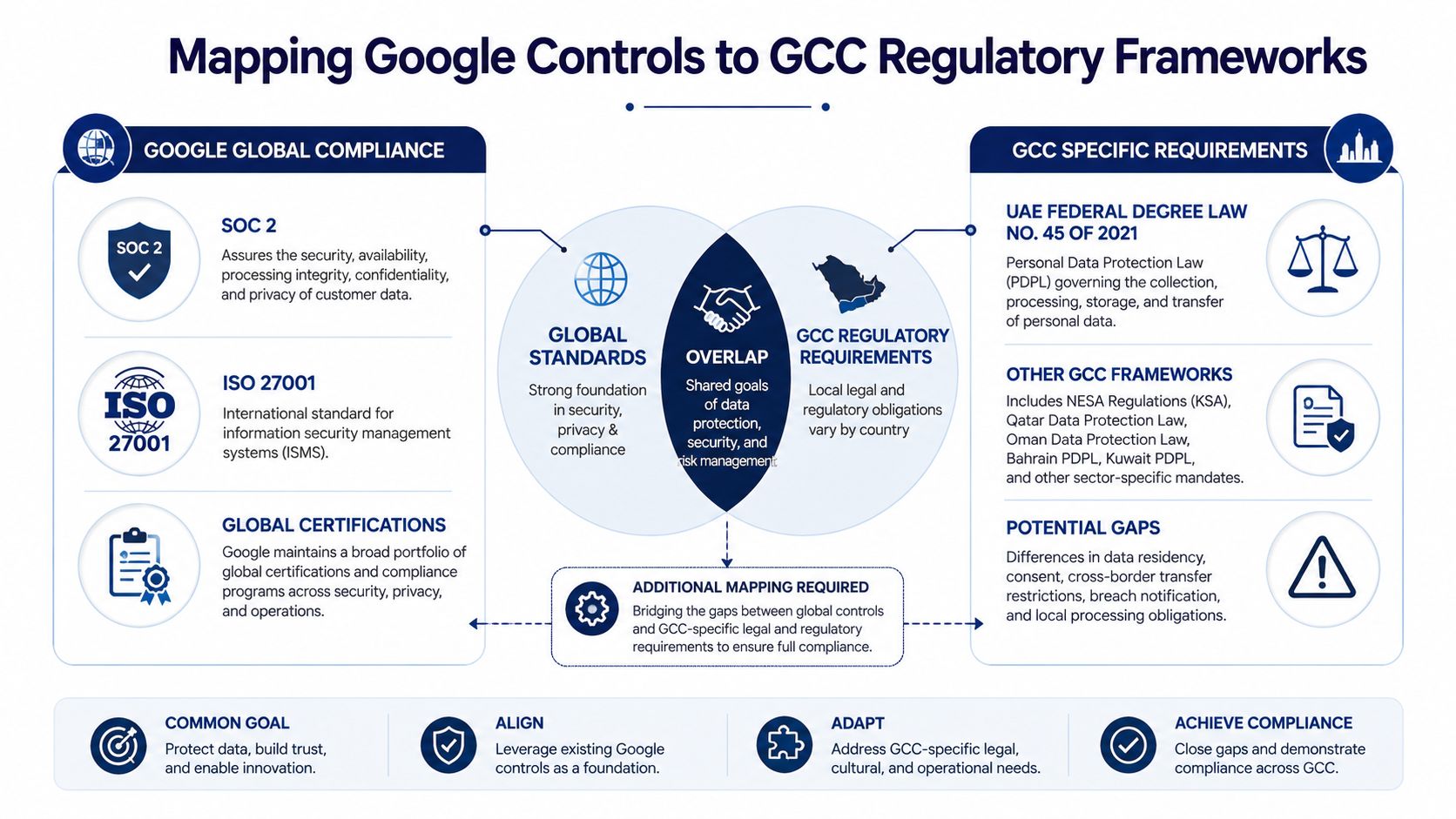
Global compliance evidence and local regulatory compliance answer different questions. Google's mappings can show alignment to recognised standards, while your organisation must determine whether that alignment satisfies UAE, Qatar, Saudi or European obligations for the specific workload.
The UAE enacted Federal Decree Law No. 45/2021 on the Protection of Personal Data on January 2, 2022. The UAE also consulted over 30 major technology companies, including Google, Microsoft and Amazon, while shaping cross-border data protection and citizen data rights, as described in Google's Middle East telecommunications regulations overview.
Use a control-by-control method
Start with the obligation, not the product. For each requirement, document:
Mapping question | Evidence to capture |
|---|---|
What must be protected? | Data classification, processing purpose and affected systems |
Where may processing occur? | Approved regions, transfer conditions and residency decision |
Who may access it? | IAM roles, privileged access approvals and review records |
How is activity proved? | Audit logs, monitoring records and ticket references |
What happens during an incident? | Notification workflow, escalation owner and communications record |
Qatar's National Information Assurance framework appears among Google Cloud's supported attestations and standards. That signals a wider regional buying pattern. GCC customers increasingly assess cloud providers against national assurance regimes rather than accepting broad claims about global compliance.
Saudi and UAE requirements can still produce different implementation decisions even when the underlying Google control appears similar. A retention policy, for example, may be technically available but unsuitable if the organisation hasn't documented the legal basis, data location, business owner and deletion evidence.
Don't confuse mapping with certification
A mapping can identify correspondence between a Google control and an internal requirement. It doesn't prove that your deployment meets the requirement. Your compliance file should record inherited controls, customer controls, compensating controls and unresolved gaps.
For UAE deployments, connect the mapping to information-governance policy, risk treatment and third-party oversight. The result should be auditable by a reviewer who wasn't involved in the original architecture decision. For a broader operating model, organisations can also review government risk and compliance practices.
Data Residency and Regional Cloud Footprint Challenges
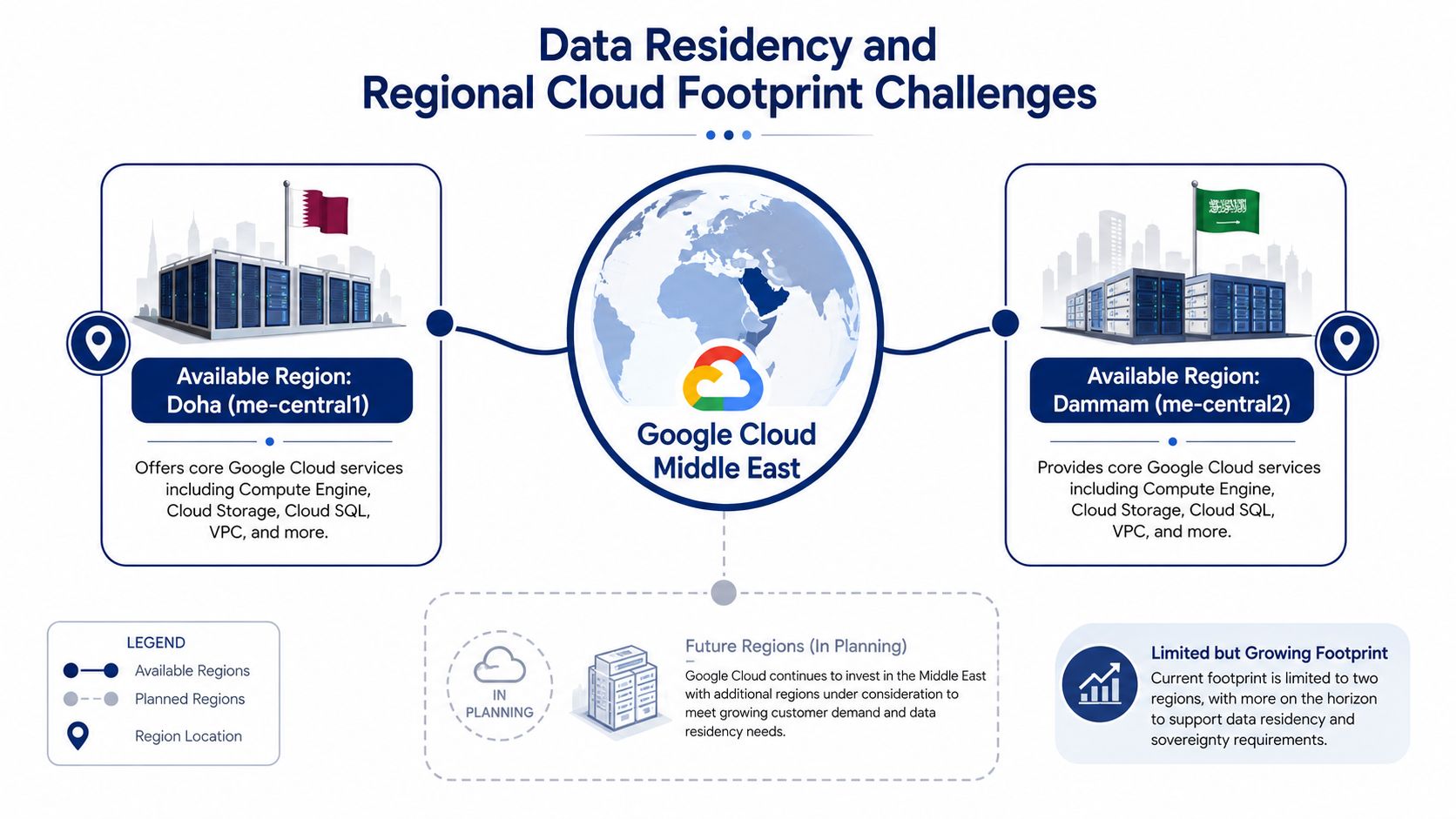
The Middle East Google Cloud footprint creates a practical architectural constraint. Google documents Doha, , and Dammam, , for compute, while sovereign controls by partners are listed for in Saudi Arabia, not the UAE, according to Google Cloud's regional zones and locations documentation.
That means “Google GRC” isn't a single stack you can deploy identically across the GCC. Product availability, region selection, sovereignty arrangements and service dependencies all affect the control design.
Compare the deployment choices
Decision | Doha | Dammam | UAE-based requirement |
|---|---|---|---|
Regional compute option | Documented as | Documented as | Requires a documented residency assessment |
Sovereign partner controls | Not identified in the stated regional listing | Listed for Saudi Arabia | Must not be assumed |
Governance implication | Cross-border processing may need review | Sovereignty model needs verification | In-country storage cannot be presumed |
GRC workload question | Which services are available? | Which controls are supported? | Which data may leave the UAE? |
A UAE enterprise should classify workloads before choosing a region. Identity metadata, security findings, audit records, personal data and business content may have different residency and retention expectations. You also need to check each required Google service, because regional product status can vary. A workload may be technically deployable while a supporting logging, security or analytics service follows a different regional model.
Build the residency decision into change control
Residency shouldn't live only in the architecture document. Put it into your change process. A new service, backup destination, integration or support workflow should trigger a review of data flows and sovereignty assumptions.
GRC and compliance solutions can support a repeatable assessment process, provided the solution captures decisions and evidence rather than merely displaying policy text.
Architecture principle: A nearby region is not automatically an approved region. The decision depends on the data, service, sovereignty model and documented risk treatment.
Integrating Google GRC Controls with ITSM Platforms
Cloud controls become operationally useful when they create accountable work. A Security Command Center finding that never becomes an assigned remediation task is visibility without governance. An audit log that sits in storage without a linked approval or incident record is evidence that may be difficult to explain during an audit.
Route technical signals into business workflows
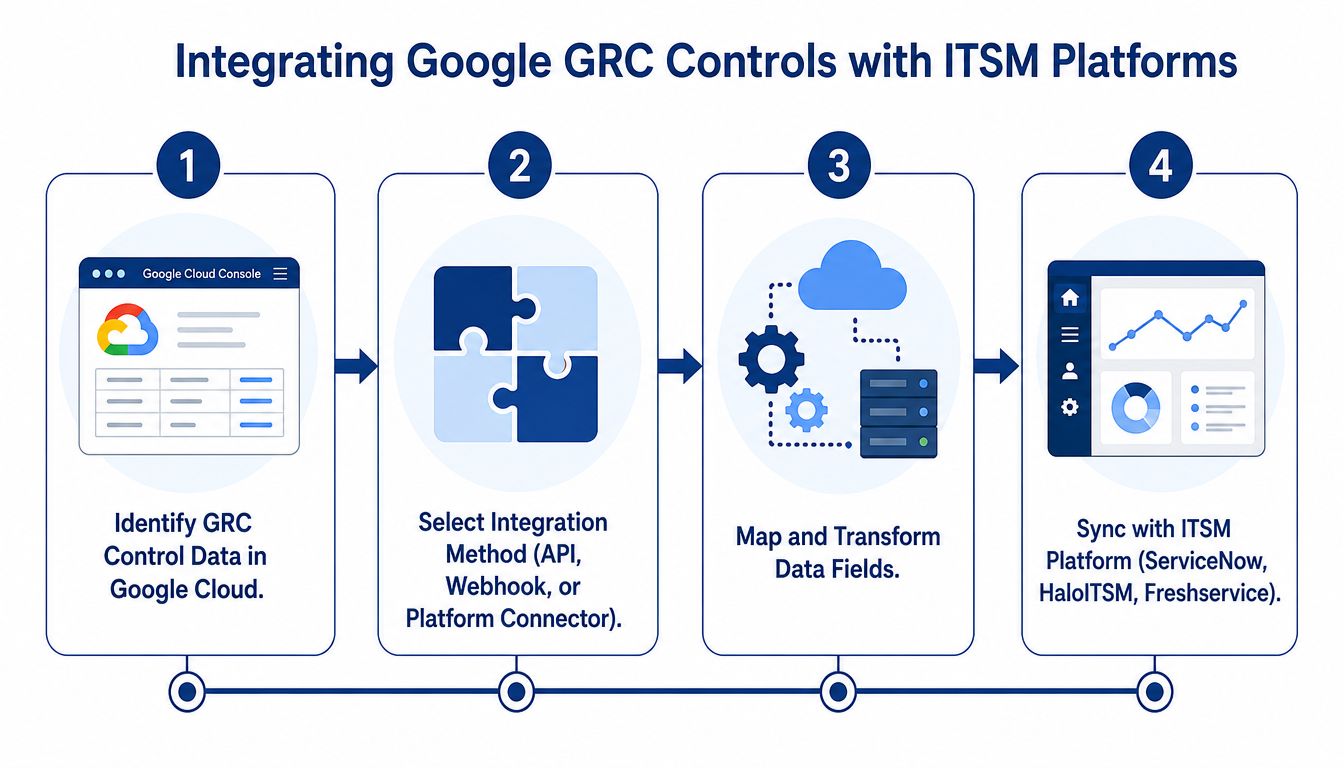
A practical integration begins by deciding which Google events require human action. Typical patterns include:
Security findings to ServiceNow: Create an incident or security task with the affected asset, severity, detection time, owner and remediation target.
Workspace audit activity to HaloITSM: Associate administrative events with review records and compliance cases.
IAM requests through Freshservice: Send access requests through approval workflows, then retain the decision and implementation evidence.
Cloud changes to change management: Require review when a deployment alters region, retention, encryption, privileged access or logging.
The integration should preserve the original event identifier, source timestamp and asset reference. Avoid copying only a summary into the ITSM platform. Keep enough context for an investigator to trace the record back to Google Cloud.
Make the ITSM platform the accountability layer
Google Cloud remains the source of technical state. The ITSM platform can become the system of record for ownership, approvals, exceptions, remediation and communications. This division works better than forcing one platform to perform every function.
Use APIs, webhooks or supported platform connectors to move structured events. Normalise fields such as control ID, asset, environment, data classification, risk rating, owner and due date. Then define workflow rules for escalation, evidence requests and closure validation.
For teams standardising ServiceNow workflows, the GRC in ServiceNow implementation approach is relevant because it treats control mapping, risk records and operational workflows as connected design decisions. DataLunix can also work across ServiceNow, HaloITSM and Freshservice, using discovery, integration mapping and workflow design to connect technical evidence to operational records.
Validate closure, don't just automate creation
Automation can open a ticket quickly. It can't decide whether the residual risk is acceptable without an approved rule and accountable owner. Require the resolver to attach remediation evidence, record validation results and obtain risk acceptance where the control remains incomplete.
Common GRC Gaps and Best Practices for Google Cloud
The most common failure is treating a provider compliance page as proof that the customer's deployment is compliant. That approach ignores configuration, data flows, local obligations, operational ownership and evidence retention.
UAE policy requires cloud users to define information security requirements for retention, processing and storage, perform due diligence on cloud-specific restrictions, include the cloud environment in risk assessments, maintain information-governance policies and ensure cloud-provider incidents are communicated. The UAE Information Assurance Regulation makes cloud adoption a governance activity, not only a technical procurement decision.
Check these gaps before an audit
Residency assumptions: Document where each data class is stored, processed, backed up and accessed.
Inherited-control confusion: Mark which controls Google operates and which your team must configure or evidence.
Incomplete risk assessment: Include cloud services, suppliers, integrations and region-specific constraints in the risk register.
Weak incident routing: Define how provider incidents reach security, legal, privacy and executive owners.
Retention ambiguity: Link technical retention settings to approved information-governance requirements.
Unmanaged exceptions: Give every exception an owner, rationale, expiry or review date and compensating control.
Disconnected evidence: Link logs, approvals, tickets and test results to the same control record.
Country-level enforcement can also appear outside traditional cloud controls. Google's 2026 UAE gambling and games ads policy permits internet gaming and sports wagering advertising only for entities authorised by the GCGRA, showing how UAE-specific regulatory requirements can be embedded directly into Google policy. Security and compliance teams should therefore monitor provider policy changes as part of regulatory change management.
For a broader perspective on turning cloud policies into accountable governance processes, this SpendLens AI cloud governance guide provides useful context. The practical lesson is simple: maintain a change log for provider policies, regional service availability and internal control decisions.
Recommended Engagement Steps for GCC and European Enterprises
GCC enterprises have built strong digital foundations. The IMF reports that the average GCC-to-advanced-economy gap on the Enhanced Digital Access Index narrowed from -0.2 in 2005, equivalent to about 20% of the full EDAI scale, to nearly zero in 2022, with the UAE and Saudi Arabia already outperforming the advanced-economy average, as detailed in the IMF analysis of GCC digitalisation. Mature digital infrastructure raises the standard for governance. It doesn't remove the need for local control mapping.
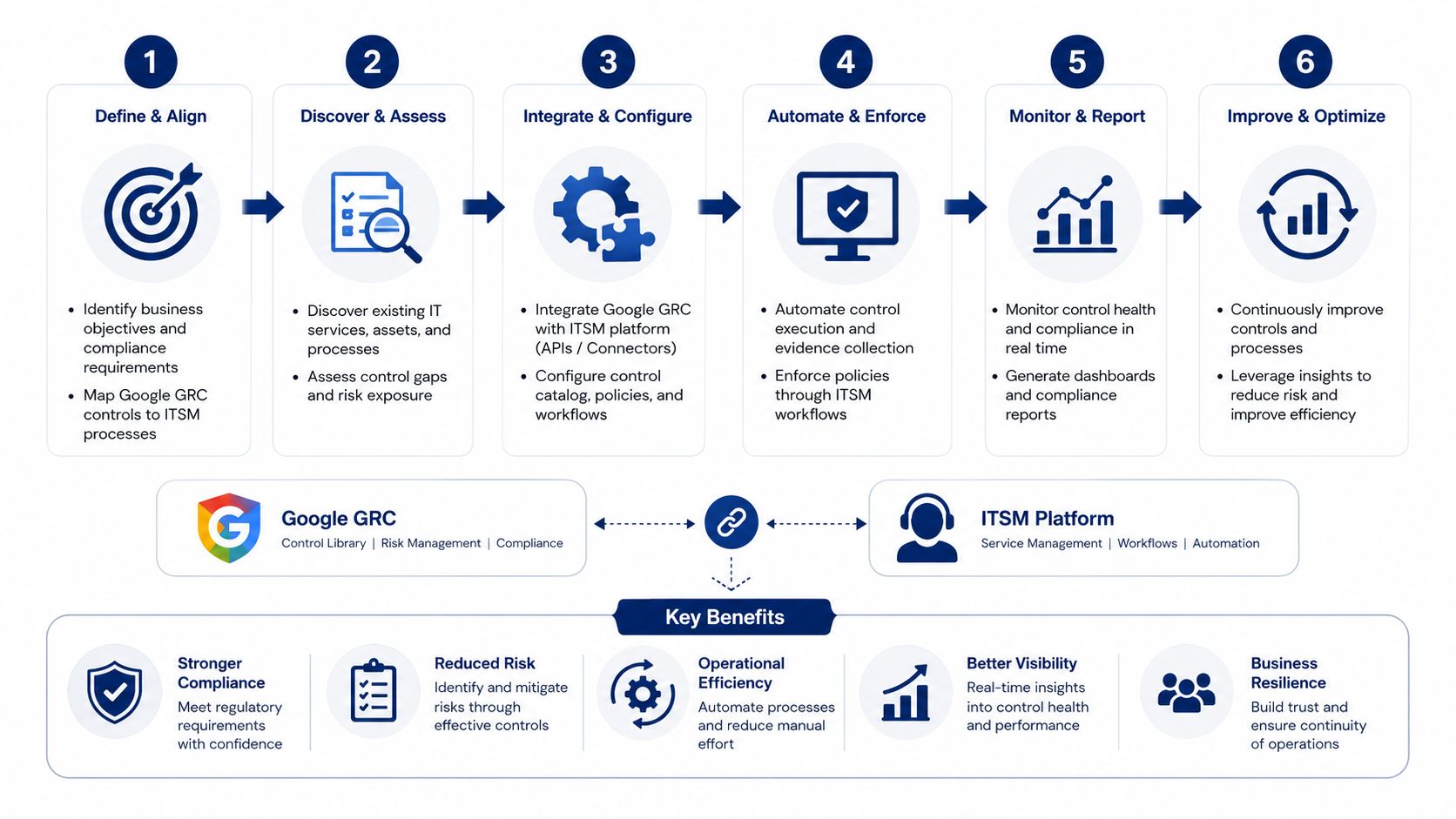
A disciplined engagement usually follows this sequence:
Begin with discovery
Bring the CIO, security, privacy, infrastructure, service management, procurement and business owners into the same discovery workshop. Catalogue Google Cloud and Workspace use, regulated data, current regions, critical integrations, existing ITSM workflows and audit commitments.
The output should be a decision-ready inventory, not a presentation. Identify where the organisation already has evidence and where teams rely on informal approvals, spreadsheets or undocumented assumptions.
Run a fit-gap assessment
Map internal policies and regulatory requirements to Google controls, customer configurations and operational procedures. Assess data residency, privileged access, logging, retention, incident response, third-party risk and control testing separately.
For each gap, choose a treatment:
configure a Google capability;
add an ITSM workflow or monitoring control;
introduce a compensating control;
restrict the workload or service;
accept the risk through formal governance.
Connect the programme to the wider digital transformation services roadmap so compliance work supports operating-model change rather than becoming a parallel project.
Implement and enable users
Design the target control model, integrate Google events with ServiceNow, HaloITSM or Freshservice, and test evidence retrieval before formal audit activity begins. Change management matters because access approvals, incident routing and evidence ownership affect daily work across IT and business teams.
A delivery partner can provide onshore leadership, offshore execution or a hybrid model through UAE-based leadership and India delivery centres. DataLunix offers discovery workshops, fit-gap analysis, Google and ITSM workflow design, managed optimisation, upgrades, outsourced operations and staff augmentation through a 200k+ certified talent pool. Select the model that matches your internal capacity and data-handling requirements.
Operate the controls continuously
After implementation, review regional product availability, provider policies, access assignments, incident workflows, evidence quality and open exceptions. A managed service can maintain the control library and integrations, while internal owners retain accountability for risk decisions.
European enterprises operating across the GCC should use the same approach, but add transfer assessments, European privacy obligations and group-wide policy requirements to the mapping. The architecture should reflect the strictest applicable obligation for each workload, not a generic regional assumption.
DataLunix helps GCC and European enterprises map Google Cloud controls to local requirements, connect security evidence with ServiceNow, HaloITSM and Freshservice, and build auditable GRC workflows around residency, access, retention and incidents. Visit DataLunix to arrange a discovery workshop and turn your GRC Google assessment into an implementable control and ITSM roadmap.