


GRC Management System: A Complete Guide for 2026

A GRC management system turns regulations, risks, controls, evidence and accountability into one operating process. That matters in the UAE, where 67% of enterprises experienced at least one significant cybersecurity incident in the prior 24 months, according to a 2025 UAE enterprise risk benchmark. The practical challenge isn't choosing a framework. It's keeping controls current, assigning ownership and proving compliance as local requirements change.
The Growing Importance of GRC Management Systems in the Middle East
The Middle East and Africa enterprise GRC market remains a relatively small share of global demand, but its direction is clear. One forecast places MEA at 4.8% of the global enterprise GRC market, valued at USD 1.04 billion in 2025, with projected growth at a 13.1% CAGR through the forecast period. The same MEA and global GRC market forecast projects the worldwide market to reach USD 38.93 billion by 2033, from USD 16.28 billion in 2022.
For UAE organisations, the significance isn't the market share alone. The UAE is one of the region's main adoption hubs alongside Saudi Arabia, supported by digital transformation, cybersecurity requirements and regulatory pressure. Financial services, government and technology organisations increasingly need a system that connects regulatory obligations to operational controls, rather than a document repository that reports compliance after the fact.
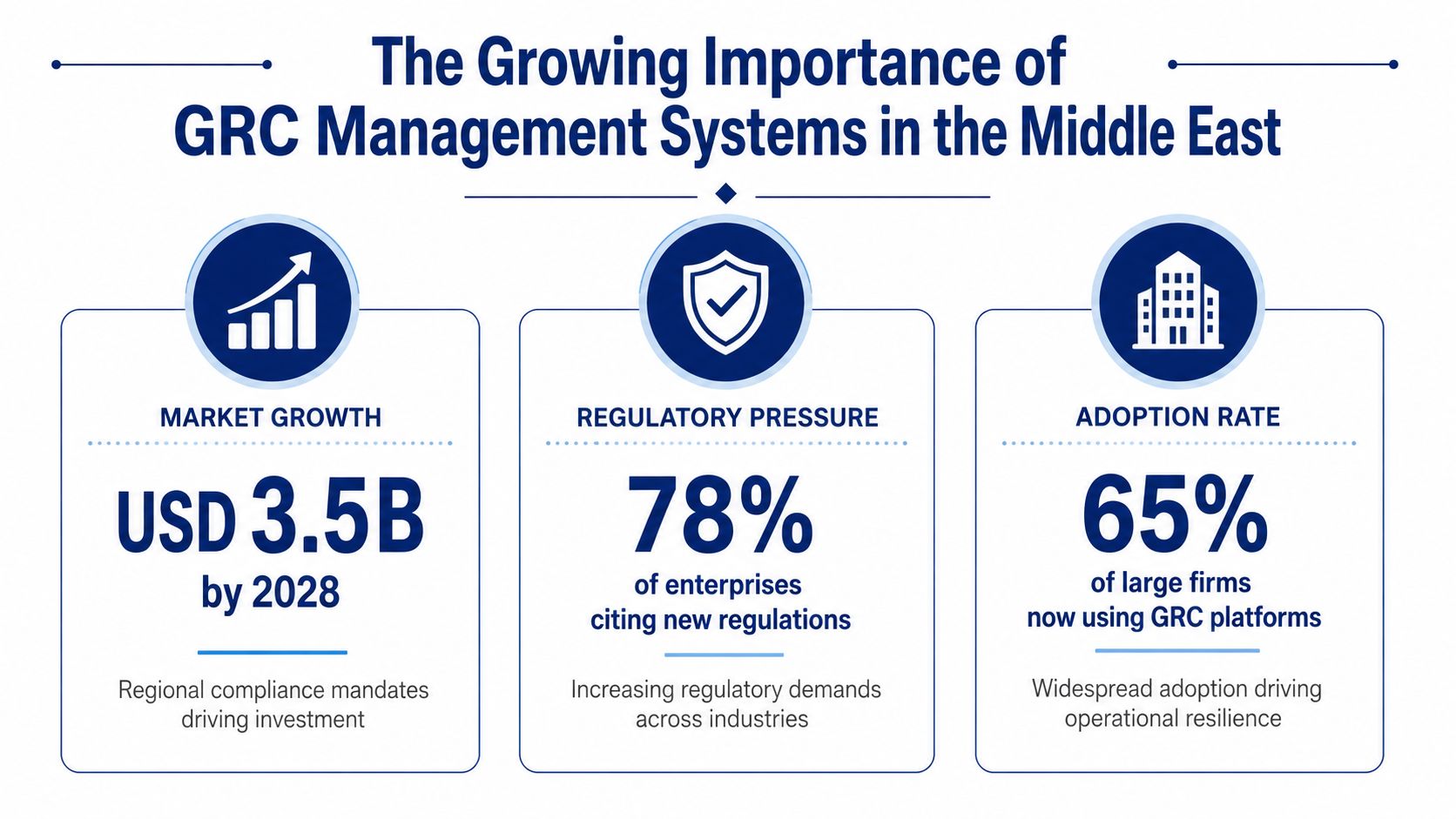
A useful regional benchmark comes from KPMG's UAE risk-management work. Its survey launched in March 2024 and ran through September 2024, collecting over 100 responses across industries and the public sector. In a separate Middle East banking study covering 23 leading banks across the UAE, Saudi Arabia, Oman and Qatar, 61% had adopted structured model risk tiering frameworks and 83% maintained a formal model inventory, as reported in the regional KPMG benchmark.
Those findings point to a shift from fragmented controls to documented, auditable governance. A platform decision now affects board reporting, regulatory assurance, third-party oversight and the speed at which risk owners can respond.
For a deeper view of enterprise operating models, see DataLunix's enterprise GRC perspective. The key question is whether your chosen platform can support continuous compliance in the UAE, not merely whether it contains familiar framework names.
What Is a GRC Management System and Its Core Modules
A GRC management system is an integrated platform for managing governance decisions, organisational risks, regulatory obligations, policies, audits, actions and evidence. Its value comes from the relationships between those objects. A control should connect to the risk it addresses, the requirement that makes it relevant, the owner responsible for operating it and the evidence proving that it worked.
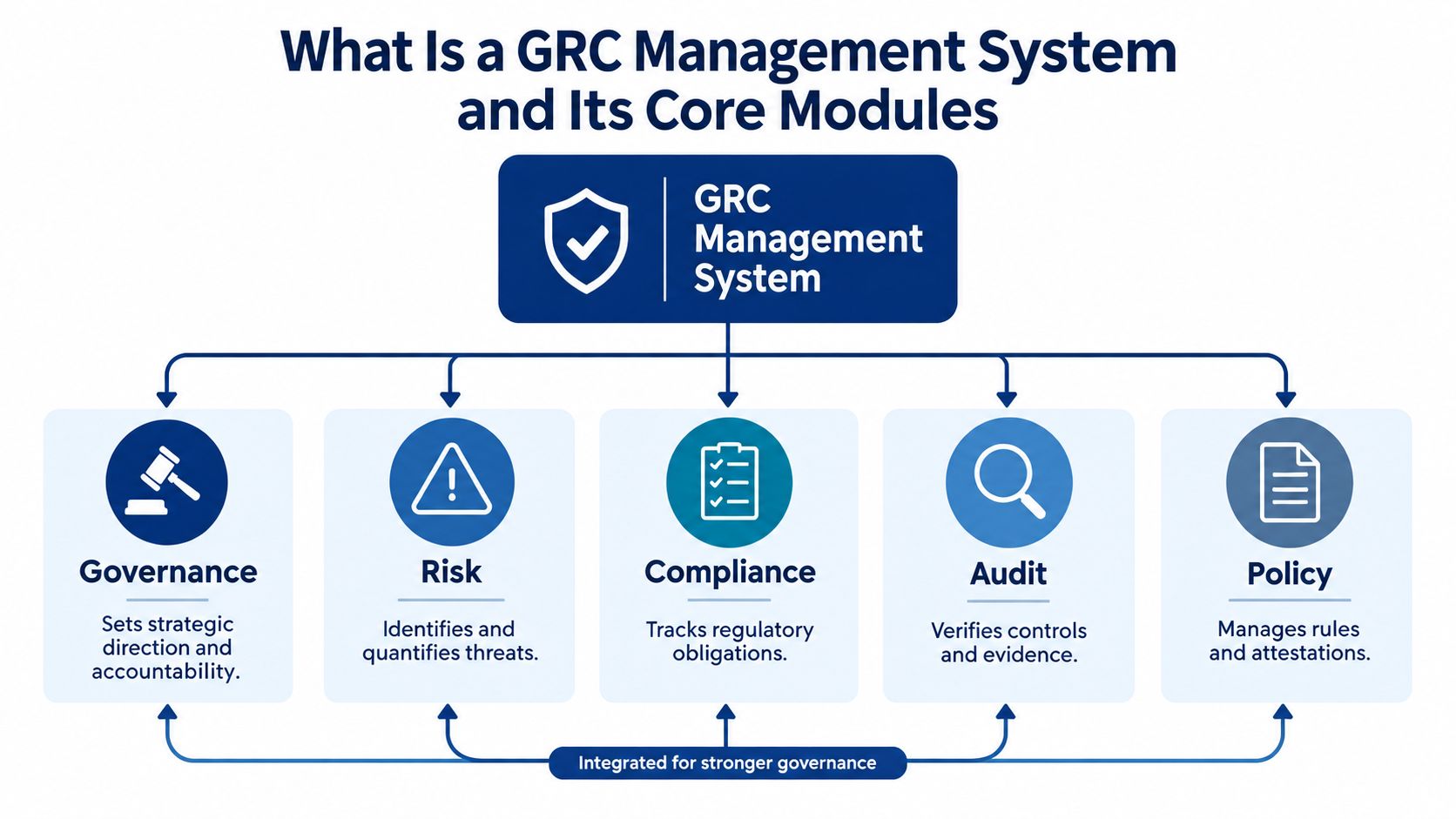
How the five modules work together
Governance defines decision rights, committees, risk appetite, accountability and escalation paths. It should show who approves a policy, who accepts a risk and which issues require board attention.
Risk management records threats, opportunities, inherent exposure, treatment plans and residual risk. In a mature implementation, a cyber risk isn't isolated from the assets, vendors, processes and controls that influence it.
Compliance management translates obligations from laws, regulators, contracts and internal standards into requirements and control objectives. In the UAE, that may include the PDPL, AML/CFT rules and requirements issued by the CBUAE, DFSA, FSRA or VARA.
Audit tests whether controls are designed and operating effectively. It should retain working papers, findings, management responses, remediation actions and evidence in a traceable chain.
Policy management controls drafting, review, approval, publication, attestation and exception handling. A policy that isn't communicated, acknowledged and linked to relevant controls provides weak assurance.
A regulatory change creates or updates a requirement.
The requirement maps to affected policies, risks and controls.
Control owners receive tasks and submit evidence.
Testing identifies exceptions or failures.
Remediation actions are assigned and escalated.
Governance dashboards show exposure, overdue work and residual risk.
This is why a guide to compliance automation is useful alongside platform selection. Automation only works when the underlying ownership, control logic and evidence standards are clear. A system that merely copies a checklist into software won't create operational compliance.
The architecture should also support integrated IT governance, risk and compliance practices. Avoid buying five disconnected modules that force the same risk, vendor or control data to be maintained repeatedly.
Practical rule: If a compliance issue can't be traced to an owner, a control, evidence and a decision, the system is recording activity rather than managing risk.
Integration Patterns with ITSM, ITOM, HRSD, and ITAM
GRC platforms become useful when they connect with the systems where work takes place. A control may require a change record, an incident investigation, an asset owner, a supplier review or employee training. Asking compliance teams to re-enter those facts creates delays and weakens data quality.
Enterprise System | Integration Purpose | Data Flow |
|---|---|---|
ITSM | Connect controls to incidents, changes, requests and remediation | GRC sends control actions and exceptions to ITSM. ITSM returns status, ownership and closure evidence |
ITOM | Relate technology risk to operational health and service dependencies | ITOM provides service maps, alerts, configuration context and availability signals |
HRSD | Manage joiner, mover and leaver controls, training and attestations | HRSD supplies workforce events, role data and completion records |
ITAM | Maintain an authoritative inventory for technology risk | ITAM provides asset ownership, lifecycle state, criticality and vendor relationships |
The strongest pattern is event-driven integration. A failed control test should create an actionable ITSM task, not sit in a GRC queue without operational context. A critical asset change should trigger a risk review when its owner, service relationship or security posture changes.
Batch synchronisation still has a place for reference data, but it needs reconciliation rules. Decide which system is authoritative for each field before building interfaces. For example, ITAM may own asset identity, HRSD may own employment status and GRC may own control status. Without that decision, integrations create duplicate records with conflicting values.
Legal and procurement teams also benefit from structured workflows. For teams assessing AI for in-house legal teams, the same principle applies: legal obligations should connect to business owners, contracts, vendors and evidence rather than remain in email threads.
DataLunix's GRC integration guidance is relevant for organisations aligning ServiceNow, HaloITSM, Freshservice or ManageEngine with governance workflows. The trade-off is straightforward. Deep integration takes design effort, but shallow integration leaves the organisation with another reporting layer.
Implementation Roadmap From Discovery to Adoption
A successful implementation starts with operating reality, not a vendor demonstration. Before configuring workflows, identify how the organisation currently records obligations, assesses risk, tests controls, manages findings and reports to executives.
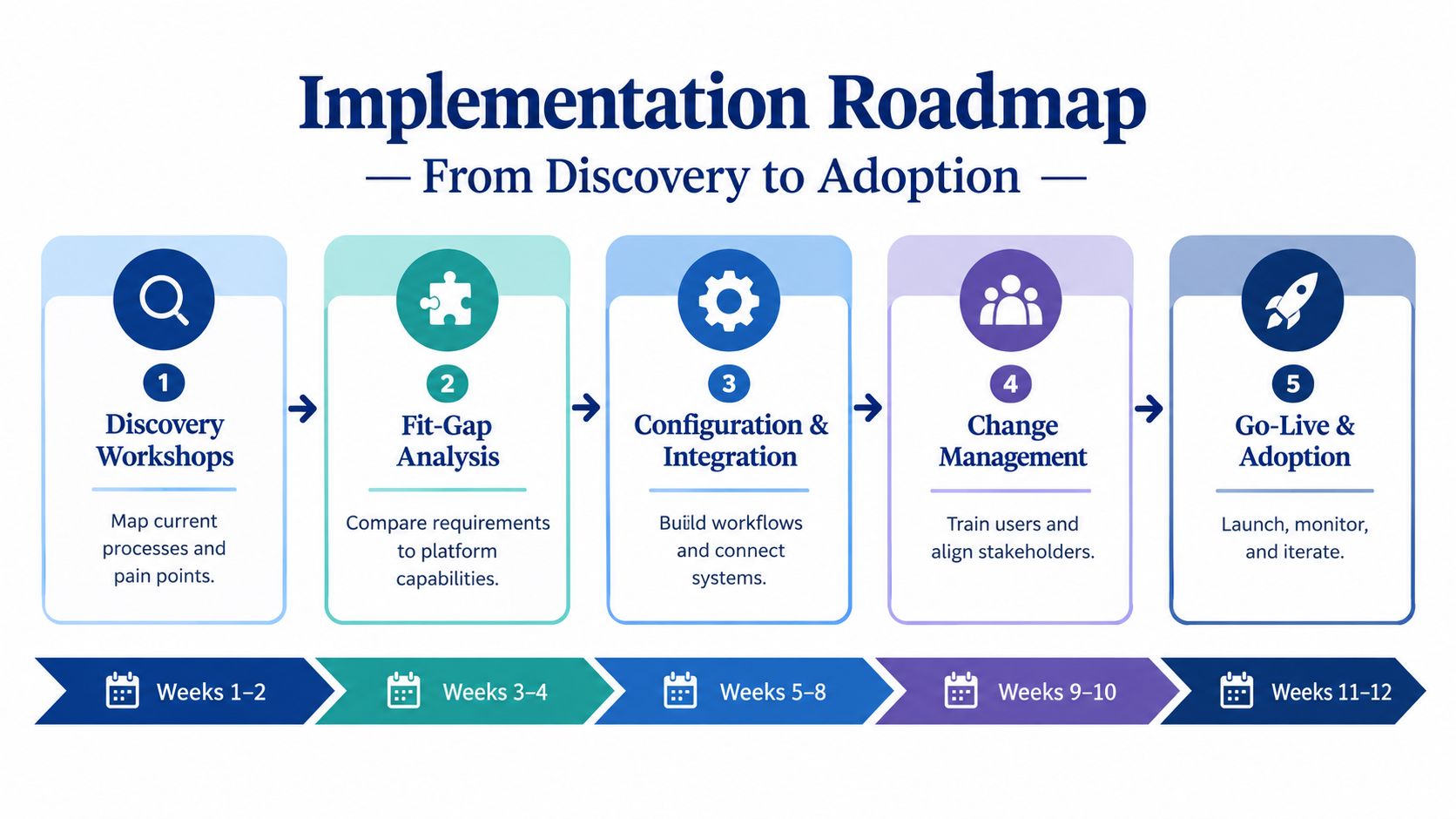
Start with discovery
Bring compliance, risk, audit, information security, legal, procurement, IT operations and business owners into discovery workshops. Map the actual workflow, including spreadsheets, shared drives, ticket queues, email approvals and informal escalation routes.
Record:
Current ownership: Identify who creates, approves, operates and tests each control.
Evidence sources: Document where evidence comes from and how often it changes.
Failure points: Find duplicate data, unclear approvals, missed reviews and manual reporting.
Decision needs: Capture what boards, regulators and risk committees need to see.
Use fit-gap analysis honestly
Compare requirements with platform capabilities across data models, workflows, integrations, reporting, access controls and regulatory content. Don't treat every feature gap as a customisation opportunity. Some gaps indicate a process that needs redesign, while others justify a controlled extension.
A sensible first release usually focuses on a coherent operating path, such as risk and control management with audit findings, rather than attempting to digitise every framework at once. Establish naming conventions, risk taxonomies, control standards and evidence retention rules before migrating large volumes of data.
Configure, integrate and test
Build workflows around accountable roles. Test ordinary work and exception paths, including a control owner who misses a deadline, a policy that requires urgent review, a vendor whose risk changes and an audit finding that remains unresolved.
Pilot with users who perform the work, not only project sponsors. Their feedback exposes confusing forms, excessive notifications and approval steps that look logical on paper but fail under operational pressure.
Treat adoption as a control
Training should be role-specific. Control owners need to know how to submit evidence, risk owners need to understand scoring and escalation, and executives need to interpret dashboards without relying on manual explanations.
The organisational change management guidance provides a useful reference for stakeholder communications, enablement and adoption planning. Go-live isn't the finish line. Review usage, overdue actions, rejected evidence and user feedback, then adjust the system.
Implementation test: A platform is adopted when accountable people use it to make decisions, not when administrators successfully load the data.
Vendor Selection Criteria for Enterprise GRC Platforms
A feature checklist won't tell you whether a vendor can support UAE operational compliance. Ask vendors to demonstrate a complete scenario, from regulatory change through control mapping, evidence collection, exception handling and board reporting.
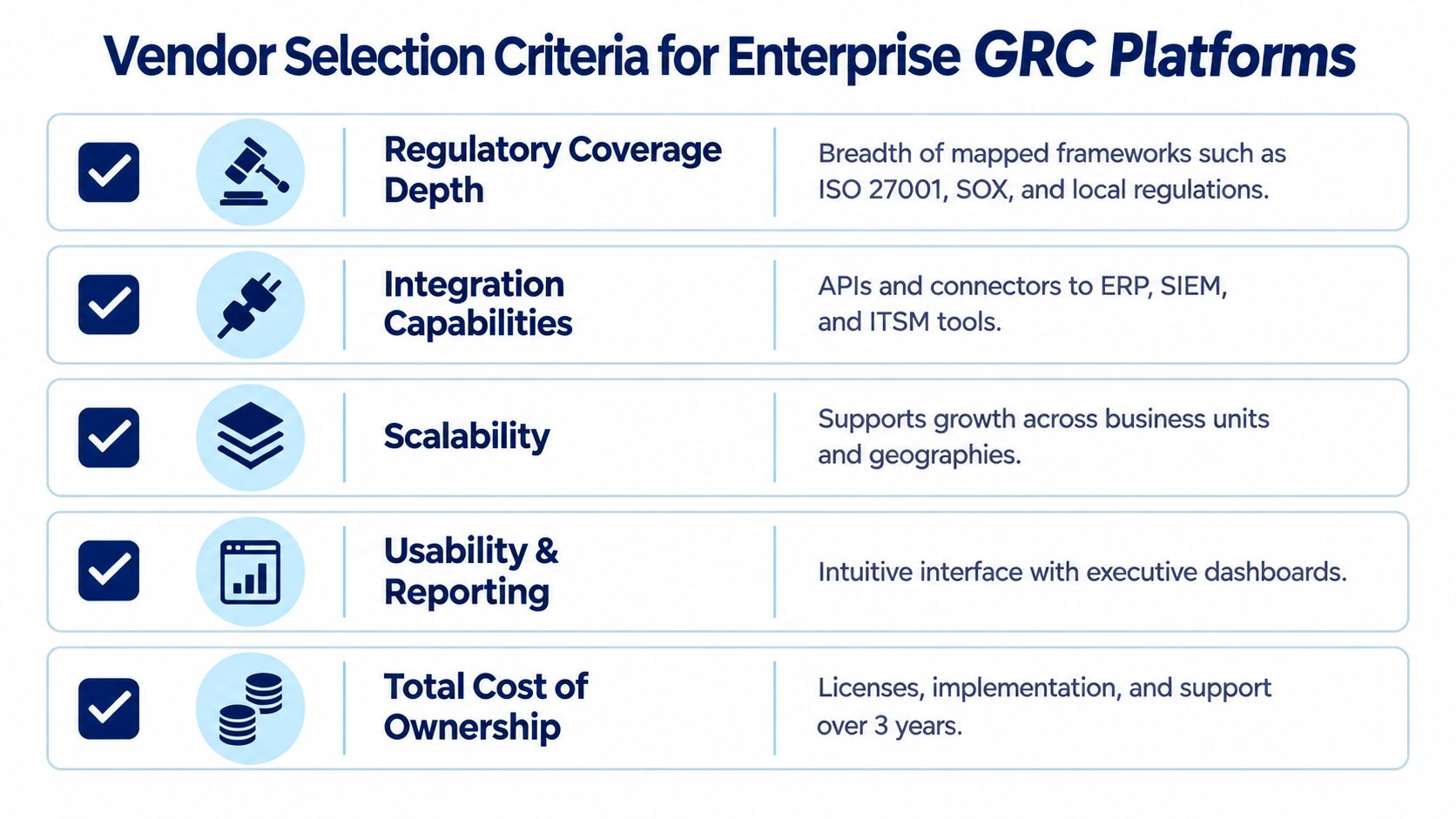
Evaluate the operating model, not the brochure
Regulatory coverage depth matters, but mapped frameworks aren't enough. Check how the vendor handles local requirements, regulatory updates, cross-mapping, interpretation notes and customer-owned obligations. A static content library won't solve quarterly change.
Integration capability should be tested against your actual environment. Request demonstrations with your ITSM, ITOM, HRSD, ITAM, SIEM, identity and procurement systems. Review APIs, authentication, error handling and reconciliation, not just connector names.
Scalability includes more than user volume. Assess business-unit separation, multi-entity reporting, jurisdictional rules, delegated administration, data residency and access segregation.
Usability and reporting determine whether control owners participate consistently. Ask users to complete a risk assessment, upload evidence and respond to a finding. Executive dashboards should expose trends, overdue actions, exceptions and risk appetite breaches without requiring spreadsheet manipulation.
Total cost of ownership includes licensing, implementation, integrations, content, support, upgrades, administration and managed services. Low initial cost can become expensive if the platform needs extensive custom development or manual maintenance.
Use a scored proof-of-value with your own scenarios. The GRC company evaluation resource can support market orientation, but procurement should make the final decision against documented operating requirements.
Real-World GRC Use Cases in UAE Regulated Sectors
A UAE financial institution may need to connect operational risk, technology assets, outsourced dependencies, critical operations and incident response. The regulatory baseline includes Federal Decree-Law No. 10 of 2025 for AML/CFT, Cabinet Resolution No. 134 of 2025 and Federal Decree-Law No. 45 of 2021 for data protection, alongside requirements from the CBUAE, DFSA, FSRA and VARA, as outlined in this UAE GRC regulatory overview.
For a CBUAE-regulated entity, the 2026 operational-risk framework requires continuous maintenance of the Master System of Record within the UAE and extends control across material products, activities, processes, systems and outsourced dependencies, according to this analysis of the UAE operational-risk framework. A workable system should therefore link each material service to its processes, technology, supplier relationships, control owners and evidence.
Financial services workflow
A risk manager can use the platform to:
Map dependencies: Link a critical service to applications, infrastructure, suppliers and accountable executives.
Test controls: Schedule recurring tests and route evidence requests to named owners.
Escalate exceptions: Create remediation actions when evidence is incomplete or a control fails.
Report exposure: Present residual risk, overdue remediation and concentration areas to governance committees.
Operational resilience requires more than documenting recovery plans. Institutions must identify critical operations, set disruption tolerances and test recovery. Severe incidents must be notified to the Central Bank within four hours, followed by a summary report within 24 hours, according to this UAE operational-resilience assessment. Those deadlines should exist as monitored workflows, not as reminders buried in a policy.
Privacy and dual-regulator environments
A data protection officer can map PDPL requirements to processing activities, data owners, retention rules, supplier contracts, assessments and incidents. A DIFC or ADGM organisation may also need separate regulator-specific obligations, with common controls mapped where they satisfy both regimes.
This model avoids two errors. Treating every regulation as entirely separate creates duplication. Treating similar requirements as identical can hide differences in scope, evidence or accountability.
Procurement teams can apply the same discipline to supplier onboarding, contract controls and concentration risk. The procurement governance risk insights provide useful context for connecting sourcing decisions with broader governance and third-party risk practices.
Measuring Success GRC KPIs and Risk Metrics That Matter
A board doesn't need a dashboard full of activity counts. It needs evidence that the organisation understands exposure, operates controls and closes weaknesses.
Track metrics that connect action to assurance:
Control effectiveness: Separate controls tested from controls that passed, failed or require remediation.
Risk exposure: Monitor changes in inherent and residual risk, with explanations for material movement.
Compliance cycle time: Measure how long teams take to assess new requirements, assign controls and close exceptions.
Evidence quality: Track rejected, expired, incomplete and late evidence rather than counting uploads alone.
Audit readiness: Review open findings, overdue actions, repeat findings and the time required to assemble evidence.
Adoption: Monitor active control owners, completed attestations and workflow completion without manual intervention.
Cybersecurity measurement should reflect the threat environment. The UAE benchmark cited earlier found that nearly 50% of exploited vulnerabilities were more than five years old, which supports prioritising remediation by exploit age, asset criticality and business impact rather than relying on annual review cycles.
For privacy and cyber governance, the platform should also support traceability between obligations, controls, evidence and executive reporting. Regional priorities reflect that need, with 55% of firms prioritising digital and technology-risk mitigation, 42% focusing specifically on cyber risks and 72% reporting confidence in meeting data-protection standards, according to PwC's Middle East technology-risk analysis.
A useful measurement programme turns every metric into a decision. If a control repeatedly fails, change its design or ownership. If evidence arrives late, fix the workflow. If risk remains above appetite, escalate it with a funded treatment plan.
DataLunix helps UAE and GCC organisations design and implement GRC workflows that connect governance, risk, compliance, audit and vendor oversight with ITSM, ITOM, HRSD and ITAM operations. Visit DataLunix to arrange a discovery workshop and assess the practical path from fragmented controls to continuous, auditable compliance.