


GRC Module in UAE: What It Is, Features, and ROI

The UAE doesn't run on one generic compliance framework. Regulated entities have to align with AML/CFT, risk management, and data protection obligations under applicable federal law, while governance expectations are also set by the CBUAE, DFSA, FSRA, and VARA, with Federal Decree-Law No. 45 of 2021 as the data-protection law that GRC programmes must account for UAE GRC guidance. That is why a grc module is no longer just a software feature, it's the control layer that keeps governance, evidence, and board reporting connected.
What a GRC Module Does in the UAE
A regulated UAE business rarely fails because it lacks a policy. It fails because the policy, the risk register, AML evidence, and the board pack live in different places, so nobody can show the full trail when a regulator asks. A grc module closes that gap by managing risks, controls, compliance obligations, policies, issues, remediation actions, and assurance activity in one auditable workflow GRC system playbook.
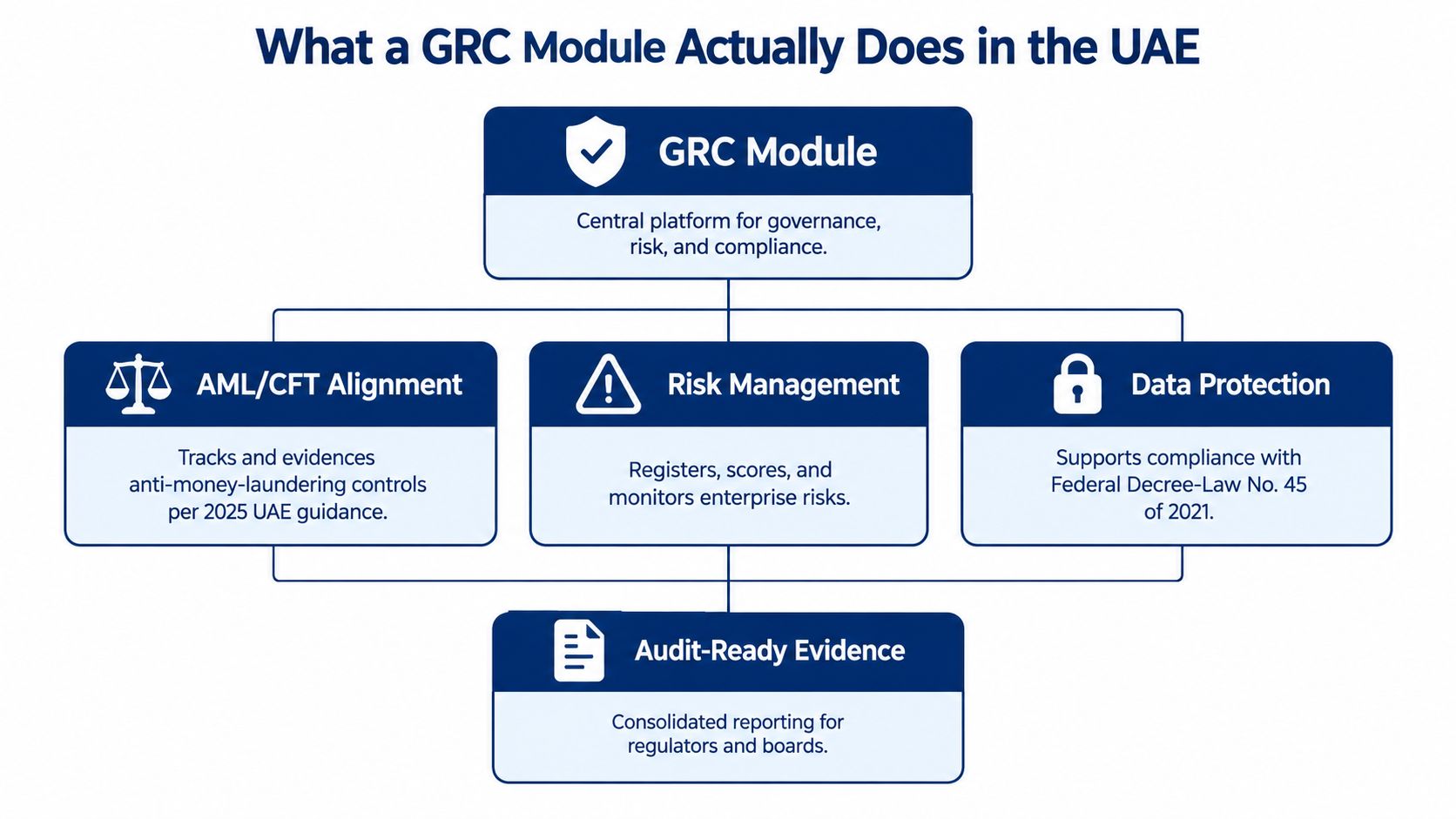
The UAE split is practical, not theoretical. A live implementation has to respect the way obligations are segmented, from governance and conduct to AML and privacy. For a clear control model, the GRC governance, risk and compliance guide maps obligations to owners and evidence in one workflow. That matters because the grc module should let teams separate controls by entity, module, and regulator, instead of piling every requirement into one register and creating duplicate controls.
Practical rule: if your controls cannot be traced from obligation to owner to evidence, you do not have a GRC system yet, you have a document library.
A useful module also has to work with the evidence trail the business already produces. The UAE's digital-government platform says the government has launched policies, strategies, and laws to promote open data UAE open data platform, which makes evidence-driven workflows easier to defend if they are designed well. In practice, that means the grc module should do four things well:
Map obligations to controls, so teams know which rule is being satisfied.
Collect evidence once, so audit and compliance do not ask for the same file twice.
Track remediation, so breaches do not disappear into email.
Report upward, so boards see status without hand-built slide decks.
For UAE enterprises, the core value is not abstract governance language. It is a jurisdiction-specific control layer that connects risk registers, AML evidence, audit trails, and policy attestations across multiple entities without duplicating the same control set.
Core Features of a Modern GRC Module
In UAE-listed and regulated organisations, a serious grc module is judged by what it can operationalise. Screen count is irrelevant. The systems that hold up in practice create discipline around policy, risk, compliance, audit, controls, and reporting without pushing teams back into spreadsheets.
Policy, risk, and compliance need separate mechanics
Policy management should do more than store PDFs. It needs versioning, attestation tracking, approval workflows, and exception handling, because policy without acknowledgement is just text. Risk management should maintain a register, scoring, and heat maps. Compliance management should map obligations to controls and regulatory citations so one control can satisfy more than one requirement.
The 2024 amendment to the SCA Corporate Governance Guide tightened expectations for governance structure, reporting, and compliance oversight, which makes board-facing mapping necessary for listed companies Chambers corporate governance guide. In practice, a UAE grc module must show who owns each control, who approved it, and what evidence supports internal control effectiveness.
Audit, controls, and reporting are where most tools fail
Audit management should handle fieldwork, evidence collection, and findings tracking inside the same workflow as remediation. Controls should support design, testing, and issue closure. Reporting should produce dashboards for operators and board-level summaries for directors.
A useful rollout starts with a small control library and maps it tightly to board responsibilities. That reduces duplication and makes internal review easier to defend, especially in multi-entity structures where the same policy can spawn duplicate controls if ownership is unclear.
A good implementation makes compliance visible before it becomes urgent. A bad one only produces reports after the exception has already become a problem.
For UAE buyers, the test is simple. If the system cannot generate auditable evidence, link it to a control owner, and roll it into board reporting, the GRC platform feature set shows what a complete control library should include.
Integrating GRC with ITSM, ITOM, ITAM, and HRSD
A grc module that sits on its own creates duplicate controls and broken evidence trails. That is the fastest way to build a noisy compliance function, because one team files an incident, another team logs a risk, and a third team asks for proof that nobody can reconcile. Integration is what turns GRC from a reporting layer into an operating system for controls.
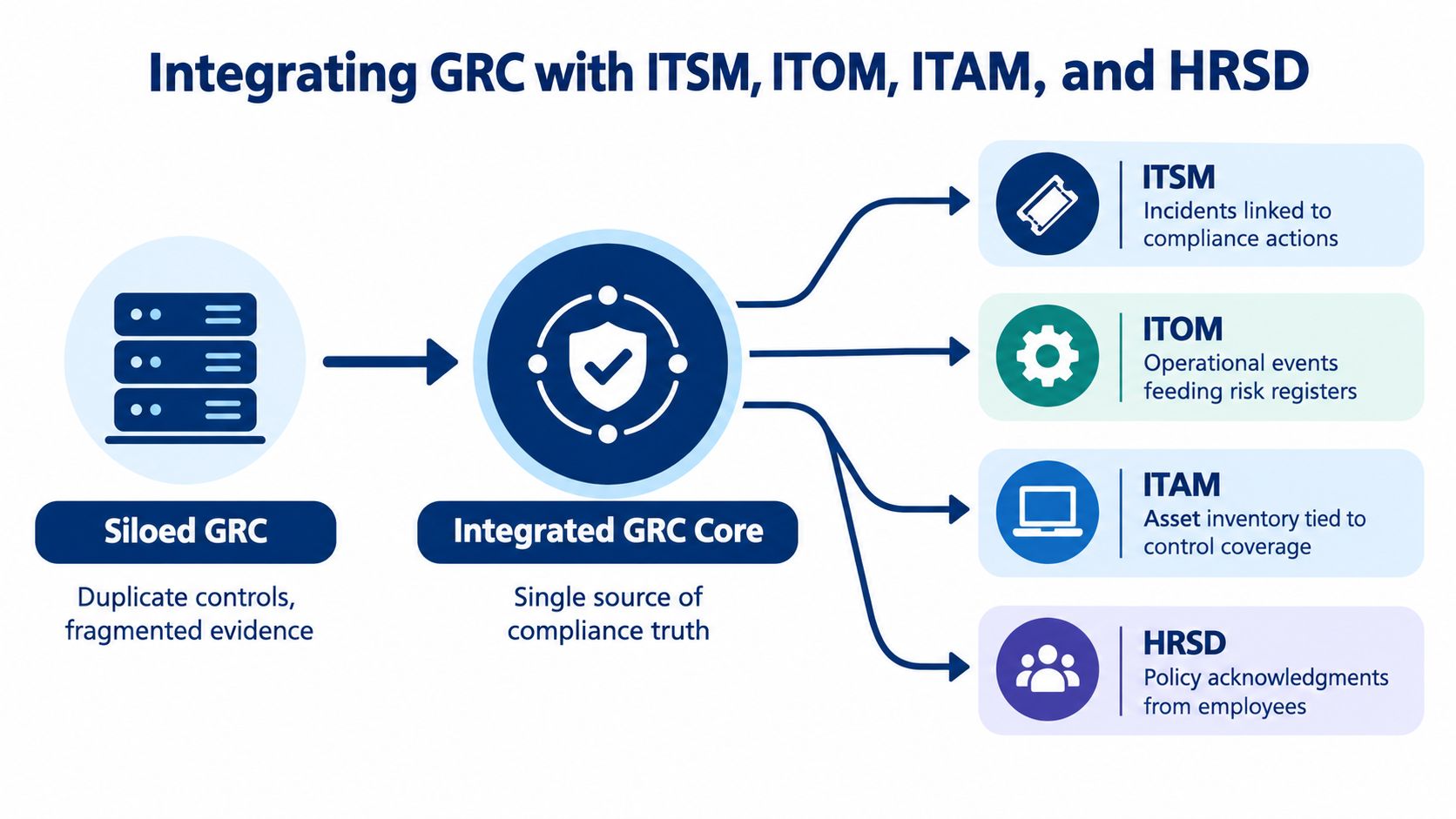
The best comparison point is unified workflow versus tool sprawl. Platforms such as HaloITSM, ServiceNow, Freshservice, and ManageEngine each offer a different route to connected operations, but the principle is the same. The GRC layer has to consume operational signals, not just record after-the-fact attestations.
What integration changes in practice
Integrated GRC lets incidents in ITSM become compliance actions, operational events in ITOM feed the risk register, asset inventory in ITAM define control coverage, and HRSD acknowledgements prove that employees saw the policy. That matters in the UAE because cross-functional evidence is harder to defend when regulated entities operate across multiple business units and jurisdictions.
The market signal also points in this direction. Independent research places the UAE cloud-based cybersecurity GRC platforms market at USD 1.2 billion and another estimate values GRC platforms software at USD 120 million in 2025 with a projection of USD 210 million by 2033 UAE market estimates. Those figures point to demand for scalable analytics, real-time compliance monitoring, and cross-functional risk workflows, not static checklists.
A useful outside reference is asset tracking best practices, because control owners often underestimate how much GRC depends on clean asset and ownership data. If the asset register is weak, control coverage becomes guesswork.
What works and what does not
What works:
Single source of truth, so evidence is attached once and reused.
Automated triggers, so failures create actions instead of waiting for meetings.
Shared identity and asset data, so ownership is clear.
What does not work:
Point integrations with no governance, because they fail without warning.
Manual exports between tools, because version drift creeps in.
Separate control libraries for each team, because duplication turns reporting into a reconciliation exercise.
See how connected workflows reduce compliance friction is useful if you want the integration logic framed in operational terms rather than vendor language.
Enterprise Use Cases and Measurable ROI
ROI in GRC is often measured poorly. Leaders chase a neat percentage lift and miss the operational gains, lower duplication, cleaner evidence, faster remediation, and fewer board escalations. In the UAE, those gains show up differently depending on the operating model.
Three common UAE use cases
A multi-entity listed company needs one control framework that maps board oversight to internal control responsibilities across entities. A financial services firm has to manage AML/CFT obligations under Federal Decree-Law No. 10 of 2025 and Cabinet Decision No. 134 of 2025, so evidence quality and suspicious activity workflows matter from day one. A technology company has to handle Federal Decree-Law No. 45 of 2021 alongside evolving PDPL, NESA, ADHICS, DFSA, FSRA, and VARA expectations.
The open-data policy in the UAE also helps. Structured, auditable evidence is easier to store, retrieve, and trace across functions. That matters when teams need to prove that a control existed, applied to the right entity, and followed the right rule set at the right time.
Where the ROI Comes From
Reduced audit preparation, because evidence is already organised.
Fewer duplicate controls, because one control can satisfy several obligations.
Faster remediation, because issues move through a defined workflow.
More accurate board reporting, because the numbers come from operational systems rather than manual roll-ups.
Board reporting accuracy is one of the first places a grc module shows value. Directors need defensible oversight. A polished slide deck does not substitute for evidence. The same logic applies to audit work, where audit workflow design determines whether evidence, remediation, and reporting stay connected or drift into separate tracks.
Selection and Implementation Roadmap for UAE Enterprises
Sequencing matters more than most vendors admit. The biggest mistake I see in UAE programmes is trying to turn on every control domain at once, especially when finance, HR, and regulated operations span multiple entities. That approach creates duplicate controls, weak adoption, and a risk register that no one trusts.
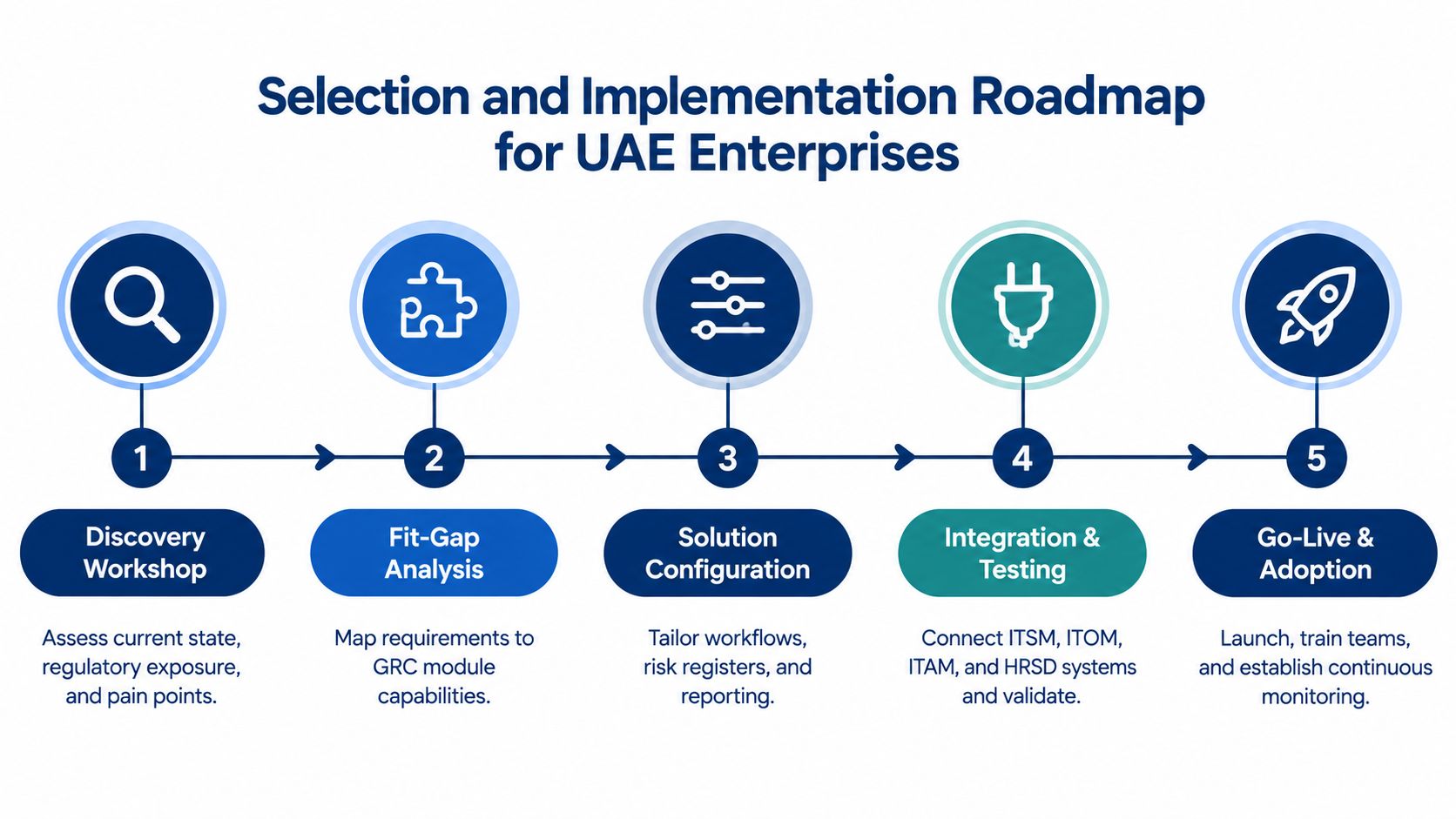
A five-phase rollout that works
Discovery workshop. Start by mapping current controls, regulatory exposure, and pain points across entities and functions.
Fit-gap analysis. Compare those requirements with the grc module capabilities you need, not the ones a demo can show.
Configuration and integration. Connect to ITSM, ITOM, ITAM, and HRSD, then localise the rule sets for UAE obligations.
Change management and adoption. Train stakeholders, set approval paths, and make policy acknowledgements part of normal work.
Optimisation and managed services. Keep monitoring, tune workflows, and update rule sets as obligations change.
The question most pages ignore is which module should come first. In a UAE enterprise, the answer depends on the highest-risk obligation set, not on which screen looks easiest. If your pain is AML evidence, start there. If your pain is board reporting and internal controls, start with governance and controls. If your pain is policy compliance across staff, start with attestations and workflow.
Implementation rule: sequence the rollout around evidence reuse, not around departmental politics.
Implementation partners earn their keep here. GRC implementation planning should not be treated as a technical install, because the hard part is aligning control ownership, evidence logic, and operating cadence across business units.
The main outcome to protect is traceability. The module has to connect risk registers, AML evidence, audit trails, and policy attestations without creating duplicate controls, or the programme will become too heavy to sustain.
Why Partner with DataLunix for GRC Deployment
DataLunix is a practical option when the issue is not just software selection, but adoption across people, process, and systems. It works as a certified reseller and delivery partner for HaloITSM, HaloPSA, Freshservice, ManageEngine, and ServiceNow, which matters when a grc module has to sit inside a broader operating model rather than live as a standalone tool.

The delivery model is straightforward. Discovery workshops and fit-gap analysis come first, then readiness assessments, change management, stakeholder communications, and enablement. Delivery can run through onshore, offshore, or hybrid models using UAE-based leadership and India delivery centres, which helps keep cost and timing under control.
For larger programmes, managed services matter just as much as implementation. Optimisation, upgrades, and outsourced operations keep the control framework current, while staff augmentation from a 200k+ certified talent pool helps teams scale without rebuilding internal capability from scratch.
The local context keeps changing too. Federal Decree-Law No. 26/2025 on Child Digital Safety takes effect in January 2026, and the wider UAE compliance environment continues to shift across privacy, cybersecurity, and financial regulation UAE compliance update. A partner who understands that pace can help your GRC module absorb new obligations without breaking the evidence model.
If you're planning a grc module rollout in the UAE, DataLunix can help you sequence it properly, connect it to your operational systems, and keep it aligned with changing obligations. Visit DataLunix to discuss implementation, integration, and managed support for your compliance environment.