
GRC Risk Solutions: A Practical Guide for GCC Enterprises

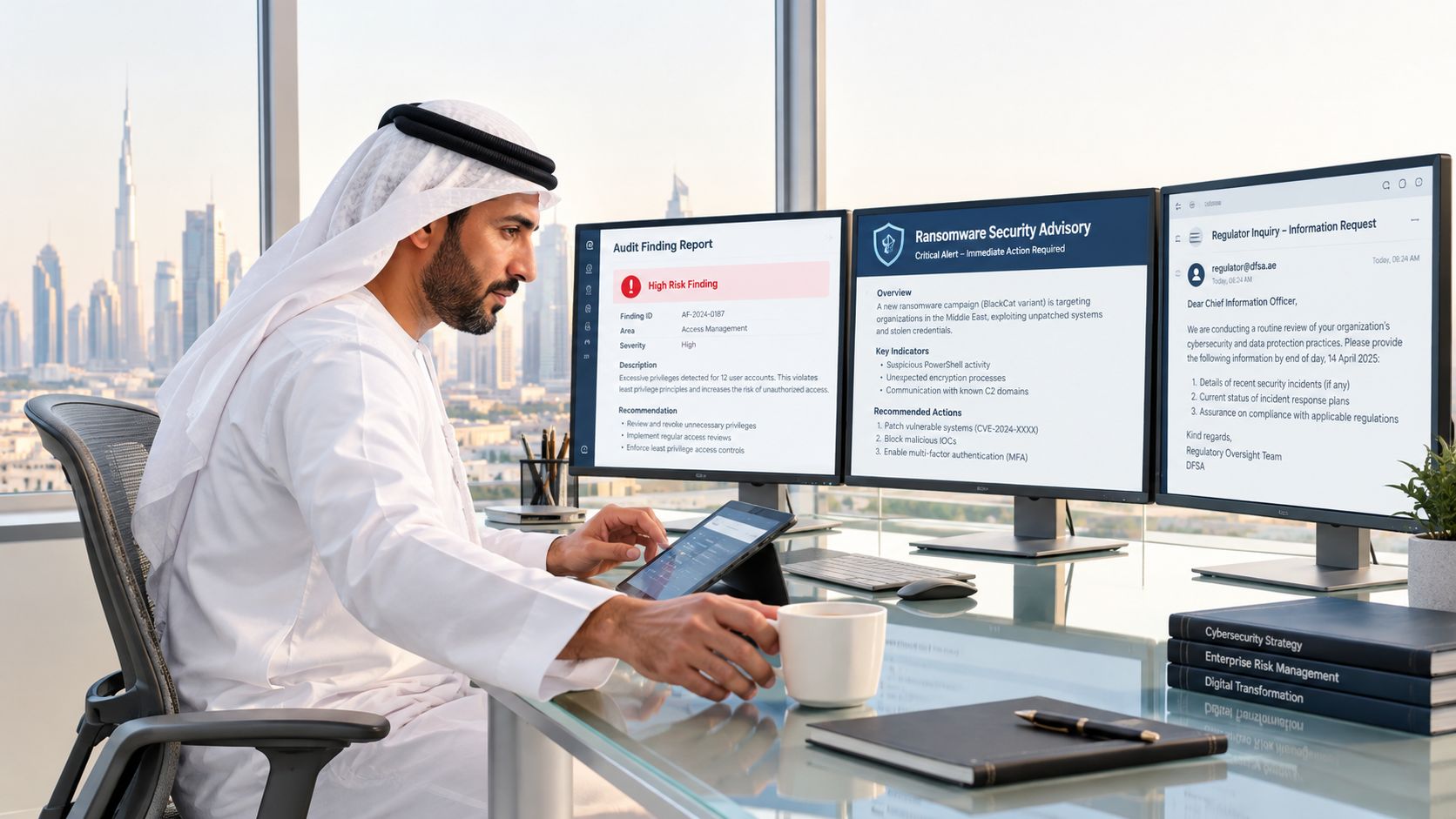
You already know the pattern. An audit finding lands in your inbox, a ransomware alert hits the security team, and procurement asks for vendor evidence before lunch. That's why GRC Risk Solutions are no longer a back-office compliance purchase. In the GCC and Europe, they're the operating layer that decides whether governance, risk, and compliance stay fragmented or become actionable across IT, security, and business teams.
What GRC Risk Solutions Mean for a GCC Enterprise
A CIO in Dubai, Riyadh, or a European hub does not wake up asking for a “GRC platform”. They wake up to a control gap, a regulator question, and a service owner who cannot find the evidence folder. GRC Risk Solutions close that gap by linking policy, risk, controls, incidents, and reporting into one operating model, so IT, security, and business teams work from the same record.
Why the case for GRC has become unavoidable
The UAE cyber picture makes the point plainly. The 2024 State of the UAE Cybersecurity Report identified more than 155,000 vulnerable assets across the country, with more than 40% of critical vulnerabilities left unaddressed for over five years, and nearly 70% of vulnerable assets reportedly located in Dubai (CPX). The same report said ransomware was behind more than half of reported cyber incidents (CPX).
That is a governance problem, not a tooling gap.
A proper GRC Risk Solution needs to do four things well:
Track ownership, so every risk and control has a named accountable person.
Link evidence to controls, so audits do not turn into screenshot hunts.
Trigger escalation, so exceptions do not sit untouched in spreadsheets.
Show residual risk, so boards see what still matters after controls run.
Saudi Arabia pushes the same discipline. Its personal data breach notification process requires qualifying incidents to be reported within 72 hours when they could harm personal data or data subjects (Saudi Data and AI Authority). That makes incident handling part of governance, not just operations.
A GRC programme that lives in policy documents only is theatre. Real GRC lives in tickets, evidence, deadlines, and board reporting. It also has to fit the way service work already runs in ITSM and ITOM platforms like ServiceNow, Halo, Freshservice, and ManageEngine. If the workflows do not connect, governance stays stuck in a separate silo.
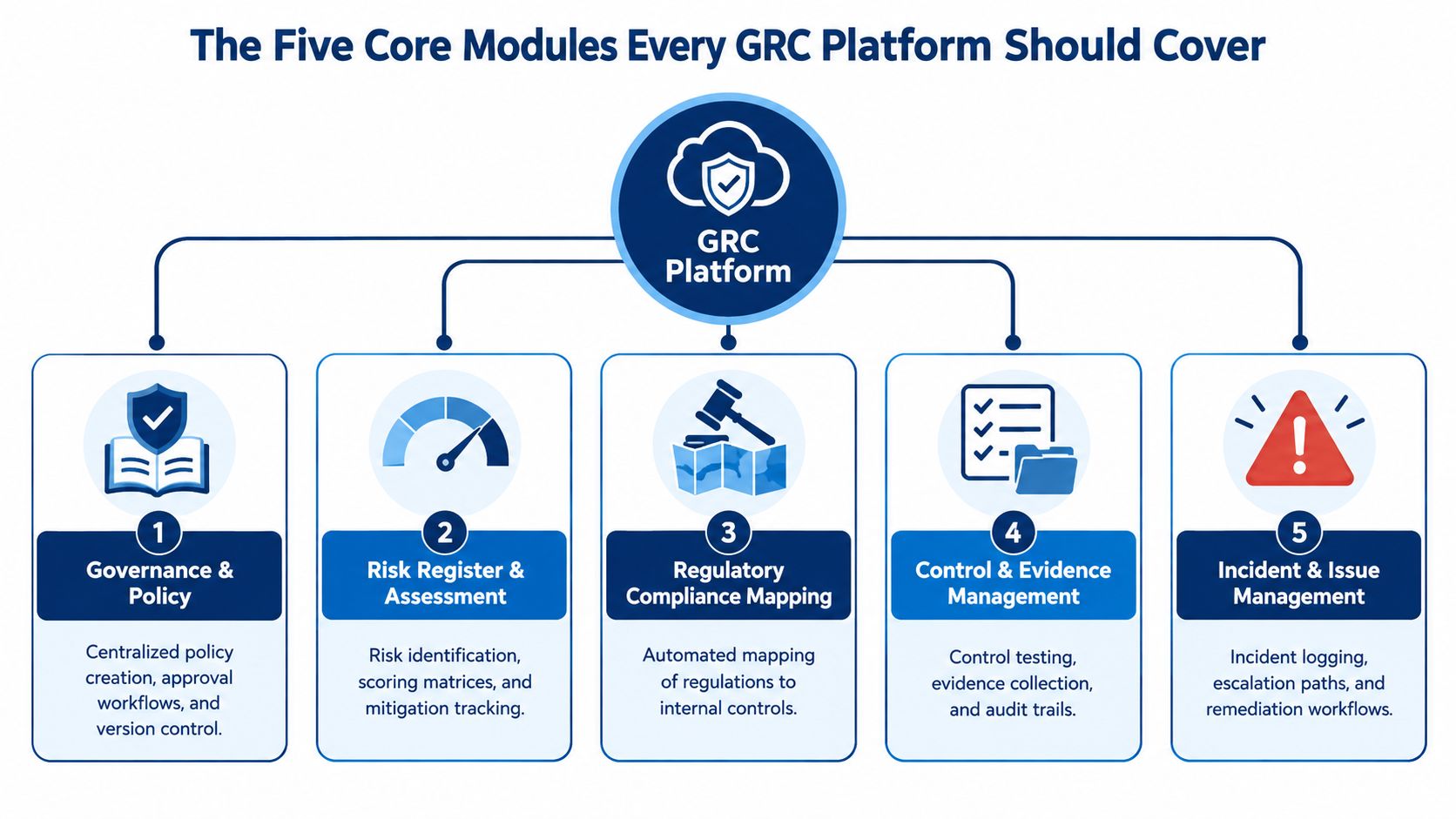
The Five Core Modules Every GRC Platform Should Cover
A GRC platform that misses the basics gives you better-looking spreadsheets, not better governance. In GCC enterprises, the right setup connects policy, risk, evidence, and escalation to the workflows people already run in ITSM and ITOM.
Governance and policy
Ownership begins here. The UAE government portal sets out cyber safety and digital security expectations that make one point clear, policy cannot live in a PDF archive and be treated as control in practice (UAE government portal).
Your platform should support:
Policy drafting and approval, with version control.
Assigned owners, so every policy has a business steward.
Review schedules, so outdated controls do not linger.
Risk register and assessment
A risk register loses value the moment it becomes static. In the UAE financial sector, the Central Bank expects banks to identify, assess, monitor, report, and mitigate operational risk within a governed framework (Central Bank of the UAE Operational Risk Regulation).
Regulatory compliance mapping
Map obligations to controls, then map controls to evidence. That is the clean way to handle UAE Information Assurance requirements and Central Bank cyber controls without running multiple disconnected trackers (Central Bank cyber framework mapping).
Control and evidence management
If the control exists but the evidence does not, the control does not exist for audit purposes. The platform needs scheduled testing, evidence upload, review history, and traceability from control to artifact. If you want a practical way to find risks derailing your OKRs, that discipline starts here, as outlined in The OKR Hub's risk identification process.
Incident and issue workflows
GRC stops being static when failed tests, incidents, and exceptions move into routed work. The workflow you need turns failed tests, incidents, and exceptions into routed work with deadlines, owners, and closure proof. For UAE banks, that matters because both operational-risk and risk-management regulations require immediate escalation when risk appetite is breached or a material risk is not adequately addressed (Risk Management Regulation).
Mapping GRC Benefits to IT and Business Outcomes
A good GRC programme doesn't sell “compliance”. It buys speed, clarity, and fewer surprises. CIOs should judge it by what changes in operations, not by how many dashboards the vendor demoed.
What to measure instead of what to promise
Use outcomes that executives already understand:
Audit cycle discipline, through continuous evidence instead of end-of-quarter scrambles.
Faster containment, when incidents flow straight into ITSM with context attached.
Stronger third-party assurance, because suppliers are tracked continuously, not once a year.
Visible AI governance, where AI workflows have owners and approval points.
Better board decisions, because residual risk is reported by service, not by spreadsheet row.
For AI governance, the problem is already visible in UAE enterprise behaviour. An IDC study of 175 senior security and technology executives found that AI adoption is advancing faster than the governance and security model around it (Zawya report on the IDC study). So the benefit is not hypothetical. It is the ability to govern AI as an asset class, not an experiment.
If your GRC platform can't show ownership, evidence, and escalation in one place, it's not reducing risk. It's redistributing admin work.
A financial-services team should treat that as resilience spend, not overhead. That's the right framing when the business depends on service continuity, regulator confidence, and clean audit trails.
Comparing Leading GRC and ITSM Platforms for the Region
No platform wins every environment. Shortlist based on what your operating model already looks like, not on who has the longest brochure.
The comparison below reflects what GCC and European enterprises usually care about, breadth of GRC coverage, ITSM and ITOM fit, regulated-industry suitability, and how easy it is to buy through authorised channels. If you need a pricing benchmark for a service-management-led stack, the SysAid pricing overview is a useful commercial reference point.
Platform | GRC Module Coverage | ITSM/ITOM Integration | Regulated-Industry Fit | Authorised Reseller Availability |
|---|---|---|---|---|
ServiceNow Integrated Risk Management | Broad, especially for mature enterprise programmes | Very strong, especially inside the ServiceNow estate | Strong for large, complex organisations | Yes, through a mature partner ecosystem |
HaloITSM with HaloAI | Good for organisations that want practical workflow-led governance | Strong for ITSM-led operating models | Good for mid-market and regulated service teams | Yes, via regional delivery partners |
Freshservice with compliance extensions | Moderate, best when service management is the anchor | Strong for IT-led teams standardising workflows | Good for growing teams that need structure quickly | Yes, with channel support and service partners |
ManageEngine with Risk Register | Functional, especially when cost control matters | Useful when ITSM is already standardised | Suitable for pragmatic, cost-sensitive environments | Yes, commonly available through resellers |
The blunt recommendation is simple. ServiceNow fits best where the organisation already runs deep on the platform. HaloITSM fits mid-market teams that want workflow control without enterprise bloat. Freshservice works when the IT operation is already standardised there. ManageEngine makes sense where budget discipline matters and the team is willing to add a GRC overlay.
For pricing and packaging comparisons in the ITSM layer, Freshservice pricing details help frame the commercial side of the decision.
Integrating GRC With ITSM and ITOM the Right Way
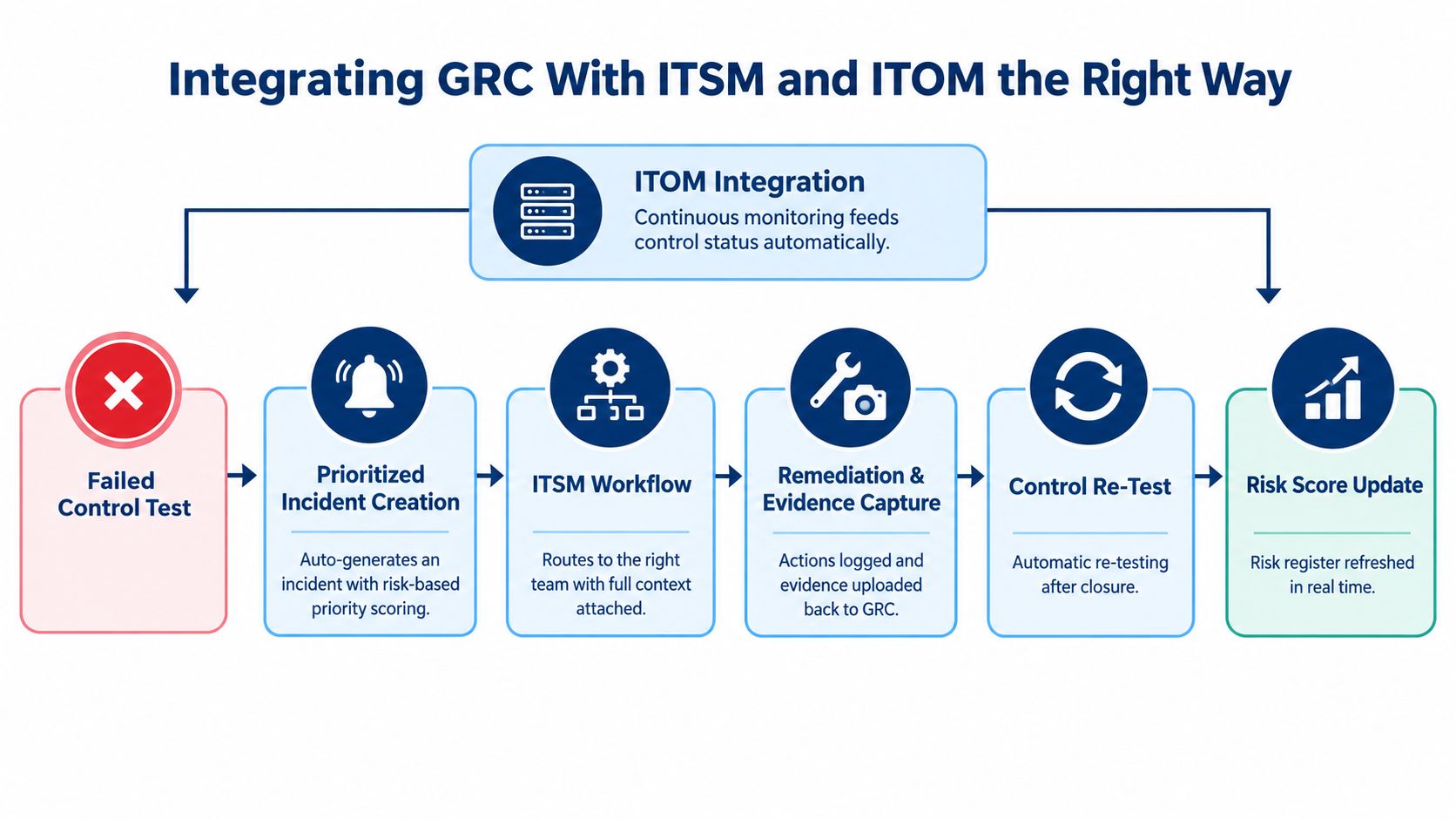
A GRC programme fails fast when it lives as a reporting layer. The workflow has to run as an operating loop, with tickets, assets, changes, and evidence moving together.
Build the loop, not the connector
Start with the failed control test. It should open a prioritised incident, not an email thread. That incident then carries the asset, service, and control context through ITSM, and it closes only when remediation evidence lands back in GRC.
Control failure shows up in operations first. In the Central Bank of the UAE operational resilience framework, continuity, recovery, response, and testing sit close to day-to-day service management, so the governance workflow has to touch the service workflow directly.
Map the CMDB to scope and accountability
If a configuration item is in scope, the control owner should know it. If a change request touches a regulated service, the risk check should happen before approval. If a vulnerability affects a critical asset, remediation should inherit the SLA and business impact already held in ITOM.
The pattern is straightforward:
Failed control test becomes a prioritised incident.
Incident pulls service and asset context from the CMDB.
Change request requires a risk check before approval.
Vulnerability finding routes into the remediation queue with SLA metadata.
Closure pushes evidence back into the GRC record for retest.
Duplicate ownership breaks the model. One record, one owner, one source of evidence.
If you're using HaloITSM, the HaloITSM pricing overview helps teams compare licence tiers before designing the integration. The same logic applies across ServiceNow, Freshservice, and ManageEngine. Buy the workflow first, then choose the licence model that fits it.
A Readiness-First Approach to Selecting the Right GRC Partner
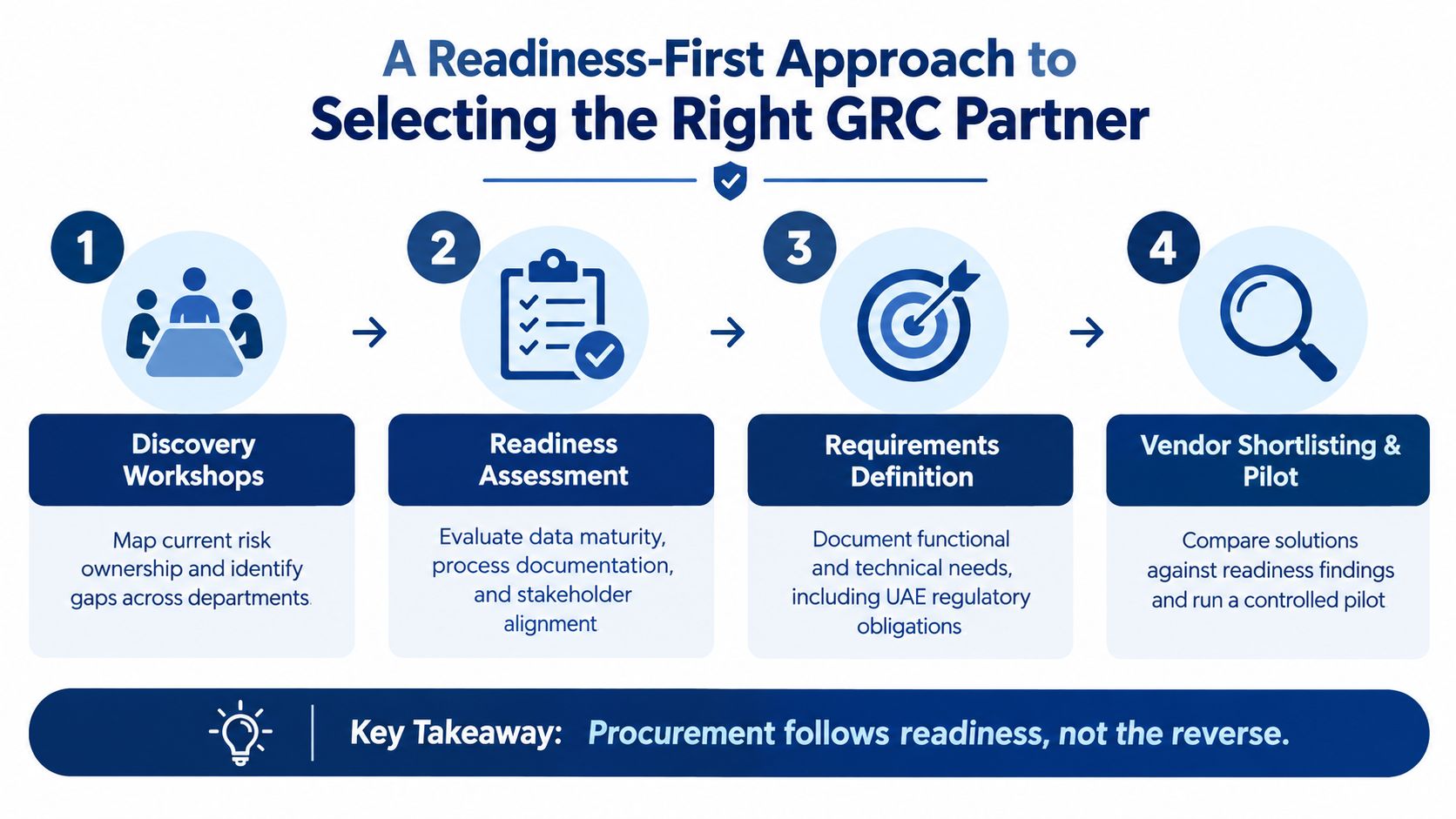
Most bad GRC decisions start with vendor demos instead of operating reality. That's backwards. You should define readiness first, then buy the platform that matches it.
What readiness actually means
First, map current ownership. If no one can explain who owns third-party risk, AI oversight, or control evidence, the software won't fix that. Second, run a fit-gap against UAE, Saudi, GDPR, and sector obligations. Third, check licensing economics through authorised resellers. Fourth, evaluate the delivery partner's onshore leadership, offshore capacity, and managed-services model.
That sequence is essential.
The shortlist filter that matters
Use these four questions before you buy:
Can the partner map controls to current obligations, without inventing a new process for every framework?
Can they integrate with ITSM and ITOM, or do they only promise exports?
Can they show licensed delivery options, including implementation and managed services?
Can they support change management, not just configuration?
DataLunix is one example of a partner model built around discovery workshops, fit-gap analysis, readiness assessment, implementation, and managed services across HaloITSM, Freshservice, ManageEngine, and ServiceNow. That matters if you want the GRC layer to behave like part of operations, not a separate compliance island.
What usually goes wrong
The common mistakes are predictable. Teams buy modules before assigning owners. They skip fit-gap. They choose on feature count instead of integration depth. They underestimate change management and then blame the platform when adoption stalls.
A GRC partner should help you see the operational shape before you sign the contract. Anything else is just expensive optimism.
A 90-Day Roadmap and KPIs to Prove the Program Works
A CIO doesn't need a ten-year transformation promise. They need a 90-day plan that shows movement, gives the board something credible, and exposes where the operating model is weak.
Days 1 to 30
Lock the scope, name the owners, and establish the baseline. At this stage you confirm which business services, control families, and regulatory obligations are in play. You should also define what counts as evidence, exception, and escalation.
Days 31 to 60
Unify policy, build the control library, and finalise integration design. This is the point where the team decides how GRC talks to ITSM, ITOM, IAM, and the CMDB. If that design is vague, the programme will drift back into spreadsheet mode.
Days 61 to 90
Stand up reporting, train the control owners, and run the first board-level residual-risk review. The first review should not be perfect. It should be honest and traceable.
Use these KPIs to prove the programme works:
Audit-finding reduction, because fewer repeat findings mean the controls are holding.
Current evidence coverage, because stale proof creates audit exposure.
Named-owner coverage, because anonymous risk is unmanaged risk.
Mean time to remediate critical vulnerabilities, because delay is where exposure grows.
AI-governance coverage, because automated workflows without governance are just faster chaos.
A regulated mid-market enterprise in the GCC or Europe usually sees the same pattern. It starts with fragmented spreadsheets, moves to a central risk register, then gains traction once ITSM tickets and evidence workflows are tied together. That's when the board starts trusting the numbers.
If you want help turning your current risk, compliance, and service workflows into one operating model, talk to DataLunix about discovery workshops, fit-gap analysis, implementation, and managed services. They work across GRC Risk Solutions, ITSM, and ITOM in the GCC and Europe, and you can start with a practical review at DataLunix.