
GRC Security Now on ServiceNow: A GCC Guide

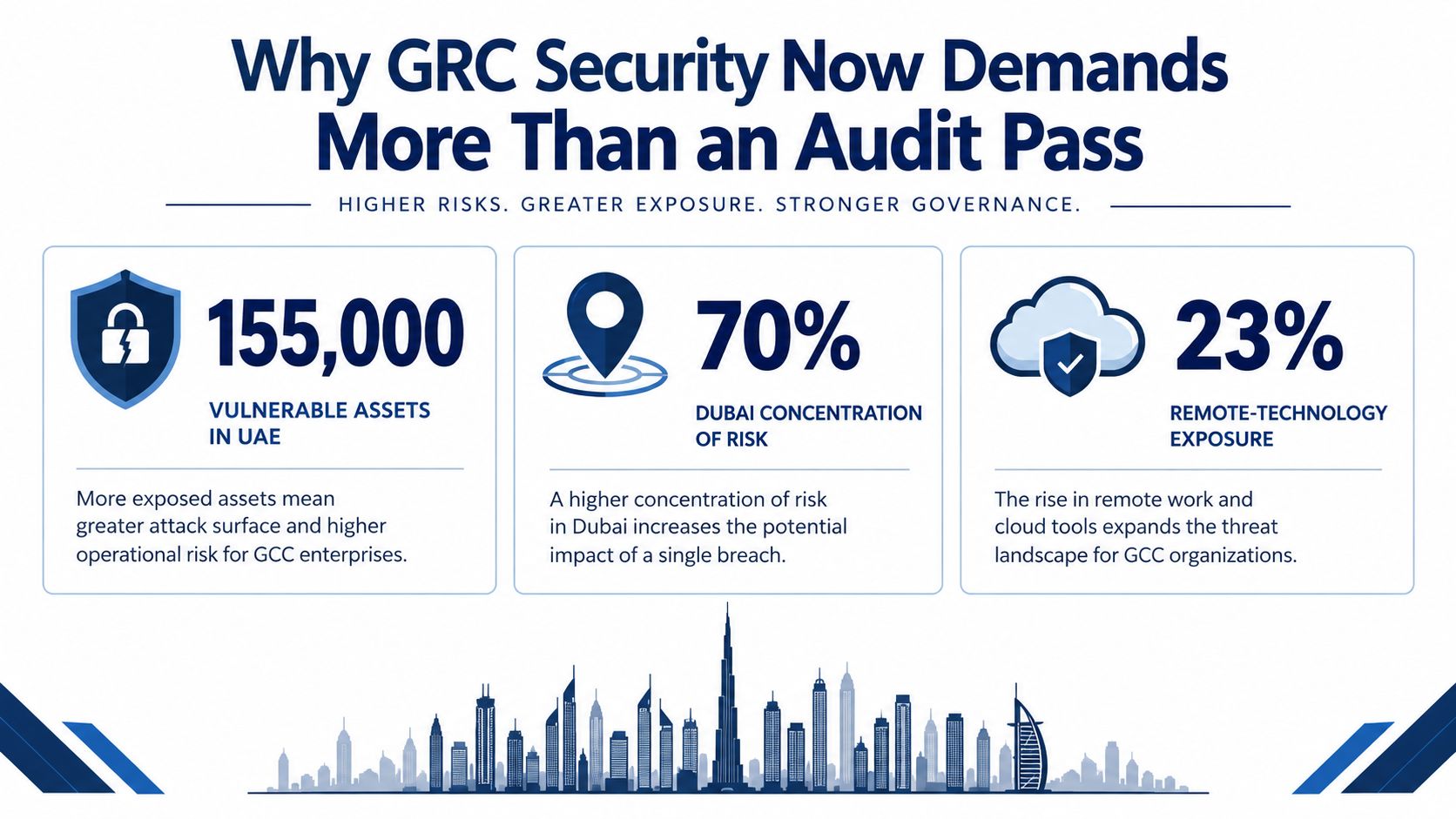
The UAE's nearly 155,000 vulnerable cyber assets, with almost 70% concentrated in Dubai, make the case for GRC security now as an operating discipline, not an audit exercise, according to the 2024 UAE cybersecurity reporting. Your ServiceNow programme should prove that accountable owners can protect and restore critical services, not merely produce compliant paperwork.
Why GRC Security Now Demands More Than an Audit Pass
A clean audit tells you what reviewers accepted at a particular point. It doesn't tell you whether your customer platform will survive a supplier outage, whether remote access remains appropriately restricted, or whether executives can authorise recovery without confusion.
The same reporting identified 23% remote-technology exposure, 58,538 DDoS attacks, and 86% of incidents targeting large organisations, alongside 40% of vulnerable assets being more than five years old. These are distinct exposure measures, not interchangeable indicators of organisational maturity.
What should your steering committee challenge?
Ask whether the programme can identify the business service behind an exposure and the person authorised to resolve it. If the answer requires several spreadsheet owners to reconcile their records, you haven't established operational governance.
Your committee should demand:
Service consequences: Describe which customer, payment, production or employee service could fail.
Accountable treatment: Name the decision-maker, remediation owner and escalation route.
Recovery evidence: Show a tested restoration path rather than a backup policy alone.
Residual-risk decisions: Record who accepted an exception, why they accepted it and what triggers reconsideration.
Don't equate purchasing ServiceNow with creating this discipline. A platform can organise weak ownership just as efficiently as strong ownership.
Steering committee rule: Approve funding against a demonstrable service-risk outcome, not the number of policies migrated.
Why are maturity scores insufficient?
A regional report cited more than 371,000 DDoS attacks in 2025, an 857% increase between 2019 and 2025, and 65% faster attack completion in Q1 2026, with some compromises causing operational impact in under 40 hours; it also contrasted 66% self-described optimised UAE cybersecurity maturity with geopolitical oversight gaps, including 40% of directors identifying regional instability as a top issue but only 15% of organisations having a formal oversight framework, in GCC resilience and governance reporting.
Those measures describe different populations and questions. My conclusion isn't that maturity assessments are useless. It's that your board needs tested decision rights and service continuity evidence alongside them.
The Three Layers of GRC on ServiceNow
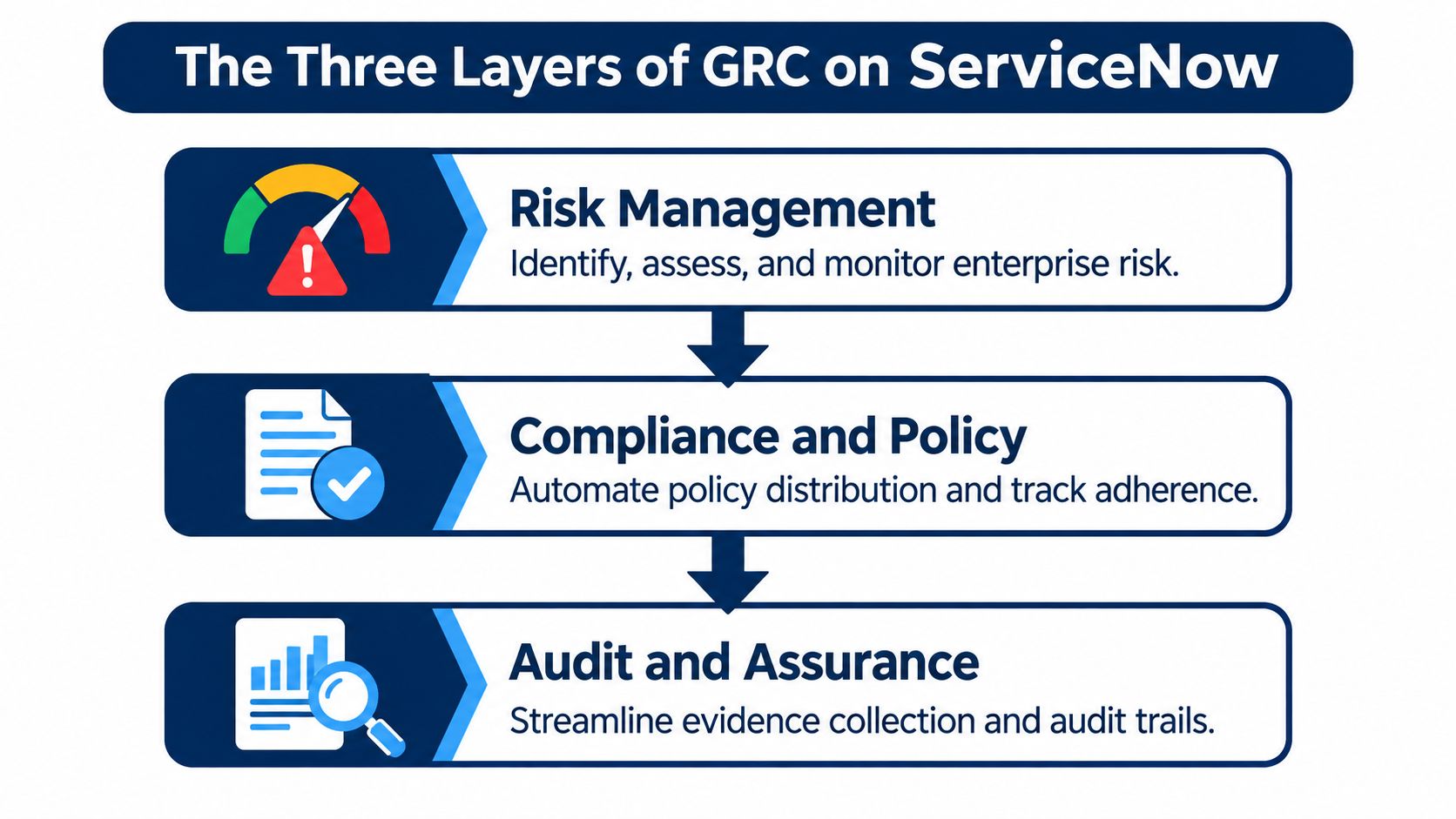
Design your ServiceNow GRC programme around risk management, compliance and policy, and audit and assurance. Treat these as connected working layers, not separate departmental implementations. Confirm application availability, terminology and licensing during fit-gap rather than assuming every capability comes with your existing subscription.
A building's fire-safety arrangements offer a useful analogy. Sprinklers represent preventive controls, alarms represent monitoring, and drills represent assurance. Owning equipment doesn't prove the occupants can respond effectively.
Which records should your CIO expect?
Require the implementation team to demonstrate the following record families using your organisation's language. Validate their configured relationships in the instance, not just in a solution presentation.
Working layer | Records to demonstrate | Leadership question |
|---|---|---|
Risk management | Risk Statements and Entity Profiles | What could happen, and where does it matter? |
Compliance and policy | Control Objectives, Policies and Indicators | What must operate, and how will we test it? |
Audit and assurance | Audit Engagements and Findings | Can an independent reviewer reproduce the conclusion? |
A Risk Statement should describe a business consequence, not merely a technical weakness. An Entity Profile should establish the scope being assessed, such as a legal entity, operational unit or relevant service grouping.
Control Objectives describe the required outcome. Policies document expectations, while Indicators should provide a repeatable test rather than another subjective declaration.
How should the layers share evidence?
Use a normalised data model so risk owners, compliance managers and auditors reference the same entities and control relationships. Don't create separate copies of an access-control obligation because different reviewers ask about it.
Reuse the evidence: Associate an appropriate test result with relevant obligations while preserving scope.
Separate assurance from ownership: Control owners operate the safeguard; reviewers challenge whether the evidence supports their conclusion.
Preserve disagreement: Record qualified findings and disputed assessments rather than overwriting them with a favourable status.
The trade-off is straightforward. Shared definitions require more design work upfront, but disconnected definitions create recurring reconciliation work throughout the programme.
Integrating GRC with ITSM ITOM ITAM and SecOps
Make the CMDB the relationship backbone for your implementation, with Configuration Items connected to services and responsible owners. Build integrations that translate operational changes into reviewable GRC signals. Don't assume an incident, event or vulnerability automatically changes a risk assessment without configured rules and validated context.
The 2025 State of the UAE Cybersecurity Report coverage identified more than 223,800 potentially exposed assets, half of critical vulnerabilities unaddressed for more than five years, 32% of incidents attributed to misconfiguration, 19% to improper usage and unlawful activity, and a 58% increase in ransomware groups operating in the UAE. It identified government, finance and energy as the most targeted sectors.
What belongs in the ServiceNow GRC integration map?
Source system | What flows into GRC | Outcome |
|---|---|---|
ServiceNow ITSM | Incidents, changes, problems and remediation tasks | Incident-driven risk reviews with accountable follow-through |
ServiceNow ITOM | Events, service-health context and dependency information | Outage-related control exceptions prioritised by service impact |
ServiceNow ITAM | Lifecycle status, ownership and retirement records | End-of-life exposure and asset-governance reviews |
ServiceNow SecOps Vulnerability Response | Vulnerable-item context, remediation status and exceptions | Vulnerability-driven control failures assessed through IRM workflows |
ServiceNow HRSD | Relevant joiner, mover and leaver workflow evidence | Access-governance checks without unnecessary HR-data disclosure |
CMDB | Configuration Items, relationships and service ownership | A consistent control-to-service reference |
Integration design matters more than connector count. Define event thresholds, evidence timestamps, deduplication rules and ownership before increasing ingestion volume.
How should you handle conflicting operational data?
If ITSM shows a remediation ticket closed but SecOps still detects the exposure, retain the discrepancy. Require technical validation before marking the associated control effective.
A closed task proves somebody completed a workflow. It doesn't, by itself, prove that the exposure disappeared.
For mixed-platform estates, use the Freshservice pricing and procurement guide when assessing commercial alternatives, but keep licensing comparisons separate from integration acceptance criteria.
For generative and agentic workflows, permit automated treatment only within a pre-approved decision boundary. A workflow may create a task or request evidence; accepting material residual risk should remain an explicitly authorised decision.
Mapping UAE and Saudi Regulations into One Control Register
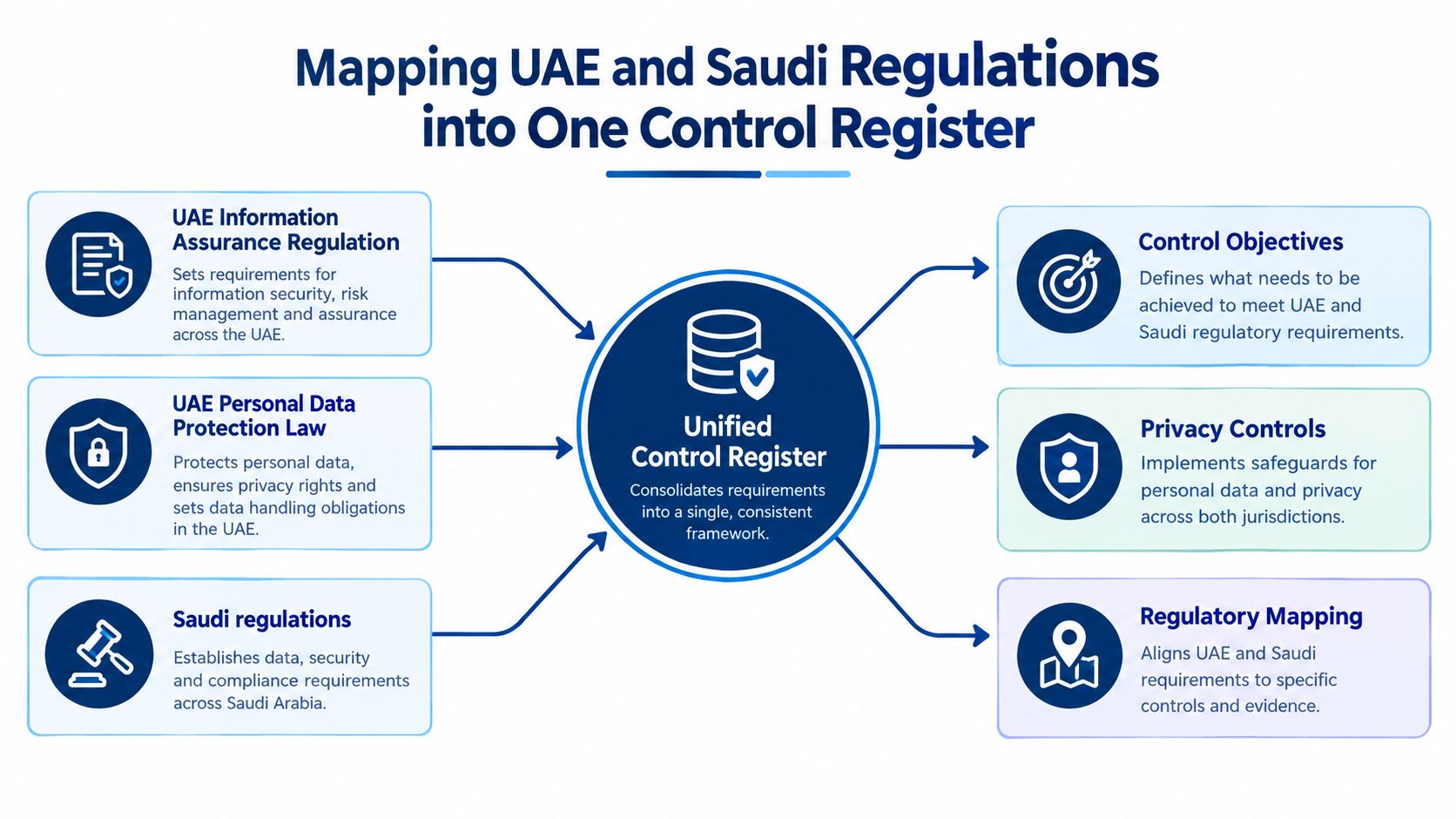
Build a unified register with shared control objectives and jurisdiction-specific obligation mappings. Don't flatten UAE and Saudi requirements into a generic compliance label. Your legal and compliance owners must validate applicability before your implementation team configures tests.
The UAE Information Assurance Regulation guidance establishes minimum protection requirements for information assets and supporting systems. Translate those requirements into testable objectives covering access, vulnerability treatment, logging, recovery, network protection and supplier oversight.
How should privacy and incident obligations enter the register?
Federal Decree-Law No. 45 of 2021, effective 2 January 2022, establishes personal-data safeguards, consent-related obligations and exceptions, correction and restriction rights, and cross-border processing requirements; the UAE Data Office is the federal regulator described in the UAE data-protection laws guidance.
Map processing purposes, lawful access, retention and transfer assessments to the relevant controls. Validate additional DIFC or ADGM obligations rather than assuming federal coverage resolves every jurisdictional question, using the UAE privacy and cybersecurity legal overview as a reference point.
For European exposure, ask counsel whether representation is required. DilicheckRep's EU and UK legal representative services provide a resource for that discussion, not a substitute for determining applicability.
The UAE Cyber Incident Response Framework and Plan covers preparation, protection, detection, response, recovery and continuous learning. Associate incident-driven treatment and corrective action with that lifecycle.
What do Saudi investment figures actually establish?
The Saudi National Cybersecurity Authority market report puts the 2023 market at SAR 13.3 billion, products and solutions at SAR 7.5 billion or 56%, government expenditure at SAR 4.1 billion or 31%, and GDP contribution at SAR 15.6 billion, comprising SAR 8.6 billion direct and SAR 7 billion indirect; it also reports approximately 19,600 professionals, with women representing more than 32%.
That establishes institutional investment, not your company's compliance. Map applicable NCA requirements into ServiceNow Policy and Compliance only after confirming scope and authoritative requirement text.
Evidence coverage: Track the percentage of critical controls with current evidence.
Exception ageing: Track the median age of unresolved high-risk exceptions.
Register discipline: Require an owner, test cadence, evidence source, exception status and applicable obligation for each control.
A Four Phase Rollout for GCC and European Enterprises
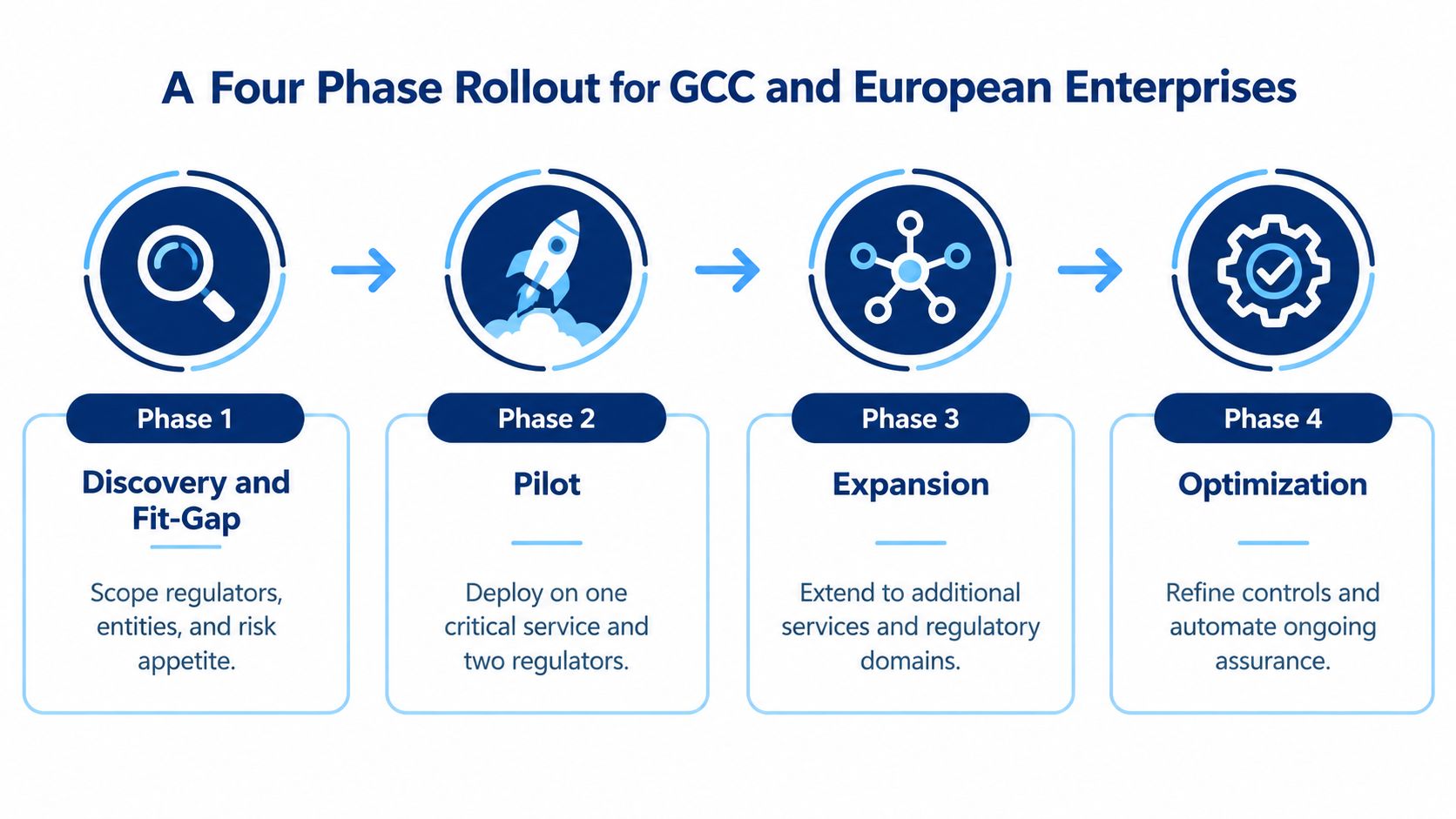
Start with a narrow, consequential pilot and expand only after the control workflow survives operational testing. A broad policy migration can look impressive while leaving ownership, evidence and escalation unresolved. Your rollout gates should test whether people can use the design under pressure.
What must discovery and the pilot establish?
Phase 1, discovery and fit-gap: Scope legal entities, regulators, critical services, risk appetite and existing evidence sources. Identify which capability needs configuration, integration, process redesign or a separate licence.
Don't let the partner treat every gap as a customisation opportunity. Challenge whether the business can adopt the standard workflow before approving bespoke development.
Phase 2, pilot: Use one critical service and two applicable regulatory mappings as a proposed implementation scope, not a universal formula. Activate executive sponsorship, stakeholder communications and role-based enablement before testing begins.
Workflow readiness: Test Arabic and English policy handling where your workforce requires both.
Hosting readiness: Verify the contracted hosting location, support access and data flows, including any proposed Abu Dhabi or Dubai data-centre arrangement.
Notification readiness: Have counsel validate applicable breach-notification triggers, recipients and timing.
European readiness: Assess GDPR-aligned controls and, for in-scope financial entities, DORA-related resilience requirements.
When should expansion and optimisation begin?
Phase 3, expansion should follow acceptance of the pilot's ownership model, evidence quality and escalation behaviour. Extend to additional entities, suppliers and integrations without duplicating the underlying control definitions.
For European logistics operations serving financial customers, distinguish contractual ICT assurance demands from direct regulatory applicability. Don't label every logistics workflow DORA-compliant.
Delivery checkpoint: A successful demonstration isn't a successful handover. Your internal team must be able to diagnose a failed evidence feed and manage an exception without the implementation consultant.
Phase 4, optimisation, upgrades and managed services requires a clear division between platform administration, control ownership, assurance and legal interpretation. Define who approves upgrades, tests integration changes and resolves broken evidence collection.
Where procurement is evaluating a wider service-management replacement, consult the HaloITSM pricing guide. Keep that sourcing decision aligned with the operating model rather than allowing a licence comparison to determine governance architecture.
Use Cases That Prove GRC Pays for Itself
Prove value through measured operational scenarios, not invented return-on-investment figures. The examples below are proposed workflow designs, not reported customer deployments. Each should have a baseline and a programme owner before you claim savings.
What should a UAE financial-services board cycle look like?
A risk manager prepares the board pack from approved risk records, exceptions and assurance results rather than reconciling independently maintained spreadsheets. The CIO reviews which material exposures require funding or an explicit acceptance decision.
The programme owner should defend report-preparation effort, manual reconciliation effort and late changes to approved reporting. A faster pack isn't valuable if the committee still can't identify the decisions it must make.
For privacy rights, configure correction and restriction requests as controlled service requests. Separate identity verification, application-owner fulfilment and completion evidence so the requester's data isn't unnecessarily exposed to every fulfiller.
Privacy KPI: Measure fulfilment against applicable deadlines and approved internal targets.
Evidence KPI: Check whether closed requests contain the verification and completion records required by the workflow.
Quality checkpoint: Confirm downstream restrictions took effect rather than relying solely on the request status.
How would a Saudi industrial supplier incident change leadership decisions?
Consider a critical maintenance supplier reporting a compromised remote-support environment. The supplier-risk owner should identify affected dependencies, while operations determines whether support access must be suspended and whether production continuity is threatened.
Tier suppliers by operational criticality before the incident. During the event, capture reassessment, compensating controls, supplier communications and the authorised decision to restore access.
Proposed scenario | Decision the workflow supports | KPI to defend |
|---|---|---|
Saudi industrial supplier incident | Suspend, constrain or restore supplier access | Time to reassess affected critical suppliers |
European logistics ICT disruption | Escalate through contractual and applicable regulatory routes | Reporting completeness and escalation timeliness |
UAE board reporting | Fund treatment or accept residual exposure | Preparation effort and reconciliation exceptions |
A European logistics firm can connect ITSM incident records with governance review to make ICT reporting repeatable. Legal owners should determine whether the obligation arises from regulation, customer contracts or internal policy.
Don't promise the platform pays for itself before measuring these outcomes. Compare implementation and operating costs against reduced manual effort, improved decision quality and demonstrated continuity performance.
Operating Models, KPIs and the AI Governance Layer
Choose ownership before designing dashboards. Centralised, federated and hub-and-spoke models suit different organisational conditions, and none compensates for unclear decision rights. My default recommendation for a multi-entity GCC or European enterprise is hub-and-spoke, provided the central team can enforce common standards.
Operating model | Where it fits | Principal trade-off |
|---|---|---|
Centralised risk office | Concentrated regulatory expertise and relatively uniform operations | Consistency can come at the cost of local responsiveness |
Embedded risk champions | Distinct business units with capable operational owners | Local relevance requires stronger calibration |
Hub-and-spoke | Shared standards across diverse entities and services | Coordination needs explicit authority and escalation |
Which KPIs should reach the board?
Use the evidence-coverage and exception-ageing measures already defined, then add indicators of service context and operational response.
Service linkage: Percentage of assessed risks tied to live services.
Response performance: Mean time to detect versus mean time to remediate, segmented by severity.
Assurance completion: Percentage of audits closed on the first cycle, with closure criteria protected from manipulation.
Decision quality: Exceptions accepted within delegated authority and reviewed when conditions change.
Don't blend detection and remediation into a single favourable average. They describe different responsibilities, and low-criticality volumes can obscure urgent failures.
How should you measure AI governance without overstating maturity?
Translate the agent safeguards below into coverage measures for declared identity and least-privilege scope, human approval thresholds, and retained, reviewable action logs. Define the agent inventory first, otherwise the denominator is unreliable.
For smaller teams developing their operating model, Rite NRG's framework for AI governance in startups is a supplementary resource to assess against enterprise requirements.
Keep platform sourcing separate from maturity claims. The SysAid pricing guide can support service-management procurement comparisons, but your committee still needs evidence that whichever tool you choose enforces approved decisions.
Agentic AI Governance and the FAQ for GCC CIOs
Govern agents as identities that can act, not just applications that generate text. Establish approval authority before deployment, then test whether security teams can reconstruct sensitive actions and stop unsafe behaviour.
A 2026 UAE study of 175 executives found 98% of security teams had encountered production AI-security risks, 92% reported sensitive-data processing, 54% encountered decisions that couldn't be explained or audited, 15% gave CISOs mandatory deployment approval, and 10% defined security requirements before evaluation; more than half had agents deployed or in development, but only one in ten considered themselves fully prepared, according to the IDC UAE AI-governance study coverage.
What must an agent-control checklist contain?
Agent identity: Assign a unique identity and accountable owner.
Least-privilege scope: Limit accessible systems, records and actions.
Human approval thresholds: Require approval for sensitive or irreversible operations.
Prompt and action logging: Record sufficient context for investigation without unnecessary sensitive-data capture.
Evidence retention: Define protected, reviewable records and authorised access.
Model-change control: Review changes to models, tools, instructions and escalation behaviour.
Use Loopfour on AI agent security as a supplementary design resource, then validate safeguards through your own tests.
What does GRC security now mean on ServiceNow?
It means connecting governance decisions with current operational evidence. Your implementation should support accountable treatment and assurance, not just document storage.
Does GRC security now require replacing every existing tool?
No, retain useful operational systems where integration and evidence quality are defensible. Replace tools when their limitations obstruct the agreed operating model, not to standardise branding.
Can GRC security now make AI agents safe automatically?
No, a governance platform doesn't guarantee safe agent behaviour. You still need enforced permissions, tested approval boundaries and a practical containment process.
DataLunix offers ServiceNow licensing support, GRC readiness and fit-gap assessments, rollout services and managed optimisation for GCC and European enterprises. Visit DataLunix to scope a critical-service pilot that connects operational resilience, regulatory evidence and AI-agent governance before you commit to a wider implementation.