
How to Choose a GRC Software Platform for Enterprise

Meta Title: How to Choose a GRC Software Platform for Enterprise
Meta Description: How should you choose a GRC software platform? Compare workflows, integrations, regional controls, implementation, and evidence before you commit.
Blog Title: How should you choose a GRC software platform for an enterprise?
Your risk register says one thing, the supplier review says another, and the evidence needed for an audit is buried in an inbox. Meanwhile, a vulnerability or privacy incident can involve teams using different systems and reporting lines. A GRC software platform should connect those records to accountable owners, practical actions, and evidence leaders can use to make decisions.
For GCC and European enterprises, choosing GRC software is an operating-model decision, not a checklist purchase. The right platform must fit your controls, jurisdictions, suppliers, and existing ITSM, ITOM, ITAM, and CSM systems. It should make risk work visible without forcing every team into an identical process.
What a GRC Software Platform Actually Does
A regional enterprise might keep cybersecurity risks in a specialist tool, operational issues in ITSM, privacy assessments in spreadsheets, supplier reviews in procurement, and audit evidence in shared folders. The problem isn't that information is spread across systems. It's that teams can't reliably connect a risk to its owner, treatment plan, control evidence, and executive report.
A GRC software platform provides a connected operating layer for identifying and assessing risk, mapping obligations to controls, assigning accountability, collecting evidence, tracking remediation, and reporting status. It shouldn't replace every source system. It should connect the relevant records and make their relationships traceable.
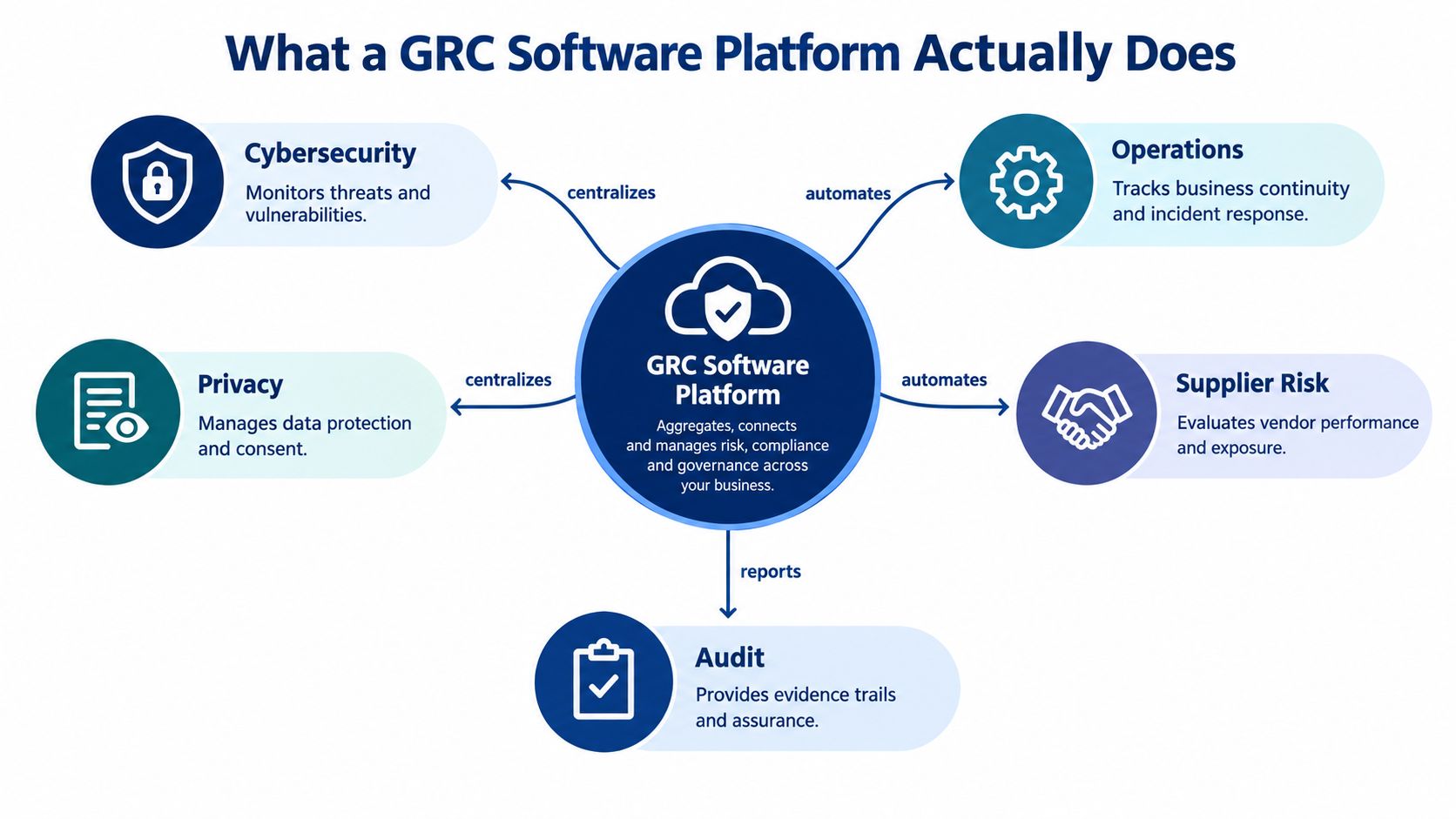
The platform has to serve three audiences with different needs:
Executives need prioritised exposure, clear ownership, and a view of whether serious risks are being treated.
Control owners need assigned tasks, understandable evidence requirements, and deadlines they can manage.
Auditors need traceable records showing who approved, tested, changed, or accepted a control.
The regional case is practical. PwC's 2022 Global Risk Survey found that 57% of Middle East respondents expected cyber risks to negatively affect their company during the following year, while 39% planned double-digit increases in cybersecurity and data-privacy spending over the subsequent three years (PwC's Middle East findings). More spending won't fix fragmented accountability on its own.
Operating condition | What the enterprise sees | What a connected platform enables |
|---|---|---|
Separate risk registers | Conflicting views of exposure | Linked risks, owners, controls, and actions |
Audit evidence scattered across folders | Slow, repeated evidence requests | Traceable records and reusable evidence |
Supplier reviews detached from procurement | Unclear accountability for vendor issues | Supplier assessments tied to controls and risk decisions |
For a useful introduction to structuring governance work, see AuditReady's guide to building audit-ready compliance frameworks. The selection test is simple: can the platform connect decisions and evidence across the operating model, not just store documents?
The Core Modules of an Enterprise GRC Platform
Treat core GRC modules as connected parts of an assurance model, not as separate items on a product sheet. Like a control room, the platform is useful only when its signals are linked and someone is accountable for responding.
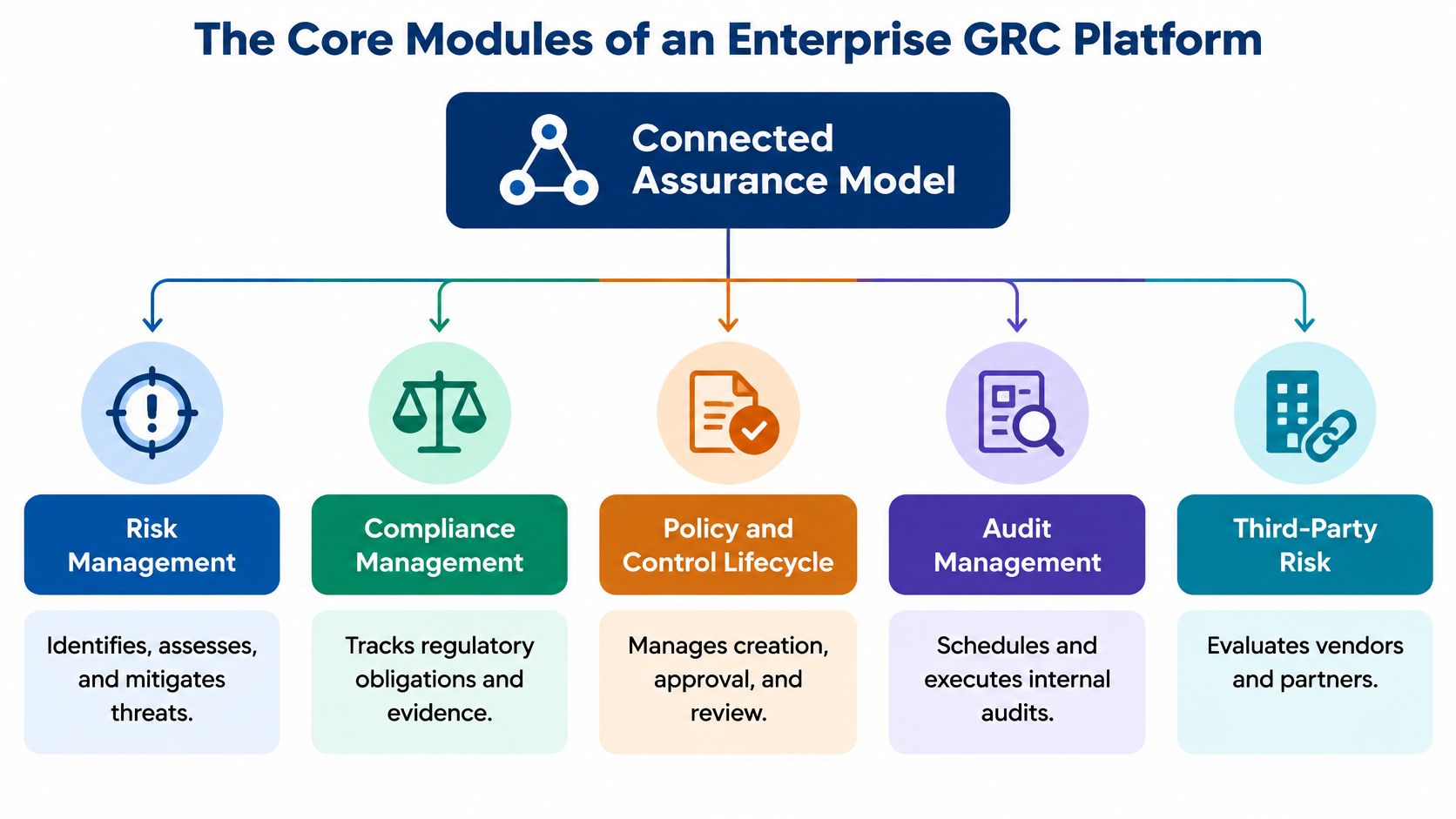
Module | Primary decision | Expected evidence |
|---|---|---|
Risk management | Which risks need treatment or acceptance? | Assessment, owner, rating, treatment, approval |
Compliance management | Which obligations apply, and are they met? | Obligation mapping, control tests, evidence |
Policy and control lifecycle | Who approves and operates each policy or control? | Publication, attestations, testing, review history |
Audit management | What assurance work is due, and what did it find? | Plans, workpapers, findings, remediation records |
Third-party risk | Does a supplier's exposure require action? | Due diligence, attestations, exceptions, review history |
Risk management should answer who owns each exposure and what treatment is approved. Compliance management should connect obligations to controls, tests, and evidence. Policy workflows need to record publication, employee attestation, approvals, and review. Audit management should link findings to corrective actions rather than leave them in a report. Third-party risk should show the supplier's business context, assessment, control gaps, and decision history.
Consider a supplier assessment that starts with a procurement record. The platform should identify relevant services and data, trigger due diligence, link the supplier to applicable controls, and assign follow-up actions. A material weakness can then flow into audit planning and executive reporting without someone manually copying the result between systems.
Practical rule: A module earns its place when it connects an accountable owner, a decision, and verifiable evidence.
Cross-module behaviours matter as much as the module names: control testing, issue remediation, risk acceptance, and immutable audit trails should work consistently across the platform. The UAE National Cybersecurity Strategy calls for risk-management standards, robust reporting, compliance and response processes, multiple governance vehicles, and approximately 20 defined performance metrics (UAE National Cybersecurity Strategy). That points to an operational measurement system, not a document repository.
How Integration Strengthens GRC Operations
GRC software gets its value from useful connections to operational systems, not from asking every team to adopt one workflow. Keep the source systems that teams already use, then connect the data needed for risk decisions, control evidence, and remediation.
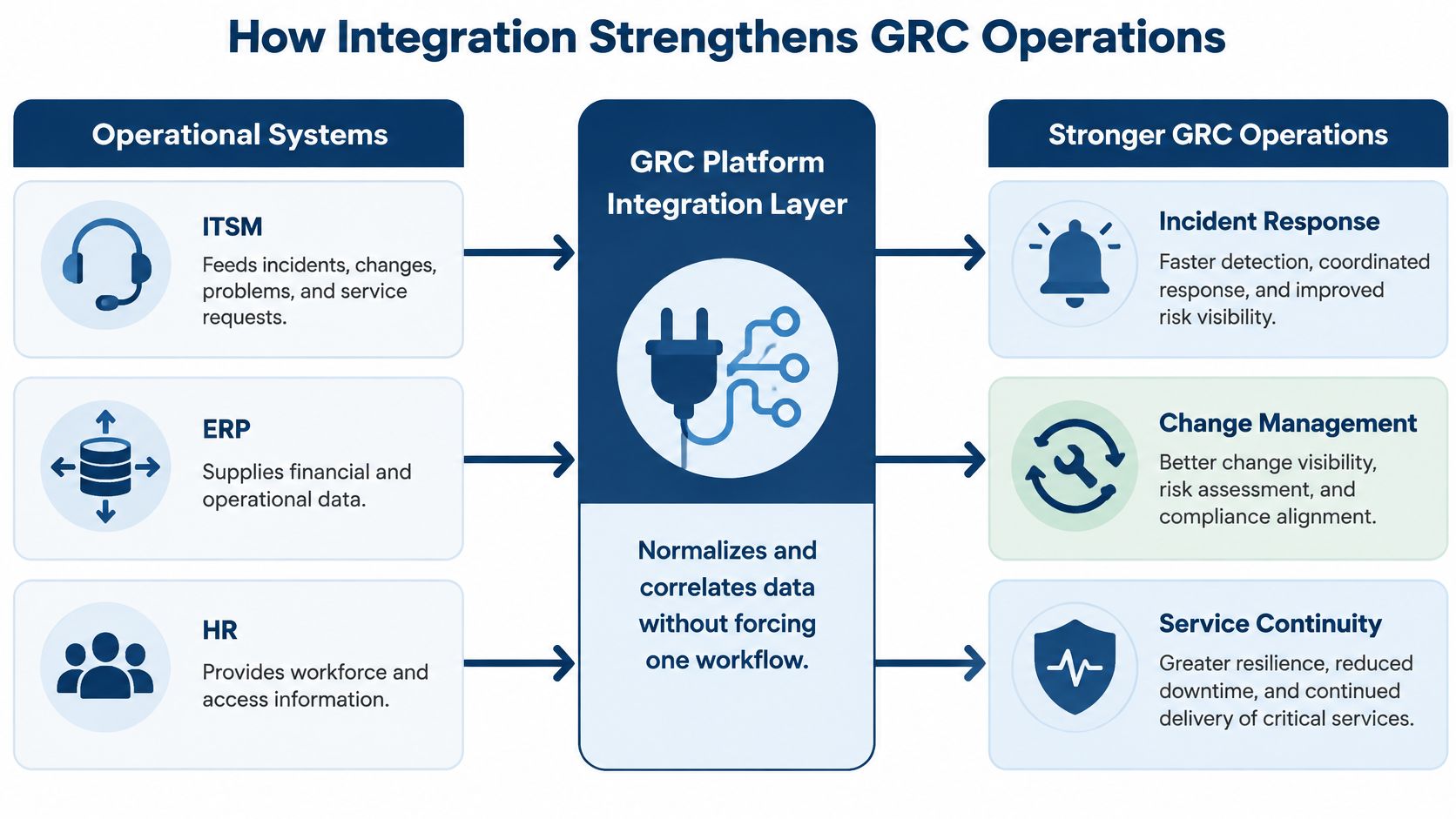
Which systems should the platform connect?
ITSM records incidents, changes, problems, and service requests. Products such as ServiceNow, Halo, Freshservice, and ManageEngine are examples to assess for integration fit, not proof of capability by name.
ITOM supplies infrastructure configuration, operational events, and change context.
ITAM identifies assets, owners, lifecycle status, and criticality.
CSM contributes customer cases, entitlements, and service context when customer impact is relevant.
An integration should preserve identity, access controls, timestamps, and evidence lineage. Ask how APIs and event triggers work, how often records synchronise, and what happens when a source record changes or disappears. A demo should show the relationship between the source record and the GRC decision, not just a dashboard tile.
For example, a critical asset vulnerability can create or update an incident, affect a mapped control, trigger a remediation task, and appear in an executive risk report. The platform should retain the links among the asset, assessment, owner, action, and closure evidence.
Operating system | Data exchanged | GRC result |
|---|---|---|
ITSM | Incidents, changes, problems, requests | Linked issues, control impact, remediation |
ITOM and ITAM | Configuration, events, ownership, criticality | Better-informed asset and technology risk |
CSM | Customer cases and service context | Risk reporting connected to service impact |
PwC's 2024 Digital Trust Insights found that 45% of Middle East respondents named cyber risk as their top priority, compared with 43% globally; 29% reported that their worst breach in the previous three years cost at least US$1 million (PwC's 2024 regional findings). Integration won't prevent every incident, but it can help teams connect operational signals to governance decisions. If you're assessing a service-management environment, DataLunix's overview of HaloITSM pricing can sit alongside a capability-based integration review.
AI can help classify incoming evidence, route tasks, remind owners, and draft reporting narratives. Keep humans accountable for regulatory interpretation, risk acceptance, and approval. A polished AI summary is not proof that the underlying record is complete or correct.
Regional Requirements That Change the Evaluation
A UAE or GCC enterprise shouldn't treat compliance as one global checklist. Federal, free-zone, sector, contractual, and internal requirements may apply to different entities and activities. Your platform should represent that structure explicitly, then let legal and compliance owners validate how obligations apply.
Under UAE Federal Decree-Law No. 45 of 2021, controllers must notify the competent authority immediately when a personal-data breach is likely to affect privacy, confidentiality, security, or data-subject rights, while processors must notify controllers without undue delay (Chambers' UAE data-protection analysis). The platform should distinguish controller and processor roles, record discovery and assessment, assign escalation tasks, and retain evidence of decisions and notifications.
Build the regional model around the work teams must perform:
Tag obligations by jurisdiction and entity. Separate federal, free-zone, sector, contractual, and internal requirements instead of applying one generic workflow.
Connect obligations to operations. Link each requirement to owners, systems, affected data or services, controls, tests, and evidence.
Configure escalation and evidence rules. Make timers, approvals, review dates, and evidence expiry visible to the people responsible.
Include supplier and AI governance. Track supplier attestations and changes, and connect AI inventories to procurement, model ownership, data lineage, monitoring, and incident workflows.
Evaluation lens | GCC question | European question |
|---|---|---|
Jurisdiction mapping | Can federal and free-zone obligations be distinguished? | Can the model reflect applicable national and sector requirements? |
Breach workflow | Can roles, escalation, and evidence be configured by regime? | Can the workflow accommodate differing reporting obligations? |
Supplier assurance | Can local evidence and supplier changes be governed? | Can third-party evidence be managed across jurisdictions? |
AI governance | Can controls reflect sector, emirate, and use case? | Can governance adapt to relevant regional and sector obligations? |
Europe also requires careful mapping across national and sector contexts. Don't assume one reporting model works everywhere. Ask legal and compliance owners to validate the obligation matrix before configuring workflows; a vendor's generic framework library isn't a substitute for that decision.
How to Compare Platforms and Run an RFP
Start with risk scenarios, not vendor feature lists. Define the decisions your organisation needs to make, the records that support them, and the evidence an auditor or regulator would expect to see. Then compare platforms against that operating model.
A 2025 YouGov survey of 330 UAE senior IT and business decision-makers found that 62% directly monitor compliance across all third-party providers, while one in three still reported compliance gaps (Cohesity's UAE data-sovereignty discussion). That makes supplier evidence a live RFP scenario, not an optional module to defer without discussion.
What should the RFP test?
Require vendors to demonstrate:
Control mapping: How obligations map to controls and how a changed requirement affects existing assessments.
Evidence lineage: Whether reviewers can trace a report back to source records, owners, approvals, and test results.
Workflow and exception handling: How overdue actions, temporary exceptions, and risk acceptance are approved and reviewed.
Integration: API and event capabilities, identity controls, synchronisation, and failure handling.
Audit and governance: Exportable audit histories, segregation of duties, and reporting that supports different audiences.
AI governance: How AI-assisted outputs are checked, traceable, and kept separate from human approvals.
Delivery and exit: Migration support, service-level commitments, upgrades, data export, and exit procedures.
Criterion | Proof to request | Decision weight |
|---|---|---|
Regional obligations | Live jurisdiction-tagged workflow | Must-have |
Third-party assurance | Supplier failure or breach scenario | Must-have |
Integration | Demonstration using your source systems | Must-have |
Reporting and audit | Traceable report and evidence export | Must-have |
AI assistance | Review, provenance, and approval controls | Based on use case |
Commercial model | Transparent licensing and service assumptions | Must-have |
Run a live scenario, such as a supplier breach that affects a critical service. Watch whether the platform connects the supplier, affected data or systems, control impact, escalation, remediation, and executive reporting. Ask users to operate the workflow rather than accepting a scripted presentation.
Model total cost of ownership across licences, implementation, integration, data cleansing, training, change management, managed services, upgrades, and internal ownership. Treat ROI as a hypothesis to test through reduced manual effort, fewer duplicate controls, faster evidence retrieval, and better remediation decisions. If service-management costs are part of the comparison, DataLunix's Freshservice pricing overview can help frame the wider platform discussion, but pricing alone won't establish fit.
Implementation Migration and Adoption Roadmap
Choose a platform only when you can explain how it will become part of everyday work. Implementation begins with discovery and readiness, not a bulk import of every spreadsheet and policy file.
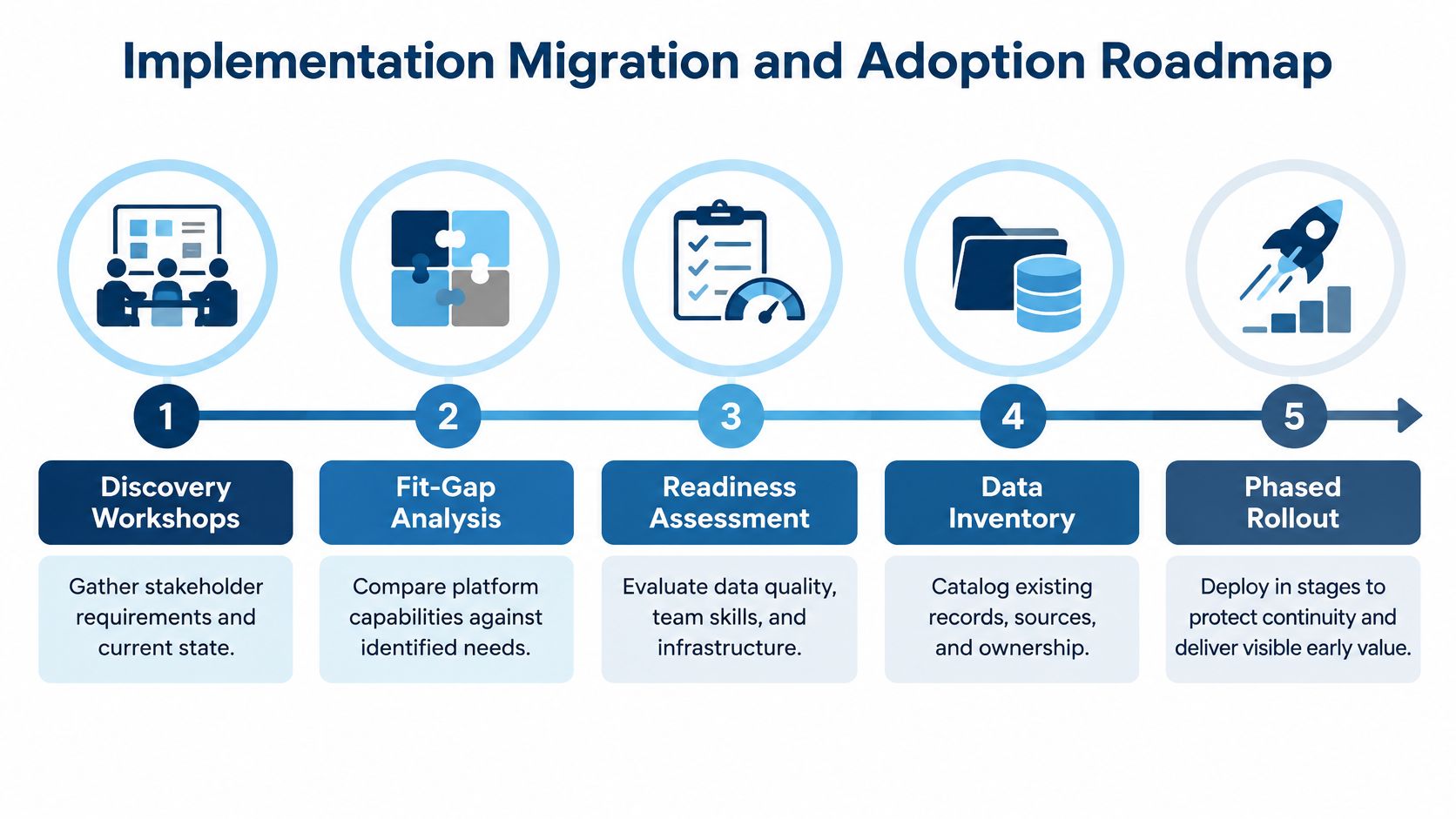
What should happen before rollout?
Run discovery workshops with risk, compliance, audit, security, procurement, IT operations, and business owners. Complete a fit-gap analysis and readiness assessment, then inventory data sources, control taxonomies, ownership, and integrations. Decide which records are authoritative before migration begins.
Clean the material you intend to move. Consolidate duplicate policies, identify current owners, distinguish active supplier records from historical ones, and classify audit evidence by relevance and retention needs. Preserve useful history, but do not migrate poor-quality data merely because it exists.
A practical sequence is:
Pilot one domain or business unit. Validate the workflow, control mappings, evidence requirements, and user responsibilities.
Test integrations and reporting. Confirm records synchronise, changes are visible, and executives can interpret the output.
Expand by jurisdiction and entity. Add requirements and workflows after legal and compliance owners validate their applicability.
Optimise operations. Review adoption, exceptions, evidence quality, and configuration after teams begin using the system.
Phase | Primary deliverable | Exit evidence |
|---|---|---|
Discovery and fit-gap | Agreed scope and operating requirements | Owners confirm processes and priorities |
Readiness and inventory | Data, control, and integration plan | Sources and ownership are documented |
Configuration and migration | Working workflows and cleansed records | Evidence and approvals are traceable |
Pilot validation | Tested service and reporting workflows | Adoption, completeness, and stability meet agreed criteria |
Phased rollout | Expanded deployment and support model | Executive reporting and ownership are active |
Use decision gates for pilot acceptance, evidence completeness, workflow adoption, integration stability, and executive reporting. Plan delivery as onshore, offshore, or hybrid according to stakeholder needs, access constraints, and delivery capacity. DataLunix's discovery, readiness, enablement, and managed-service model can support GCC and European programmes; define the scope and acceptance criteria before treating any delivery model as a fit.
The UAE Federal Decree-Law on Personal Data Protection requires controllers to notify the competent authority when they become aware of a personal-data breach or violation, assess its effect, and document the response (UAE legislation on personal data protection). Make sure migration and workflow tests can preserve that incident timeline and supporting evidence.
KPIs Common Pitfalls and the Buyer Action Plan
A GRC platform is working when people use it to make and evidence decisions, not merely when users can log in. Track indicators that reflect adoption, timeliness, assurance, risk, suppliers, and business outcomes.
KPI group | Example measure | Why it matters |
|---|---|---|
Ownership and adoption | Active control ownership | Shows whether responsibility is assigned and exercised |
Evidence quality | Evidence completeness | Reveals whether control claims can be substantiated |
Remediation | Overdue actions and exception age | Highlights unresolved exposure and stalled decisions |
Risk governance | Visibility of accepted risks | Shows whether acceptance is accountable and reviewable |
Supplier assurance | Supplier review coverage | Indicates whether external exposures receive attention |
Audit efficiency | Audit request turnaround | Tests whether evidence is findable and reusable |
Workflow performance | Cycle time for key processes | Identifies bottlenecks and avoidable hand-offs |
Executive oversight | Use of risk reporting in decisions | Tests whether reporting supports action |
Avoid the common traps: launching with every framework at once, importing unclean data, treating AI features as governance, underfunding control ownership, measuring only logins, overlooking supplier evidence, and failing to integrate operational systems.
A dashboard isn't a control. The accountable owner, reliable evidence, and completed action are what make the process defensible.
For regulated financial institutions, the UAE Central Bank's Operational Risk Regulation requires IT policies and processes to identify, assess, monitor, and manage technology risks. That supports a repeatable control cycle, which a platform should make visible through owners, evidence, monitoring, and treatment records (UAE Central Bank Operational Risk Regulation).
Before signing, define the highest-risk scenario, identify the system of record, prove an integration, demand evidence-level demonstrations, model total cost, and agree adoption and outcome measures. For further service-management comparisons, DataLunix's SysAid pricing overview can be considered alongside the broader GRC business case.
DataLunix supports enterprise transformation through discovery, fit-gap analysis, readiness assessment, implementation, integration, enablement, and managed services across GCC and European environments. If you're evaluating a GRC operating model and need to connect it with your existing service-management systems, visit DataLunix to discuss your requirements.