
ICT Risk: How to Assess, Control and Report It

ICT risk is exposure to harm from technology failure, misuse or concentration, affecting confidentiality, integrity, availability or a business objective. The TDRA government cybersecurity monitoring report recorded 43,247 attempted cyberattacks and 197 incidents in April 2020, with 67 incidents classified as severe. Attack volume alone says little about business impact.
Keep attempts, incidents and severity separate on the register. The same report recorded 120,038 attempts in July 2020, approximately 177.5% more than in April, while incidents fell slightly to 181. Score each risk against the affected service, control weakness and accountable owner, so high activity does not obscure operational or strategic exposure.
What ICT Risk Means for the Enterprise
ICT risk is the chance that failure, misuse or over-reliance on information and communications technology harms confidentiality, integrity, availability or a stated business objective. It's broader than a cyber metric. A quiet month for incidents can still hide a dangerous position if one identity provider, cloud region or outsourced desk can stop payments, clinical care or payroll.
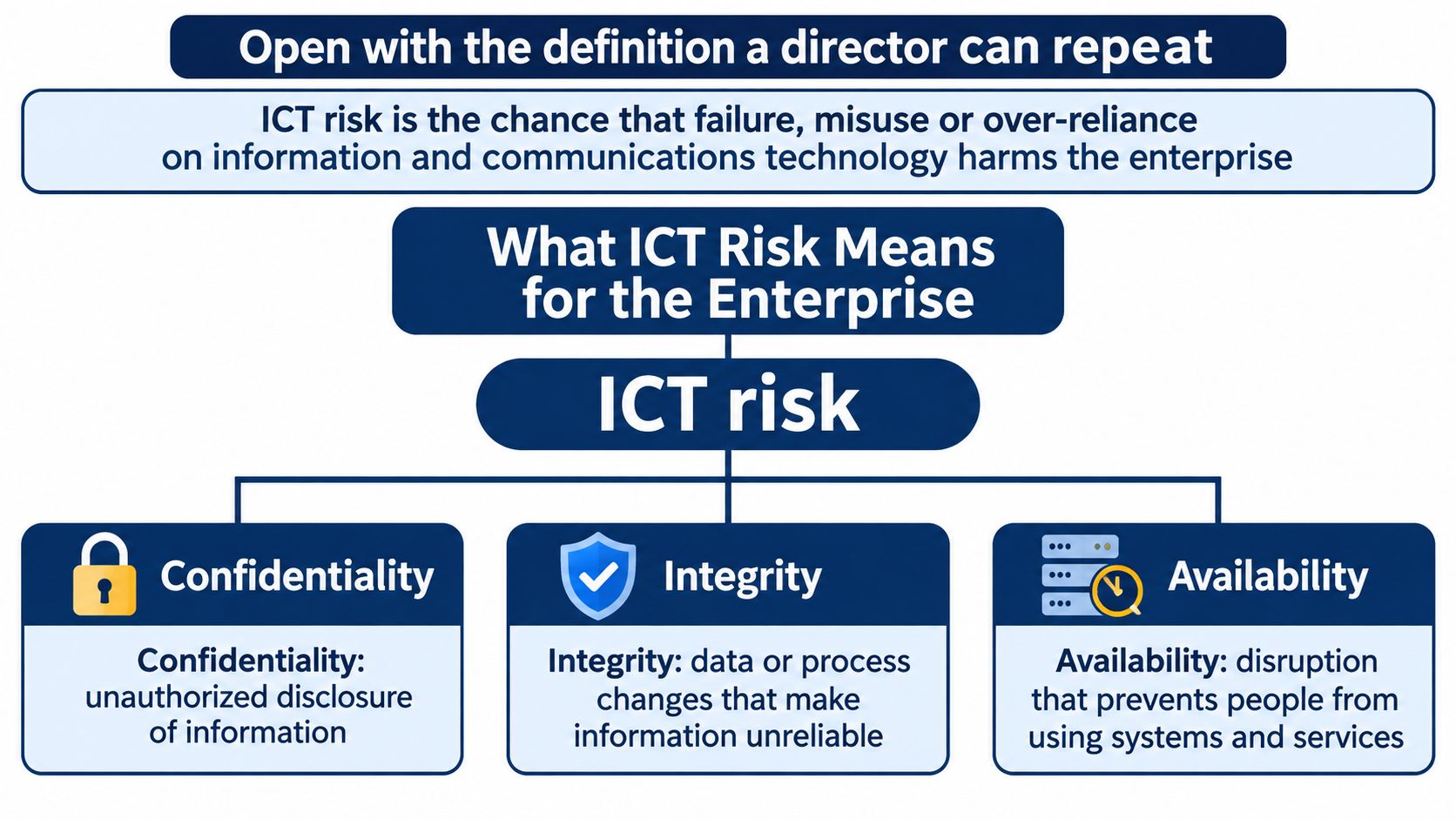
The three categories you need
Technical ICT risk sits in assets, identities, configurations, vulnerabilities and networks. An internet-facing host left unpatched for years belongs here because the immediate weakness is technical, even if exploitation later disrupts operations. The CISO and infrastructure lead need a reliable asset record before they can defend it.
Operational ICT risk sits in how work runs. Change, incident handling, capacity, backup, supplier run-books and service desk mistakes determine whether a technical fault becomes a business outage. A failed change during a peak trading or payroll week is operational because scheduling, approval and rollback failed to protect the service.
Strategic ICT risk comes from choices the board owns. Vendor concentration, cross-border processing, new regulatory duties and AI systems able to alter production belong here. A single EU payments region with no tested exit isn't solved by another monitoring tool, because the exposure is the sourcing decision itself.
Category | What it covers | Typical trigger | Accountable owner |
|---|---|---|---|
Technical | Assets, identity, configuration, vulnerabilities, networks | Internet-facing host unpatched for years | CISO with infrastructure lead |
Operational | Change, incident, capacity, backup, supplier run-books, desk error | Failed change in a peak trading or payroll week | Head of IT operations |
Strategic | Vendor concentration, residency, regulation, AI that can change production | Single EU cloud region for payments with no exit test | CIO with the board risk committee |
Practical rule: Give every issue one primary category. Add a secondary tag only when one control genuinely spans both, so the same outage isn't scored twice.
Start by filing your open issues against the table today. If two teams claim the same risk under different categories, keep the category that identifies the decision needed first. That choice tells you who must act, what evidence matters and whether the board, operations or security owns the next step.
How to Score ICT Risk on a Register
Build the register inside your service platform, not as a quarterly spreadsheet exercise. Every row needs a risk ID, category, asset or service, owner, inherent likelihood, inherent impact, heat score, existing control, residual score, treatment, due date and evidence link. Without an owner, date and evidence field, you've created an observation list rather than a management tool for ICT risk.
Score or band | Likelihood | Impact | What to do |
|---|---|---|---|
1 | Rare, under once in five years | Negligible, no customer effect | Record only |
2 | Unlikely, once in two to five years | Minor, one team delayed | Accept with a review date if product is 1 to 4 |
3 | Possible, about yearly | Moderate, a service misses its SLA | Monitor if product is 5 to 9 |
4 | Likely, several times a year | Major, critical service or reportable data event | Mitigate inside an SLA if product is 10 to 15 |
5 | Almost certain this quarter | Severe, safety, payments, care or board-level breach | Escalate the same week if product is 16 to 25 |
Multiply likelihood by impact. Scores of 1 to 4 can be accepted with a review date, 5 to 9 need monitoring, 10 to 15 need mitigation inside an agreed SLA, and 16 to 25 need escalation the same week. Colour the heatmap to match those bands so a director can see the required action without reading scoring notes.
Why exposure age changes likelihood
Teams under-score old weaknesses because nothing happened last month. That's the wrong test. The Gulf News report on the UAE cybersecurity assessment identified more than 223,800 internet-facing or otherwise exposed assets, while approximately half of critical vulnerabilities had remained unaddressed for more than five years.
That age should raise likelihood. A long remediation cycle gives attackers more time to chain weaknesses across identity, network and application layers, even when current exploit counts look flat. I would score a critical, internet-facing weakness that has remained open for years at likelihood 5 unless you can prove that compensating controls block the relevant path.
Configuration deserves equal attention because misconfiguration represented 32% of reported cyber incidents in the same assessment. Don't let a scanner close the discussion. Authenticated scanning, secure baselines and drift detection should feed the score, while the register records who owns remediation and when it breaches your risk appetite.
How to keep scores honest
Classify the asset first: Record business criticality and external exposure before assigning likelihood.
Use risk-based SLAs: Measure overdue critical exposure, not total tickets closed.
Rescore after change: Update the score after every material change and completed treatment, not only at quarter-end.
Escalate visibly: Send exposures beyond risk appetite to an executive owner with a dated decision.
Now take one live service and complete a blank row. Name the configuration item, write the harm in business language, score it before controls, list the control that operates today, then record the residual score. If you can't link evidence for that control, don't claim the reduction yet.
Controls That Actually Reduce ICT Risk
A control earns credit in the ICT risk register when it changes likelihood or impact and leaves evidence that an owner can inspect. Record whether it addresses technical, process or governance exposure, then link the evidence to the relevant service or configuration item. This keeps operational weaknesses, vendor dependencies and the authority granted to AI agents visible alongside technical exposure.
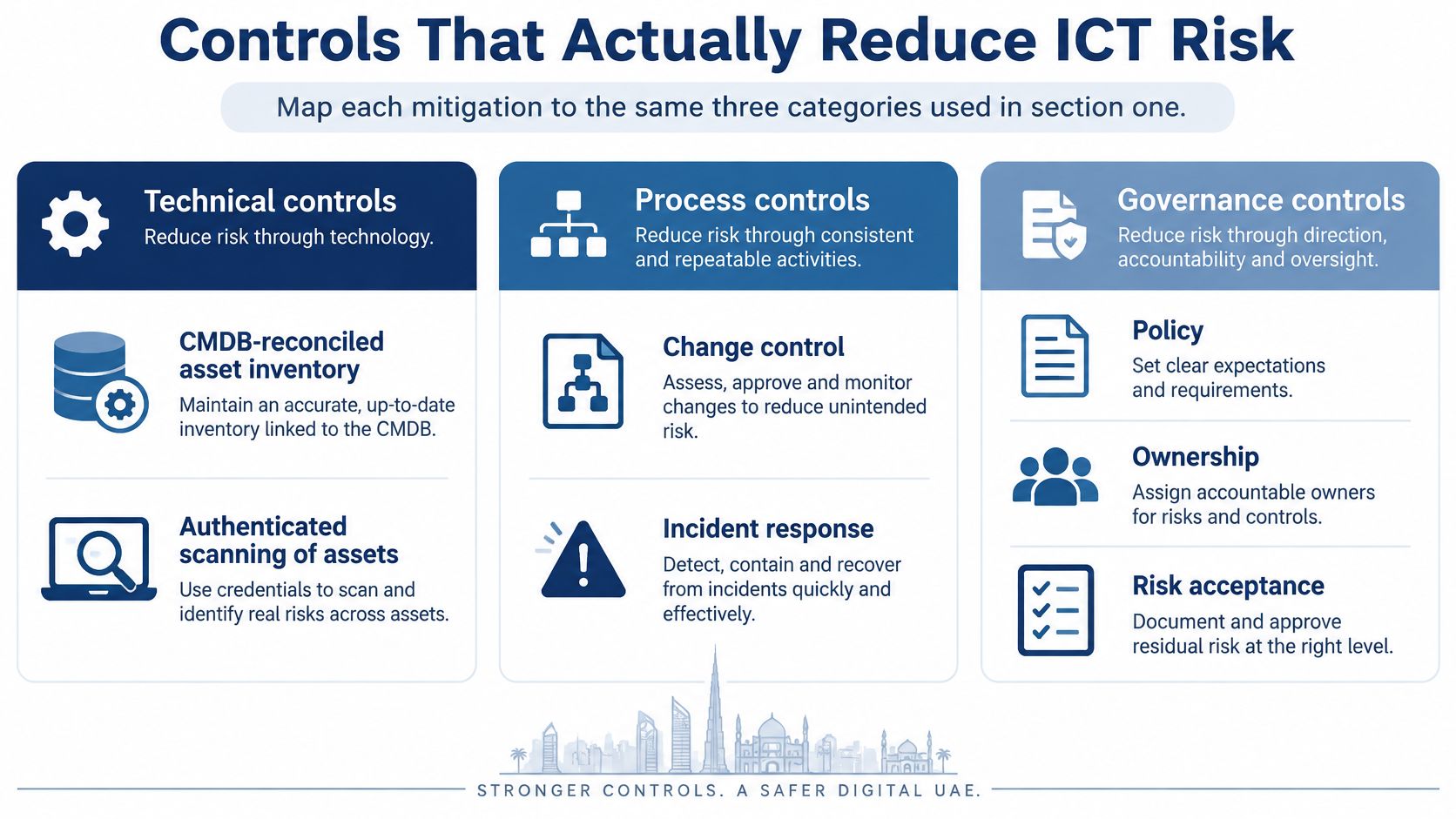
Technical, process and people controls
Technical controls include a CMDB-reconciled asset inventory, authenticated scanning, secure configuration baselines, drift detection, identity hardening, email and endpoint protection, and backups restored in a test. For critical customer journeys, independent uptime monitoring gives availability evidence beyond the platform's own health reporting. Keep dependencies current: an outage or compromise at a concentrated vendor can affect several services at once.
Process controls connect findings to accountable work. Tie change approval to the heat score, assign vulnerabilities an owner and risk-based SLA, and track incidents from identification through containment, recovery and follow-up. A service platform should preserve the links and timestamps that let teams trace a finding from risk record to change or incident. SysAid licensing considerations may inform a platform comparison, but licensing alone does not show whether a control operates or produces usable evidence.
People controls define decision rights. Record who may accept risk, who is on call, how phishing is exercised and which approvals apply to privileged or automated changes. For an AI agent, specify the actions it may take, the approval threshold and the human owner responsible for exceptions. The UAE Cyber Incident Response Framework formalises incident management through governance, alert schemas, reporting requirements and lifecycle management. That means clear classifications, reporting routes and a tracked response, not just an escalation email.
Control | Category | Residual score allowed | Evidence field |
|---|---|---|---|
CMDB-reconciled asset inventory | Technical | 1 to 4 for internet-facing assets | Reconciliation report linked to CI |
Authenticated scanning of internet-facing systems | Technical | 9 or below per finding | Scan export with owner and SLA date |
Secure configuration baselines and drift detection | Technical | 9 or below | Baseline version and drift alert record |
Change approval tied to heat score | Process | 9 or below before change | Change record linked to risk ID |
Incident lifecycle from identification to follow-up | Process | 6 or below after recovery | Incident record with timestamps |
Named risk acceptors and on-call rota | People | Accepted only at 1 to 4 | Signed acceptance in register |
Privileged and automated change approval threshold | People | 4 or below for AI-initiated change | Approval log |
Give misconfiguration its own control. Patch volume does not prove that exposed settings are corrected. Re-score after treatment, and allow a lower residual score only when evidence shows the control was operated. A purchase record is not proof of operation.
Governance Reporting in the GCC and Europe
Governance decides who can accept ICT risk, what must be reported and how quickly the organisation must act. Don't rescore risks in the board pack. Show the current residual position, overdue treatments, concentrations and decisions required, then let accountable executives accept, fund or reject each treatment.
UAE scope and reporting duties
Your first UAE scope test is whether you operate assets or services designated as critical. According to the UAE government cyber safety and digital security guidance, the Telecommunications and Digital Government Regulatory Authority (TDRA) designates critical entities that must apply the Information Assurance Regulation under the Critical Information Infrastructure Protection Policy.
That regulation requires organisations to establish, implement, maintain and continuously improve information assurance across information assets and supporting systems. Its scope covers the use, processing, storage and transmission of information and data, plus the supporting systems and processes. Treat the UAE TDRA and government cyber-safety pages as your public baseline when you map controls and scope.
Personal data needs a separate register dimension. The UAE government data protection laws summary describes Federal Decree-Law No. 45 of 2021 as an integrated framework for personal-data confidentiality and privacy. An outage register that ignores unlawful processing, excessive collection or confidentiality failure is therefore incomplete.
Prepare breach content before an incident forces the question. Your incident record should already hold the breach's nature and form, causes, approximate record counts, categories of people affected, contact point, likely consequences and measures taken or proposed. Processors need a tested route to notify controllers quickly, with facts preserved from detection.
European duties and one shared board pack
In Europe, financial entities manage ICT risk under DORA as a board resilience duty. They maintain registers of ICT arrangements, assess provider concentration, test scenarios and report major incidents to authorities. Organisations outside finance may still face NIS2-style duties for essential services and GDPR breach-notification clocks, so legal, security and operations need one escalation calendar.
Use the DORA regulation text itself as the EU reference point for financial entities. The point for your board isn't the article number. It's whether critical functions can continue, whether one provider creates unacceptable concentration and whether an exit can be executed under pressure.
One pack can serve both regions if it contains:
Top residual risks: Business service, owner, score and decision required.
Overdue treatments: Age, reason for delay and revised date.
Concentration map: Critical providers, regions, subcontractors and exit status.
Open critical exposures: Asset, exposure age and compensating control.
Incident view: Total incidents shown beside severe incidents and customer impact.
Decision log: Risks accepted, funding approved and deadlines set by the board.
Report volume and severity together. A fall in total incidents means little if severe cases, overdue critical exposures or single-provider dependencies are rising.
Close every pack with named decisions rather than awareness items. If the board accepts a score above appetite, record the acceptor, expiry date and condition that will force the risk back onto the agenda.
Putting ICT Risk into ITSM and AI Workflows
A register stored beside the service platform quickly becomes stale because assets, incidents and changes move without it. Put ICT risk into the record flow your teams already use, whether that's ServiceNow, HaloITSM or Freshservice. The risk record should point to the CMDB configuration item, treatment work and evidence, not duplicate them in free text.
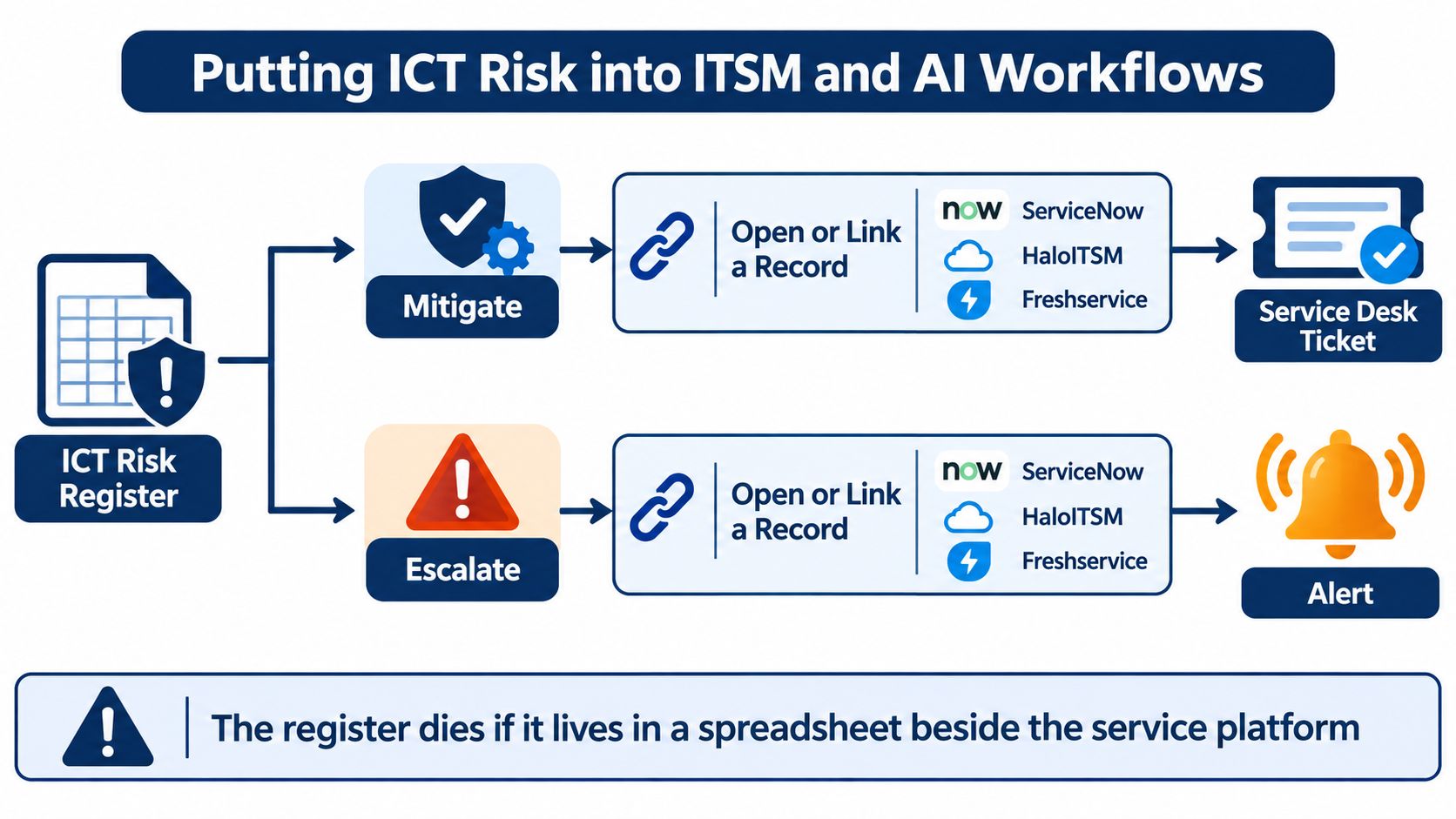
The record flow that keeps risk current
When a risk enters the mitigate or escalate band, open or link the work immediately. Use a problem or change record for treatment, an incident when the risk is already live, the CMDB item as the asset and an attachment or knowledge article as audit evidence. ITOM discovery should then refresh exposure so a new internet-facing host becomes a risk candidate promptly.
Platform design matters more than dashboard design. Our overview of Freshservice licensing and plan fit can support procurement, but you still need mandatory links between risk, configuration item, owner, treatment and evidence. If those fields are optional, reporting will drift within one quarter.
Narrow permissions for AI
Use AI for drafting and routing, not unsupervised closure. It can draft a risk statement from the configuration item and recent incidents, suggest likelihood from vulnerability age and criticality, summarise evidence and route approval to the service owner. It must not close a critical exposure or approve production change on its own.
Maintain an inventory of every agent and copilot. For each one, record the model or service used, tools it may call, data it may read, actions it may trigger, logging arrangements and the human threshold at which it must stop. Include Arabic-language records, cross-border support access, fallback procedures and evidence retention in that assessment.
The Al Etihad report on the UAE cybersecurity report 2025 highlights AI-driven phishing, misinformation and attacks against critical infrastructure while calling for AI-governance frameworks and stronger cybersecurity audits. It also points to GCC data-centre capacity projected to grow from roughly 1 GW in 2025 to about 3.3 GW over the following five years.
Local hosting still isn't the same as control. Data may sit in a UAE or EU region while updates, administrators, telemetry, model dependencies or incident response remain externally controlled. Record that gap as strategic exposure and test the manual register path. If the platform or model is unavailable, your team must still identify critical risks, assign owners and escalate decisions.
ICT Risk Scenarios Teams Already Face
Attack volume can fall while ICT risk becomes more concentrated. The Arabian Business report on UAE cyber threats states that DDoS attacks fell from 58,538 in the first half of 2023 to 2,301 in the first half of 2024, a decline of approximately 96.1%, while the number of ransomware groups operating in the UAE increased by 58%. Those figures describe different threats, so they should not be collapsed into a single measure of business exposure. Record the affected service, owner, evidence and operational consequence.
A ransomware incident on a Dubai finance file share can begin with compromised identity or an exposed service. Business impact then depends on how quickly the service is isolated and whether restoration priorities are clear. Recovery depends on isolated, tested backups and documented restoration priorities. For a separate hardware failure, recovering data from a failed hard drive addresses device recovery, not ransomware response.
Age is a risk factor for critical flaws. Track the oldest open exposures, rather than relying on closed-ticket totals, and set risk-based SLAs for internet-facing assets. If remediation must wait, record compensating controls, the accountable owner and the target date. Escalate the oldest critical exposures to the CIO so that accepted risk remains visible.
Configuration drift creates another exposure. An emergency change, supplier update or manual fix can leave an exposed service outside its approved baseline. Link the baseline, drift alert and reconciliation to the change record. That gives reviewers evidence of what changed and whether the service returned to its approved state.
A single EU cloud region carrying payments can create strategic concentration even when availability appears strong. Put the dependency, available substitutes and exit test in the risk record, then assign the board treatment. An exit statement without a tested route does not reduce the score.
A processor breach requires legal and operational facts in the same ticket, including estimated record counts and the controller notification path. An AI copilot with authority to approve change presents a separate governance risk. Remove that permission until a human approval threshold is defined and decisions are logged.
Scenario | Category | Score and heat band | First move |
|---|---|---|---|
Ransomware on a Dubai finance file share | Technical and operational | 4 x 5 = 20, escalate | Isolate identity and restore tested backup |
Critical flaws open more than five years | Technical | 5 x 4 = 20, escalate | Risk-based SLA on internet-facing assets |
Configuration drift on exposed services | Technical | 4 x 4 = 16, escalate | Baseline and drift detection, not patch count |
One EU cloud region for payments | Strategic | 3 x 5 = 15, mitigate | Board treatment and an exit test |
AI copilot able to approve change | Strategic | 3 x 4 = 12, mitigate | Remove tool permission until a human threshold exists |
Add matching cases to the ITSM risk register with an owner, score, evidence and first move. Keep technical, operational and strategic exposure connected to the service record, so decision-makers can see both immediate control work and dependencies that may constrain future choices.
Run a Readiness Check Before You Fund Controls
Don't fund automation until you know whether the underlying ICT risk record is trustworthy. Run this workshop check with security, operations, service owners and procurement in the room, and require evidence for every yes. A small organisation may supplement its thinking with a practical threat assessment for Edmonton businesses, but GCC and European enterprises still need their own asset, provider and regulatory scope tested.
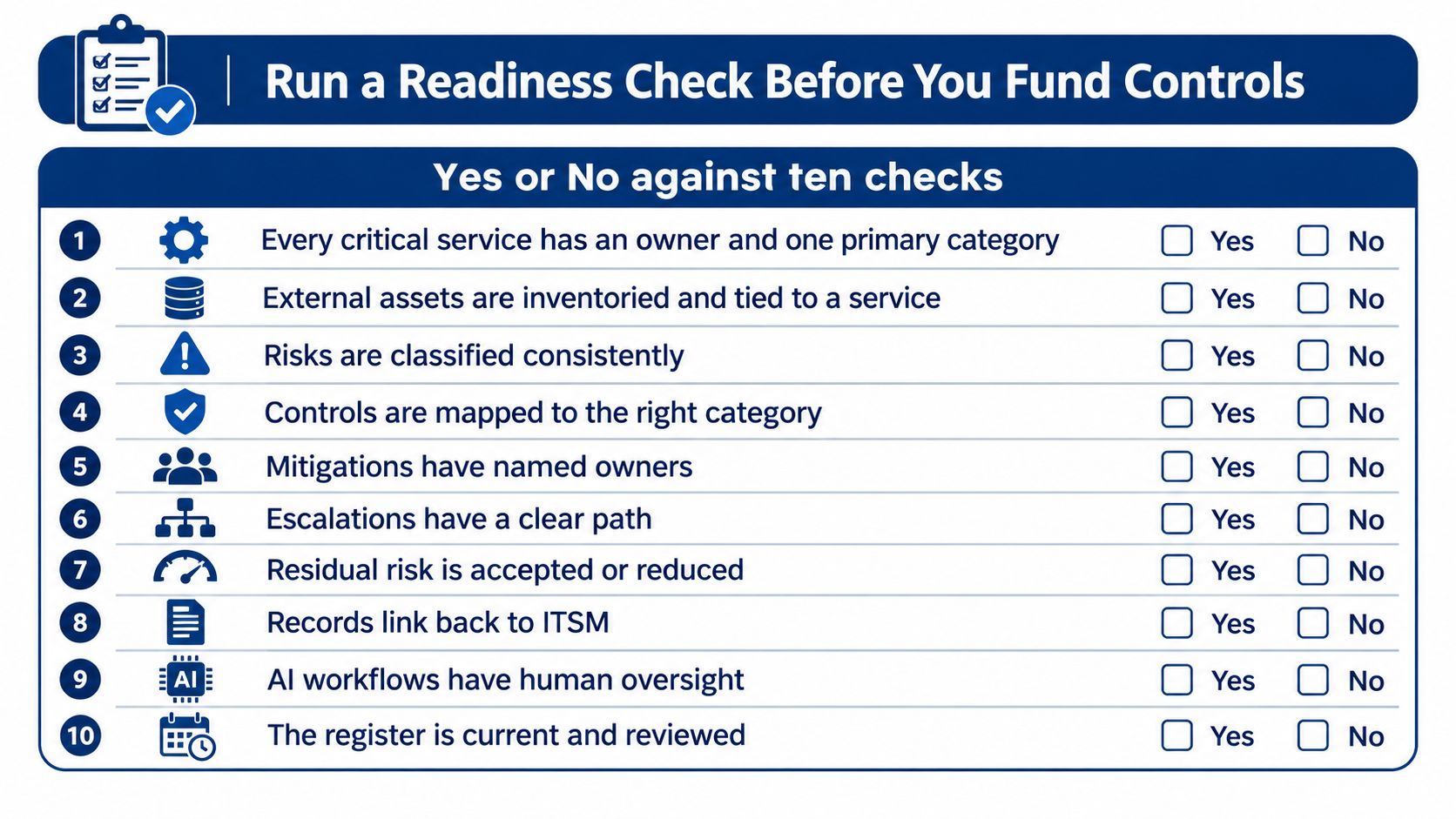
Answer yes or no:
Every critical service has an owner and one primary category.
External assets are inventoried and tied to a configuration item.
Critical vulnerabilities older than your age limit are visible to the CIO.
The 1 to 5 scales and four heat bands are written down.
Every treatment scored 16 or above has a date and evidence link.
Incident records hold UAE or GDPR notice content from detection.
Vendor concentration is a named strategic risk with an exit idea.
AI agents are listed with tool permissions and a human stop.
Scorers see the same record in HaloITSM, Freshservice or ServiceNow.
A board pack exists for this quarter.
If you're comparing platforms during the pilot, see our guide to HaloITSM licensing and implementation fit, then judge the tool against the ten checks rather than its dashboard.
Under 6 means you're not ready to automate scoring. Six to eight means pilot the register inside the ITSM tool before adding models. Nine or ten means AI may draft statements and route approvals, with a human stop on critical exposure. We start every consulting engagement with discovery workshops, fit-gap analysis and readiness assessments that map requirements to technological capabilities, determine solution scope and identify organisational or technical gaps. Our no-obligation discovery call maps your current tooling, licence position and process gaps, and a senior consultant replies within one business day with next steps.
Turn your readiness score into a working ICT risk register with owners, evidence and board decisions inside your ITSM platform. Visit DataLunix to book a discovery call, and we'll map your current tooling, licence position and process gaps before recommending the next control or transformation step.