
What Is an Integrated Risk Management Application?

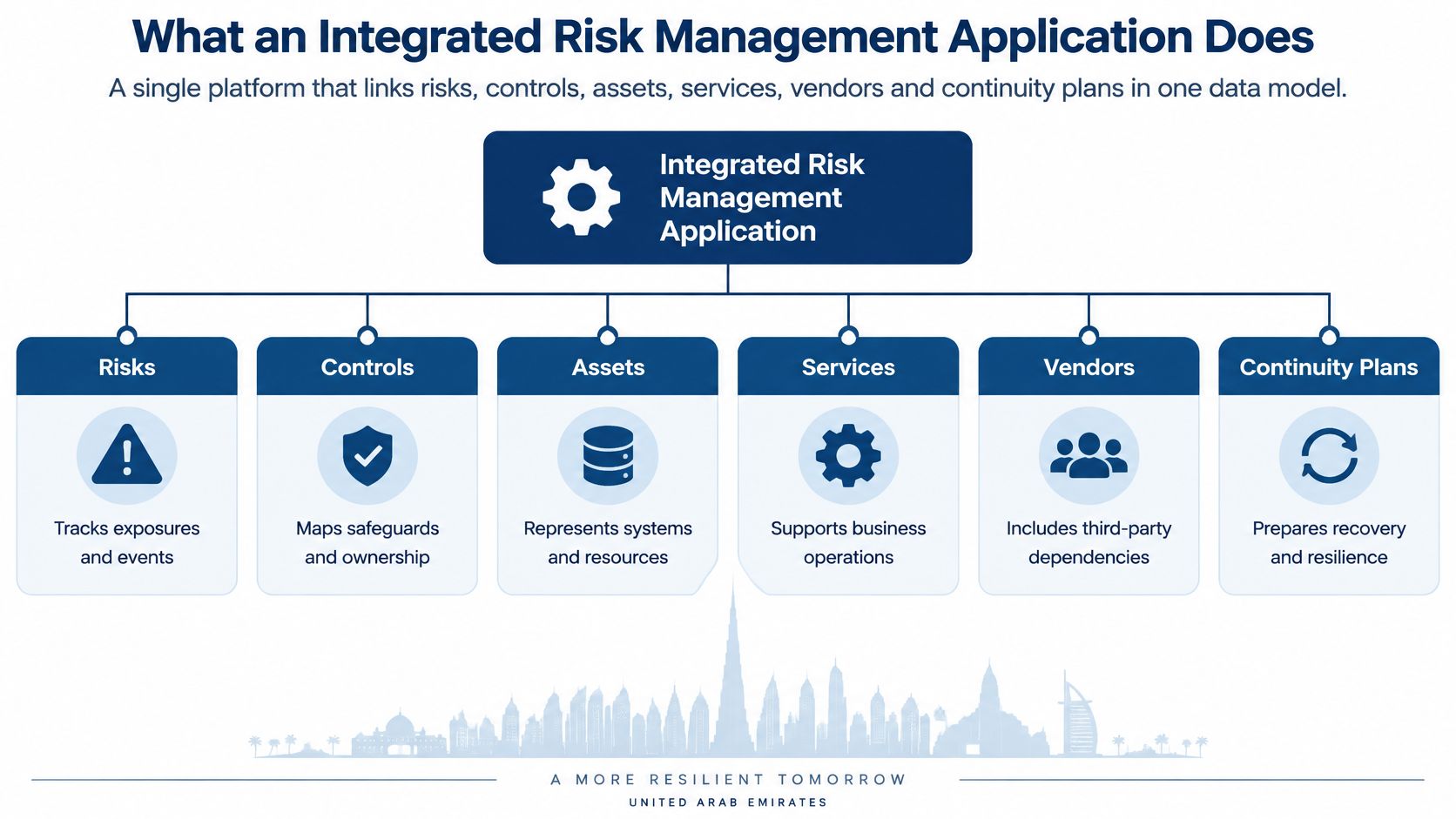
An integrated risk management application is a single platform that links risks, controls, assets, services and vendors so one linked risk view drives decisions. If your payment service failed today, could your team identify the affected processes, responsible suppliers and recovery owners without assembling spreadsheets?
Meta Title: Integrated Risk Management Application Guide for ITMeta Description: Learn how an integrated risk management application connects services, assets and vendors, validates recovery plans, and helps your team prove resilience today.Blog Title: What Is an Integrated Risk Management Application?
What an Integrated Risk Management Application Does
An integrated risk management application connects exposures to safeguards, accountable owners and continuity plans. When someone changes a service or records a control failure, the linked records should trigger reassessment rather than wait for another scheduled review.
Think of scattered spreadsheets as smoke alarms in separate rooms that never communicate. The application acts as the building's alarm panel, showing where the problem started and who must respond.
Core capabilities of an integrated risk management application
Capability | What it holds | Question it answers |
|---|---|---|
Risk register | Risks with owners, causes, impact and likelihood scores | Which risks matter most today? |
Control library | Controls mapped to policies, regulations and risks | Which controls cover which obligations? |
Issue and action tracking | Findings, treatment actions, due dates and escalations | Which actions are overdue and who owns them? |
Third-party risk | Vendors, contracts, assessments and resilience ratings | Which suppliers could disrupt a critical service? |
Continuity and resilience | Critical operations, recovery objectives and test results | Can we recover within tolerance if a service fails? |
Reporting and evidence | Dashboards, board packs and audit trails | What is our residual risk and can we prove it? |
In the 2024 Protiviti UAE internal-audit survey, 59% of respondents conducted risk assessments annually, yet 83% agreed that unanticipated risks required management attention during the year. A periodic register alone can't support that ongoing response.
Practical check: Try joining your risk, control, asset and vendor records without exporting them. Missing relationships reveal an integration problem, not a shortage of logged risks.
How It Connects Services, Assets and Vendors
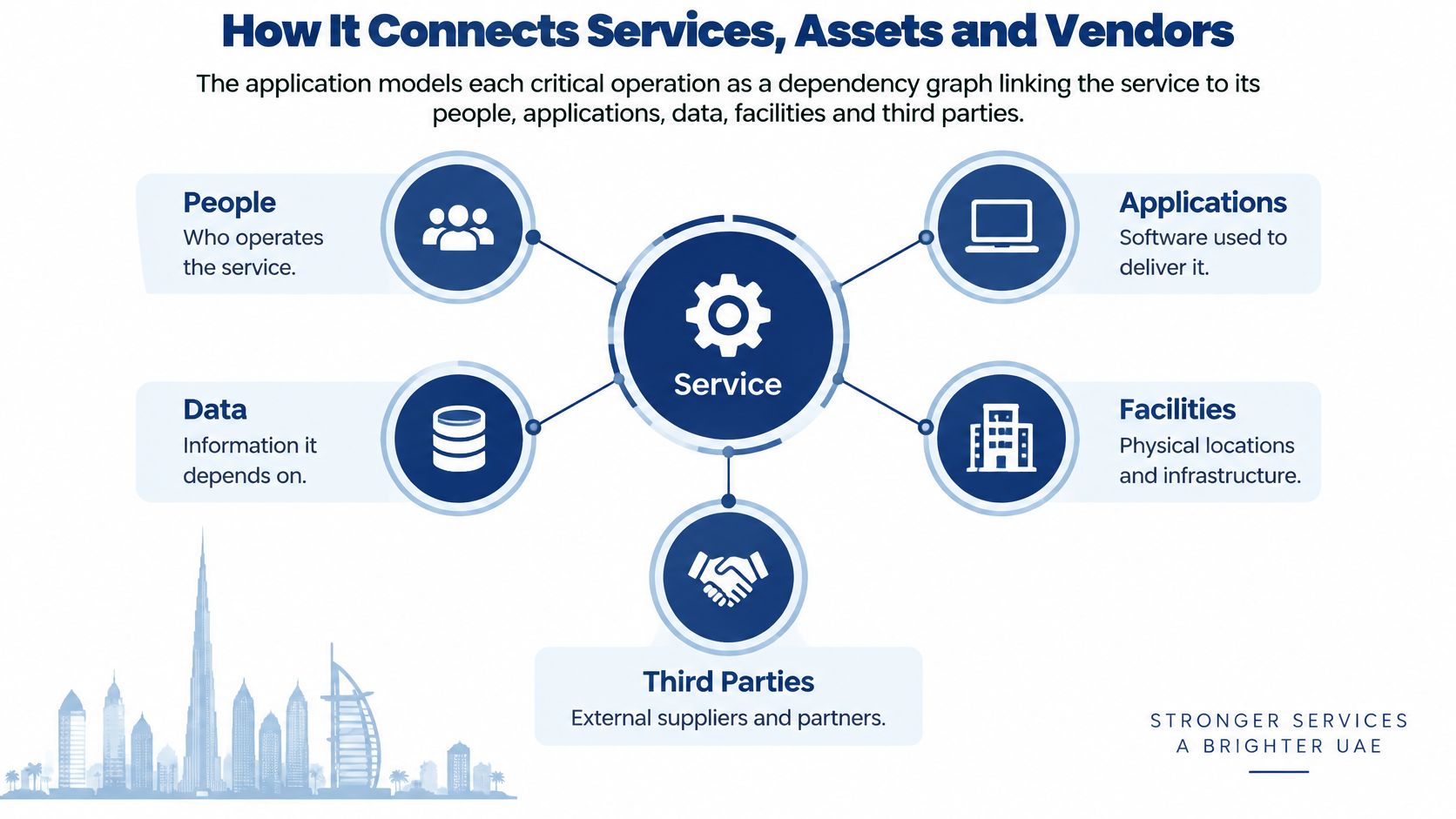
Say your payment service stops processing transactions. A useful dependency map immediately identifies its applications, databases, operating teams, hosting facilities and payment processor, alongside affected business processes and recovery targets.
The core mechanism is a dependency graph, a connected model rather than a collection of isolated risk statements. Each relationship needs an owner and an authoritative data source.
ITSM: HaloITSM, ServiceNow or Freshservice supplies incidents, changes and problems so risk owners can reassess operational exposure.
CMDB: Configuration items and relationships identify which infrastructure supports each service.
ITOM discovery: Discovered resources and connections help teams detect changes and stale dependencies.
ITAM: Ownership, licences and lifecycle status expose unsupported or unaccounted-for assets.
Vendor and contract records: Supplier obligations and service relationships identify external failure points.
HR and identity data: Roles, access rights and staff records establish operational responsibility and sensitive access.
The Central Bank of the UAE's operational-resilience requirements require regulated financial institutions to identify Critical Operations and map the assets needed during disruption, including their interconnections and interdependencies.
The difficult work is reconciliation. Operational technology (OT), non-OT equipment, cloud resources and legacy inventories may describe the same asset differently.
Is your CMDB authoritative, or does someone still repair the risk register through an undocumented spreadsheet feed? That manual handoff can break traceability.
Use Cases for Enterprise IT and Service Teams
A critical vulnerability on an internet-facing payment service should receive greater urgency than an equivalent flaw on an isolated development host. Technical severity matters, but business exposure determines treatment priority.
A DataLunix.com GRC overview citing the 2024 State of the UAE Cybersecurity Report reports more than 155,000 vulnerable assets nationally, over 40% of critical vulnerabilities unaddressed for more than five years, and nearly 70% of vulnerable assets located in Dubai.
Translate that exposure into team-level decisions:
Service desk and ITSM: Link repeated payment incidents to a risk record and require risk review before approving a related change.
IT operations: Prioritise vulnerabilities using exposure, exploitability, asset criticality, age, service dependency and remediation ownership.
Asset and licence teams: Assign an owner to an unsupported server before accepting its continued operation.
Procurement: Track a supplier's recovery-test evidence and unresolved resilience findings.
HR and service teams: Require human approval when an AI-enabled workflow gains access to sensitive employee data.
When consolidating inventories, Bridge Global's data migration guide provides useful context for planning migration checks. Include connector and asset-management requirements when reviewing Freshservice pricing considerations.
Give each team dashboards showing residual risk, overdue treatments, exposure concentration and control effectiveness, not just open-finding counts.
Choosing a Platform and Proving the Dependency Map
Choose a platform by testing what your team can demonstrate during disruption. A polished register isn't enough if responders can't identify affected processes, accountable owners and current evidence.
Selection criteria and what good looks like
Criterion | What good looks like | Red flag |
|---|---|---|
Dependency modelling | Services linked to assets, people, data, facilities and vendors | Risks stored as standalone statements |
Native integration | Live feeds from ITSM, CMDB, ITOM and ITAM | Manual CSV exports as the main data source |
Third-party risk workflow | Assessments, Board approvals and resilience ratings together | Vendor reviews kept in email or spreadsheets |
Evidence and audit trail | Time-stamped test results and approvals for each control | Evidence stored outside the platform |
Continuous monitoring | Reassessment triggered by change, incident or expiry | Annual review cycle only |
Reporting for boards | Residual risk, overdue actions and recovery performance | Module counts instead of outcomes |
The Central Bank's third-party risk requirements require licensed financial institutions to maintain a Board-approved third-party strategy integrated into operational risk management and verify at least equivalent operational resilience where providers affect Critical Operations. Third-party reliance must also inform business continuity planning and dependency mapping.
Expect vendor assessments, approval workflows, resilience comparisons, contract relationships, renewal alerts and remediation tracking. If HaloITSM is shortlisted, evaluate the integration scope alongside HaloITSM licensing considerations.
How do you prove an integrated risk management application works?
Test a real critical service before committing to a broad rollout. Ask the implementation team to demonstrate the following sequence:
List the service's assets, people, vendors, data sets and recovery targets.
Display those relationships together, with accountable owners.
Simulate a disruption and measure how quickly responders identify affected processes.
Check evidence dates, too. Completed assessments can conceal stale test results.
At DataLunix, every consulting engagement begins with discovery workshops, fit-gap analysis and readiness assessments to map requirements, scope and gaps. The same team assesses, configures and supports the environment afterwards.
For FUJIFILM, we reconciled OT and non-OT assets into a single CMDB feeding the service desk, with dependencies mapped and updated automatically. Ask us to test your critical service's dependency map before configuration begins.
A Phased Rollout and Change Plan
Start with a controlled service scope and expand only when ownership, reconciliation and response workflows work. Before configuration, record baseline reporting effort, incident recovery time and audit findings so you can evaluate results.
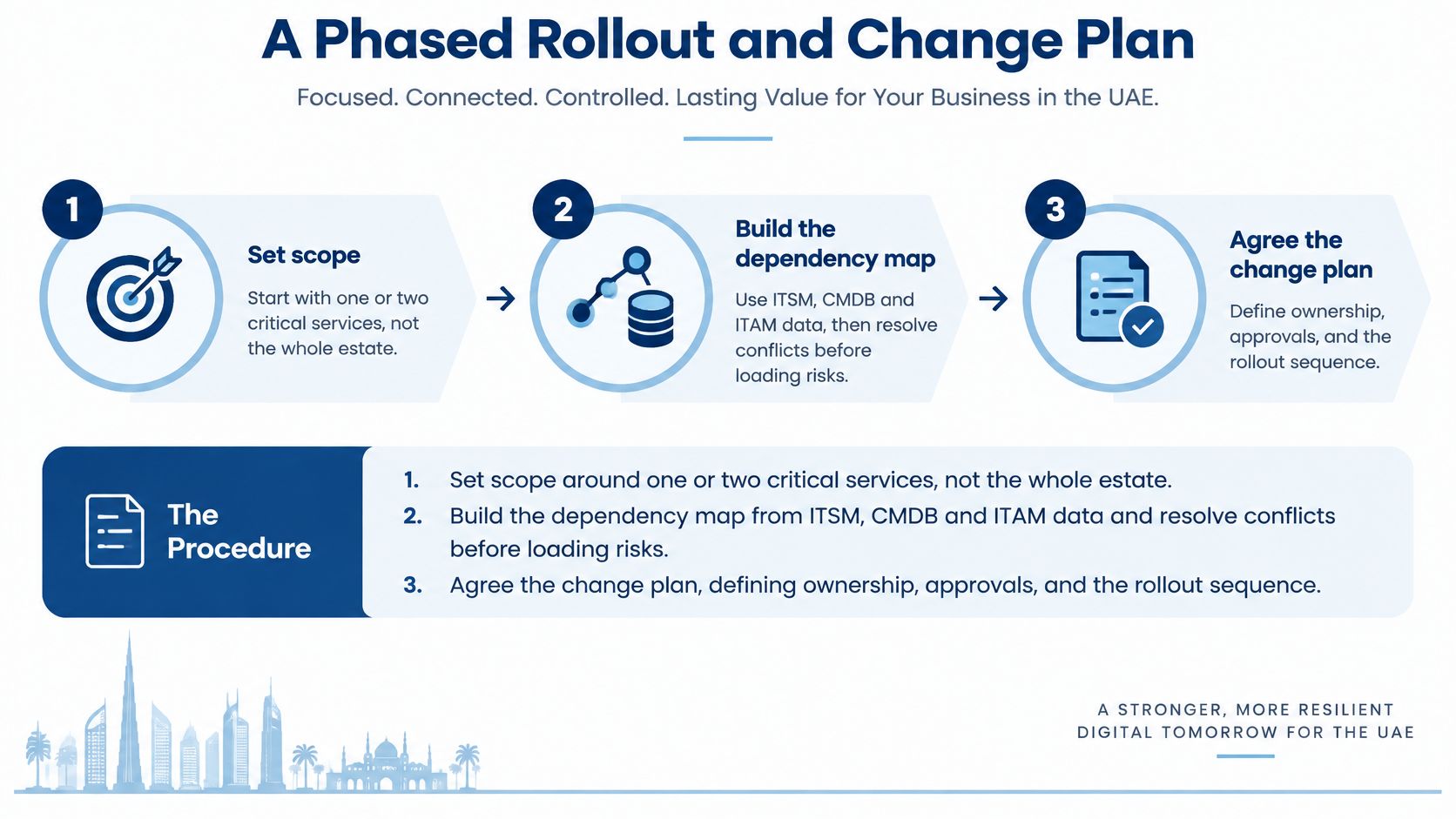
Set scope. Select a small group of critical services. Identify affected stakeholders and publish the communication plan.
Reconcile dependencies. Combine ITSM, CMDB and ITAM records. Resolve conflicting identifiers before loading risk records.
Agree accountability. Have the risk committee approve taxonomy, scoring and ownership. Assign treatment owners now, not after launch.
Configure workflows. Build registers, controls and escalation rules. Assess how approval responsibilities will change.
Pilot in parallel. Compare outputs against the legacy register. Train owners to investigate differences and treat risks, not merely log them.
Migrate history. Validate relationships, attachments and evidence. Retire spreadsheets only after reconciliation passes.
Launch with hypercare. Keep support available through stabilisation. Review adoption and unresolved ownership issues before expanding.
For McDonald's Saudi Arabia, DataLunix ran ITSM cutover in parallel with the legacy tool, migrated historic ticket data and stayed on hypercare after go-live. We support implementation change through impact assessments, stakeholder communications and training enablement.
When comparing replacement tools, include migration and adoption work alongside SysAid pricing considerations.
Governance Playbook and KPIs for GCC and European Teams
The Central Bank's operational-risk regulation requires licensed financial institutions to integrate operational risk fully into wider risk management and governance. Translate that obligation into accountable controls, monitoring, reporting and traceable evidence; confirm local requirements before applying this UAE baseline elsewhere.
KPMG's UAE enterprise-risk overview reports that only 19% of organisations had a formal disaster-recovery plan, 38% had recovery-time and recovery-point objectives for all critical processes, and 22% had mapped critical processes to supporting dependencies.
A practical governance cadence is:
Monthly: Review leading residual risks and overdue actions.
Quarterly: Report recovery performance and third-party exposure to the board.
Six-monthly: Exercise critical-operation continuity plans.
Annually: Refresh the playbook and responsibilities.
On material change: Reassess affected services, suppliers and AI-enabled workflows.
AI governance needs ongoing visibility: the MSCI Institute corporate-risk survey reports that 42% of UAE organisations precisely understood data flows and processing locations, 33% had a thorough understanding of software-supply-chain dependencies, and 36% continuously assessed AI-provider risk beyond onboarding.
KPIs for measuring integrated risk management value
KPI | Definition | Reference value |
|---|---|---|
RTO and RPO attainment | Tested services meeting recovery-time and recovery-point targets | Approved per service |
Critical processes with mapped dependencies | Critical operations linked to assets, vendors and data | Increase validated coverage |
Overdue treatment actions | Actions past their agreed deadline | Downward trend |
Third-party assessments on cycle | Critical vendors reassessed within policy | All within approved cycle |
Control evidence freshness | Key controls with current test evidence | Within policy-defined validity |
Reporting hours saved | Reporting effort before versus after rollout | Pre-rollout baseline |
Can an integrated risk management application replace ITSM?
No, ITSM manages service delivery and support. The risk application uses those operational records to guide governance and treatment.
How do you validate an integrated risk management application dependency map?
Reconcile it against discovery, asset, supplier and identity records. Then test a disruption with the people responsible for recovery.
How should you measure an integrated risk management application return?
Compare reporting effort, recovery performance and audit findings against your baseline. Include implementation and ongoing operating costs, not just licence spend.
DataLunix offers discovery-led assessment, dependency reconciliation and implementation support to connect risk decisions with your operating environment. Visit DataLunix to arrange a readiness assessment and a dependency-map test for a critical service before you automate the wider programme.