
Integrated Risk Management Software: 2026 Buyer's Guide

Meta Title: Integrated Risk Management Software Selection GuideMeta Description: Compare integrated risk management software by evidence feeds, owners, and live ITSM sync. A UAE and GCC buyer's guide for CIOs who need audit-ready records.Blog Title: What should you demand from integrated risk management software in 2026?
Many UAE organisations still lack full compliance automation. Private organisations spent about SAR 9.3 billion of Saudi cybersecurity spending on products, solutions, and services in 2023, or 69%, according to the National Cybersecurity Authority.
What should the register prove when that volume of evidence lands?
A heat map that cannot point to a ticket, a test, and a named owner is a view, not a control system. Integrated risk management software records risks, controls, assessments, compliance obligations, and vendor risks, links each to an owner and an asset, and reports exposure across the enterprise. I would not score a platform on how many charts it ships. Under UAE and GCC regulatory scrutiny, the buyer's test is whether those records stay tied to live operational evidence, so the same volume does not fall back into another workbook.
What Integrated Risk Management Software Means
Say a bank keeps credit risk in a workbook, cyber findings in the service desk, and vendor reviews in email. Treat the platform as a general ledger for risk. Every entry has an owner, a balance, and an audit trail, instead of a stack of separate notebooks.
It sits between enterprise risk management, governance, risk and compliance, and IT operations. It replaces the spreadsheets, shared drives, and audit folders where many teams still track exposure. Four domains meet there, plus the operational feed.
Enterprise risk: scored items against appetite.
Compliance and internal audit: obligations, tests, and findings.
Third-party risk: supplier tiers tied to services.
IT and security risk: incidents and assets from ITSM and ITOM tools.
The UAE Central Bank rulebook defines enterprise risk management as an organization-wide process covering identification, assessment, measurement, monitoring, control, reporting, and mitigation. That same framework places risk beside governance, internal controls, compliance, outsourcing, and financial reporting. You need one view of material risks, owners, control status, escalation, and management reporting.
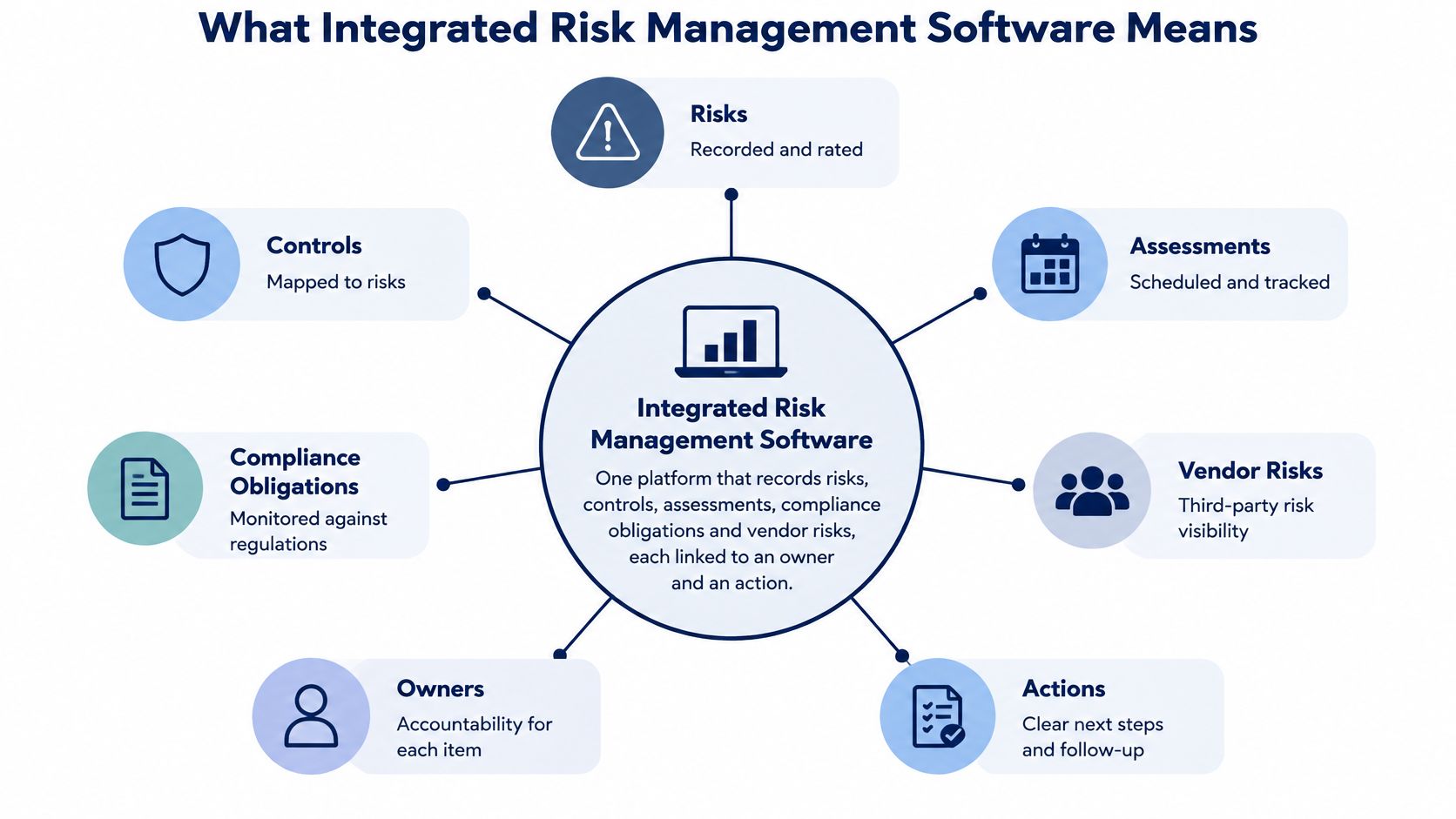
If risks sit in three spreadsheets, two ticket queues, and an audit tracker, the organisation needs one platform.
CROs, CIOs, internal audit, and compliance leads use it most.
Core Capabilities and What Each One Tracks
A risk with no linked control and no named owner is an opinion. The rows below only work together.
Capability | What it holds | Example output | Usual owner |
|---|---|---|---|
Risk register | Risks with scores, appetite and owners | Heat map of top 20 enterprise risks | CRO |
Control library | Controls mapped to frameworks and domains | One control evidencing ISO 27001 and a national model | Risk and compliance |
Control testing and evidence | Test results, evidence files and due dates | Failed test with a dated file and a 14-day due date | Control owners |
Assessments | Self-assessments, audits and business impact analyses | Annual business impact analysis scored by service | Internal audit |
Compliance obligations | Regulations, policies and attestations | Quarterly board attestation tracked to completion | Compliance |
Vendor risk | Supplier tiers, due diligence and SLAs | Critical supplier review overdue alert | Procurement |
Issue and incident linkage | Incidents and issues tied to risks and controls | Security incident linked to an unmitigated control | IT security |
Analytics and reporting | Dashboards, aging metrics and exceptions | Remediation aging by business unit | Board reporting |
The UAE Information Assurance model uses 188 security controls across 15 domains, six management and nine technical. Priority One controls are mandatory for every implementing entity, including banks, telecoms, healthcare, and government, regardless of risk profile. The library needs mandatory flags, risk-based applicability, and domain mapping so one control can evidence several frameworks without a duplicate copy.
In any demo, pick one high-risk item. It should link to a control, a named owner, dated evidence, and a remediation due date.
How IRM Connects to ITSM, ITOM and ESM Platforms
ITSM tools hold incidents, changes, and assets, and they rarely hold risk acceptance. Risk platforms hold controls, and they do not hold live asset state. Integration decides whether a vulnerability becomes a ticket, a score, or both.
Integration pattern | How data moves | Example platforms | Best when |
|---|---|---|---|
Native module | Risk records live inside the ITSM suite | ServiceNow IRM and CMDB | One vendor, a contained risk estate |
API sync | Scheduled two-way sync of assets, incidents and changes | HaloITSM, HaloPSA, Freshservice | Mixed vendors, separate risk team |
CMDB-driven | Discovery feeds configuration items that risks link to | ServiceNow CMDB, Freshservice discovery, ManageEngine | Asset-heavy or OT-heavy estates |
Event-driven | A vulnerability or incident event updates the risk record | SIEM or scanner feeding a ticket and a risk | Real-time exposure tracking |
Unify the data in four moves. Share one asset identifier across the CMDB, discovery, and the register. Map ITSM priority to likelihood and impact so incidents and risks use one scale. Sync assets daily, and push incidents and vulnerabilities as events. Name a golden-record owner for each domain.
We connect HaloITSM, HaloPSA, Freshservice, SysAid, Serviceware, and ServiceNow into agentic workflows. In the FUJIFILM ITAM setup, DataLunix reconciled OT and non-OT assets into one CMDB that feeds the service desk, with dependencies kept current. That is where unification usually breaks, on two names for one asset. Compare seat math on Freshservice pricing before you assume the native module is cheaper than an API sync.
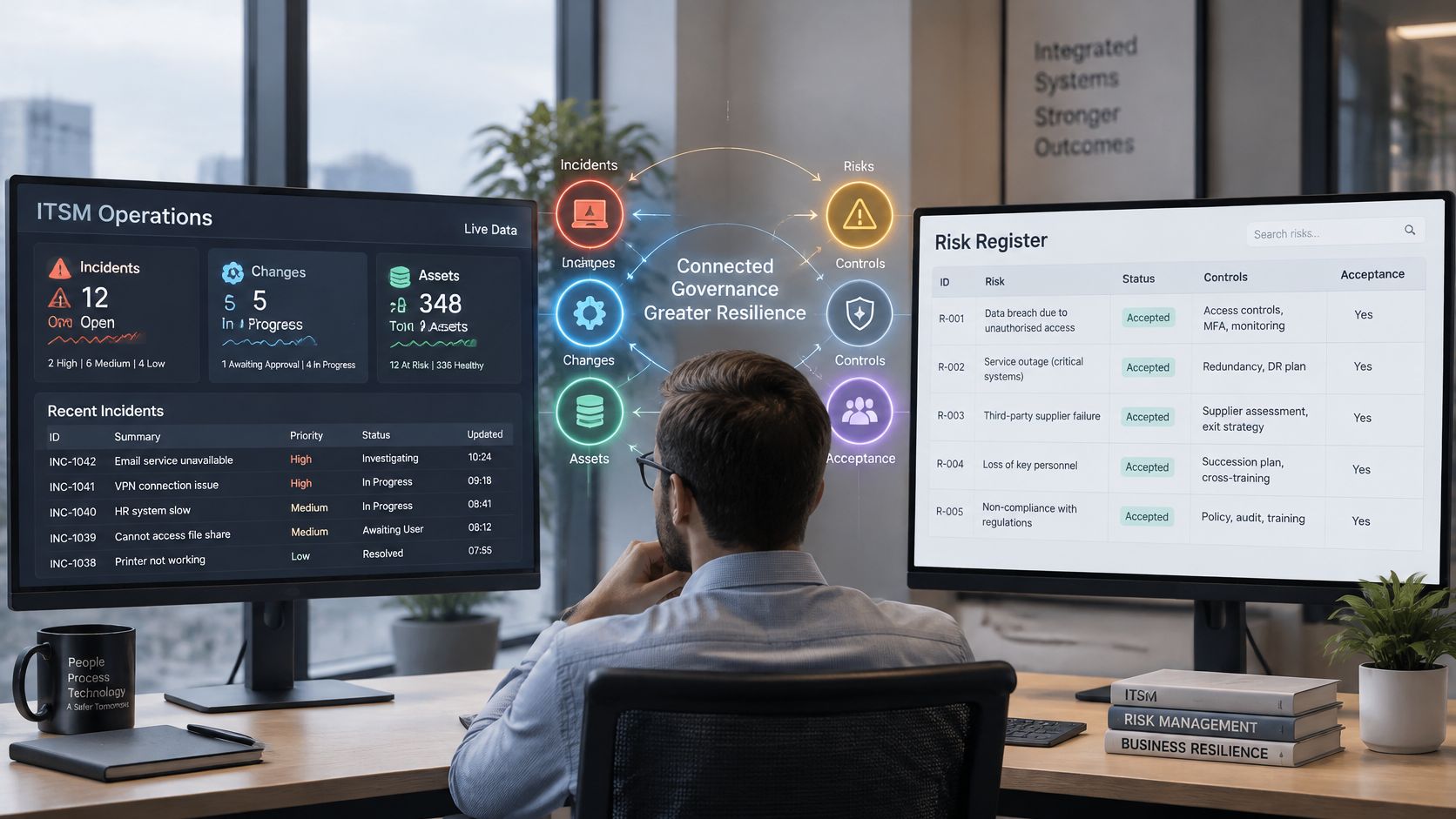
A closed incident should update the linked risk inside one sync cycle. If it does not, the integration is a copy job.
Selection Criteria for Integrated Risk Management Software
Rank criteria by how often they cause regret, not by how pretty the demo looks.
Evidence interoperability. What share of controls is fed by ITSM, identity, cloud, and asset tools? A Middle East data-security forecast found that 48% of UAE organisations lacked full compliance automation.
Framework mapping. One control should satisfy ISO 27001, ISO 27005, COSO, and central-bank rules without duplicates.
Data residency. Confirm where UAE and KSA data is hosted and processed.
Connectors. Native links and APIs for ITSM, ITOM, and ESM.
Access. Role-based rights and segregation of duties.
Audit trail. Time-stamped evidence and decision logs.
Board reporting. Appetite, exceptions, and committee packs.
Three-year cost. Licences, configuration, integration, and support.
Paste this into the demo. Can evidence come from our ticketing tool without a manual upload? How are duplicate controls reconciled? How is stale evidence flagged? Show an exception routed to an owner and closed with a timestamp. What is the three-year price at our agent count? Ask every vendor on the same basis. We offer discounted licences for HaloITSM, HaloPSA, Freshworks, SysAid, and Serviceware, plus ServiceNow implementation, when you plan the project with us. See how HaloITSM pricing sits against that three-year stack.
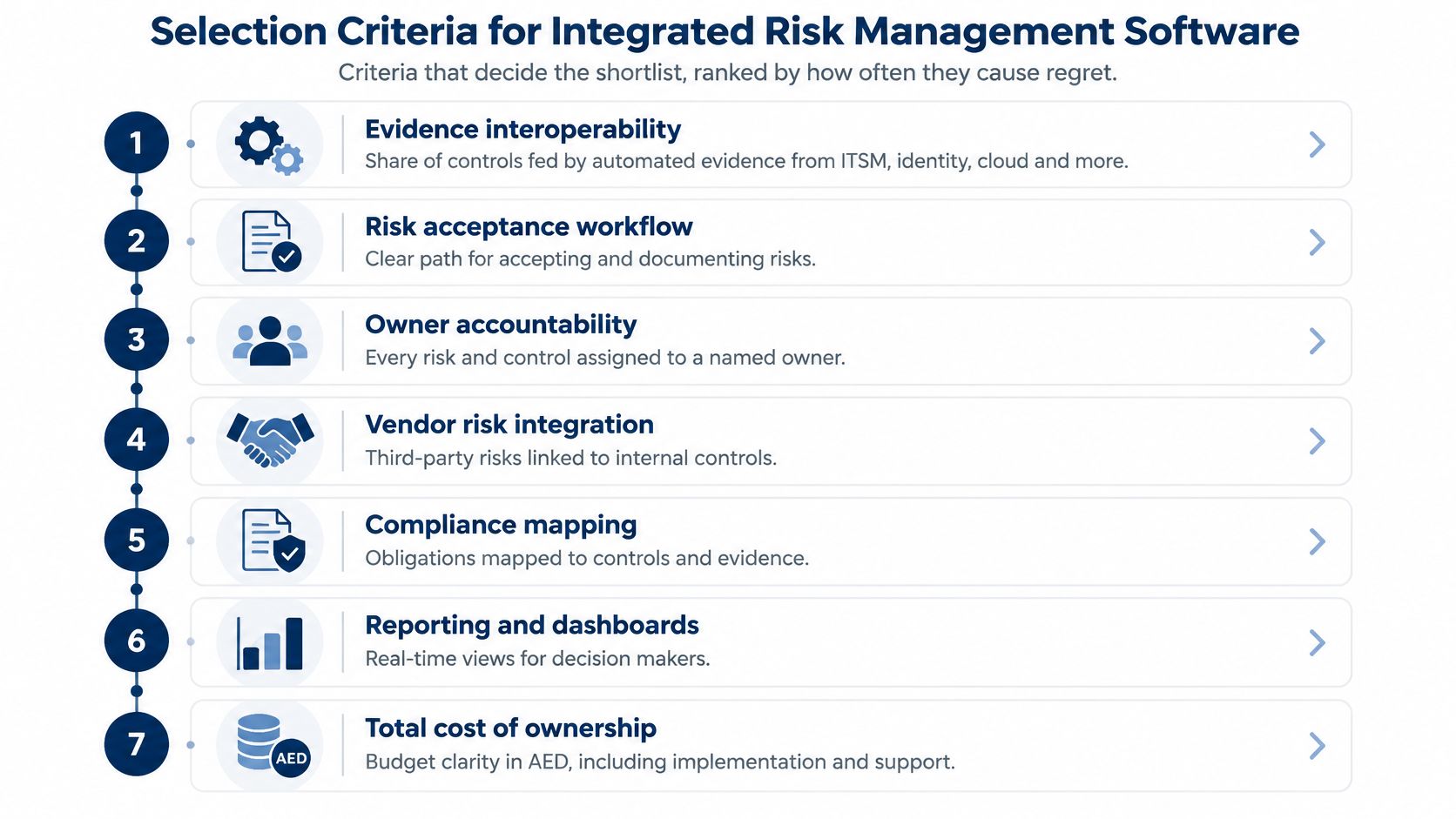
Dashboard breadth ranks last. A polished view of unlinked evidence still leaves audit preparation manual.
Implementation Roadmap From Discovery to Adoption
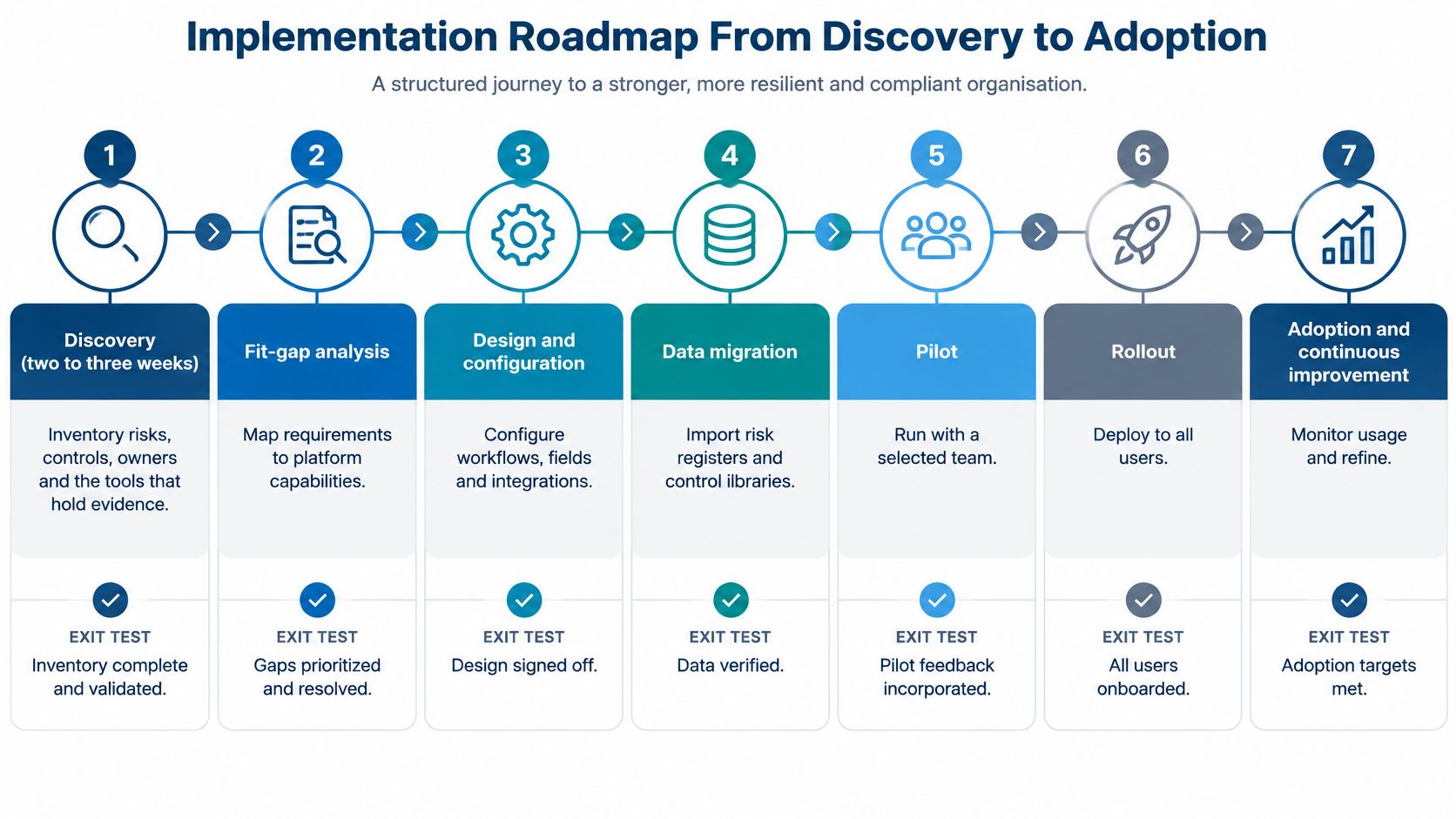
Vendors compress discovery. Unmapped evidence sources and unnamed owners show up late, so the first phase often runs long. The pilot has to use live feeds, not sample rows.
Discovery, two to three weeks. Inventory risks, controls, owners, and evidence tools. Exit when every high-risk item has a named owner and a source.
Fit-gap. Map requirements to the platform and log organisational and technical gaps. Exit when gaps are accepted or designed out.
Design. Agree taxonomy, scoring, the control library, and escalation. Exit on a signed design.
Pilot, eight to twelve weeks. One business service, one framework, live evidence. Exit when one control is tested end to end with automated evidence and a named owner.
Change. Impact assessment, a stakeholder plan, and role-based training before each wave. Exit when those three exist for the next unit.
Rollout. By business unit or geography. Exit when that wave's owners are live.
Steady state. Quarterly review of adoption and control coverage. Exit when coverage holds without a shadow register.
Our engagements start with discovery workshops, fit-gap analysis, and readiness assessments. During rollout we run change impact assessments, stakeholder communication, and training. Licence shape for a phased wave is easier to judge against SysAid pricing than against a full-estate quote.
Use Cases and Pitfalls Enterprises Hit Most
The expensive mistake is buying the dashboard before the feeds exist. Connect sources first. A dashboard with nothing behind it cannot be audited.
A UAE bank needs a bank-wide, and where relevant group-wide, view of material risks. The Central Bank corporate governance regulation requires policies, systems, and controls that identify, measure, monitor, report, and mitigate those risks in a timely way, with the risk function independent of risk-taking management and reporting to the board or board risk committee.
A listed entity has to keep board-approved appetite and committee records in the system, not only in minutes. A public body chasing ISO 27001 and ISO 27005 needs one auditable record across departments. A service-platform move has to keep history. For McDonald's Saudi Arabia, DataLunix ran cutover in parallel with the legacy tool, migrated historic tickets, and stayed on hypercare. Copy that pattern for risk records. HaloPSA pricing matters when the same estate also carries supplier workflows.
Other failures, and the fix:
Copied controls. Map once and reuse.
No owner. Block save until an owner is set.
Policy templates with no workflow. Attach each policy to a control test.
Shadow spreadsheets. Retire them on a set date.
Skipped discovery. Budget the first phase.
Governance Model and ROI for IRM Programmes
Put the operating rules in the system. Record board approvals, appetite thresholds, committee meetings, ownership, segregation of duties, and audit-ready evidence. The risk officer's functional line and the administrative line should not collapse into one login, and internal audit and compliance stay separate roles.
Use a planning formula, not a vendor ROI slide.
Annual ROI = (audit-preparation hours saved × loaded hourly rate) + avoided duplicate-control effort − (three-year platform cost ÷ 3).
Gather inputs in this order.
Three-year cost from RFP quotes: licences, configuration, integration, and support.
Audit-preparation hours per cycle, measured before and after go-live.
Duplicate controls removed across frameworks.
Exception hours avoided by owner routing and automated evidence.
If you cannot fill line 2 from a real cycle, you do not have a benefit yet. You have a licence forecast. Freshworks pricing is one input to that three-year cost, not the whole of it.
Start a Pilot and Track the Right KPIs
Where integrated risk management software earns a pilot
Pick one business service that already has a live compliance obligation. Run an eight-to-twelve-week pilot. Baseline the measures below first. Continue only if they move the right way inside that window.
KPI | How to calculate | Early signal |
|---|---|---|
Controls with automated evidence | Controls fed by automated evidence divided by all controls | Rising share each quarter |
Average days to close exceptions | Total closure days divided by closed exceptions | Falling quarter on quarter |
Repeat findings | Findings recurring after closure divided by all findings | Trending toward zero |
Assets with a verified owner | Assets with a named owner divided by all assets | Rising share each quarter |
Audit preparation hours | Hours spent preparing each audit cycle | Measurably lower after go-live |
Remediation aging | Open items past their agreed due date | Shrinking backlog |
For UAE-listed entities, KPMG's note on listing requirements says the board approves the risk-management policy, reviews it continuously, sets enterprise-wide appetite and tolerance, and adopts a framework aligned with practices such as COSO. A permanent risk committee must meet at least once every three months. The risk-management officer reports functionally to that committee and administratively to the CEO. Confirm those records are live in the platform before you expand the pilot.
A 30-minute consultation is free on the DataLunix.com calendar, with a senior consultant. Use it to lock pilot scope, then line up discovery, fit-gap, and licensing on the same engagement.
FAQ
What is integrated risk management software?
Integrated risk management software is one system for risks, controls, assessments, obligations, and vendor risk. Each item has an owner and an asset, so exposure is reported across the enterprise instead of across spreadsheets.
Does integrated risk management software remove manual compliance work?
Only if evidence is pulled from ITSM, identity, cloud, and asset tools. In the UAE, many organisations still lack full compliance automation, so a central register can just move the manual work.
How should integrated risk management software link to ITSM?
Share one asset ID, map priority to likelihood and impact, and update risk when an incident closes. Native modules fit a single suite. API or event sync fits mixed vendors.
What should a pilot of integrated risk management software prove?
One service, one framework, and one control tested with automated evidence and a named owner. Stop the rollout if exception days, repeat findings, and owner coverage do not move.
DataLunix connects risks, controls, incidents, and evidence across ServiceNow, HaloITSM, HaloPSA, and Freshservice, starting with discovery and fit-gap rather than a dashboard rollout. We also support change, licensing, and the pilot scope a CIO can audit. Visit DataLunix to book the free 30-minute consultation and set that pilot with a senior consultant.