
GRC Information Security Explained for Enterprise Leaders

Updated: 10 hours ago
You're preparing for an audit, responding to a customer security questionnaire, and trying to understand whether an incident ticket, a cloud configuration change, and a supplier review belong to the same risk. GRC information security gives you that connection. It combines governance, risk management and compliance so your organisation can protect information, make accountable decisions, and demonstrate control effectiveness through evidence rather than annual paperwork.
What GRC Information Security Means for Modern Enterprises
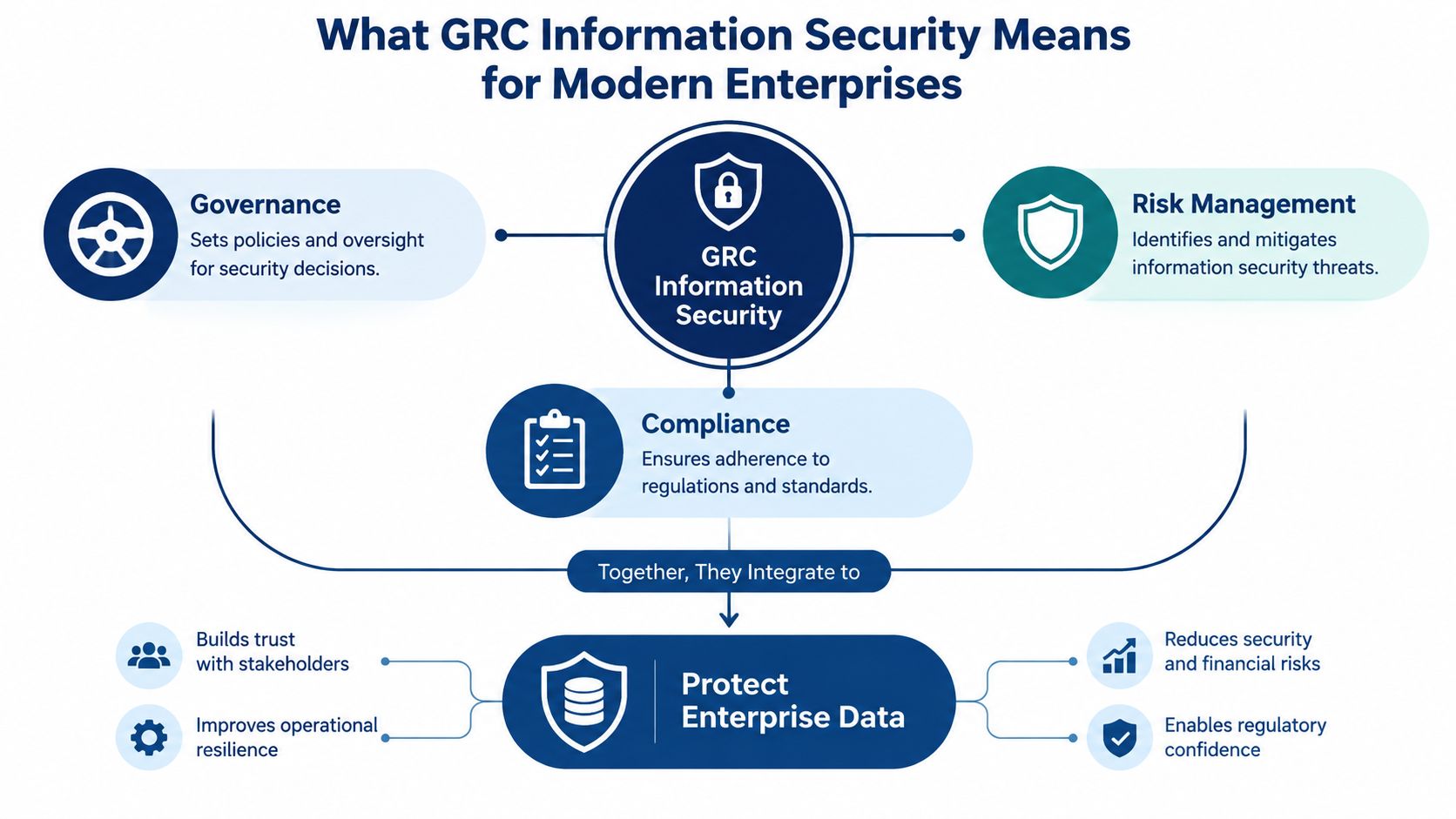
GRC information security is the integrated discipline that aligns security direction, risk decisions and compliance obligations around the protection of enterprise information. Governance sets accountability, risk management prioritises exposure, and compliance verifies that policies, regulations and standards are being followed.
A Dubai enterprise might have a security policy approved by its board, a risk register owned by technology leadership, and an audit team requesting evidence from several business units. At the same time, its service desk is handling access requests, infrastructure teams are applying changes, and a security information and event management platform is generating alerts. If these activities remain separate, leadership sees fragments rather than a defensible view of risk.
The problem isn't always a lack of controls. It's the absence of relationships between controls, services, owners, evidence and decisions. A password standard may exist, but nobody can quickly show which systems it covers, who tests it, or what happens when an exception remains open.
Why the UAE context changes the operating model
The UAE has moved from policy formation to active enforcement. Federal Decree-Law No. 34 of 2021 on Combatting Rumours and Cybercrimes took effect on 2 January 2022, and the official UAE platform states that it criminalises hacking, tampering with government information systems and other cyber offences. The same official UAE cyber safety and digital security guidance notes that the UAE ranked fifth globally for cybersecurity infrastructure in the Global Cybersecurity Index 2024. Dubai's Law No. (15) of 2024 formally defines information security and designates DESC as the competent entity for electronic security in the emirate.
That legal and institutional maturity makes GRC a business operating capability, not merely a compliance department's filing system. The UAE Cybersecurity Council said in 2026 that more than 90,000 to 200,000 breach attempts strike UAE infrastructure every day, with 128 confirmed cyber threat incidents targeting entities across the country since the start of 2026, as reported by WAM on state-sponsored cyber threats targeting the UAE. Regional reporting also cited more than 373,429 DDoS incidents in the UAE by the end of 2024, described as an 862% increase since 2019, in the same source.
For CIOs, the practical message is straightforward. Security decisions need business owners, risk decisions need evidence, and compliance teams need access to operational data. A useful cybersecurity governance, risk and compliance model connects those responsibilities without turning every audit into a manual reconstruction exercise.
How Governance Risk and Compliance Work Together
Governance is the steering wheel, risk management is the navigation system, and compliance is the set of traffic rules. The analogy separates their jobs without disconnecting them. Governance chooses direction and authority, risk management explains hazards and trade-offs, and compliance confirms that the organisation meets binding requirements.
Practical rule: Governance decides who can decide, risk management explains what could go wrong, and compliance checks whether the agreed requirements are being met.
Governance sets direction and ownership
Governance turns business priorities into security expectations. The board or executive committee approves risk appetite, senior leaders assign accountability, and security leadership defines policies, standards and escalation routes.
A governance decision might require stronger protection for a customer-facing service, impose approval requirements for privileged access, or define who can accept residual risk. It should also specify what happens when a control can't be implemented on schedule. Without that clarity, teams often treat unresolved findings as administrative issues rather than decisions requiring management attention.
Risk management makes uncertainty actionable
Risk management identifies threats, vulnerabilities, affected information assets and potential business consequences. It then helps leaders prioritise treatment. The output isn't just a list of technical weaknesses. It should show the affected service, responsible owner, existing controls, residual exposure, treatment plan and acceptance authority.
Risk assessments become more useful when they draw from operational records. A repeated change failure, a critical vulnerability, or an unresolved supplier issue can provide stronger context than a static workshop performed once a year. governance in risk management becomes practical here, because governance defines how risk information influences investment and prioritisation.
Compliance provides verification and feedback
Compliance maps obligations to policies, controls, tests and evidence. It may involve UAE requirements, contractual commitments, ISO standards, sector rules or internal policies. Compliance shouldn't be treated as a final inspection. Findings can reveal weak process design, unclear ownership or controls that exist on paper but aren't consistently performed.
The three pillars therefore form a feedback loop:
Governance sets the expectation.
Risk management identifies exposure and selects treatment.
Compliance tests whether the treatment works and produces evidence.
Management reviews results and adjusts direction.
When one pillar operates alone, gaps appear. Governance without risk becomes disconnected policy. Risk without governance produces analysis without authority. Compliance without either can become checklist completion rather than meaningful assurance.
Mapping Major Frameworks to Your Business Needs
Framework selection should follow business purpose, regulatory exposure and operating complexity. You don't need a separate programme for every framework. You need a unified control library that maps one operational control to several obligations where the intent is equivalent.
The UAE Information Assurance Regulation requires a lifecycle-based GRC model. Organisations must define security objectives, perform formal risk assessments, implement controls aligned to business risk, monitor control effectiveness and use objective measurements to improve information assurance. The regulation therefore treats GRC as a feedback loop, with residual risk explicitly accepted by management, rather than as a one-time compliance exercise. You can review the UAE Information Assurance Regulation for the formal requirement.
A UAE cybersecurity compliance overview states that the UAE Information Assurance Standards are based on ISO/IEC 27001:2013 and organised into four priority tiers, P1 through P4, with P1 the highest priority and P4 the lowest, as described by Global Micro's UAE framework overview. National guidance also separates mandatory controls from risk-based controls. That distinction lets enterprises tailor implementation, but only when risk scoring, treatment decisions and governance evidence are disciplined.
Framework | Primary Focus | Best Fit Scenario |
|---|---|---|
ISO 27001 | Information security management system and continual improvement | Organisations seeking a structured management system and certification pathway |
NIST CSF | Cybersecurity outcomes across identify, protect, detect, respond and recover | Technology teams that need a practical security operating vocabulary |
COBIT | Governance and management of enterprise information and technology | Boards and CIO functions aligning technology decisions with business objectives |
GDPR | Protection of personal data and data subject rights | Organisations processing personal data connected to European operations or customers |
Use frameworks as views over one control environment
ISO 27001 can provide the management system, NIST CSF can help security teams describe operational outcomes, COBIT can support technology governance, and GDPR can define privacy obligations. The mistake is duplicating evidence requests for controls that address the same underlying activity.
Start by recording the control objective, control owner, applicable entities, supporting services, test method, evidence source and exception process. Then map each framework requirement to that record. This approach also helps distinguish mandatory UAE controls from risk-based controls and makes scoping decisions visible.
For a broader comparison of regional and international approaches, Beyond Surplus' resource on data security and COSO offers useful context on how internal control thinking relates to data security. You can also use this GRC frameworks guide for EU, US and UK requirements when your enterprise operates across jurisdictions.
Core Processes and Roles That Make GRC Operational
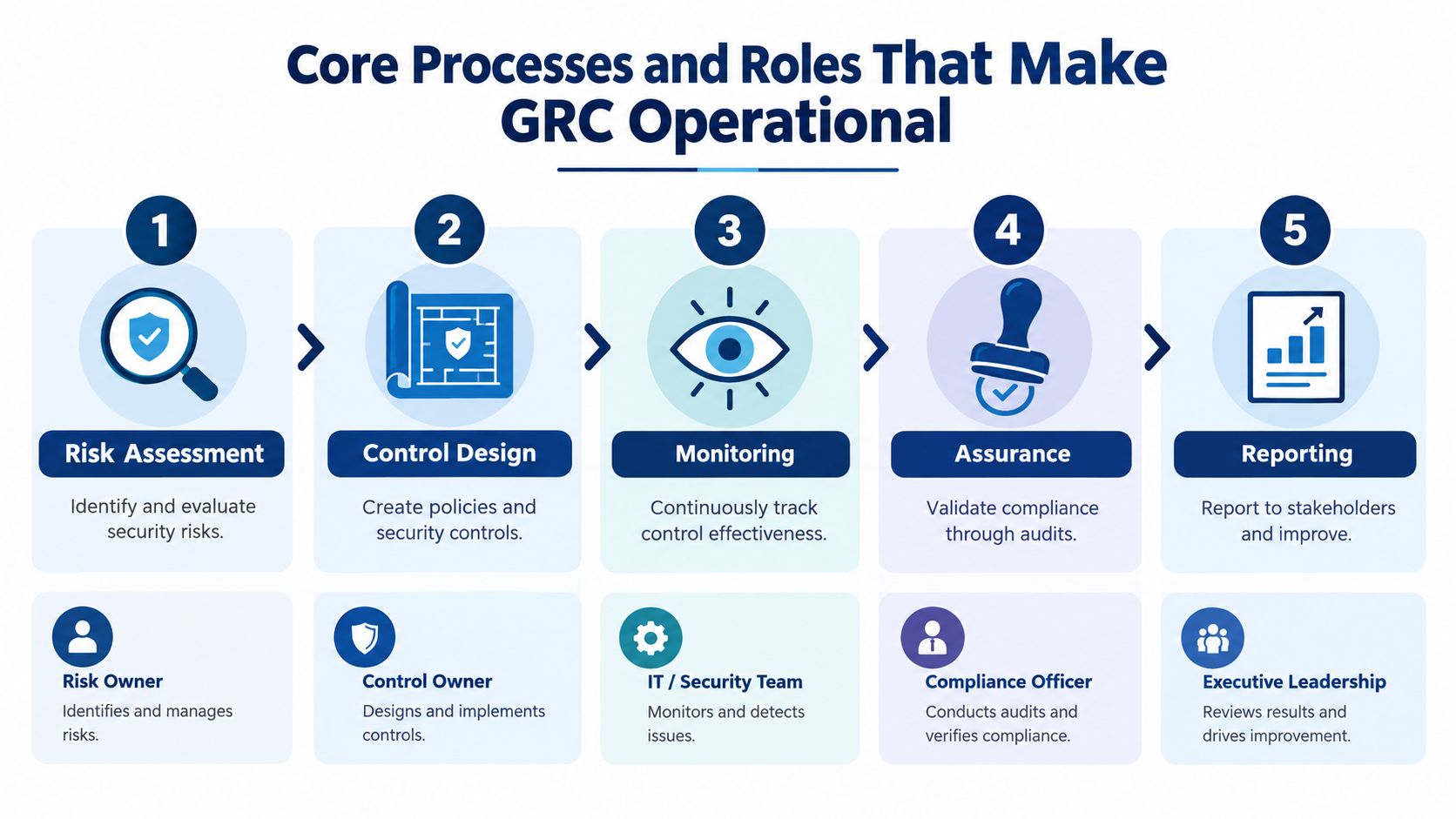
A GRC programme becomes operational when every important control has a purpose, an owner, a test, an evidence source and an escalation path. The lifecycle starts with risk assessment, moves through control design and monitoring, and ends with assurance and reporting. The final report should influence the next risk decision, not sit in an audit folder.
Build accountability into each stage
Risk owners decide how a business risk should be treated and whether residual exposure can be accepted. Control owners operate and maintain the specific safeguards. Compliance officers map obligations, coordinate testing and challenge incomplete evidence. Internal audit provides independent assurance rather than operating the control itself.
A control owner might be responsible for access reviews, while an application owner confirms the population of users and a service manager supplies workflow evidence. That chain matters because an access review isn't credible if the organisation can't establish which applications, identities and privileged accounts were included.
The UAE's mandatory and risk-based control structure makes role clarity more important. Mandatory controls should have a clear applicability decision and operating owner. Risk-based controls require documented rationale, a repeatable risk score and an authorised treatment or deferral decision.
Turn evidence into management information
Evidence can include approved policies, workflow records, change approvals, vulnerability results, access review outcomes, incident records and supplier assessments. The evidence should be linked to a control and time period, with enough context for an independent reviewer to understand what was tested and what exceptions remained.
Evidence isn't a screenshot collection exercise. It should let a reviewer trace the path from requirement to control, control to activity, and activity to management decision.
A mature lifecycle looks like this:
Assess: Identify assets, services, threats and business impact.
Design: Define controls that address the prioritised exposure.
Operate: Assign owners and embed the control in daily work.
Monitor: Test effectiveness using objective operational evidence.
Assure: Validate results and investigate exceptions.
Improve: Update risk treatment, control design or ownership.
This structure makes residual risk visible. Management can accept it knowingly, transfer it, reduce it or avoid the activity. The GRC team provides the evidence and challenge, but the accountable business owner makes the decision.
Integrating GRC With ITSM ITOM and CSM Platforms
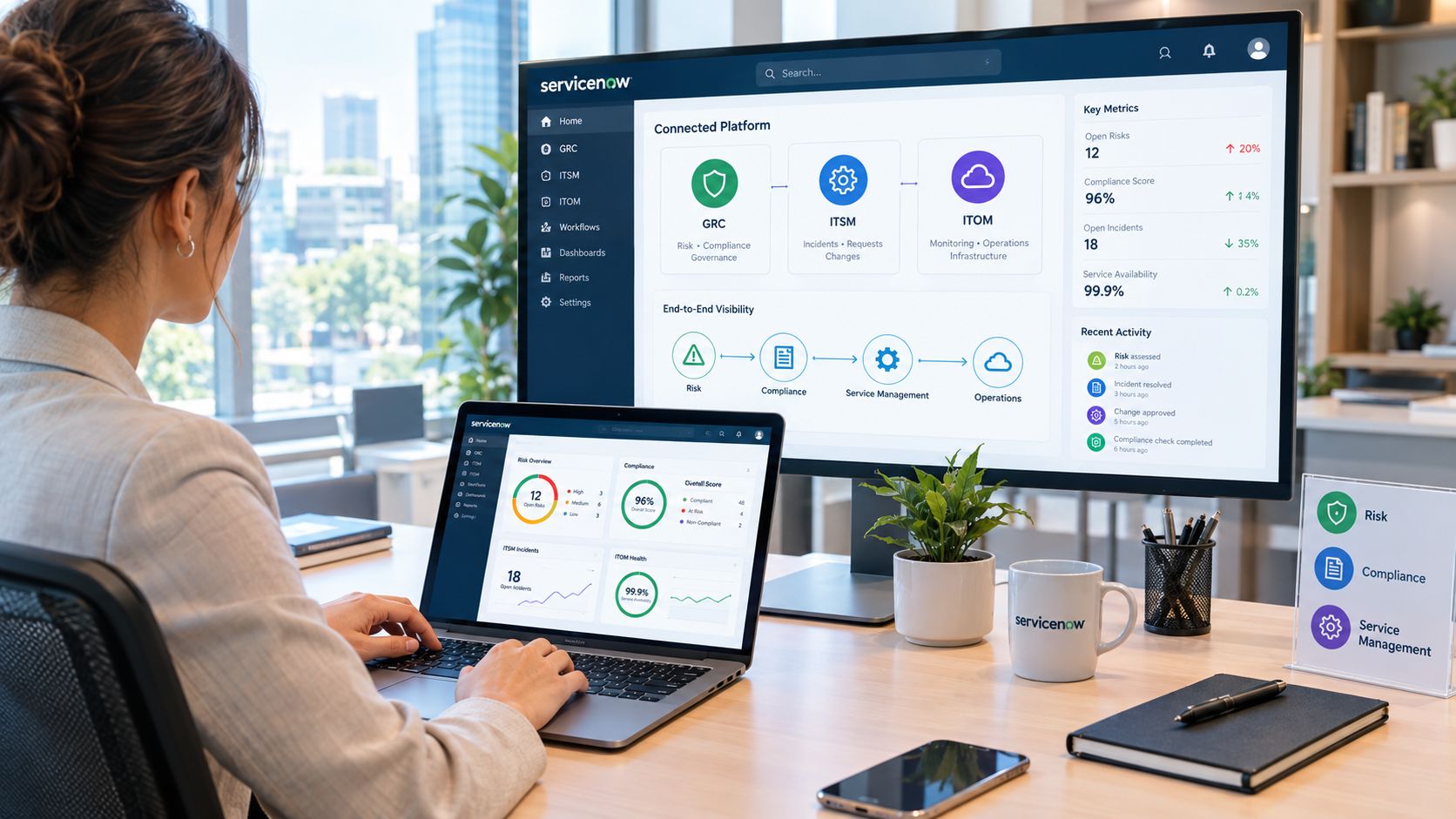
Spreadsheets can document a control, but they rarely prove that the control operated consistently across services, entities and suppliers. IT service management, IT operations management and customer service management platforms can place GRC activities inside the workflows where work already happens.
Connect controls to operational records
In ServiceNow, a risk can be related to a business service, configuration item, change, incident or problem. HaloITSM and HaloPSA can support service workflows, approvals and ownership models. Freshservice can provide service, asset and operational records that help teams connect control activity to the systems being protected.
Useful integration patterns include:
Change governance: Require risk assessment and approval evidence before a high-impact change moves into implementation.
Incident response: Link security incidents to affected services, response tasks, communications and post-incident actions.
Asset accountability: Use the CMDB or asset register to identify system owners, criticality and control scope.
Vulnerability treatment: Convert prioritised findings into assigned remediation work with due dates and exception approval.
Supplier assurance: Connect third-party assessments to contracts, services, findings and renewal decisions.
SIEM evidence: Feed alert summaries, monitoring results and investigation records into control testing where the data is reliable and appropriately governed.
The objective isn't to automate every judgement. Automation should collect repeatable evidence, identify exceptions and route decisions to the right owner. A risk owner still needs to decide whether residual exposure is acceptable.
Design for continuous demonstration
The UAE Information Assurance Standard v2.1, issued in November 2025, replaced the older 2020 regulation and is centralised under the UAE Cyber Security Council. Recent UAE material describes 15 control families, split into 70 always-applicable controls and 64 risk-based controls, as reported in Oliver Wyman's UAE GRC technology summit material.
That model changes audit preparation. Instead of asking teams to recreate evidence at audit time, configure workflows so evidence accumulates as services operate. GRC automation for connected workflows can support this pattern when the underlying data model, ownership and testing logic are defined first.
DataLunix operates in this space by unifying data across platforms such as HaloITSM, HaloPSA, Freshservice and ServiceNow, with implementation, integration and managed-service capabilities for GCC and European organisations.
Your Implementation Readiness Checklist and Roadmap
A successful implementation starts with scope, not software. Decide which entities, services, regulations and control families matter first. Then establish whether your current records can support risk scoring, ownership, evidence collection and management reporting.
Confirm readiness before configuration
Use a workshop with CIO, CISO, risk, compliance, service management, infrastructure, legal, procurement and business owners. Record decisions rather than collecting broad requirements that nobody can prioritise.
Your readiness checklist should include:
Business scope: Identify legal entities, critical services, information types, cloud environments and third parties.
Obligation register: Record applicable UAE, European, contractual and internal requirements.
Control inventory: Remove duplicates and map related requirements to common control objectives.
Risk method: Define likelihood, impact, scoring bands, treatment options and acceptance authority.
Ownership model: Name risk owners, control owners, evidence providers and assurance reviewers.
Evidence assessment: Identify which records exist in ITSM, ITOM, CSM, SIEM, CMDB and document repositories.
Fit-gap analysis: Compare current workflows with the required approval, testing and escalation paths.
Adoption plan: Prepare communications, role-based training and practical guidance for frontline teams.
Sequence the roadmap around value
Phase one establishes the baseline. Confirm scope, catalogue services and assets, assess current controls and identify urgent governance gaps.
Phase two creates the operating model. Approve policies, define ownership, configure risk scoring, map controls and establish exception handling.
Phase three embeds workflows. Link controls to incidents, changes, assets, service requests, supplier records and monitoring evidence. Start with repeatable controls where operational data is already trustworthy.
Phase four improves assurance. Introduce scheduled testing, evidence validation, dashboards and management review. Use findings to adjust control design rather than just extending remediation dates.
Phase five scales the environment. Add business units, cloud services and third parties after the core model is stable. Standardise integrations and monitor data quality as scope grows.
Don't treat change management as a final communication exercise. Service desk agents, engineers, application owners and suppliers need to understand what changed in their workflow, which decisions they own and why the evidence is required.
Measuring Success and Choosing the Right GRC Partner
A GRC programme succeeds when leaders can see whether controls operate, risks receive decisions and findings close for meaningful reasons. Useful measures should reflect both control performance and management responsiveness.
Track indicators such as:
Control effectiveness rate: The proportion of tested controls that meet their defined objective.
Mean time to remediate: How long owners take to resolve validated control or security weaknesses.
Audit finding closure: Whether findings close with verified evidence rather than status updates.
Third-party risk coverage: Whether material suppliers have current assessments, owners and treatment decisions.
Evidence freshness: Whether automated evidence reflects the required operating period.
Risk acceptance quality: Whether accepted residual risks include rationale, authority and review conditions.
Don't claim improvement until your baseline and measurement method are stable. A dashboard can make performance visible, but it can't correct unclear ownership or unreliable source data.
Select a partner for operating capability
Assess whether a partner can facilitate discovery workshops, perform fit-gap analysis, configure the platform, integrate operational systems and support adoption. Review its delivery model, licensing approach, certified resources, managed services and ability to work across onshore, offshore or hybrid teams.
For platform and operating-model decisions, GRC platform guidance for enterprise leaders can help frame the evaluation. Ask prospective partners to demonstrate a complete traceability path, from a requirement to a control, then to a workflow record, evidence item, exception and management report.
In the GCC, that might mean aligning UAE Information Assurance requirements with services across Dubai or Abu Dhabi entities. In Europe, it may mean mapping privacy and security obligations to shared controls while preserving local accountability. In both cases, the partner should show how the model works in daily operations, not only how it appears in a presentation.
Frequently Asked Questions About GRC Information Security
What does GRC information security mean?
GRC information security connects governance, risk management and compliance to protect information and support accountable decisions. It links policies and obligations to operational controls, owners, evidence and remediation.
Why is GRC important for UAE enterprises?
UAE organisations operate within a mature legal and institutional security environment, while facing persistent cyber threats. GRC helps leaders demonstrate that controls are risk-based, monitored and supported by evidence.
How do ITSM platforms support information security GRC?
ITSM platforms embed approvals, incidents, changes, assets, suppliers and remediation tasks into auditable workflows. Integrating those records with ITOM, CSM and SIEM data can reduce manual evidence collection and improve traceability.
Should an enterprise use ISO 27001 and NIST CSF together?
Yes, when each framework has a defined purpose. ISO 27001 can structure the management system, while NIST CSF can provide operational language for cybersecurity outcomes, with a shared control library preventing duplicate work.
What should CIOs measure first?
Start with control effectiveness, remediation performance, audit finding closure, third-party risk coverage and evidence quality. Define ownership and measurement rules before building executive dashboards.
DataLunix helps GCC and European enterprises design and operate evidence-backed GRC workflows across ServiceNow, HaloITSM, HaloPSA and Freshservice, from discovery and fit-gap assessment through integration, enablement and managed services. Visit DataLunix to discuss a practical roadmap for connecting your controls, risks, services and audit evidence.