


GRC Microsoft: A Practical Enterprise Roadmap

A lot of teams buy Microsoft 365, turn on a few compliance features, and call it GRC. That's not a programme, it's a start. If your regulators expect live evidence, your auditors want traceable control ownership, and your IT team still runs incidents in ServiceNow or Halo, GRC Microsoft has to be treated as an operating model, not a licence line item.
What Microsoft GRC Actually Means
GRC Microsoft is the set of overlapping capabilities inside the Microsoft ecosystem, Compliance Manager, Azure Purview, Defender, Sentinel, Azure Policy, and the Microsoft 365 compliance centre, wired together to deliver governance, risk management, and compliance. Microsoft doesn't sell one product called GRC. The outcome emerges from configuration, integration, and how disciplined your operating model is.
What it covers natively
If your enterprise already lives in Microsoft 365 and Azure, the native stack handles a large share of everyday control work. It gives you policy enforcement, evidence capture, data classification, identity controls, and technical telemetry. Microsoft's own compliance materials show the cloud has more than 100 compliance certifications, audit reports, attestations, and other offerings, including more than 40 region- and country-specific offerings, with the United Arab Emirates explicitly included in that catalogue, which is why the stack feels so usable in GCC environments. Microsoft compliance and data residency overview
Practical rule: use Microsoft for technical control truth, then put a workflow layer in front of it when the business needs ownership, escalation, and sign-off.
What it doesn't solve alone
Microsoft is strong on control evidence. It's weaker on cross-platform risk registers, regulatory content libraries, audit-ready remediation workflows, and policy attestation campaigns across non-Microsoft systems. That's where specialist GRC tooling earns its keep, because Microsoft GRC becomes the system of record for technical controls, while an ITSM or GRC platform acts as the system of action.
The most useful way to think about it is simple. Microsoft shows what's happening, and your operating platform decides who does what next. If you want a clean conceptual primer on information governance before you wire the tooling together, the F1Group information governance guide is a useful companion.
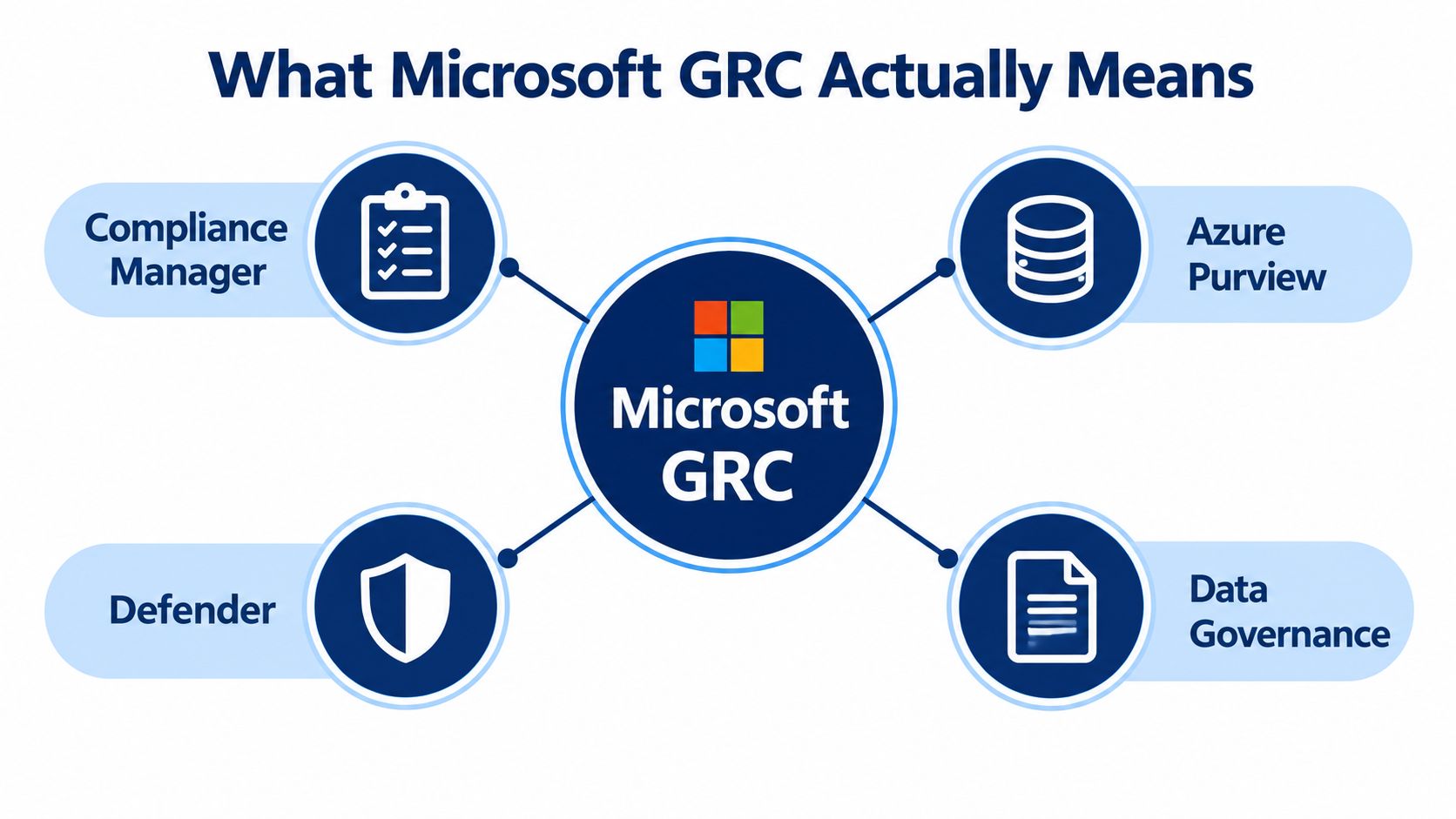
For a practical implementation pattern, many teams start with the control backbone described in this Microsoft GRC operating model note.
Mapping Microsoft Products to the Three GRC Disciplines
A Microsoft GRC rollout only makes sense if you map the stack to the three disciplines, govern, risk, and comply. That view is better than a product checklist because it shows which parts Microsoft handles natively and where GCC enterprises still need a workflow layer in front of it.
Govern
Governance is the clearest part of the stack. Purview handles data discovery, classification, and governance, so teams can see what data exists, where it lives, and who should be allowed near it. Entra ID Governance covers access reviews, entitlement management, and privileged identity workflows. Azure Policy turns guardrails into enforceable definitions, while Microsoft 365 admin centres provide the configuration surfaces.
Risk
Risk is more spread out. Defender provides threat-informed signals, Defender for Cloud shows cloud workload posture, and Sentinel correlates logs for detection and response. Those tools give strong evidence for risk decisions, but they do not operate like a classic risk register. They show signals that support treatment decisions. They do not run the risk lifecycle for you. Purview Risk and Compliance features add coverage at the data layer, but they stay control-centric rather than board-centric.
Comply
Compliance is where Microsoft is strongest, because parts of the stack were built for assessment and evidence from the start. Compliance Manager acts as the regulatory template engine, Purview Compliance Portal supports assessment and evidence work, and Azure Policy exposes technical compliance state. Microsoft's own UAE-facing compliance materials explicitly list UAE NESA Information Assurance Standards and the UAE Data Privacy Law, which matters because local mapping is already built into the product story. Microsoft cloud compliance and UAE frameworks
Compliance gets easier when the same control is visible across identity, device, workload, and evidence layers. It gets messy when each team exports its own version of truth.
Microsoft GRC Products Mapped to the Three GRC Disciplines
Microsoft Product | GRC Discipline | Primary Use Case | Known Limitation |
|---|---|---|---|
Purview | Govern | Data discovery, classification, and governance | Does not run the business workflow around control ownership |
Entra ID Governance | Govern | Access reviews and privileged access oversight | Strong on identity, weak on wider risk treatment |
Azure Policy | Govern | Policy guardrails and technical enforcement | Technical control state only, not enterprise risk context |
Defender | Risk | Threat-informed security telemetry | Security signal, not a risk register |
Defender for Cloud | Risk | Cloud workload posture | Fragmented across subscriptions and workloads |
Sentinel | Risk | Correlation, detection, and response | Strong telemetry, weak governance workflow |
Compliance Manager | Comply | Control mapping and assessment tracking | Templates need local interpretation and tuning |
Purview Compliance Portal | Comply | Evidence, audit, DLP, and assessment views | Not enough for cross-system remediation ownership |
Microsoft 365 compliance features | Comply | Policy, audit, retention, and labels | Limited outside the Microsoft estate |
Integration Patterns with ITSM and ITOM Platforms
ITSM is where Microsoft GRC becomes operational. ServiceNow ITSM and ServiceNow GRC, Freshservice, Halo, and ManageEngine ServiceDesk Plus sit in front of Microsoft as the system of action. They hold tasks, approvals, SLAs, and escalations. Microsoft should feed them, not replace them.
The three patterns that actually work
The first pattern is incident and change-driven control evidence. Alerts from Sentinel, Defender, and Purview move into ITSM through webhooks, Event Hubs, or Graph API subscriptions. That creates an auditable chain from detection to ticket to closure. The second pattern is bi-directional control state sync, where Azure Policy and Compliance Manager status feeds into ServiceNow GRC or Halo risk modules, and remediation tickets flow back through Logic Apps, ServiceNow IntegrationHub, or middleware. The third pattern is access governance hand-offs, where Entra ID Governance access reviews and PIM activations trigger approval steps in the ITSM platform.
What to connect first
Start with the connectors that give you lineage, not glamour.
Sentinel to ITSM: use incident forwarding for security events that need operational ownership.
Compliance Manager API to GRC workflows: pull assessment state into the governance record.
Defender XDR streaming: push threat evidence into the ticketing trail.
Purview Atlas API: connect catalogue and lineage to downstream control work.
Operational rule: if the ticket can't prove who saw it, who owned it, and when it was closed, a regulator will treat it as a weak control, even if the alert itself was accurate.
For teams building that bridge, the Microsoft GRC integration blueprint is a useful reference point because it treats tooling as an operating chain, not a feature catalogue. That matters in the UAE, where evidence depth matters as much as evidence existence.
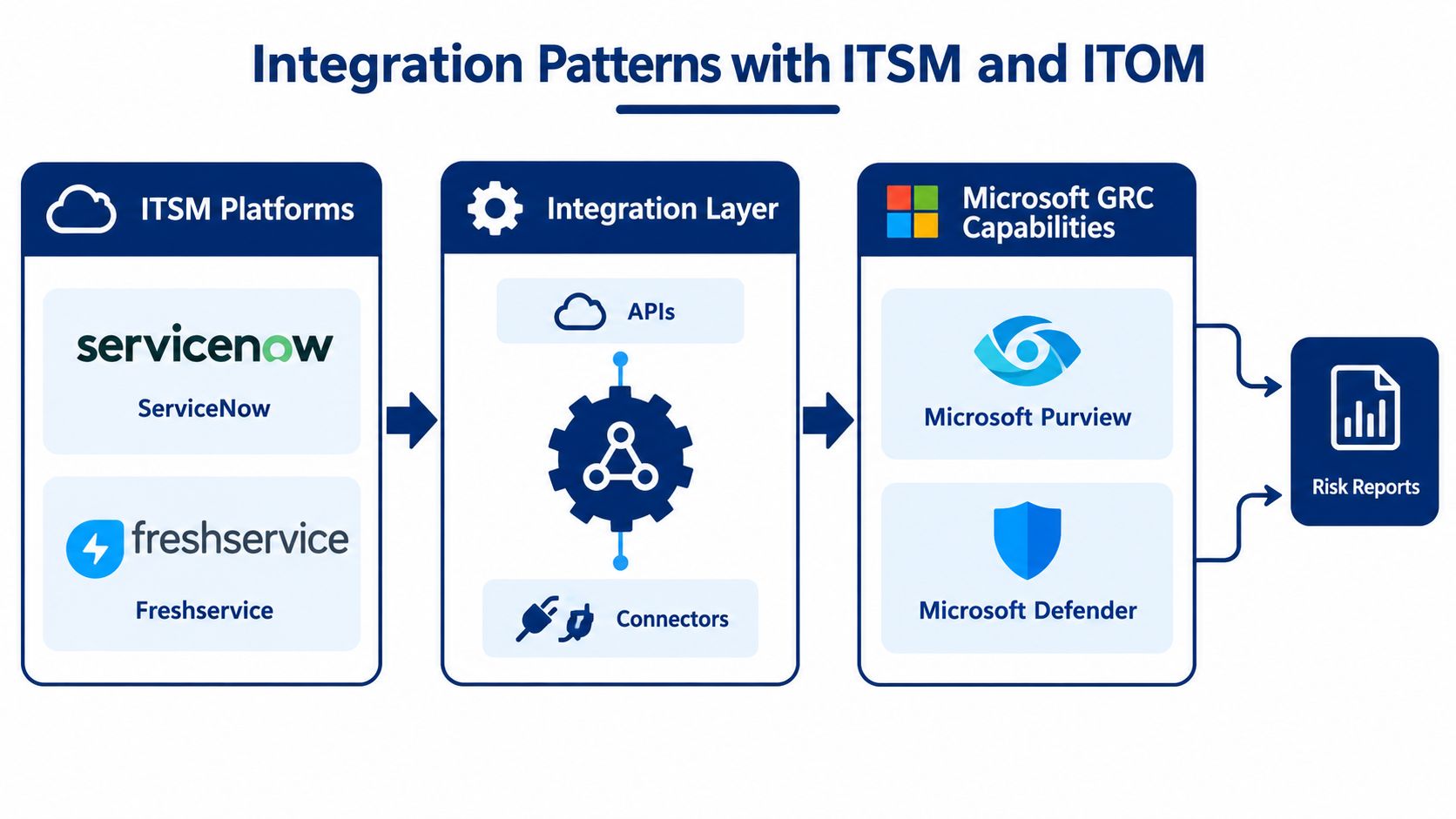
The hard truth is that integration depth determines whether audit evidence survives a regulator visit. Shallow sync looks fine in a demo. Deep sync survives a question from compliance.
UAE and GCC Regulatory Anchors for Microsoft
In the GCC, Microsoft GRC only matters if it maps to the regulator in front of you. In Dubai, that means DESC. In Abu Dhabi and wider critical infrastructure discussions, NESA still matters. Add the UAE Data Privacy Law, sector overlays like the Insurance Authority's ISR rules, and the control picture gets specific fast.
Where Microsoft anchors the local rules
Compliance Manager is the cleanest place to map frameworks because it ties controls to ISO-style obligations and local templates. Purview is the stronger anchor for classification, retention, and DLP when privacy obligations apply. Defender and Sentinel are the practical anchors once the work shifts to threat monitoring, incident evidence, and security telemetry.
Microsoft's UAE compliance posture is not theoretical. Microsoft says it was the first global cloud provider to obtain DESC CSP certification, and its UAE cloud regions, UAE Central in Abu Dhabi and UAE North in Dubai, support in-country data residency, failover, and disaster recovery for customer data and applications. Microsoft UAE DESC certification details
Why residency changes the evidence story
Residency changes how a regulator reads the file. Evidence kept in a UAE-located tenant supports an in-country operating posture. Evidence kept in a global tenant needs more contractual and architectural explanation. That difference looks minor in procurement and becomes decisive in an audit.
Regulator / Framework | Primary Control Families | Microsoft Anchor Product | Residency Implication |
|---|---|---|---|
DESC | Cloud security, auditability, provider certification | Compliance Manager, Azure Policy | In-country UAE evidence is easier to defend |
NESA | Information assurance, critical infrastructure controls | Defender, Sentinel | Local telemetry supports governance expectations |
UAE Data Privacy Law | Classification, retention, lawful processing | Purview | Residency strengthens the evidence chain |
ISR | Security operations and incident control | Sentinel, Defender | Incident lineage needs local operational ownership |
ISO 27001 | Control mapping and audit evidence | Compliance Manager | Template mapping is straightforward, local proof still matters |
Continuous telemetry should be treated as the new audit posture. DataLunix's government risk and compliance note shows how GCC teams should frame that shift. Microsoft's in-country data processing for Microsoft 365 Copilot in the UAE also points in the same direction, because interaction data is stored and processed within national borders under normal operations, with alignment to UAE AI policy and local governance expectations. Microsoft 365 Copilot UAE data residency details
Architecture, Licensing, and Residency Considerations
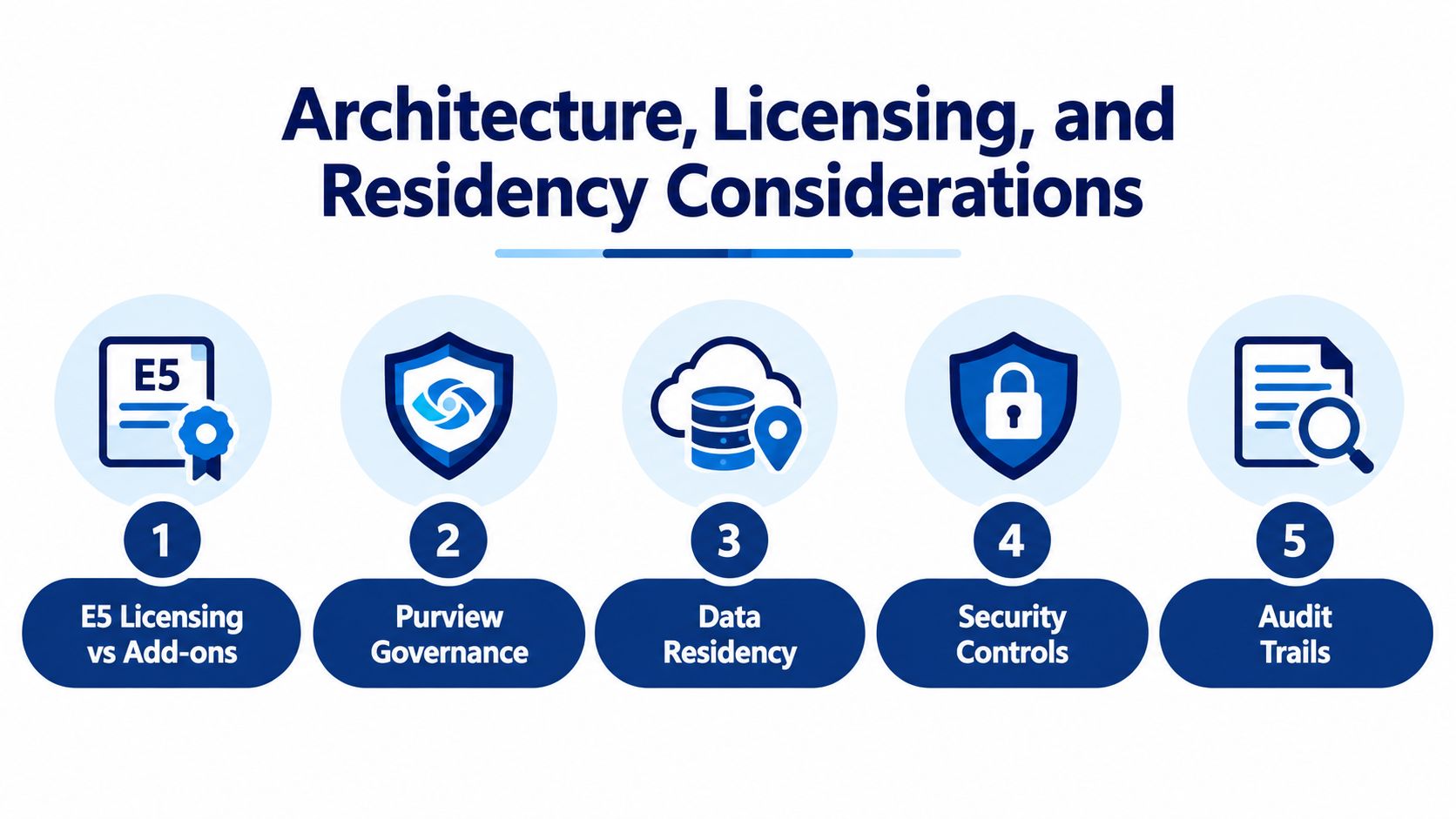
Procurement usually asks for a tool demo first. That's backwards. The decisions that really matter are licensing, architecture, residency, and automation, in that order. Get those wrong and every downstream control conversation becomes expensive.
Start with licensing
Microsoft GRC can look cheap until the add-ons appear. E5 gives you a base, but serious GRC work often pulls in Compliance add-ons, Purview capacity, Defender for Cloud coverage, and Sentinel ingestion costs. Teams also miss the hidden price of evidence retention in Log Analytics. If you don't model storage, you'll underbudget the audit trail.
Then settle the architecture
Multi-entity GCC groups usually need a hub-and-spoke tenant topology. That lets each business unit keep local control while the group gets a consolidated evidence layer. Azure landing zone design should support the Data Management Boundary, and Lighthouse helps with delegated administration. For evidence consolidation, many enterprises now use Microsoft Fabric as the evidence lake because it gives reporting teams a common surface to query.
Residency and automation come next
Residency choices shape your audit trail. UAE North and UAE Central support in-country deployment patterns, while global tenants can complicate regulator-readiness. Automation should then be built with Logic Apps and Event Grid for evidence pipelines, Entra ID Governance for access attestation, and Power Platform as the front-end for non-technical control owners.
If your residency decision comes after the evidence workflow is built, you've already made the expensive choice.
For architecture planning, the DataLunix cloud readiness guide is the sort of internal blueprint teams use before they wire the first control. The point is simple. Four decisions shape everything downstream, license, topology, residency, and automation.
Where Microsoft GRC Stops and Specialist Tools Take Over
Microsoft is excellent at telemetry, control enforcement, and evidence capture inside its own ecosystem. It stops short where real enterprises feel friction.
The five gaps that keep showing up
The first gap is a unified risk register with bowtie-style modelling. Microsoft gives you risk signals, but not a true enterprise risk engine. The second is issue and remediation workflow with SLA, ownership, and committee escalation. ITSM helps, but it doesn't always give you audit-grade lineage. The third is multi-framework control mapping, where one control must map across PDPL, NESA, ISO, and PCI. The fourth is vendor and third-party risk lifecycle management with continuous external scoring. The fifth is policy distribution, attestation campaigns, and employee compliance.
That's where specialist tools earn their seat. ServiceNow GRC and Archer handle the workflow engine. OneTrust and Securiti handle privacy management. LogicGate is often a fit for mid-market programmes. ProcessUnity is built for third-party risk. If you want Microsoft as the technical record and another platform as the governance record, that's the cleanest pattern.
Use Microsoft to prove the control exists. Use a specialist tool to prove the organisation acted on it.
The right answer isn't to replace Microsoft. It's to accept the boundary. Microsoft gives you control truth, specialist GRC gives you process truth, and the two together give you something regulators trust.
Migration and Change Management Roadmap
Rollout fails when teams treat Microsoft GRC as a configuration project. It's a change programme. The sequence matters.
The five stages that work
Discovery comes first. Inventory Microsoft 365, Azure, and Dynamics tenants, then map current controls to NESA, DESC, and the UAE Data Privacy Law. The main artefact here is a control-to-obligation matrix. Baseline comes next. Turn on Compliance Manager templates, configure Azure Policy initiatives, and wire Defender and Sentinel data sources.
Integration is the third stage. Connect ServiceNow, Halo, or Freshservice with Logic Apps, Graph API, or Sentinel SOAR so incidents and tickets move both ways. The key output is an integration blueprint. Adoption follows. Train control owners, publish the RACI, and put GRC KPIs into operational dashboards. The main artefact is the evidence register. Continuous assurance is the last step, where quarterly attestations give way to automated monitoring and monthly evidence packs.
Common failures to avoid
Skipping discovery: teams import templates before they understand local obligations.
Chasing scores: Compliance Manager scores are useful, but they are not the goal.
Under-resourcing access reviews: cutover breaks fast when role-based reviews are treated as admin work.
The organizational change management guide is worth aligning with before launch, because the technical rollout will only stick if owners know their obligations and act on them.
Recommended Next Steps for Enterprise Leaders
Make the next quarter about continuous, regulator-visible assurance, not another annual attestation cycle. Appoint one accountable owner for Microsoft GRC outcomes, then run a 90-day discovery sprint that produces a control-to-obligation map for NESA, DESC, ISR, and the UAE Data Privacy Law. Pick the ITSM platform of action, lock the integration scope, and decide residency in-region before you build the evidence pipelines.
Budget for Compliance Manager capability and Sentinel together, not as separate experiments. Set a board KPI on automated control coverage, not policy count. If you want to test your readiness quickly, DataLunix looks at your tenant structure, control mapping, workflow gaps, residency choices, and evidence depth, then shows where Microsoft is enough and where you need a specialist layer.
If you need a blunt Microsoft GRC readiness review, DataLunix can assess the control model, the ITSM integration path, and the residency risks before rollout starts. Visit DataLunix to scope a discovery workshop, map the gaps, and build a practical GCC-ready assurance model around your Microsoft estate.