


GRC Module in ServiceNow: A Practical 2026 Guide

A regulatory notice arrives, the CISO needs a control map, and risk, compliance and audit teams discover that the latest evidence sits across spreadsheets, email and disconnected systems. The GRC module in ServiceNow addresses that operational problem by connecting policies, controls, risks, issues, audits, vendors and evidence in workflows on the ServiceNow AI Platform.
Why the GRC Module in ServiceNow Exists
A mid-sized Abu Dhabi bank receives an urgent NESA circular. The CISO asks for a control mapping, but the compliance lead owns one spreadsheet, risk owns another, and internal audit has evidence in a shared inbox. Nobody has a reliable view of which controls apply to which systems, who owns the exceptions, or whether the evidence is current.
That situation is common in regulated enterprises. The problem isn't a lack of effort. It's that each team maintains a different version of the control environment. A policy update may not reach the risk register. A failed test may not create a remediation task. An audit request may trigger a manual search through documents that were never linked to the underlying service or business owner.
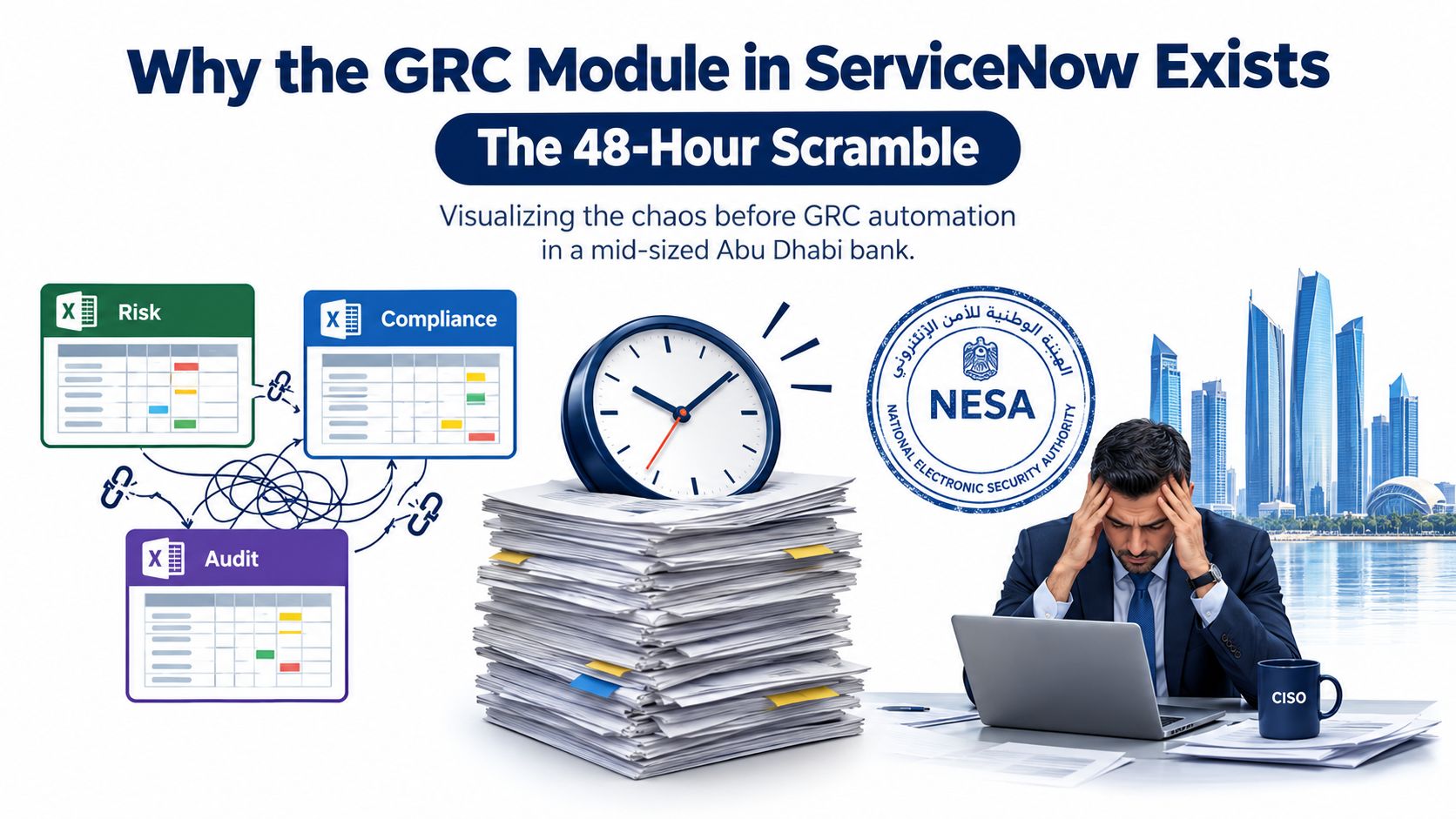
From compliance binders to operational workflows
The GRC module in ServiceNow is intended to provide a shared operating layer for policies, controls, risks, issues and evidence. ServiceNow positions its GRC suite as a real-time control and compliance management layer, and says customers can save more than 700 hours per year in risk management through its applications. That claim matters because it describes operational effort, not just a feature list. ServiceNow's GRC product materials also describe faster full-control attestation.
The practical shift is from treating governance as a binder to treating it as a workflow. A policy can have an owner, approval path and attestation campaign. A control can map to several regulatory citations. A failed test can create an issue with an accountable owner, due date and escalation route.
For UAE and GCC organisations, the value appears when obligations from banking, telecom, government or cross-border operations meet one control model. EU-facing organisations face a similar challenge when privacy, resilience, outsourcing and information security requirements overlap.
Practical rule: A GRC platform won't repair unclear ownership. It will expose that weakness faster and make it visible to every team.
Good governance also depends on how people create, approve, use and retain information. Teams that need broader context can review the benefits of governance for professionals, particularly when designing ownership and evidence practices around the platform.
Core Modules Inside the ServiceNow GRC Suite
The suite works best when you design it as one connected programme rather than buying isolated applications. ServiceNow describes the product family across Integrated Risk Management, Business Continuity Management, Privacy Management and Third-Party Risk Management, with shared data across policies, controls, risks and vendor workflows. ServiceNow's GRC overview explains that integrated model.
What each application actually does
Policy and Compliance Management gives policies, standards and internal control procedures a managed lifecycle. It can cross-map controls to external regulations and support continuous monitoring of control activities, as described in the Policy and Compliance Management documentation.
Risk Management handles risk assessments, indicators, risk statements and issues. The application supports continuous monitoring and risk-based decision-making, while ServiceNow says its AI and machine learning capabilities can assign, group and suggest remediation, reducing some activities from days to minutes. The risk overview documentation provides the product detail.
Audit Management plans engagements, assigns work, organises evidence and routes findings into remediation workflows. It becomes more useful when auditors can reuse current control tests and risk information instead of requesting the same evidence from each department.
Vendor Risk Management structures supplier assessments, due diligence, issues and remediation. It's particularly relevant where critical services, cloud providers and outsourced operations cross UAE, KSA and European jurisdictions.
Continuous Monitoring turns selected control checks into repeatable indicators. It should be applied where a dependable data source exists, not where a team is merely hoping automation will compensate for an undefined control.
Application | Primary Use Case | Key Tables | Typical Workflows |
|---|---|---|---|
Policy and Compliance | Policies, obligations and controls | Policies, citations, control objectives, controls | Drafting, approval, mapping, attestation |
Risk Management | Enterprise and operational risk | Profiles, risks, indicators, issues | Assessment, scoring, treatment, escalation |
Audit Management | Internal audit planning and execution | Audits, workpapers, findings, evidence | Scoping, testing, finding remediation |
Vendor Risk Management | Third-party due diligence | Vendors, assessments, questionnaires, issues | Tiering, assessment, review, remediation |
Continuous Monitoring | Repeatable control validation | Indicators, evidence, control tests | Collection, evaluation, exception creation |
The shared entity model is the differentiator. One control can support a policy requirement, relate to a risk statement, appear in an audit plan, support a vendor review and receive evidence from monitoring. That's the operating model explored further in this guide to ServiceNow Integrated Risk Management.
Architecture, Data Model and Integration Points
The GRC capability sits on the ServiceNow AI Platform, so the design question isn't only which application to activate. It's which business entities, services, users and evidence sources should participate in the control environment.
A typical implementation works with profiles, controls, risks and issues, alongside policy and compliance records such as policy statements and citations. Delivery teams may encounter tables including , , , , and . These names matter during configuration, reporting and integration design, but they shouldn't become an excuse to customise the platform before the governance model is agreed.
Where the platform connects
The integration points determine whether GRC becomes operational or remains a compliance register.
CMDB relationships: Controls can be scoped to applications, services and infrastructure where configuration data is reliable.
ITSM incidents: Incidents can provide evidence, trigger observations or create issues when they reveal a control weakness.
ITOM events: Operational signals can support monitoring when event data has clear ownership and usable thresholds.
SecOps incidents: Security cases can feed risk and remediation workflows, while the GRC team retains responsibility for compliance interpretation.
Identity provider feeds: User records support attestations, approvals and ownership assignments tied to real employees rather than stale directory entries.
The platform's trust posture also matters for regulated buyers. ServiceNow states that its Government Community Cloud has a FedRAMP High Baseline Provisional Authority to Operate and meets DoD Impact Level 4 requirements. It says the initial DoD IL4 approval arrived in October 2019, and that it audited more than 80 EU Cloud Code of Conduct requirements through an internal audit and external assessment. These are US and European assurance signals, not UAE approvals, but they show the level of control scrutiny applied to parts of the platform. ServiceNow's compliance disclosures should be reviewed alongside local legal and regulatory requirements.
For GCC and EU organisations, these integrations are implementation scope, not optional enhancements. If the CMDB has duplicate services, the control universe will inherit those duplicates. If the identity feed is incomplete, attestations will be assigned to the wrong people. A practical ServiceNow GRC integration approach starts with data ownership and failure handling before connector configuration.
Where to Start When Risk and Compliance Live in Different Time Zones
The right starting application depends on maturity, audit pressure and the speed of external regulatory change. A first-time programme built around a policy library needs a different entry point from a bank that already runs risk and control self-assessments across business units.
Three credible entry points
Starting module | Best when you see | Typical GCC/EU trigger | Common risk if started too early |
|---|---|---|---|
Policy and Compliance | Policies and controls are scattered or undocumented | A first major regulatory examination or framework mapping | Creating records without clear control ownership |
Integrated Risk Management | Risk assessments and indicators already have executive sponsorship | Existing risk committees, RCSA activity or recurring issue escalation | Producing dashboards from weak or inconsistent risk data |
Regulatory Change Management | External obligations change across jurisdictions and business lines | Multiple regulators, active horizon scanning and cross-border operations | Tracking alerts without a process for applicability decisions |
Start with Policy and Compliance Management when auditors ask basic questions such as, “Which control satisfies this obligation?” or “Who approved the current policy?” The first release should establish the authority documents, control taxonomy, ownership model and evidence expectations.
Start with Integrated Risk Management when leadership already discusses risk in structured terms and needs a consistent view of inherent exposure, residual exposure, indicators and issues. Risk workflows become valuable only when risk owners understand how to assess and treat risks.
Choose Regulatory Change Management when the organisation has a genuine need to triage evolving obligations across jurisdictions. Loading every possible regulatory update before defining applicability, ownership and escalation creates noise rather than resilience.
Vendor Risk and Continuous Monitoring usually belong in a later phase. Vendor workflows depend on a usable supplier inventory and tiering method. Monitoring depends on stable source data, agreed thresholds and a defined response to failure.
The fastest route to value is usually the smallest defensible control model, not the largest module bundle.
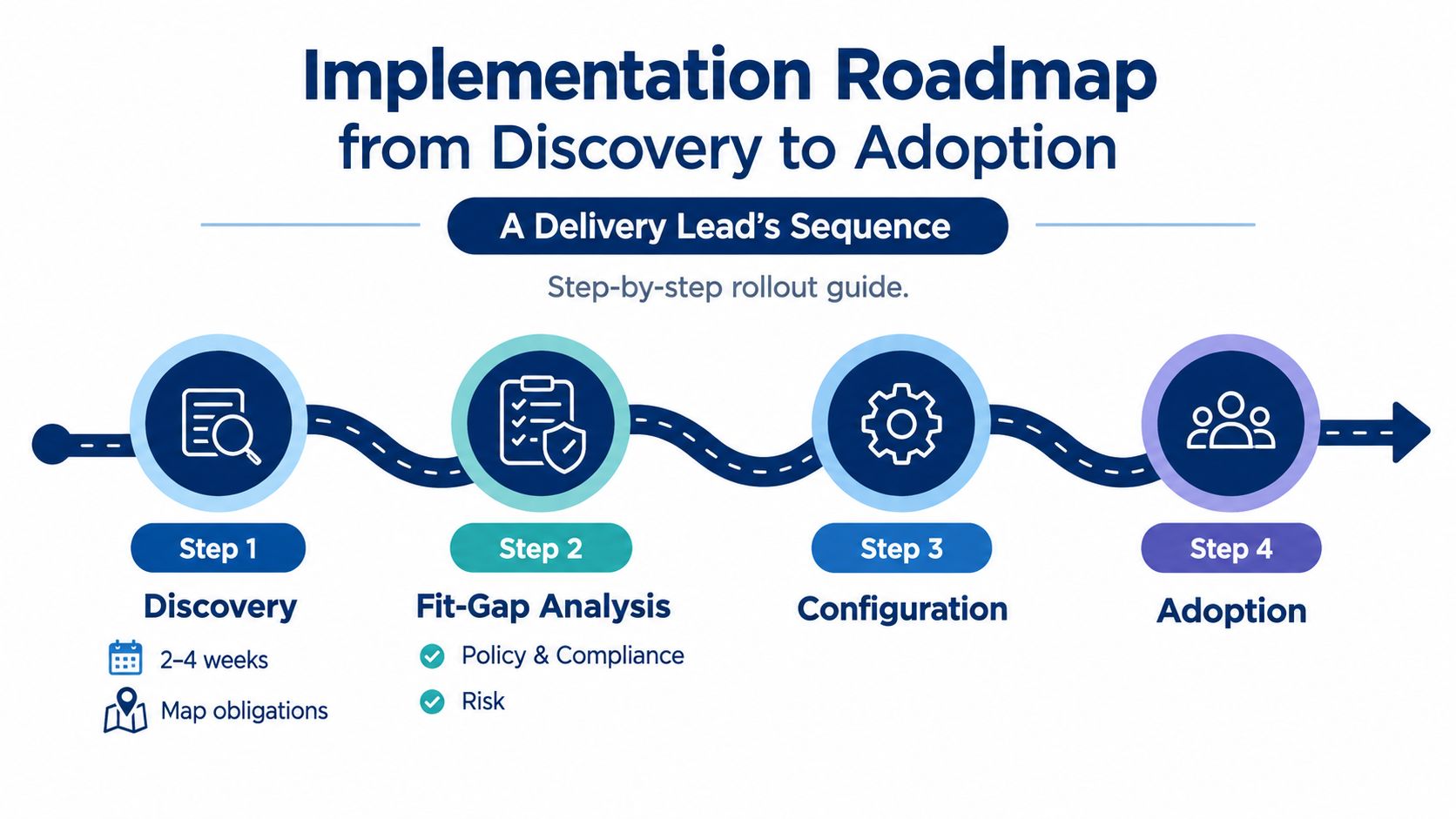
Implementation Roadmap from Discovery to Adoption
A successful rollout starts with decisions, not configuration. The delivery team needs to know which obligations matter, which controls already exist, who owns them and what evidence an auditor will accept.
Discovery and fit-gap
Begin with workshops across compliance, risk, audit, security, IT operations and business ownership. Map obligations to controls, identify duplicated requirements and document where evidence currently lives. ServiceNow recommends a pilot approach in its GRC product documentation, which is sensible for organisations that need to validate the model before scaling it.
The discovery gate is scope. Don't load every policy, business unit and regulation at once. Select a defensible starting population with accountable owners and a clear examination or reporting need.
The fit-gap phase compares the operating model with Policy and Compliance, Risk and Audit capabilities. Decide what can be configured, what requires integration and what should remain a controlled manual activity. Avoid custom fields that merely reproduce spreadsheet columns.
Design and configuration
The design must settle four issues before administrators build workflows:
Control taxonomy: Define what makes a control preventive, detective, manual or automated in your organisation.
Ownership: Assign accountable control owners, evidence contributors, reviewers and approvers.
Issue routing: Decide when an observation stays in GRC and when a security or operational case belongs in SecOps or ITSM.
Evidence retention: Agree how evidence is named, reviewed, retained and linked to the relevant obligation.
Configure on a non-production instance, then test realistic scenarios. A control failure should create the expected issue, notify the correct owner, preserve evidence and support escalation without manual intervention.
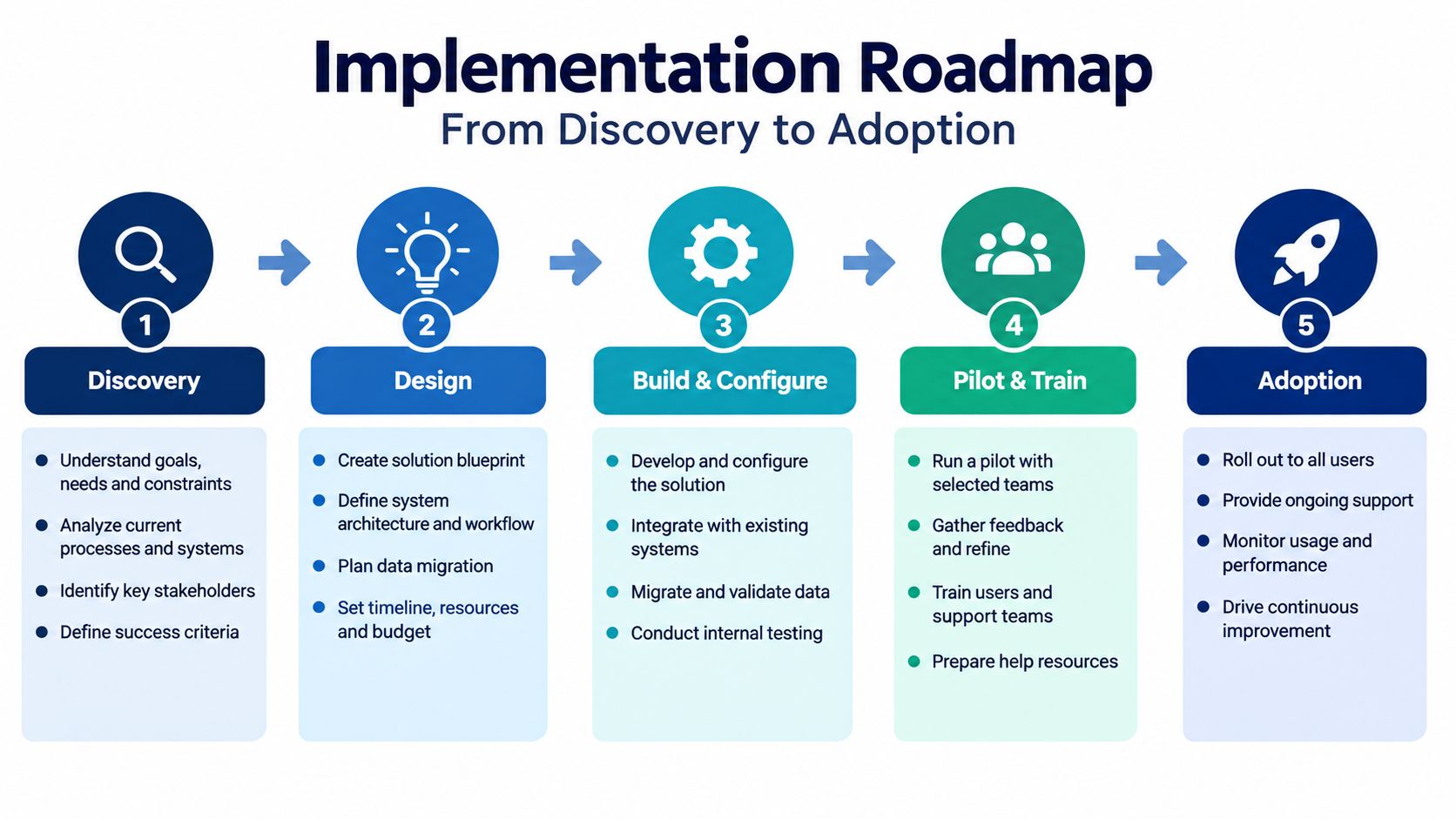
Adoption and proof
Put experienced power users into the first adoption wave. They can test terminology, challenge ownership assumptions and identify workflows that look correct to an administrator but fail in daily operations.
Measure whether users complete attestations, remediate issues, provide evidence and interpret dashboards correctly. Deployment is not the outcome. The outcome is a control programme that people can run without returning to parallel spreadsheets.
A phased ServiceNow GRC implementation roadmap should therefore include a gate after every stage. If the control library is unclear, pause configuration. If the CMDB scope is unreliable, narrow the entity population. If users don't understand their responsibilities, invest in enablement before adding another module.
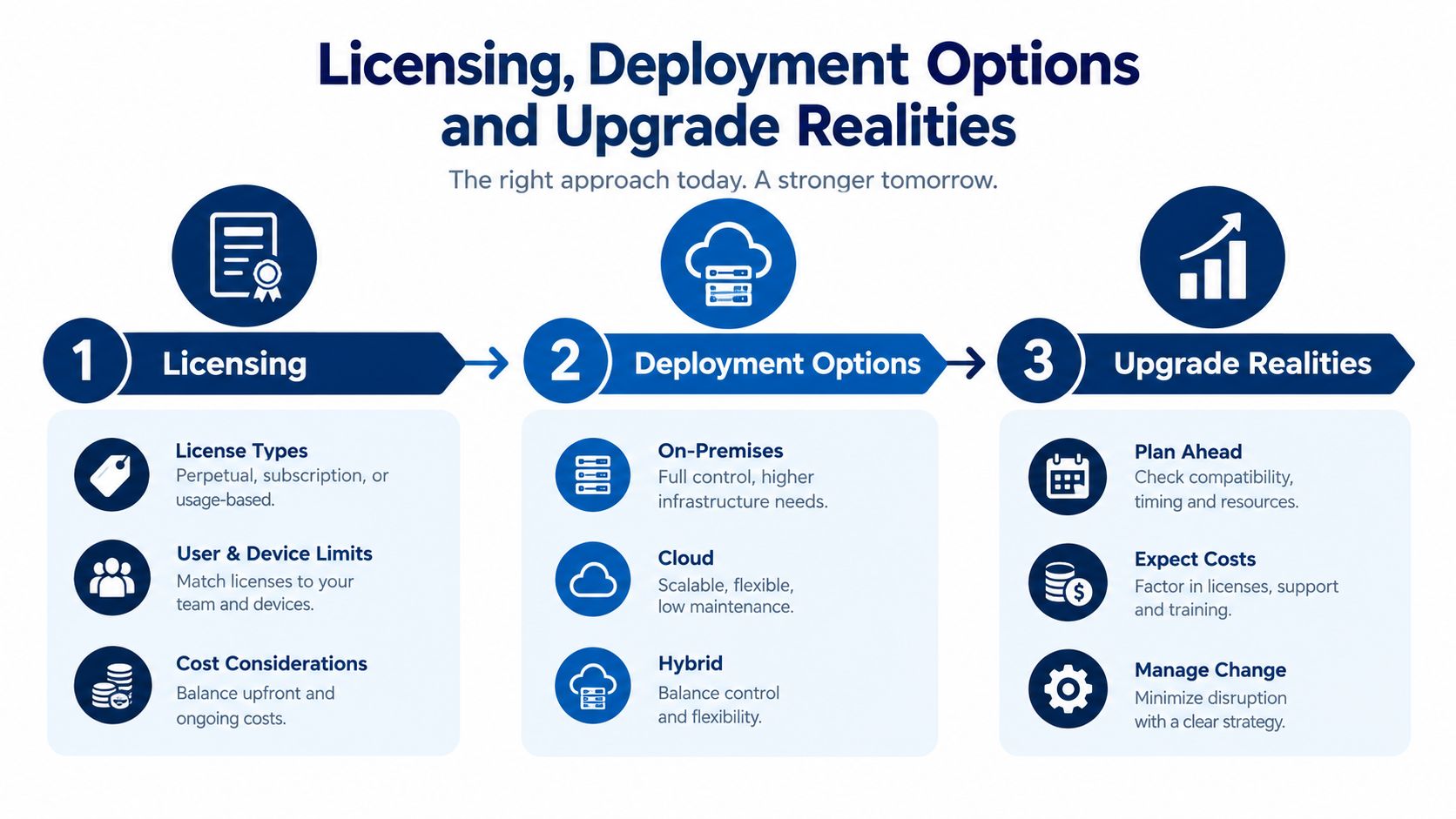
Licensing, Deployment Options and Upgrade Realities
Buying more applications doesn't automatically improve governance. It can increase the number of records, workflows and owners that your organisation must maintain without resolving the underlying control problem.
ServiceNow delivers GRC capabilities as modular applications from the ServiceNow Store. The available applications include Audit Management, Business Continuity Management, Operational Resilience, Policy and Compliance Management, Regulatory Change Management, Risk Management and Vendor Risk Management. ServiceNow's documentation says entitlement must be verified before activation, so licensing and release governance belong in the implementation plan, not at the end. The ServiceNow Store guidance sets out that requirement.
What drives total cost
Licensing discussions usually turn on the users who administer, assess, approve, attest, audit or manage vendors. The exact package and entitlement should be confirmed with ServiceNow because names and commercial structures can change.
Deployment decisions also require regional scrutiny. UAE and European stakeholders may have different expectations around data residency, cross-border transfers, support access and evidence retention. Treat those requirements as architecture and legal decisions, not assumptions about where a platform is hosted.
Upgrade planning is another cost driver. A regulated GRC instance needs regression testing for workflows, integrations, reports, data models and evidence exports. Teams that postpone upgrades during a transformation programme often inherit a larger testing burden later.
Commercial reality: The platform can centralise governance, but it won't make licensing, data residency, release testing or ownership disappear.
A useful enterprise GRC software assessment should compare the target operating model with the organisation's existing ServiceNow footprint. If the business only needs a narrow compliance checklist, a large integrated platform may be disproportionate. If risk, audit, IT and vendor operations already depend on ServiceNow, shared workflows may justify the investment.
KPIs, Pitfalls and a Managed Services Engagement Model
A steering committee should judge the programme by operating evidence, not by the number of activated applications. Useful measures include control coverage, mean time to remediate audit findings, policy attestation completion, vendor reviews completed on time and the signal-to-noise ratio of continuous monitoring.
These metrics need agreed definitions. “Control coverage” is meaningless if the denominator changes every reporting cycle. “Monitoring success” is misleading if indicators generate failures that nobody owns. Each KPI needs a source, owner, reporting cadence and decision threshold.
Failure patterns that repeat
Audit-only design: Compliance teams build a repository that business owners never use. Countermeasure, assign first-line ownership and connect issues to operational work.
Excessive customisation: Administrators reproduce legacy spreadsheets in new forms. Countermeasure, use the standard data model unless a regulatory or operating requirement justifies deviation.
Weak training: Control owners receive tasks without understanding evidence quality. Countermeasure, train by role and test the complete workflow.
Poor CMDB reconciliation: GRC scopes controls to obsolete or duplicate services. Countermeasure, establish an approved entity population and a reconciliation owner.
A managed service can support different levels of responsibility. Some organisations keep governance and regulatory interpretation in-house while outsourcing platform operations. Others co-manage administration, upgrades and evidence workflows with a regional partner.
Tier | Scope | Primary Owner | Typical SLAs | Best Fit |
|---|---|---|---|---|
Operate | Administration, incidents, reports and routine workflow support | Managed service team | Agreed operational response targets | Teams needing stable day-to-day support |
Optimise | Process improvement, automation tuning, data quality and release readiness | Shared service and client team | Service and improvement targets | Organisations with a live GRC programme |
Transform | Roadmap, integrations, operating model and adoption | Client executive sponsor with transformation partner | Programme milestones and governance gates | Enterprises expanding across jurisdictions |
An experienced ServiceNow GRC consultancy can help decide which responsibilities should remain with the CISO, risk function, internal audit, IT operations or an external service team.
Questions for the business case
Is ServiceNow GRC a compliance tool or a risk platform?
It can support both, but the starting point should match maturity. Policy and Compliance Management supports audit readiness, Risk Management supports structured risk decisions, and Regulatory Change Management fits organisations that must track evolving obligations across jurisdictions.
Does continuous monitoring remove manual control work?
No. It reduces manual work only where source data, thresholds, ownership and failure handling are defined. Poorly designed indicators create noise and can weaken confidence in the programme.
What should a CIO ask before approving the rollout?
Ask which obligations are in scope, which business entities will be governed, who owns each control, where evidence comes from and how issues will be routed. Also ask what will deliberately remain out of scope, because disciplined exclusion is essential to a manageable first release.
DataLunix offers discovery workshops, fit-gap analysis, ServiceNow GRC implementation, integration, adoption enablement and managed optimisation for GCC and European organisations. To assess your control model, regulatory scope and platform readiness, visit DataLunix and request a practical GRC assessment.